The term industrial hot air dryer can describe several types of industrial drying equipment. In material-processing industries, it may refer to equipment that circulates heated air around products or raw materials. In compressed-air treatment, however, heated air is commonly used in regenerative adsorption dryers to remove moisture from the desiccant and restore its drying capacity.
For industrial compressed-air systems, this heated regeneration process is particularly useful when low pressure dew points, continuous operation, and reduced purge-air consumption are required.
This guide focuses on how hot air is used in industrial compressed-air drying systems, the main technologies available, and the factors to consider when selecting a suitable dryer.
What Is an Industrial Hot Air Dryer?
In compressed-air applications, an industrial hot air dryer generally refers to an adsorption dryer that uses heat during regeneration.
The dryer does not use hot air to dry products directly. Instead, compressed air passes through a bed of desiccant that adsorbs water vapor. Once the desiccant becomes saturated, heat is introduced during the regeneration cycle to release the retained moisture.
This allows the desiccant to recover its adsorption capacity and continue producing dry compressed air.
Lingyu’s compressed-air dryer range includes heatless, heated regenerative, modular, blower-heated, zero-purge blower-heated, and heat-of-compression adsorption dryers, providing different regeneration methods for different industrial requirements.
For a broader overview of these systems, buyers can review the desiccant air dryer product category.
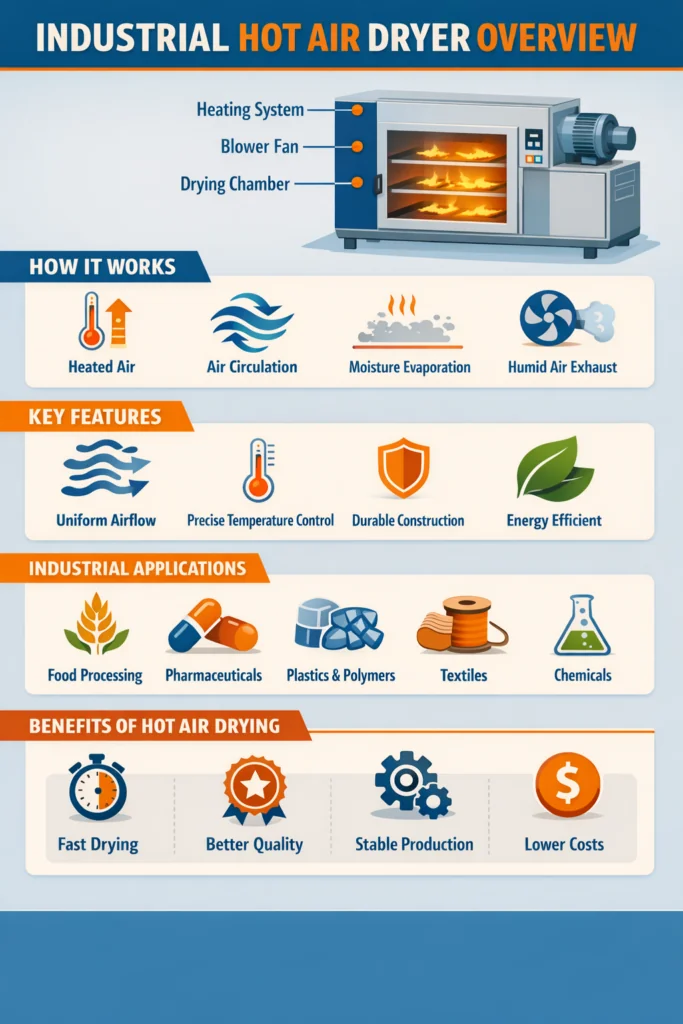
How Heated Regenerative Air Drying Works
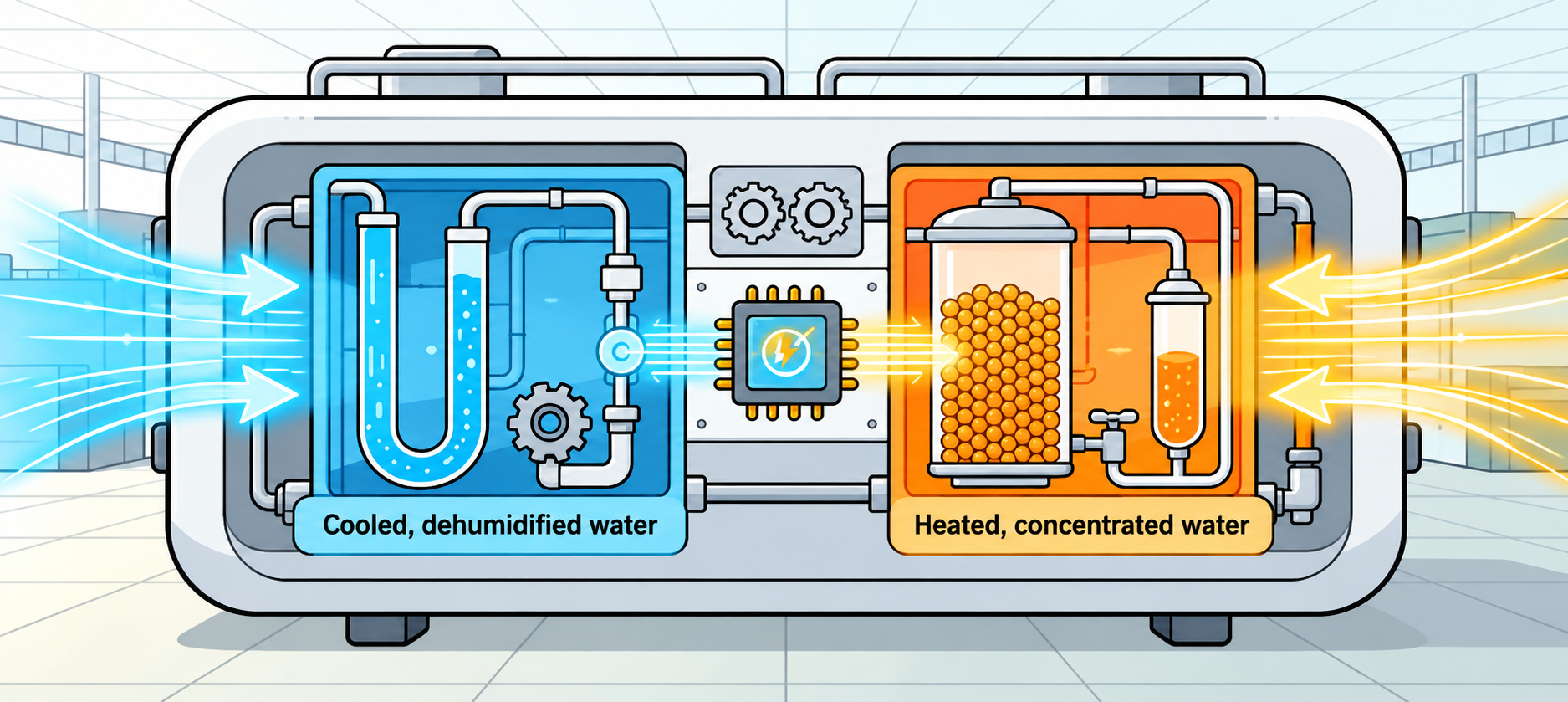
The basic drying process consists of two alternating stages: adsorption and regeneration.
Adsorption
During adsorption, wet compressed air enters a vessel filled with desiccant. Water vapor is captured by the desiccant while dry compressed air leaves the dryer and continues downstream.
Regeneration
Once the desiccant reaches the appropriate moisture-loading condition, the vessel switches to regeneration.
In a heated regenerative system, an external heat source raises the temperature of the desiccant. The added thermal energy releases moisture previously adsorbed by the desiccant so that it can be carried out of the dryer.
This process is based on temperature swing adsorption: the desiccant adsorbs moisture under normal drying conditions, while elevated temperature provides the energy required for desorption. The regeneration sequence also includes a cooling stage before the desiccant bed returns to normal adsorption service.
The heating stage can reduce the quantity of dry compressed air required for regeneration compared with conventional heatless systems.
Heated Purge vs. Blower-Heated Dryers
Not all heated industrial compressed-air dryers use the same regeneration method.
Heated Purge Regenerative Dryer
A heated purge dryer uses an external heater together with a portion of dry product air.
The dry purge air is heated and passed through the saturated desiccant bed, carrying released moisture out of the system.
Compared with a heatless dryer, external heating can reduce the quantity of compressed air needed for regeneration.
Lingyu heated-purge configurations operate with average purge-air consumption of 4–8%, depending on the series and specified operating conditions.
For installations where this regeneration method is appropriate, a heated regeneration adsorption air dryer provides one possible configuration.
Blower-Heated Regenerative Dryer
A blower-heated dryer reduces dependence on compressed product air by using an independent blower to draw ambient air into the regeneration circuit.
The blower air is heated and passed through the desiccant bed to provide the thermal energy and airflow needed to remove moisture.
Lingyu’s HRB-E Series Low-Purge Blower-Heated Regenerative Desiccant Air Dryer is specified with:
Rated inlet pressure: 0.7 MPa
Operating pressure range: 0.6–1.0 MPa
Rated inlet temperature: 10–30°C
Maximum inlet temperature: ≤40°C
Inlet air dew point: ≤25°C
Regeneration air consumption: 2–3%
Outlet pressure dew point: −20°C / −40°C optional
Rated ambient temperature: 35°C
Ambient operating range: 2–40°C
A blower-heated regeneration adsorption air dryer can therefore be worth considering for larger systems where compressed-air regeneration losses represent a significant operating cost.
Zero-Purge Blower-Heated Dryer
Some blower-heated systems are engineered to avoid compressed-air consumption during regeneration.
In Lingyu’s HRB-Z zero-purge configuration, ambient air is used during heating. During the cooling stage, air circulates through the cooling circuit and regeneration tower rather than relying on dry product air.
This configuration is specified with approximately 0% regeneration air consumption and selectable outlet pressure dew points of −20°C or −40°C under its specified operating conditions.
For facilities where compressed-air conservation is particularly important, a blower zero-purge adsorption dryer may provide a suitable alternative.
Why Heated Regeneration Matters
Regeneration method has a major impact on the lifecycle operating cost of an adsorption dryer.
A heatless dryer uses part of the dried compressed air to regenerate the saturated desiccant. This approach is mechanically straightforward, but purge-air consumption can become significant in large or continuously operating systems.
Adding heat reduces the amount of dry compressed air needed for regeneration.
Blower-heated systems reduce this requirement further by using ambient air during regeneration, while zero-purge designs are engineered to avoid compressed-air purge loss during their regeneration sequence.
For this reason, a dryer should not be selected only by purchase price. Regeneration air consumption, electrical heating demand, operating hours, compressor energy cost, load profile, and required pressure dew point should all be considered.
Key Features of Industrial Heated Air Dryers
Several technical characteristics are particularly important when evaluating a heated regenerative compressed-air dryer.
Pressure Dew Point
Pressure dew point determines how dry the delivered compressed air will be.
For example, Lingyu’s HRB-E low-purge blower-heated series provides selectable outlet pressure dew points of −20°C or −40°C.
The required value should be based on the actual process and the lowest downstream temperature rather than assuming that the lowest possible dew point is always necessary.
Regeneration Air Consumption
Regeneration air consumption directly affects compressed-air system efficiency.
A lower purge requirement means that more compressor output remains available for production.
This difference can become particularly important at large flow rates or in systems operating continuously.
Heating and Airflow Control
Effective desiccant regeneration depends on distributing heated regeneration air through the adsorption bed correctly.
Poor airflow distribution can result in uneven heating and incomplete regeneration, so blower selection, heater sizing, vessel design, and internal airflow distribution all matter.
Temperature Monitoring
Regeneration performance depends on reaching the required desorption temperature while maintaining safe operating conditions for the heater, desiccant, valves, and other components.
Temperature monitoring is therefore an important part of heated regeneration control.
Automatic Switching and Control
Twin-tower dryers must coordinate adsorption, depressurization, heating, cooling, repressurization, and tower switching without interrupting downstream compressed-air supply.
More advanced systems can also provide communication functions and load-responsive or dew-point-based energy-saving control.
Industrial Applications
Heated regenerative adsorption dryers are commonly used where refrigerated drying cannot provide sufficiently low moisture levels.
Typical applications can include electronics, semiconductor manufacturing, pharmaceutical production, chemical processing, new-energy materials, steelmaking, power generation, and other industrial processes requiring consistently dry compressed air.
Manufacturers operating sensitive electronic production equipment can review Lingyu’s electronics and precision manufacturing application.
Similarly, compressed-air requirements in pharmaceutical and biopharmaceutical production may justify lower pressure dew points and tighter control of the overall compressed-air treatment system.
The required dryer configuration should still be determined from the actual process conditions rather than from the industry name alone.
How to Choose the Right Heated Industrial Air Dryer
The first selection criterion should be the required pressure dew point.
If a production process only requires moderate moisture removal, a refrigerated dryer may be more economical. Heated adsorption technology generally becomes more appropriate when a substantially lower pressure dew point is required.
Other important factors include:
- Operating pressure
- Inlet temperature
- Normal and peak compressed-air flow
- Load fluctuations
- Ambient conditions
- Operating hours
- Required pressure dew point
- Available regeneration energy
- Purge-air consumption
- Acceptable pressure drop
- Lifecycle cost
For comparison with a more conventional drying method, buyers can review the refrigerated air dryer range before deciding whether adsorption drying is necessary.
For adsorption dryers specifically, regeneration method is another major consideration.
A smaller compressed-air installation may prioritize equipment simplicity, while a large station operating continuously may place greater emphasis on reducing purge-air losses.
This is why lifecycle cost is usually more useful than comparing equipment prices alone.
Energy Efficiency Considerations
Energy efficiency in an industrial heated air dryer involves both electricity consumption and compressed-air consumption.
A dryer with a heater consumes electrical energy, but the complete system may still operate more efficiently if heating substantially reduces the amount of compressed air required for regeneration.
One Lingyu installation used eight customized 220 m³/min low-purge blower-heated regenerative adsorption dryers with a required pressure dew point of ≤−40°C and regeneration air consumption of ≤3%. The customized configuration achieved approximately 8% energy savings compared with conventional heated-purge dryers.
This illustrates why dryer efficiency should be evaluated at system level rather than by heater power alone.
Actual energy performance will still depend on operating pressure, airflow, load profile, ambient conditions, regeneration sequence, compressor efficiency, and operating hours.
Controls and Automation
Modern adsorption dryers increasingly use intelligent controls to adapt regeneration to actual operating conditions.
Basic systems can regenerate according to fixed timing. More advanced designs can use operating data or optional dew-point-based control to adjust the drying and regeneration cycle according to actual demand.
Lingyu’s zero-purge blower-heated design supports RS-485 communication, with optional IoT connectivity and additional communication functions.
Control systems can also monitor important operating parameters and provide energy-saving functions under changing load conditions.
These capabilities can be useful where dryers need to communicate with a central compressed-air station or plant monitoring system.
Installation and Maintenance
Reliable performance depends on correct installation as well as dryer design.
The dryer should be sized according to actual compressed-air operating conditions rather than compressor nameplate flow alone.
Inlet temperature, operating pressure, flow variation, required pressure dew point, and ambient conditions should all be considered during sizing.
Pre-filtration is also important because excessive oil and particulate contamination can affect desiccant performance and overall dryer reliability.
During operation, maintenance should include inspection of:
- Heaters
- Blowers
- Valves
- Silencers
- Filters
- Temperature and pressure sensors
- Control components
- Drainage equipment
- Desiccant condition
- Regeneration performance
Where particulate and oil removal are required in addition to moisture control, a precision compressed air filter can form part of the broader compressed-air treatment system.
Choosing a Reliable Manufacturer
For heated regenerative dryers, manufacturer engineering capability is particularly important because performance depends on more than the adsorption vessels themselves.
Airflow distribution, heater sizing, blower selection, switching-valve reliability, desiccant quantity, temperature control, regeneration logic, and system integration all influence long-term operation.
Lingyu specializes in compressed-air purification and separation technologies and integrates R&D, manufacturing, sales, and service.
The company’s manufacturing facilities cover approximately 40,000 m², and its service network includes more than 40 sales and after-sales service locations.
Buyers can review the Lingyu company profile when evaluating its manufacturing and technical capabilities.
For large-flow or low-dew-point applications, practical project experience with the relevant regeneration technology should also be considered when comparing manufacturers.
Conclusion
An industrial hot air dryer can mean very different equipment depending on the application.
For compressed-air treatment, heated air is primarily used to regenerate desiccant in adsorption dryers, rather than to dry products directly.
Heated-purge, low-purge blower-heated, and zero-purge blower-heated technologies provide different balances between equipment complexity, electrical energy consumption, and compressed-air regeneration losses.
Lingyu’s HRB-E low-purge blower-heated configuration provides 2–3% regeneration air consumption with selectable −20°C or −40°C pressure dew points, while its zero-purge blower-heated configuration is designed around approximately 0% regeneration air consumption under its specified operating conditions.
The appropriate solution depends on required pressure dew point, flow capacity, operating pressure, inlet temperature, load profile, regeneration energy, purge-air consumption, installation conditions, and lifecycle cost.
For low-dew-point compressed-air projects, the most effective dryer is therefore not necessarily the system with the most complex regeneration technology. It is the configuration that delivers the required air quality while balancing compressed-air use, electrical energy consumption, reliability, maintenance, and total operating cost.