Laser cutting compressed-air systems place different demands on air treatment than many conventional pneumatic applications. In addition to moisture removal, the dryer must operate reliably at the pressure and airflow required by the cutting system while limiting unnecessary pressure loss.
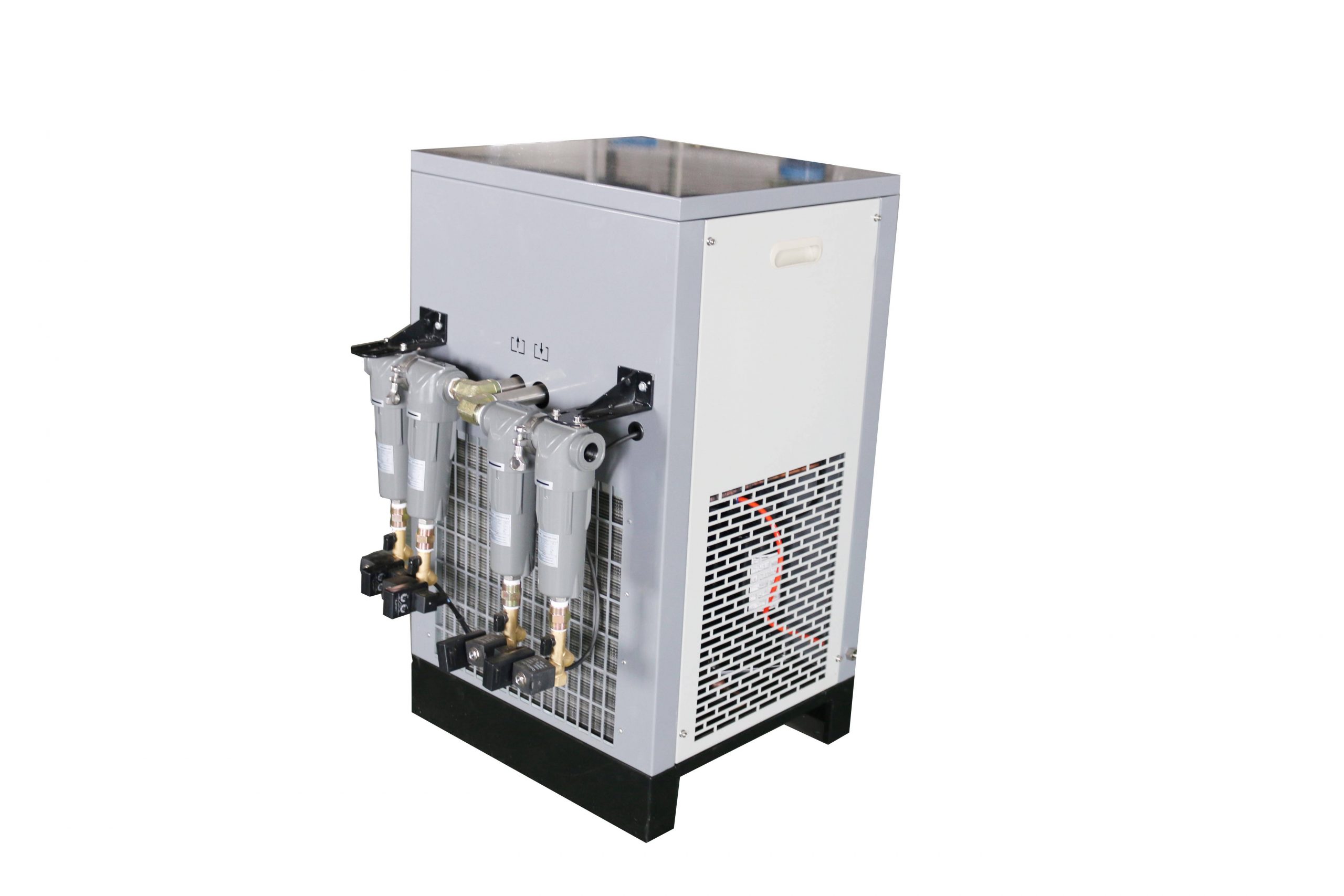
Lingyu’s special combination refrigerated air dryer is designed specifically around this type of application. Rather than discussing laser cutting air quality in general, this guide focuses on the dryer configuration, operating conditions, moisture-removal process, pressure considerations, and equipment-selection factors.
For users comparing other refrigeration drying technologies outside this application, Lingyu’s refrigerated air dryer range provides additional options for conventional industrial compressed-air systems.
Why Laser Cutting Requires a Dedicated Dryer Configuration
A laser cutting compressed-air supply must deliver air under stable operating conditions.
Moisture entering the downstream air system can create condensate in piping and point-of-use components. The drying system must therefore not only reduce moisture but also operate correctly at the required air pressure and treatment capacity.
The special combination design is best considered as part of the complete laser cutting compressed-air supply system rather than simply as another standard refrigerated dryer.
Its main selection parameters include required airflow, operating pressure, inlet temperature, required outlet dew point, allowable system pressure drop, compressor capacity, filtration requirements, and peak cutting-air demand.
Multi-Stage Moisture Removal Process
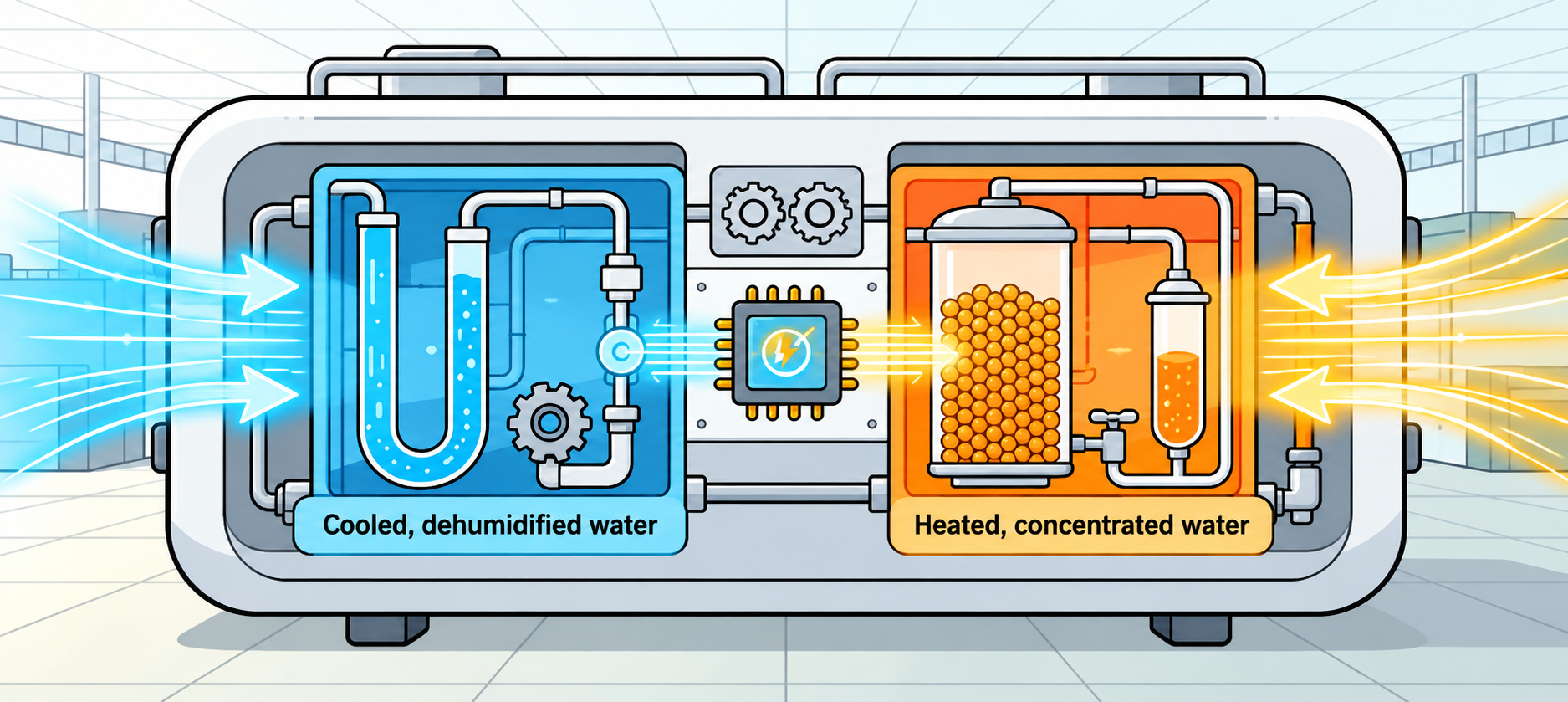
The system uses several treatment stages, including double-stage pre-cooling, refrigeration and condensation, and multi-stage gas-water separation.
The basic objective is to reduce the temperature of the compressed air so that water vapor condenses and then efficiently separate the resulting liquid from the compressed-air stream.
Pre-Cooling
The pre-cooling stage reduces the thermal load entering the main refrigeration section.
Lowering the compressed-air temperature before final refrigeration can reduce the amount of cooling work required from the refrigeration system.
Refrigeration and Condensation
The compressed air is further cooled until moisture vapor condenses into liquid water.
The dryer is intended to provide an outlet pressure dew point of +2°C to +10°C under the stated operating conditions.
Gas-Water Separation
After condensation occurs, the liquid water must be removed from the airflow.
Effective separation is particularly important because simply cooling compressed air without removing the condensate does not complete the drying process.
Operating Conditions
The specified operating range for this special laser cutting dryer is:
| Parameter | Specification |
|---|---|
| Applicable medium | Compressed air / non-corrosive air |
| Airflow range | 2.5–150 Nm³/min depending on configuration |
| Inlet air pressure | 10–16 bar |
| Standard inlet temperature | 45°C |
| Maximum inlet temperature | 50°C |
| Working ambient temperature | 2–45°C |
| Outlet pressure dew point | +2°C to +10°C |
| Cooling method | Forced air cooling |
| Full-load pressure drop | Approximately 0.2 bar |
These operating parameters should be confirmed against the final equipment configuration when the dryer is selected for a specific project.
Why Operating Pressure Is Important
One of the main differences between this dryer and a conventional lower-pressure industrial refrigerated dryer is its stated 10–16 bar inlet-pressure range.
Equipment working at these pressures must be selected according to the actual compressor and cutting-system requirements rather than simply by comparing airflow.
Operating pressure also affects the dryer pressure rating, filter pressure rating, pipe diameter and connections, air receiver configuration, system pressure loss, and available point-of-use pressure.
The dryer should therefore be treated as part of the complete laser cutting compressed-air system.
Pressure Drop and Available Cutting Pressure
Pressure drop is especially important where the downstream process requires a defined working pressure.
The dryer is designed around a full-load pressure drop of approximately 0.2 bar. This value should not be evaluated independently.
Total pressure loss can also occur across pre-filters, after-filters, air receivers, valves, piping, flexible connections, and point-of-use filtration.
The correct objective is to maintain sufficient pressure at the laser cutting equipment rather than only checking compressor discharge pressure.
Technical Parameters
The available technical configurations include:
| Processing Capacity | Input Power | Connection | Weight | Dimensions |
|---|---|---|---|---|
| 3.8 m³/min | 0.44–1.25 kW | G1½” | 105 kg | 1000×600×1050 mm |
| 7.0 m³/min | 0.48–1.42 kW | G1½” | 130 kg | 1100×600×1100 mm |
| 10.5 m³/min | 0.60–1.90 kW | G2″ | 155 kg | 1250×700×1155 mm |
| 13.5 m³/min | 0.80–3.60 kW | G2½” | 350 kg | 1400×850×1350 mm |
| 17.0 m³/min | 1.02–3.61 kW | DN80 | 450 kg | 1570×800×1200 mm |
| 21.5 m³/min | 1.02–4.03 kW | DN80 | 480 kg | 1500×950×1400 mm |
| 25.0 m³/min | 1.40–5.50 kW | DN80 | 530 kg | 1835×940×1480 mm |
| 28.5 m³/min | 1.40–6.20 kW | DN80 | 540 kg | 1835×940×1480 mm |
| 32.0 m³/min | 2.02–7.58 kW | DN80 | 560 kg | 1835×940×1480 mm |
| 37.0 m³/min | 1.83–6.75 kW | DN100 | 680 kg | 1900×980×1580 mm |
For product-specific configuration information, users can review Lingyu’s special combination refrigerated air dryer for laser cutting.
How to Size the Dryer for a Laser Cutting System
Selecting the correct dryer should begin with the actual cutting-air requirements rather than the nominal compressor size.
Maximum Air Consumption
Determine the maximum airflow required when the laser cutting machine is operating at its highest demand.
If several machines share one compressed-air station, simultaneous demand needs to be considered.
Operating Pressure
Confirm both compressor discharge pressure and the minimum pressure required at the cutting machine.
The difference between these two values must accommodate pressure loss through the entire treatment and distribution system.
Inlet Temperature
The dryer should receive compressed air within its specified inlet-temperature range.
The standard inlet temperature is 45°C, with a specified maximum of 50°C. Higher inlet temperatures increase the refrigeration and moisture load.
Required Dew Point
The current configuration specifies a refrigerated-air pressure dew point of +2°C to +10°C.
This should be compared with the actual air-quality requirement of the laser cutting system rather than assuming that a lower dew point is always necessary.
Do Not Confuse Drying With Filtration
A refrigerated dryer primarily controls moisture.
Particles, oil aerosols, and other contaminants may require separate filtration stages.
Appropriate precision compressed air filters should therefore be selected according to the required air-quality level and system pressure.
This is particularly important in a dedicated cutting-air system because the dryer and filters perform different functions.
Air-Cooled Installation Considerations
The dryer uses forced air cooling.
An air-cooled refrigeration system requires adequate airflow around the condenser to reject heat effectively. Installation planning should therefore account for ventilation around the dryer, ambient temperature, distance from heat-producing equipment, dust accumulation around the condenser, maintenance access, and sufficient space around air inlet and exhaust areas.
Poor heat rejection can reduce refrigeration performance even when the dryer itself is correctly sized.
Laser Cutting Application Scope
This dryer is specifically intended for the compressed-air treatment portion of a laser cutting system. Broader topics such as cutting processes, plant configuration, and industry-specific air-quality requirements are better addressed separately.
For those requirements, users can review Lingyu’s metal fabrication and laser cutting application page.
Nitrogen generation, assist-gas purity, and nitrogen-generator selection are separate technical subjects and should not be treated as functions of this refrigerated dryer.
Centralized vs. Dedicated Dryer Configuration
A project may use either a dedicated air-treatment system for one cutting machine or a centralized compressed-air station serving multiple production units.
The correct arrangement depends on total airflow, simultaneous demand, operating pressure, pipeline distance, allowable pressure loss, and production redundancy requirements.
For a dedicated system, dryer capacity may be matched closely to the cutting machine and compressor. For a centralized system, peak simultaneous demand and future expansion should also be considered.
Maintenance Priorities
Routine maintenance should focus on maintaining stable refrigeration, heat transfer, condensate drainage, and airflow.
Typical inspection points include the condenser, refrigeration system, drain, gas-water separation system, filters, connections and piping, operating pressure, and inlet and outlet temperatures.
Maintenance frequency should reflect actual operating hours and environmental conditions rather than relying only on a generic fixed schedule.
Information to Prepare Before Selection
Before requesting a laser cutting dryer configuration, prepare the number of laser cutting machines, maximum simultaneous airflow, compressor discharge pressure, required point-of-use pressure, inlet-air temperature, required dew point, operating hours, installation environment, and filtration requirements.
This information allows the dryer, filters, piping, and compressor capacity to be evaluated as one treatment system.
For non-standard capacity or operating conditions, a customized technical configuration should be evaluated.
Conclusion
The special combination refrigerated air dryer for laser cutting is intended to provide stable moisture control for compressed-air systems operating under the pressure and airflow conditions required by laser cutting equipment.
Its key parameters include an airflow range of 2.5–150 Nm³/min depending on configuration, 10–16 bar inlet pressure, 45°C standard inlet temperature, 50°C maximum inlet temperature, 2–45°C working ambient temperature, +2°C to +10°C outlet pressure dew point, forced air cooling, and approximately 0.2 bar full-load pressure drop.
Selection should focus on airflow, operating pressure, inlet temperature, outlet dew point, system pressure loss, cooling conditions, and filtration requirements. Most importantly, the dryer should be evaluated together with the compressor, filtration equipment, piping, and actual point-of-use pressure so that the complete compressed-air system meets the requirements of the cutting equipment.