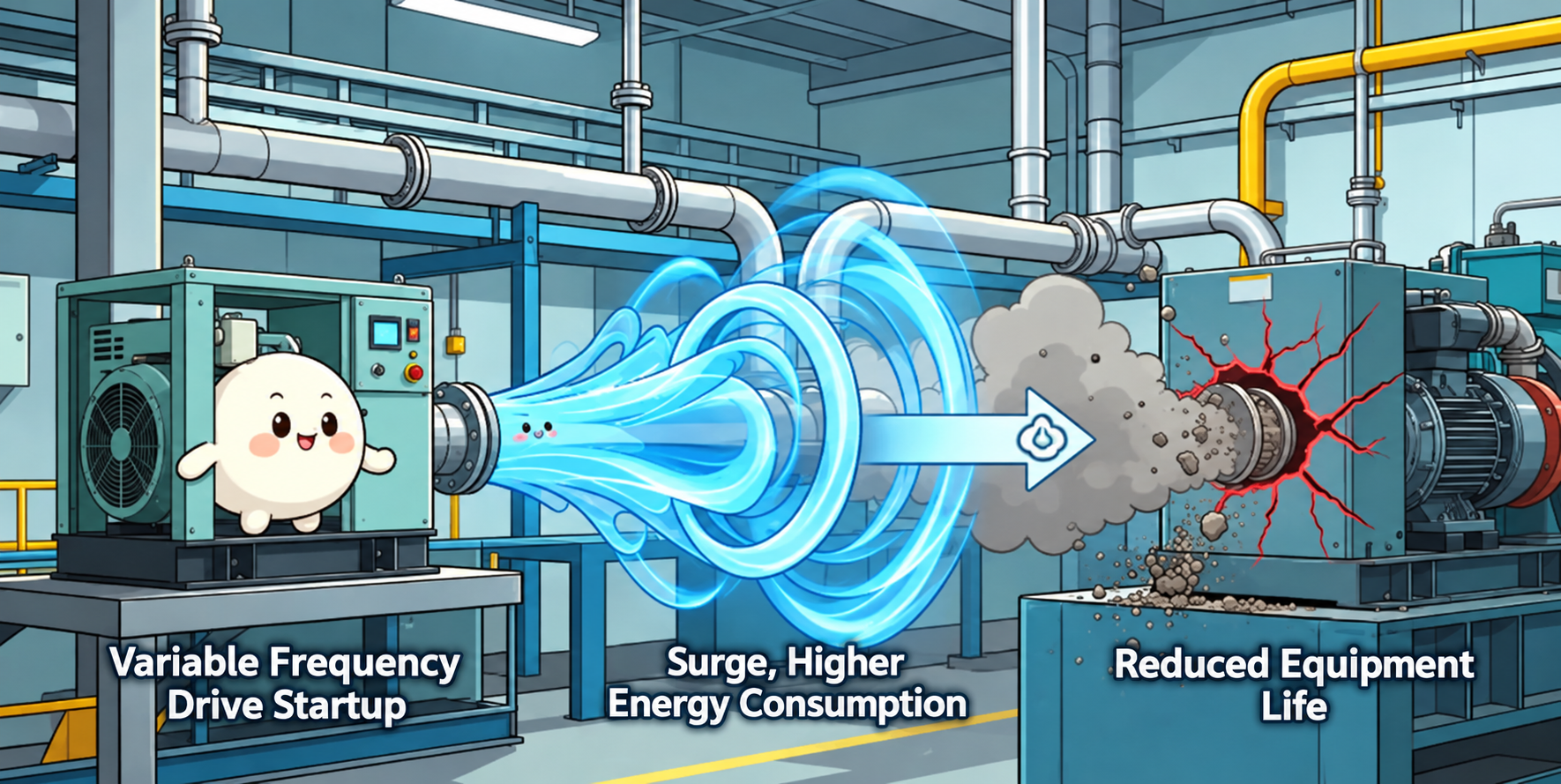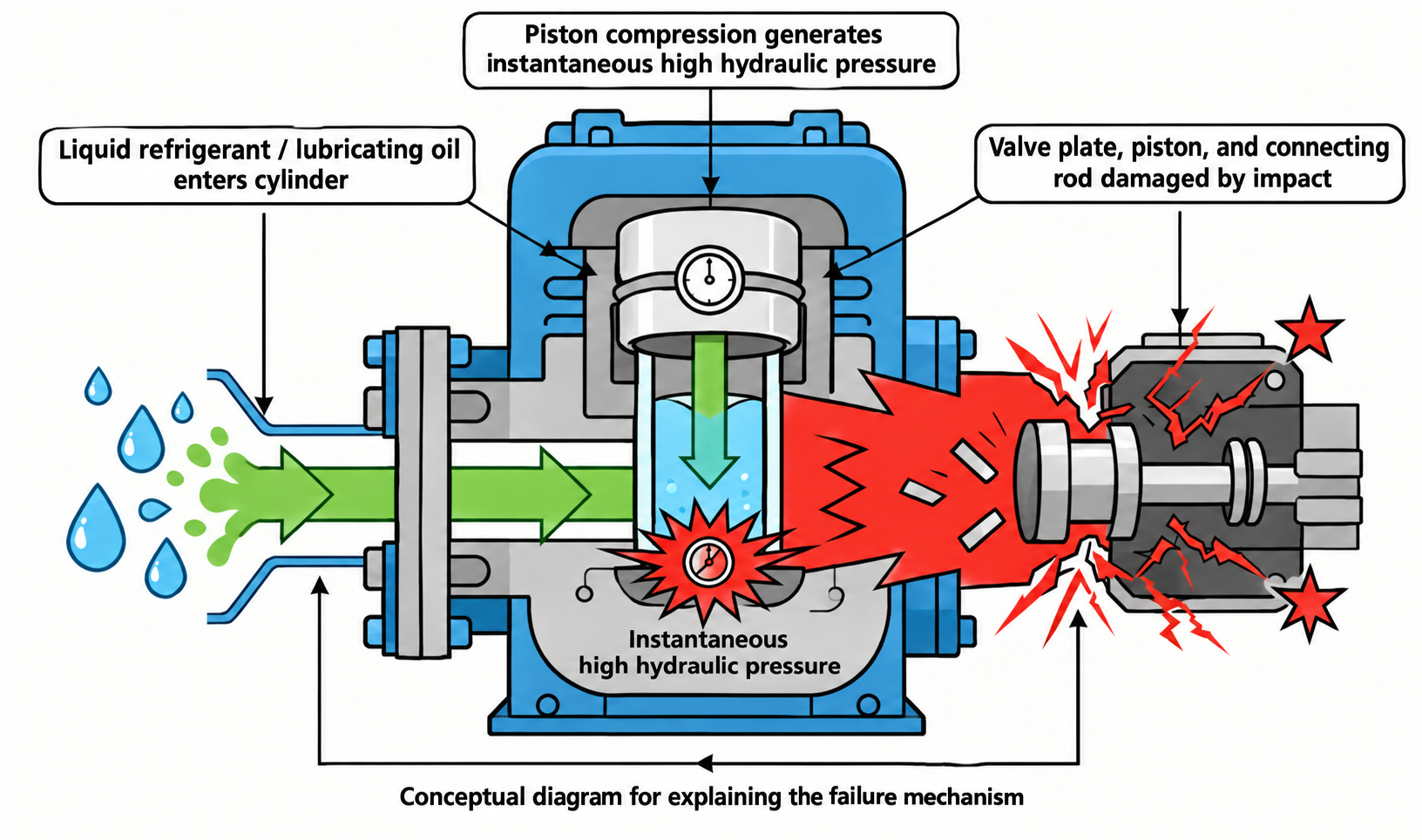
A variable speed refrigerated air dryer uses a variable frequency drive, or VFD, to adjust refrigeration compressor speed according to the actual compressed air drying load.
Unlike a conventional fixed-speed refrigerated dryer, which typically operates its refrigeration compressor at one main speed and controls capacity through cycling, unloading, bypass, or other control methods, a VFD refrigerated air dryer can reduce compressor speed when full cooling capacity is not required.
This is particularly important because many compressed air systems do not operate at full load all day.
Air demand may rise and fall according to:
- Production shifts
- Machine cycles
- Seasonal conditions
- Compressor loading
- Ambient temperature
- Inlet compressed air temperature
- Changes in plant air consumption
When the drying load decreases, a variable speed dryer can reduce refrigeration output instead of continuing to operate at full compressor speed.
The result can be lower energy consumption, reduced compressor cycling, and more stable dew point control under variable-load conditions.
This guide explains how a variable speed refrigerated air dryer works, how it differs from a fixed-speed dryer, why part-load operation matters, and when VFD technology makes economic sense.
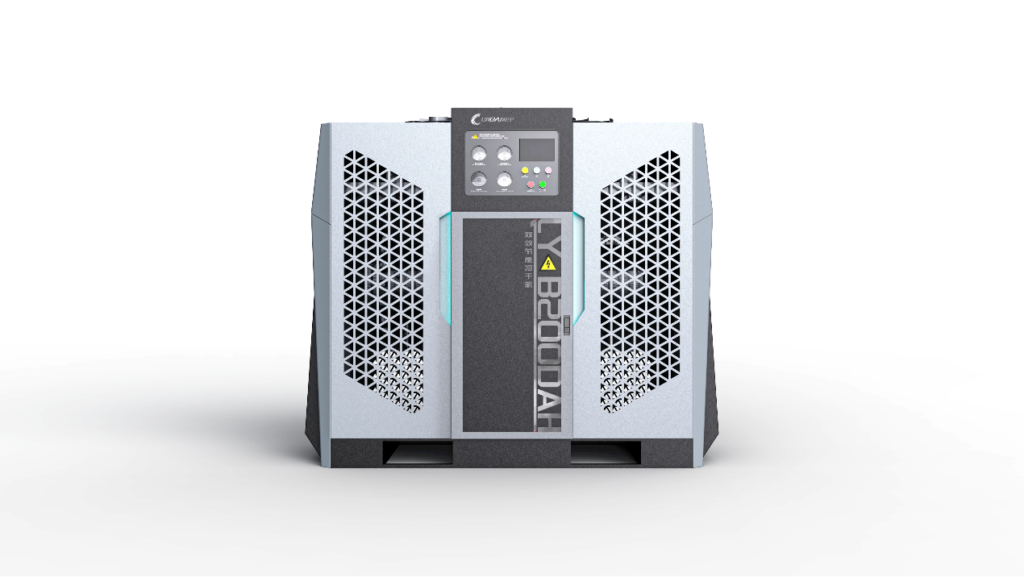
What Is a Variable Speed Refrigerated Air Dryer?
A variable speed refrigerated air dryer is a refrigerated compressed air dryer equipped with a variable frequency drive that controls the speed of the refrigeration compressor.
The purpose of the VFD is to match refrigeration capacity more closely to the actual moisture and thermal load entering the dryer.
The basic relationship is:
Lower drying load → lower compressor speed → lower power consumption
and:
Higher drying load → higher compressor speed → more refrigeration capacity
Instead of treating the dryer as either fully loaded or lightly loaded while running at essentially the same compressor speed, the VFD allows the refrigeration system to operate across a wider range of capacity.
This is why variable speed control is especially useful in plants where compressed air demand changes significantly throughout the day.
Fixed-Speed vs VFD Refrigerated Air Dryer
The main difference between a fixed-speed refrigerated dryer and a VFD dryer is how refrigeration capacity responds to changing load.
Fixed-Speed Refrigerated Air Dryer
A fixed-speed refrigeration compressor generally operates at a fixed rotational speed whenever it is running.
When the dryer does not need full refrigeration capacity, the system must control excess capacity through methods such as:
- Compressor start/stop cycling
- Refrigerant bypass
- Unloading
- Thermal storage
- Other capacity-control strategies
The exact control method depends on dryer design.
A fixed-speed dryer can be highly effective when the compressed air load remains relatively stable and close to the selected design capacity.
However, efficiency may decline when the dryer spends long periods operating far below full load.
VFD Refrigerated Air Dryer
A VFD dryer adjusts refrigeration compressor speed according to the required cooling load.
Instead of repeatedly producing maximum refrigeration capacity and then reducing or interrupting it, the compressor can slow down when demand falls.
A simplified comparison is:
| Operating Condition | Fixed-Speed Dryer | VFD Dryer |
|---|---|---|
| Full load | Runs near full capacity | Runs near full capacity |
| Medium load | May cycle or bypass capacity | Reduces compressor speed |
| Low load | More cycling or excess capacity control may occur | Operates at lower speed where permitted |
| Rapidly changing load | Capacity control reacts in steps | Capacity can follow demand more continuously |
| Energy advantage | Often strongest near design load | Often strongest under variable or part-load conditions |
The VFD advantage therefore does not come simply from adding an inverter.
It comes from matching refrigeration output more closely to the actual drying requirement.
Why Part-Load Operation Matters
Many industrial compressed air systems spend a large percentage of operating time at part load.
For example, a dryer may be sized for the maximum compressor flow, but actual airflow may regularly fall to:
- 80% of rated capacity
- 60%
- 40%
- Or even lower during certain production periods
At the same time, inlet temperature and ambient temperature may also vary.
This means the dryer frequently does not need its maximum refrigeration capacity.
A dryer selected for a worst-case summer condition may have substantially more cooling capacity than required during:
- Cooler seasons
- Night shifts
- Reduced production
- Weekend operation
- Low compressor loading
This is where variable speed technology becomes valuable.
Refrigeration Load Is Not Constant
The refrigeration system has to remove heat from the incoming compressed air.
That load changes with several factors:
Airflow
More compressed air generally means a greater cooling and moisture-removal load.
Inlet temperature
Hotter compressed air requires more cooling.
Ambient temperature
Ambient conditions influence condenser performance and refrigeration-system load.
Moisture content
Warm, humid inlet air can place a higher moisture load on the dryer.
Because these variables continuously change, the actual refrigeration requirement can be much lower than the dryer’s rated maximum for large portions of its operating life.
A VFD allows refrigeration capacity to respond to these changes.
How VFD Control Reduces Energy Consumption
The refrigeration compressor is one of the major electrical loads inside a refrigerated air dryer.
Reducing compressor speed during periods of lower demand can reduce the power required by the refrigeration system.
The control sequence can be simplified as:
Sensors detect reduced drying load
↓
Controller reduces required refrigeration capacity
↓
VFD lowers compressor speed
↓
Electrical power consumption decreases
↓
Dryer maintains the required dew point without unnecessary full-speed operation
The dryer increases compressor speed again when conditions become more demanding.
The aim is not to run the compressor as slowly as possible.
The aim is to run it only as fast as necessary to maintain the required compressed air conditions.
Fixed Speed at Part Load
Consider a refrigerated dryer selected to handle the maximum airflow of a production line.
During peak production, the dryer may operate close to full capacity.
But during the night shift, compressed air demand may fall significantly.
A fixed-speed dryer still has a refrigeration compressor designed around the maximum condition.
Depending on its control system, it may respond by:
- Switching the compressor on and off
- Using hot-gas bypass
- Unloading
- Allowing the evaporator temperature to rise and fall within a control range
These strategies can control the dryer effectively, but they do not always reduce electrical consumption in direct proportion to the reduced air demand.
The dryer can therefore consume more energy than the actual drying load would suggest.
VFD Operation at Part Load
A variable speed dryer approaches the same condition differently.
If the compressed air load decreases, the controller reduces refrigeration compressor speed.
For example:
High load → higher compressor frequency
Medium load → reduced frequency
Low load → lower stable operating frequency
The compressor therefore produces less refrigeration capacity and consumes less power when full capacity is unnecessary.
This is the main reason a VFD dryer can outperform a fixed-speed design in applications with significant load variation.
Compressor Cycling in Fixed-Speed Refrigerated Dryers
One issue with fixed-speed refrigeration systems is compressor cycling.
When cooling demand falls below the compressor’s available capacity, the dryer may periodically switch the refrigeration compressor off and back on.
This is called cycling.
A typical sequence may look like:
Compressor ON → evaporator cools
↓
Cooling demand falls
↓
Compressor OFF
↓
Temperature rises
↓
Compressor restarts
The frequency of these cycles depends on:
- Dryer design
- Thermal mass
- Airflow
- Ambient conditions
- Control setpoints
- Refrigeration circuit design
Cycling is not automatically a problem. Many refrigeration systems are specifically designed to operate this way.
However, frequent cycling can create several disadvantages.
Start-Stop Energy Demand
Starting a refrigeration compressor requires a different operating condition from steady running.
Repeated starts do not allow the refrigeration system to operate continuously at its most stable point.
Temperature Variation
When refrigeration capacity repeatedly switches between running and stopped states, evaporator conditions can fluctuate.
A well-designed dryer manages this variation, but the control is inherently less continuous than modulating compressor speed.
Mechanical Stress
Frequent starting can increase electrical and mechanical stress on refrigeration components compared with stable continuous operation.
The actual effect depends strongly on compressor technology and dryer design.
How VFD Reduces Compressor Cycling
A VFD dryer can reduce the need for repeated start-stop operation by keeping the refrigeration compressor running at a lower speed during part-load conditions.
Instead of:
100% capacity → OFF → 100% → OFF
the system can operate more like:
100% → 75% → 55% → 40% → 60%
depending on demand and the allowed compressor operating range.
This produces smoother capacity adjustment.
Reducing cycling can improve:
- Control stability
- Refrigeration-system operating consistency
- Temperature control
- Compressor operating conditions
However, VFD compressors also have minimum allowable speeds.
When the drying load becomes extremely low, the dryer may still need additional control strategies.
Variable speed does not mean the compressor can continuously slow down to zero RPM.
VFD and Dew Point Stability
Energy efficiency is only useful if the dryer still maintains the required air quality.
For a refrigerated air dryer, one of the most important performance indicators is the pressure dew point.
A typical industrial refrigerated dryer is often designed to deliver a pressure dew point around:
+3°C to +5°C
under rated conditions.
The challenge is maintaining stable performance as compressed air flow and thermal load change.
Dew Point Behavior in Fixed-Speed Systems
A fixed-speed system controls refrigeration capacity in steps or through bypass and cycling strategies.
At variable load, evaporator conditions may move within a larger operating range.
A properly designed fixed-speed dryer can still provide stable dew point performance.
However, maintaining stability at widely varying load can require additional control measures.
Dew Point Behavior in VFD Systems
A variable speed dryer can adjust cooling capacity more continuously.
If inlet conditions change gradually, the refrigeration system can increase or decrease compressor speed accordingly.
This can help keep evaporator conditions closer to the intended operating range.
The potential result is:
- More controlled cooling
- Reduced temperature fluctuation
- Stable condensate formation
- More consistent pressure dew point
The exact performance still depends on the complete dryer design.
A VFD cannot compensate for poor heat exchanger sizing, incorrect refrigerant control, inadequate condensate separation, or a dryer operating beyond its rated conditions.
Avoiding Overcooling
More refrigeration is not always better.
If a refrigerated dryer cools the compressed air too aggressively, the evaporator can approach freezing conditions.
This creates the risk of:
- Ice formation
- Airflow restriction
- Heat exchanger blockage
- Unstable dryer operation
Traditional dryers use various refrigeration controls to prevent this.
A variable speed system provides another control mechanism.
When cooling demand decreases, compressor speed can be reduced rather than continuing to produce unnecessary refrigeration capacity.
This helps the dryer maintain the intended evaporator operating condition without excessive cooling.
Energy Consumption: Fixed Speed vs VFD
The energy advantage of variable speed operation depends heavily on the actual operating profile.
There is no universal percentage by which every VFD dryer reduces electricity consumption.
The savings depend on factors such as:
- Percentage of time spent at part load
- Compressor speed range
- Refrigeration compressor efficiency
- Airflow variation
- Inlet temperature variation
- Ambient temperature
- Dryer size
- Control logic
- Operating hours
At or Near Full Load
When both dryers are operating close to maximum design capacity, the difference in electrical consumption may be relatively small.
Both systems need to provide nearly the same amount of refrigeration.
In this condition, a VFD cannot create a large reduction in the fundamental cooling requirement.
At Medium Load
At medium load, the benefit of variable speed becomes more significant.
A fixed-speed compressor may still run at full rotational speed when operating.
The VFD compressor can slow down and more closely match the reduced cooling demand.
At Low Load
At low load, variable speed control can provide a substantial efficiency advantage if the compressor can operate efficiently within the required speed range.
However, extremely low loads may eventually fall below the compressor’s minimum stable operating speed.
The dryer may then need to:
- Cycle
- Use bypass control
- Enter an energy-saving standby mode
- Combine VFD modulation with another control strategy
A good VFD dryer therefore uses variable speed as part of an overall capacity-control system rather than as the only control mechanism.
Why Dryer Load Changes Even When Compressor Flow Looks Stable
Airflow is not the only variable affecting dryer energy consumption.
Consider two operating conditions with the same compressed air flow.
Condition A
- High inlet air temperature
- High ambient temperature
- High moisture load
Condition B
- Lower inlet air temperature
- Cooler ambient conditions
- Lower moisture load
Even though airflow is identical, Condition B may require significantly less refrigeration.
A VFD dryer can respond to these thermal changes by reducing compressor speed.
This means energy savings can occur because of both:
airflow variation
and
temperature variation
This is particularly relevant for plants with large seasonal temperature differences.
VFD Dryer Control Strategy
A variable speed refrigerated dryer normally uses several operating signals rather than adjusting speed based on airflow alone.
Depending on system design, control inputs may include:
- Evaporator temperature
- Refrigerant pressure
- Outlet air temperature
- Compressor load
- Dew point
- Inlet conditions
The controller uses these values to determine the amount of refrigeration capacity required.
The objective is to maintain an appropriate balance between:
dew point stability
and
minimum necessary energy consumption
A well-designed control algorithm is therefore just as important as the VFD itself.
Does a VFD Dryer Always Save Energy?
No.
A variable speed dryer has the greatest advantage when there is meaningful variation in drying load.
If a dryer operates close to full rated capacity for almost every hour of the year, there may be less opportunity to reduce compressor speed.
The energy savings may therefore be limited.
This is why dryer selection should consider the load profile, not just maximum airflow.
When Does a VFD Refrigerated Air Dryer Make Sense?
A variable speed dryer is particularly attractive in several operating situations.
1. Highly Variable Air Demand
If plant compressed air demand changes significantly during the day, VFD control can follow those changes.
Typical examples include:
- Multiple production shifts
- Batch manufacturing
- Assembly facilities
- CNC workshops
- Plants with intermittent machinery
If airflow frequently falls far below peak capacity, variable speed operation can reduce unnecessary refrigeration power.
2. Long Part-Load Operating Hours
A dryer that spends most of the year at 40–70% load may be a stronger candidate for VFD technology than one operating continuously near 100%.
The more part-load hours available, the greater the opportunity for energy savings.
3. Significant Seasonal Temperature Changes
Dryers are usually selected for demanding design conditions.
During cooler months, actual cooling demand can be substantially lower.
A VFD dryer can reduce refrigeration output as the thermal load falls.
4. Large Refrigerated Air Dryers
As dryer capacity increases, refrigeration compressor power also becomes more significant.
This means even moderate efficiency improvements can produce meaningful annual electricity savings in large continuously operated systems.
5. 24/7 Industrial Operation
Operating hours strongly influence return on investment.
A dryer operating:
24 hours/day × 365 days/year
has many more opportunities to recover the additional cost of variable speed technology than a dryer running only several hours per week.
6. Plants Focused on Lifecycle Energy Cost
The purchase price of a dryer is only one part of its total cost.
Over many years of operation, electrical consumption may represent a substantial portion of lifecycle cost.
For energy-intensive facilities, it can therefore make sense to compare dryers using:
Total annual kWh
rather than only initial purchase price.
When May a Fixed-Speed Dryer Make More Sense?
A VFD dryer is not automatically the best choice.
There are situations where a conventional fixed-speed refrigerated dryer may remain a practical option.
Stable Near-Full Load
If compressed air demand remains consistently close to design flow, there is less capacity available for speed reduction.
The energy difference may not justify additional VFD cost and complexity.
Small Systems
In smaller dryers, absolute refrigeration power may already be relatively low.
Even a large percentage reduction in part-load power could translate into modest annual cost savings.
Limited Operating Hours
If the dryer operates only occasionally, annual energy savings may be too small to produce an attractive payback.
Low Electricity Cost
Where electrical power is inexpensive, the financial return from variable speed may take longer.
Simple Applications
Some users may prioritize:
- Low initial investment
- Simple maintenance
- Standardized spare parts
- Straightforward controls
In these cases, a conventional fixed-speed dryer can still be a reasonable choice.
How to Evaluate Whether VFD Is Worth It
The most useful approach is to evaluate the dryer using an annual operating profile.
Instead of asking only:
“What is the maximum airflow?”
ask:
“How many hours does the dryer operate at each load?”
For example:
| Dryer Load | Annual Operating Time |
| 100% | Peak production hours |
| 75% | Normal daytime production |
| 50% | Reduced production |
| 25% | Night or weekend operation |
Then compare estimated power consumption for fixed-speed and variable-speed designs at each load point.
A basic annual energy calculation is:
Annual energy consumption = Power at load × Operating hours at that load
Add all operating points together.
The result provides a much more realistic comparison than simply comparing rated compressor power.
Example of Part-Load Thinking
Suppose two refrigerated dryers are both sized for the same maximum compressed air flow.
Dryer A uses fixed-speed refrigeration.
Dryer B uses a VFD compressor.
If the plant operates at full load for almost the entire year, both dryers need close to maximum refrigeration capacity.
The VFD advantage may be relatively small.
Now assume the same plant operates:
- At full load only during several peak hours
- At 60% load for most of the day
- At 30% load during the night
In this case, Dryer B has many hours during which compressor speed can be reduced.
The annual energy difference can become much more important.
The lesson is:
VFD savings are driven by operating profile, not simply dryer size.
VFD Dryer and Pressure Dew Point Control
For users evaluating a variable speed dryer, energy consumption should never be considered separately from dew point.
The dryer must first meet the required air quality.
A useful control hierarchy is:
1. Maintain safe evaporator conditions
2. Maintain required pressure dew point
3. Reduce refrigeration power whenever possible
A VFD system that saves energy but allows dew point to rise beyond the process requirement is not operating correctly.
Likewise, a dryer that maintains unnecessarily aggressive cooling at all times may provide acceptable air quality but waste electricity.
The best control system continuously balances both objectives.
Other Factors Affecting VFD Dryer Efficiency
Variable speed is only one part of refrigerated dryer efficiency.
The total performance also depends on:
Heat Exchanger Efficiency
Efficient air-to-air heat exchange allows incoming compressed air to be pre-cooled by outgoing dry air.
This reduces the refrigeration load.
Condenser Performance
A dirty or poorly ventilated condenser forces the refrigeration compressor to work harder.
Regular cleaning remains important even with variable speed technology.
Condensate Separation
Water condensed in the evaporator must be effectively separated from the compressed air.
Poor separation can reduce downstream air quality regardless of compressor control.
Condensate Drains
Blocked drains can cause water carryover.
Drains that remain continuously open can waste compressed air.
Pressure Drop
Excessive pressure drop through the dryer increases the energy required by the air compressor.
A dryer should therefore be evaluated according to both:
electrical consumption
and
compressed air pressure loss
Correct Sizing
An oversized dryer may spend most of its operating life at extremely low load.
A VFD can help manage part-load operation, but extreme oversizing is still undesirable.
An undersized dryer may operate continuously at maximum capacity and fail to maintain the required dew point.
Correct sizing remains essential.
Variable Speed Does Not Replace Proper Dryer Design
It is important not to treat VFD technology as a solution to every refrigerated dryer performance problem.
A high-efficiency dryer still requires:
- Correct heat exchanger sizing
- Effective refrigerant control
- Reliable water separation
- Proper condensate drainage
- Adequate condenser capacity
- Low pressure drop
- Suitable sensors
- Good control logic
A VFD improves capacity modulation.
It does not compensate for an incorrectly designed refrigeration circuit.
Maintenance Considerations for VFD Refrigerated Air Dryers
Variable speed dryers share many maintenance requirements with conventional refrigerated dryers.
Important items include:
- Cleaning the condenser
- Inspecting heat exchangers
- Checking condensate drains
- Monitoring refrigerant conditions
- Inspecting filters
- Monitoring pressure drop
- Checking dew point
- Verifying temperature and pressure sensors
The VFD and electronic control system should also be kept:
- Clean
- Dry
- Properly ventilated
- Within the specified ambient temperature range
Because control accuracy affects compressor speed, sensor condition is especially important.
Incorrect readings can cause the dryer to operate at unnecessarily high speed or fail to provide sufficient cooling.
Fixed-Speed vs VFD: Which Should You Choose?
The correct choice depends primarily on the load profile.
Choose a fixed-speed refrigerated dryer when:
- Air demand is relatively stable
- The dryer normally operates close to rated capacity
- Operating hours are limited
- Initial cost is a major consideration
- Energy savings from part-load operation would be small
Consider a variable speed refrigerated air dryer when:
- Airflow varies significantly
- The dryer spends long periods at part load
- Inlet conditions vary substantially
- The plant operates many hours per year
- Refrigeration compressor power is significant
- Energy cost is important
- Stable capacity modulation is desirable
The decision should be based on total lifecycle economics rather than VFD technology alone.
FAQ About Variable Speed Refrigerated Air Dryers
What is a variable speed refrigerated air dryer?
A variable speed refrigerated air dryer uses a VFD to adjust refrigeration compressor speed according to the actual compressed air cooling and drying load.
When demand decreases, compressor speed can be reduced to lower electrical consumption.
What is the difference between fixed-speed and VFD refrigerated dryers?
A fixed-speed refrigeration compressor normally runs at a fixed speed when operating.
A VFD compressor can change speed according to load.
This allows the VFD dryer to better match refrigeration capacity to part-load conditions.
Does a VFD dryer save energy at full load?
At full load, the dryer still needs close to its maximum refrigeration capacity.
Energy savings may therefore be smaller than at part load.
The largest advantage generally occurs when the dryer spends substantial operating time below maximum load.
Why is part-load efficiency important?
Industrial compressed air demand rarely remains constant.
If the dryer regularly operates at 30–70% of rated load, a VFD compressor may reduce speed instead of continuously operating at full refrigeration capacity.
This can lower annual electricity consumption.
Does VFD control improve dew point stability?
It can.
By adjusting refrigeration capacity more continuously, a VFD system can help maintain more stable evaporator conditions as load changes.
Actual dew point stability still depends on the complete dryer and control design.
Does a VFD dryer eliminate compressor cycling?
It can significantly reduce cycling during part-load operation.
However, refrigeration compressors have minimum operating speeds.
At very low loads, some dryers may still use cycling or another capacity-control method.
Is a variable speed dryer always more efficient?
Not necessarily.
If a dryer operates almost continuously at full capacity, there may be little opportunity to reduce compressor speed.
VFD technology is most valuable where drying load changes significantly.
When does a VFD refrigerated dryer make sense?
It is usually most attractive when:
- Air demand is variable
- Part-load hours are high
- Operating hours are long
- Electricity cost is important
- Dryer refrigeration power is substantial
How should I compare VFD and fixed-speed dryers?
Compare annual power consumption across the actual operating load profile.
Do not compare only rated electrical power at 100% load.
Evaluate:
- Full-load power
- Part-load power
- Annual operating hours
- Dew point performance
- Pressure drop
- Maintenance
- Initial cost
This gives a much more realistic lifecycle comparison.
Conclusion
A variable speed refrigerated air dryer reduces energy consumption by matching refrigeration compressor speed to the actual drying load.
The key difference is simple:
Fixed-speed dryer: refrigeration capacity is mainly produced at a fixed compressor speed and controlled through cycling or other capacity-control methods.
VFD dryer: compressor speed changes according to actual demand.
This difference becomes most important during part-load operation.
When compressed air flow, inlet temperature, or ambient temperature decreases, a VFD dryer can reduce refrigeration compressor speed instead of continuing to operate at maximum speed.
This can provide:
- Lower part-load energy consumption
- Reduced refrigeration compressor cycling
- Smoother capacity control
- Stable dew point performance
- Lower annual electricity consumption
However, a VFD dryer is not automatically the best solution for every installation.
If compressed air demand is stable and the dryer operates close to full load almost continuously, the energy advantage may be relatively limited.
The strongest applications for VFD refrigerated dryers are systems with:
variable air demand + long part-load operating hours + high annual operating hours + meaningful refrigeration power consumption.
For this reason, the correct question is not simply:
“Is a VFD dryer more efficient?”
It is:
“How much of the year will this dryer actually operate at part load?”
That operating profile determines whether variable speed control can produce meaningful energy savings over the lifetime of the refrigerated air dryer.