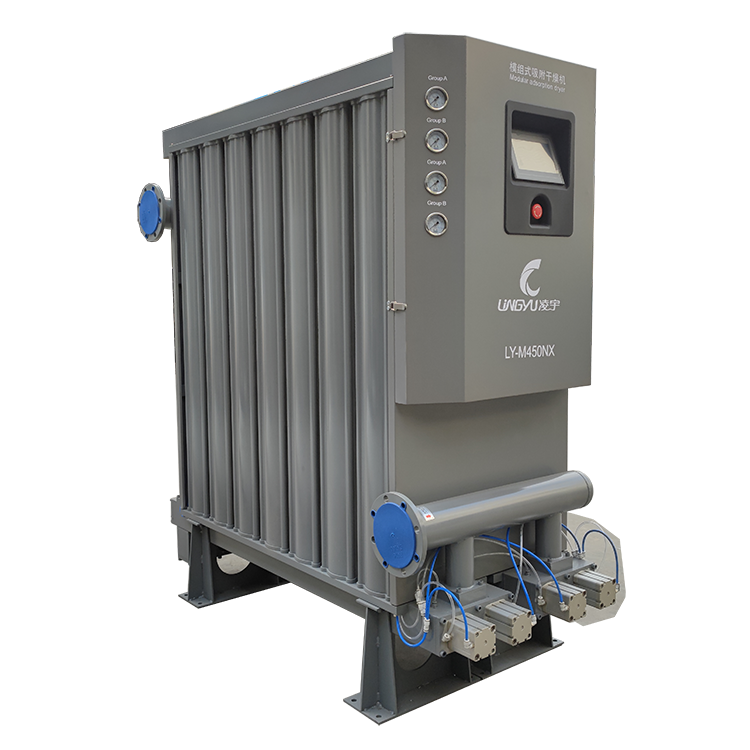
The M Series Modular Desiccant Air Dryer is designed for compressed-air systems that require low pressure dew points while placing additional emphasis on compact construction, clean internal air paths, and relatively low regeneration-air consumption.
Rather than using a conventional large twin-vessel arrangement, the M Series applies a modular adsorption structure with straight-through adsorption chambers and a specially designed airflow distribution system.
The M Series combines this modular construction with 5–8% regeneration-air consumption, a standard outlet pressure dew point of ≤−20°C, and an optional −40°C configuration.
For users comparing other adsorption technologies, Lingyu’s desiccant air dryer range includes heatless, heated-purge, blower-assisted, and heat-of-compression configurations.
How the M Series Modular Dryer Works
The M Series is based on the operating principle of a conventional twin-tower adsorption dryer but uses multiple modular adsorption chambers.
During operation, one group of adsorption chambers treats the incoming compressed air while another group undergoes regeneration.
When Group A is adsorbing, compressed air enters the lower manifold and passes through the adsorption chambers. Moisture is retained by the desiccant, and the dried compressed air exits through the upper manifold.
A portion of the dry product air is diverted to Group B as regeneration air. During regeneration, the inlet to Group B is closed and its exhaust path is opened. Dry regeneration air passes through the adsorption chambers, desorbs moisture from the desiccant, and carries that moisture out through the silenced exhaust valve.
This alternating adsorption and regeneration process allows continuous dry-air production.
Straight-Through Adsorption Chamber Design
One of the most important characteristics of the M Series is its straight-through adsorption chamber structure.
This arrangement improves desiccant utilization and adsorption efficiency compared with less uniform airflow configurations. The objective is to make compressed air pass more evenly through the available desiccant rather than allowing part of the bed to carry most of the airflow.
More uniform airflow helps reduce uneven airflow distribution, adsorption dead zones, channeling, tunneling, and localized desiccant wear.
This airflow arrangement is a key technical difference between the M Series modular structure and a conventional large-vessel adsorption configuration.
“Snowstorm” Desiccant Filling and Air Distribution
The M Series uses a specially designed base incorporating an inlet-air buffer chamber together with a unique “snowstorm” desiccant filling method.
The purpose of this arrangement is to improve airflow distribution through the adsorption chambers and reduce the direct mechanical impact of incoming compressed air on the desiccant.
The structure is designed to help address channeling and tunneling while reducing desiccant attrition and dust generation.
This is important because adsorption performance depends not only on the type of desiccant used but also on how effectively the compressed air contacts the adsorption bed.
Regeneration Air Consumption: 5–8%
A major operating characteristic of the M Series is its relatively low regeneration-air requirement of 5–8%.
This value should be considered when calculating the total compressed-air requirement of the system. The compressor must supply enough air for both downstream production demand and dryer regeneration demand.
Reducing purge consumption is valuable because regeneration air has already been compressed and therefore represents compressor energy.
The 5–8% figure is an M Series design specification and should not be treated as a universal regeneration-air value for all adsorption dryers.
Desiccant Configuration
The M Series uses:
Activated alumina + high-performance molecular sieve
This desiccant combination is used with a standard outlet pressure dew point of ≤−20°C, while −40°C is available as an option.
The use of two adsorbent materials allows the system to be configured around the required drying performance.
The optimized chamber design also reduces desiccant attrition and dusting and improves overall desiccant utilization. A fixed claim that this configuration automatically extends adsorbent life by 3–5 years is not supported by the supplied technical information, so that numerical comparison has been removed.
Standard Operating Conditions
The M Series operates under the following standard conditions:
| Parameter | Specification |
|---|---|
| Applicable medium | Compressed air / non-corrosive air |
| Rated inlet pressure | 0.7 MPa |
| Operating pressure range | 0.6–1.0 MPa |
| Rated inlet temperature | 10–30°C |
| Maximum inlet temperature | ≤40°C |
| Inlet air dew point | ≤15°C |
| Outlet pressure dew point | ≤−20°C |
| Optional outlet dew point | −40°C |
| Desiccant | Activated alumina + high-performance molecular sieve |
| Rated ambient temperature | 35°C |
| Ambient operating range | 2–45°C |
| Regeneration air consumption | 5–8% |
The ≤15°C inlet-air dew point requirement is particularly important and should not be overlooked during system design.
Why Inlet Air Dew Point Matters
Unlike some other adsorption dryer configurations, the M Series explicitly specifies an inlet-air dew point of ≤15°C.
This means upstream treatment conditions form part of dryer selection.
If excessive moisture or liquid water enters the modular adsorption chambers, the moisture load on the desiccant increases and can affect the intended adsorption cycle.
The M Series should therefore be considered as part of the complete compressed-air purification system rather than as an isolated piece of equipment.
Clean Internal Air Path
All surfaces in contact with compressed air receive an anti-corrosion oxidation treatment.
The purpose is to reduce corrosion and help prevent secondary contamination of the treated compressed air. This construction is specifically identified as beneficial for food and pharmaceutical applications.
For industry-specific compressed-air requirements, users can review Lingyu’s pharmaceutical and biopharmaceutical compressed air solutions.
Aerospace-Grade Magnesium-Aluminum Modular Structure
The structural design is one of the clearest differentiators of the M Series.
The integrated body is manufactured from aerospace-grade magnesium-aluminum extruded alloy. Compared with a conventional large cylindrical vessel arrangement, this allows the dryer to use a narrow modular form.
Representative dimensions include:
| Model | Airflow | Dimensions |
|---|---|---|
| LY-M10NX | 1.5 m³/min | 460×300×752 mm |
| LY-M20NX | 2.5 m³/min | 460×300×1246 mm |
| LY-M30NX | 3.8 m³/min | 460×300×1546 mm |
| LY-M50NX | 6.5 m³/min | 400×778×1735 mm |
| LY-M100NX | 13.5 m³/min | 400×1126×1735 mm |
| LY-M150NX | 21.5 m³/min | 400×1474×1735 mm |
| LY-M300NX | 37.0 m³/min | 762×1300×1760 mm |
| LY-M500NX | 55.0 m³/min | 762×1884×1760 mm |
The compact structure allows the equipment to pass through standard doorways, which can simplify installation where access routes or equipment-room dimensions are limited.
M Series Capacity Range
The standard M Series range extends from 1.5 to 55.0 m³/min.
| Model | Inlet Airflow | Connection | Weight |
|---|---|---|---|
| LY-M10NX | 1.5 m³/min | G1″ | 35 kg |
| LY-M20NX | 2.5 m³/min | G1″ | 60 kg |
| LY-M30NX | 3.8 m³/min | G1″ | 70 kg |
| LY-M50NX | 6.5 m³/min | G1½” | 190 kg |
| LY-M75NX | 10.5 m³/min | G2″ | 285 kg |
| LY-M100NX | 13.5 m³/min | G2½” | 375 kg |
| LY-M120NX | 17.0 m³/min | G2½” | 470 kg |
| LY-M150NX | 21.5 m³/min | G2½” | 565 kg |
| LY-M180NX | 25.0 m³/min | G2½” | 660 kg |
| LY-M200NX | 28.5 m³/min | DN80 | 755 kg |
| LY-M300NX | 37.0 m³/min | DN100 | 940 kg |
| LY-M350NX | 41.5 m³/min | DN100 | 1130 kg |
| LY-M450NX | 50.0 m³/min | DN100 | 1320 kg |
| LY-M500NX | 55.0 m³/min | DN125 | 1510 kg |
All listed models use a 220V / 50Hz power supply. For airflow above 55 m³/min, or projects involving special specifications, materials, pressures, or temperatures, a separate technical evaluation is required.
For equipment-specific information, users can review the M Series modular adsorption air dryer product page.
Pressure-Vessel Inspection Considerations
According to Lingyu’s product classification, the M Series is not classified as a pressure vessel subject to mandatory special-equipment inspection and does not require the annual pressure-vessel reinspection applicable to conventional pressure-vessel equipment.
This can be relevant for facilities concerned with equipment inspection and maintenance administration.
The classification should be understood as a product-specific statement rather than a universal exemption from every local pressure-equipment regulation. Applicable local requirements should still be considered for the installation.
Full-Capacity Standby Configuration
The M Series can also be configured with a full-capacity standby unit at relatively low cost.
This can be useful where continuous compressed-air availability is important and operators want redundancy without installing another large conventional vessel dryer.
Maintenance and servicing costs for the modular configuration are also described as relatively low.
These characteristics are more useful for lifecycle evaluation than unsupported fixed maintenance intervals or exact payback claims.
Service Life: Up to 30 Years
The M Series is specified with a service life of up to 30 years, rather than a guaranteed fixed 30-year operating life.
The “up to” qualification is important because actual service life depends on operating and maintenance conditions.
Filtration and Upstream Air Quality
The M Series should receive compressed air within its specified inlet conditions, particularly the ≤15°C inlet dew point requirement.
Upstream liquid water, oil aerosols, and particles should therefore be controlled according to the overall purification design.
Where additional filtration is required, suitable precision compressed air filters can be integrated with the drying system.
The filter configuration should be determined according to the actual air-quality and system requirements.
Where the Modular Design Is Most Relevant
The modular configuration is particularly relevant where a project values restricted installation space, narrow equipment-room access, low regeneration-air consumption, clean corrosion-resistant internal surfaces, low-dew-point compressed air, full-capacity standby capability, reduced pressure-vessel inspection administration, or modular expansion across different airflow requirements.
Food and pharmaceutical applications are specifically associated with the clean internal construction, while detailed industry air-quality requirements should be evaluated separately for the intended process.
M Series vs. Conventional Twin-Tower Dryer
The main technical difference is structural.
A conventional adsorption dryer typically uses larger adsorption vessels, while the M Series distributes adsorption across multiple straight-through chambers integrated into a modular magnesium-aluminum structure.
The resulting design emphasizes more uniform airflow, compact dimensions, lower regeneration-air consumption, and reduced desiccant channeling and dusting.
The M Series should therefore not be treated simply as a smaller version of a conventional twin-tower dryer.
What to Check Before Selecting an M Series Dryer
Before selecting a model, confirm the actual airflow, inlet pressure, inlet temperature, inlet dew point, required outlet pressure dew point, ambient temperature, installation dimensions, and redundancy requirements.
The ≤15°C inlet dew point requirement deserves particular attention because it determines whether the upstream treatment arrangement is suitable for the modular dryer.
If a −40°C outlet pressure dew point is required, this should be specified when requesting the equipment because it is an optional configuration rather than the standard ≤−20°C condition.
For special capacities or operating requirements, users can use Lingyu’s contact page for technical configuration support.
Conclusion
The M Series Modular Desiccant Air Dryer differentiates itself through its straight-through adsorption chambers, specially designed airflow distribution, “snowstorm” desiccant filling method, aerospace-grade magnesium-aluminum modular structure, and 5–8% regeneration-air consumption.
Its standard operating conditions include 0.7 MPa rated inlet pressure, 0.6–1.0 MPa operating pressure, 10–30°C rated inlet temperature, ≤40°C maximum inlet temperature, ≤15°C inlet-air dew point, ≤−20°C outlet pressure dew point with −40°C available as an option, 35°C rated ambient temperature, and a 2–45°C ambient operating range.
For selection, users should focus on airflow, upstream air condition, required dew point, regeneration-air consumption, installation space, and redundancy requirements rather than treating the M Series as simply a smaller version of a conventional adsorption dryer.