In modern food production, controlling oxygen exposure can play an important role in maintaining product quality during packaging, storage, transportation, and retail.
Nitrogen food preservation uses nitrogen to displace part or most of the oxygen in a package, container, or headspace. Because nitrogen is relatively inert under normal food-packaging conditions, it can help reduce oxidation and create a more controlled atmosphere around the product.
This approach is commonly used in nitrogen flushing, modified-atmosphere packaging, headspace filling, and selected storage applications. The required nitrogen purity, residual oxygen level, gas flow, and packaging method should always be matched to the specific food product and production process.
What Is Nitrogen Food Preservation?
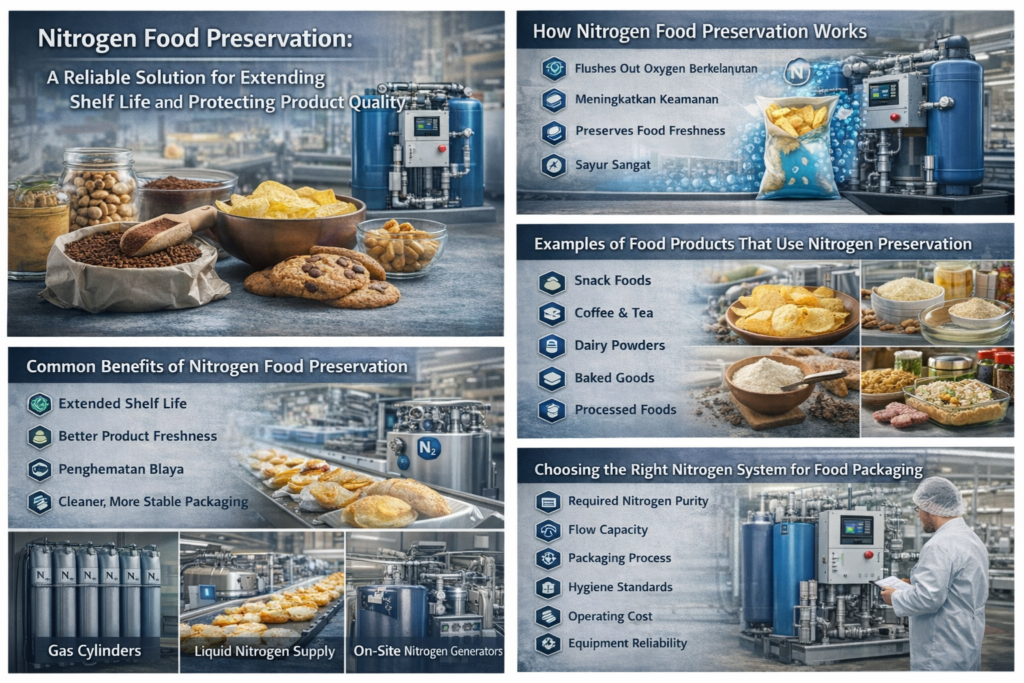
Nitrogen food preservation refers to the use of nitrogen gas to reduce oxygen exposure around food products.
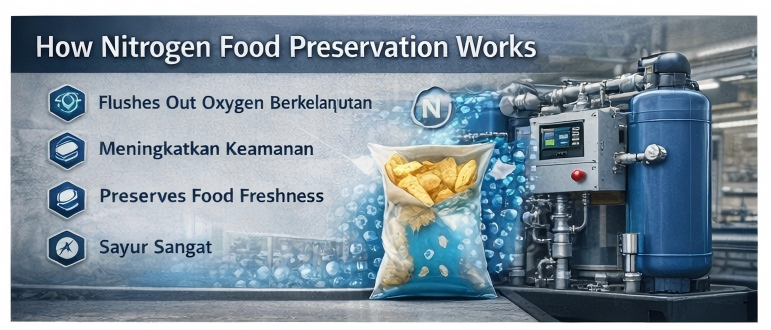
In many packaging applications, nitrogen is introduced before or during sealing so that atmospheric air in the package is displaced. Lowering oxygen concentration can help slow oxidation-related changes such as rancidity, flavor deterioration, aroma loss, and color changes in oxygen-sensitive foods.
Nitrogen may also be used as part of a modified-atmosphere packaging system together with other gases, depending on the product and preservation objective.
Common uses include nitrogen flushing before sealing, modified-atmosphere packaging, package headspace filling, storage-tank and container blanketing, and continuous nitrogen supply for automated packaging lines.
Why Oxygen Control Matters in Food Packaging
Oxygen can contribute to several types of food-quality deterioration.
Products containing oils and fats can undergo oxidation that contributes to rancidity and undesirable changes in flavor and aroma. Oxygen exposure may also affect color, nutrients, and other quality characteristics depending on the product.
Coffee, nuts, snack foods, powders, cereals, edible oils, and other oxygen-sensitive products can therefore benefit from controlled package atmospheres.
Nitrogen helps by reducing the amount of oxygen surrounding the product.
However, nitrogen should not be treated as a universal microbial-control method. Microbiological stability depends on multiple factors, including product composition, temperature, water activity, packaging conditions, other gases present, and the microorganisms of concern.
Nitrogen is therefore one part of a preservation strategy rather than a substitute for appropriate food-safety controls.
How Nitrogen Food Preservation Works
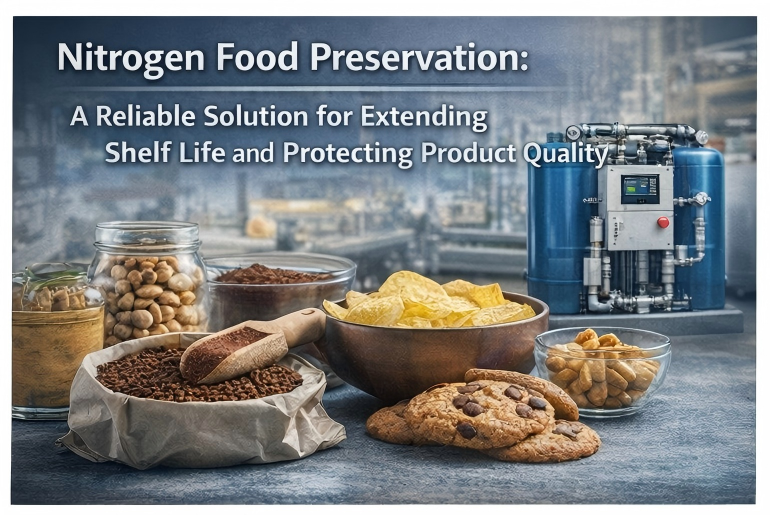
The basic principle is oxygen displacement.
Nitrogen is introduced into a package, container, or storage space before sealing or during controlled-atmosphere operation. As nitrogen enters, the proportion of atmospheric oxygen around the product is reduced.
The appropriate method depends on the product, packaging equipment, production speed, residual-oxygen target, and required shelf-life performance.
Nitrogen Flushing
Nitrogen flushing introduces nitrogen into the package shortly before sealing.
The incoming gas displaces part of the air in the headspace, reducing the amount of oxygen surrounding the food.
This method is commonly used for products such as snack foods, coffee, nuts, powders, and other packaged foods where oxidation control is important.
The effectiveness of flushing depends on factors such as package geometry, nitrogen flow rate, filling method, sealing speed, and the target residual oxygen level.
Modified-Atmosphere Packaging
In modified-atmosphere packaging, nitrogen may be used alone or as part of a controlled gas mixture.
Different foods require different gas compositions. Nitrogen should therefore not automatically be treated as the only or ideal gas for every MAP application.
The appropriate atmosphere should be determined according to the food, its deterioration mechanisms, packaging material, storage conditions, and required shelf life.
Headspace Filling
Nitrogen can be used to fill unused package volume while reducing oxygen exposure.
For fragile products such as potato chips and puffed snacks, a nitrogen-filled headspace can also provide physical cushioning that helps reduce product crushing during transportation and handling.
This gives nitrogen packaging both an atmosphere-control function and, in some applications, a package-protection function.
Tank and Container Blanketing
Nitrogen can also be introduced into the headspace of tanks, vessels, or storage containers.
By reducing contact between the stored product and atmospheric oxygen, nitrogen blanketing can help control oxidation in suitable liquid or dry-food processes.
The required nitrogen pressure, flow, purity, and control method depend on the storage system and product requirements.
Main Benefits of Nitrogen Food Preservation
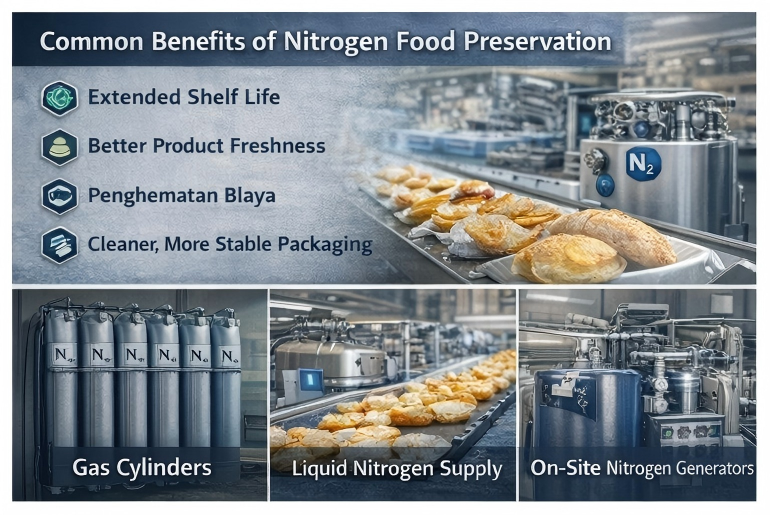
When properly applied, nitrogen can help reduce oxidation-related deterioration, support retention of flavor and aroma, improve product stability, protect fragile foods, and integrate with automated packaging operations.
For suitable products and packaging systems, reducing oxygen exposure can contribute to longer shelf life. Actual shelf-life performance should be validated using the specific product formulation, packaging material, residual oxygen level, storage temperature, and distribution conditions.
Gas-filled packaging can also create a protective cushion around fragile products, helping reduce breakage during handling and transportation.
Nitrogen can be integrated into continuous filling, flushing, and sealing equipment, making it suitable for high-throughput food-packaging operations.
Foods Commonly Packaged with Nitrogen
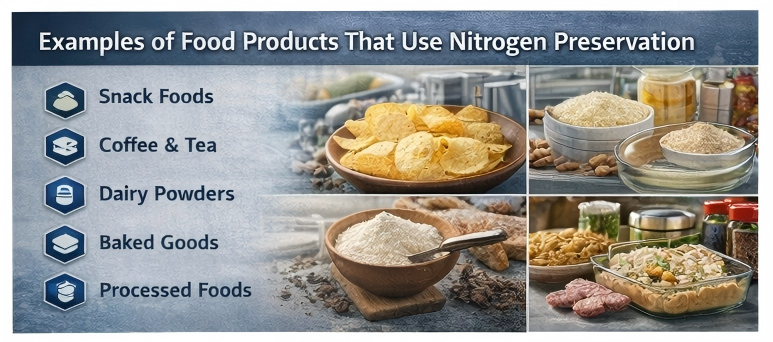
Nitrogen can be used with many oxygen-sensitive or fragile food products, including potato chips and puffed snacks, nuts and seeds, coffee beans and ground coffee, tea products, milk powder and selected dairy powders, cereals and dry ingredients, bakery and dry-food products, seasonings and powdered ingredients, edible oils, and selected liquid ingredients.
The same nitrogen conditions should not be applied automatically to every food product. Gas purity, flow rate, residual oxygen target, and packaging method should be determined according to the actual process.
For broader compressed-air and gas-treatment requirements in this sector, see Lingyu’s food and beverage applications.
Nitrogen Supply Options for Food Production
Food manufacturers generally obtain nitrogen through cylinders, bulk supply, or on-site generation.
Gas Cylinders
Nitrogen cylinders can be practical for low-volume or intermittent gas use.
They require relatively little installed infrastructure, but regular replacement, cylinder handling, storage, and delivery management can become less convenient as consumption increases.
Bulk or Liquid Nitrogen
Facilities with higher consumption may use bulk nitrogen supplied by an external gas provider.
Bulk supply can support substantial demand but requires storage equipment, delivery planning, and sufficient site access for replenishment.
On-Site Nitrogen Generation
For regular or continuous nitrogen demand, an on-site nitrogen generator can produce nitrogen directly from compressed air.
Lingyu’s PSA nitrogen generator uses two adsorption towers filled with Carbon Molecular Sieve (CMS). Oxygen is preferentially adsorbed by the CMS while nitrogen passes through the adsorption bed and is collected as product gas.
The second tower regenerates while the first tower adsorbs, and the towers switch automatically to maintain continuous nitrogen production.
How a PSA Nitrogen Generator Works
Pressure Swing Adsorption separates nitrogen from compressed air through repeated adsorption and regeneration cycles.
Compressed air enters one adsorption vessel, where the CMS preferentially adsorbs oxygen molecules. Nitrogen passes through the bed and exits as product gas.
At the same time, the second vessel undergoes depressurization and regeneration. Oxygen previously adsorbed by the CMS is released and discharged.
When the active adsorption tower reaches its operating limit, the control system switches the tower functions. The regenerated tower begins adsorption while the other tower regenerates.
This continuous alternating process allows nitrogen to be produced on site without relying entirely on stored gas deliveries.
PSA Nitrogen Generator Operating Range
Lingyu’s PSA nitrogen generation system supports a broad range of nitrogen purity requirements.
| Parameter | Specification |
|---|---|
| Inlet air temperature | ≤40°C |
| Inlet air pressure | 0.5–0.8 MPa |
| Nitrogen purity | 95%–99.999% |
| Nitrogen dew point | ≤−40°C |
| Ambient temperature | ≤40°C |
| Switching cycle | 45–60 seconds |
| Power supply | 220 V / 50 Hz |
| Noise level | ≤75 dB |
The appropriate purity should be selected according to the packaging or storage requirement rather than automatically choosing the highest available purity.
Why On-Site Nitrogen Generation Can Be Useful
On-site generation can reduce dependence on cylinder replacement schedules and regular bulk-gas deliveries.
It also allows production facilities to generate nitrogen according to their operating schedule and actual gas demand.
Lingyu’s PSA systems include automatic start/stop, PLC-controlled tower switching, real-time nitrogen purity and flow monitoring, and off-spec nitrogen alarm and protection.
For automated food-packaging lines, these functions can help operators monitor gas production and identify conditions in which nitrogen falls outside the required purity range.
How Much Nitrogen Purity Is Needed for Food Packaging?
There is no single nitrogen purity that is automatically correct for every food application.
The required purity should be determined by the residual oxygen level that the packaging or storage process needs to achieve.
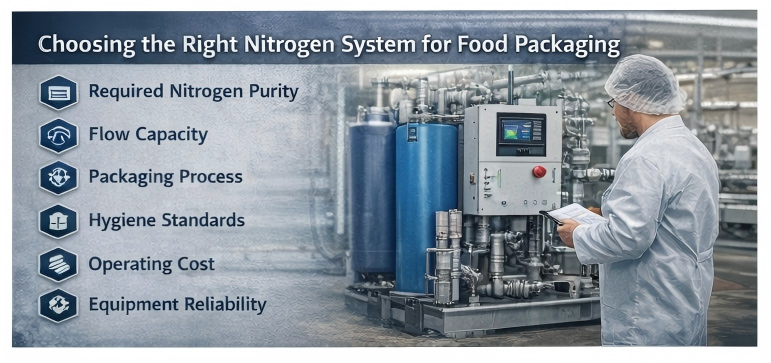
Important considerations include maximum acceptable residual oxygen, product sensitivity to oxidation, package volume, nitrogen flushing efficiency, packaging-line speed, desired shelf-life performance, nitrogen consumption, applicable food-production requirements, and operating cost.
A higher nitrogen purity does not automatically result in a better system if the application does not require it.
Higher purity can affect nitrogen recovery, compressed-air demand, equipment size, and operating cost. The system should therefore be designed around the actual process specification.
Nitrogen Flow Is as Important as Purity
Purity is only one part of nitrogen-generator sizing.
The generator must also deliver enough nitrogen during both normal and peak packaging demand.
A packaging line may have relatively low average consumption but much higher instantaneous demand during flushing, filling, or multiple-machine operation.
System design should therefore consider both required nitrogen purity and required nitrogen flow rate.
A nitrogen buffer tank can also be used to help balance generator output against changing downstream demand.
Compressed-Air Treatment for PSA Nitrogen Generation
A PSA nitrogen generator depends on properly conditioned compressed air.
A typical nitrogen-generation arrangement can include an air compressor, receiver tank, refrigerated air dryer, filtration stages, PSA generator, nitrogen buffer tank, nitrogen/oxygen analyzer, and outlet controls.
Moisture, oil, and particulate contamination should be controlled before compressed air enters the CMS adsorption vessels.
Where additional inlet-air filtration is required, Lingyu’s precision compressed air filters can be integrated into the compressed-air pretreatment system.
Stable inlet conditions help the adsorption system maintain reliable nitrogen production.
Online Purity Monitoring and Off-Spec Gas Protection
Nitrogen quality should not be assumed solely from the generator’s nominal specification.
Lingyu’s PSA control system monitors nitrogen purity and flow online. If purity falls below the specified value, the system can activate an alarm, and a persistent off-spec condition can trigger protective shutdown.
This is particularly important where the food-packaging process depends on maintaining a defined residual oxygen level.
The package itself should still be validated separately because generator nitrogen purity and residual oxygen inside a sealed package are not the same measurement.
Buffer Storage and Nitrogen Distribution
A nitrogen buffer tank can help stabilize pressure and supply when downstream gas demand changes quickly.
The required buffer volume depends on factors such as generator output, packaging-line consumption, peak flow, operating pressure, and acceptable pressure fluctuation.
Distribution piping should also be sized to provide sufficient flow without excessive pressure loss.
For larger facilities, nitrogen demand from multiple packaging lines should be considered together rather than sizing each line independently without evaluating total system load.
Selecting an On-Site Nitrogen System for Food Production
A reliable nitrogen system should be selected from actual process data.
Key engineering factors include required nitrogen purity, target residual oxygen in the package, required nitrogen flow, peak packaging-line demand, compressed-air capacity and pressure, inlet air temperature, compressed-air quality, packaging operating hours, nitrogen buffer requirements, distribution pressure, online purity monitoring, off-spec gas handling, maintenance access, expected future production demand, and lifecycle operating cost.
For facilities evaluating different purity levels and production capacities, Lingyu’s nitrogen generator range provides multiple PSA configurations.
Nitrogen Preservation and Food Safety
Nitrogen can help control oxidation and package atmosphere, but it should not be presented as a standalone food-safety guarantee.
Food safety still depends on factors such as raw-material quality, hygienic processing, temperature control, formulation, water activity, packaging integrity, microbial hazards, and applicable regulatory requirements.
Gas purity and gas quality used in a food-production environment should also be selected and verified according to the requirements applicable to the product and target market.
Nitrogen preservation should therefore be integrated into the broader food-safety and quality-control system rather than treated as a replacement for it.
Conclusion
Nitrogen food preservation reduces oxygen exposure around suitable food products and helps create a more controlled packaging or storage atmosphere.
For oxygen-sensitive products, nitrogen flushing or modified-atmosphere packaging can help reduce oxidation, protect flavor and aroma, improve package stability, and support longer shelf life. Nitrogen-filled headspace can also provide physical cushioning for fragile foods.
Nitrogen can be supplied through cylinders, bulk systems, or generated on site. For facilities with continuous or predictable nitrogen demand, PSA generation provides a way to produce nitrogen directly from compressed air.
Lingyu PSA systems use twin CMS adsorption towers and support nitrogen purity from 95% to 99.999%. The operating range in the source also includes ≤40°C inlet air temperature, 0.5–0.8 MPa inlet pressure, ≤−40°C nitrogen dew point, ≤40°C ambient temperature, a 45–60 second switching cycle, 220 V / 50 Hz power supply, and ≤75 dB noise level. Automatic operation, online purity and flow monitoring, and off-spec gas protection support continuous nitrogen production.
The correct nitrogen solution should ultimately be selected according to the food product, target residual oxygen, required nitrogen purity and flow, packaging process, compressed-air conditions, storage requirements, and applicable food-production standards.
For project-specific system sizing and nitrogen requirements, contact Lingyu.