Nitrogen is widely used across modern industry to create controlled low-oxygen environments, protect sensitive materials, support manufacturing processes, and maintain product quality.
Applications range from food packaging and pharmaceutical production to electronics manufacturing, chemical processing, and metal fabrication. Traditionally, many facilities have depended on nitrogen cylinders or bulk liquid nitrogen deliveries.
For operations with regular nitrogen demand, producing nitrogen directly at the facility can provide greater control over gas availability, production capacity, and operating conditions. A nitrogen generation unit uses compressed air as its feed source and separates nitrogen on site according to the required purity, flow, pressure, and process conditions.
Manufacturers evaluating on-site nitrogen production can explore Lingyu’s nitrogen generator range for different nitrogen purity and production requirements.
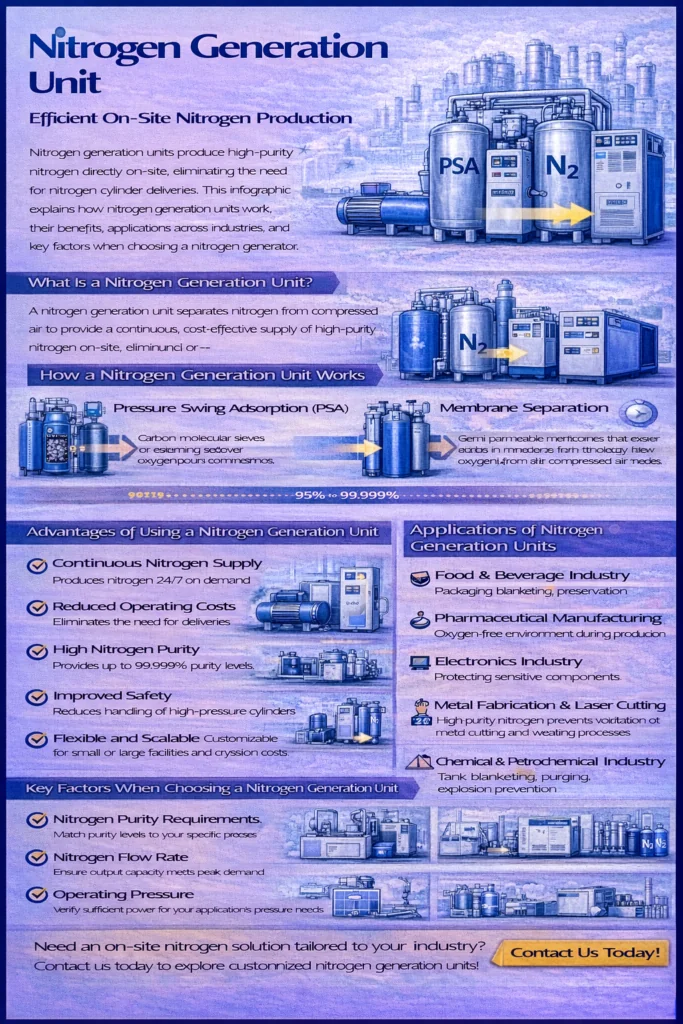
What Is a Nitrogen Generation Unit?
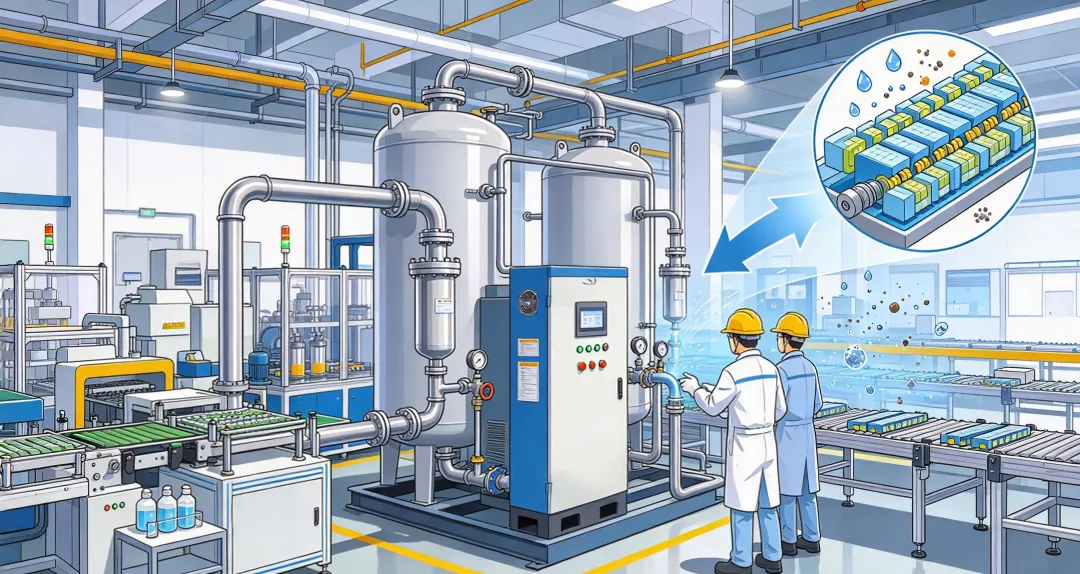
A nitrogen generation unit is an on-site system designed to produce nitrogen from compressed air and deliver it to an industrial process.
Rather than storing all required nitrogen in cylinders or depending entirely on scheduled bulk-gas deliveries, the facility generates nitrogen as part of its own utility system.
Depending on the installation, a complete arrangement may include:
- Air compressor
- Air receiver
- Compressed-air dryer
- Filtration equipment
- PSA nitrogen generator
- Nitrogen buffer tank
- Nitrogen or oxygen analyzer
- Pressure-control equipment
- Off-spec gas handling
- Downstream distribution piping
The exact system configuration depends on nitrogen demand, existing site utilities, required gas quality, and point-of-use conditions.
The nitrogen generator should therefore be considered as part of a complete system. Compressed-air capacity and quality, air treatment, nitrogen storage, monitoring, and downstream distribution can all affect overall performance.
How a PSA Nitrogen Generation Unit Works
Lingyu’s nitrogen generation equipment uses Pressure Swing Adsorption (PSA) technology.
A PSA nitrogen generator uses two adsorption towers filled with Carbon Molecular Sieve (CMS). Conditioned compressed air enters one tower, where oxygen is preferentially adsorbed by the CMS while nitrogen passes through as product gas.
While one tower performs adsorption, the second depressurizes and regenerates. The towers alternate automatically to maintain continuous nitrogen production.
Depending on system configuration, controls may also include nitrogen purity monitoring, flow monitoring, alarms, and off-spec gas handling.
For a more detailed technical explanation, see how PSA nitrogen generation works.
The Main Stages of On-Site Nitrogen Production
A nitrogen generation system can be understood as several connected stages rather than a single piece of equipment.
1. Compressed-Air Generation
The process begins with ambient air, which is compressed to provide the feed gas required by the PSA generator.
The compressor must supply sufficient pressure and air volume for the selected nitrogen purity and production capacity.
When a nitrogen generation unit is added to an existing facility, the available compressor capacity should be checked against the additional compressed-air demand of the nitrogen system.
2. Compressed-Air Treatment
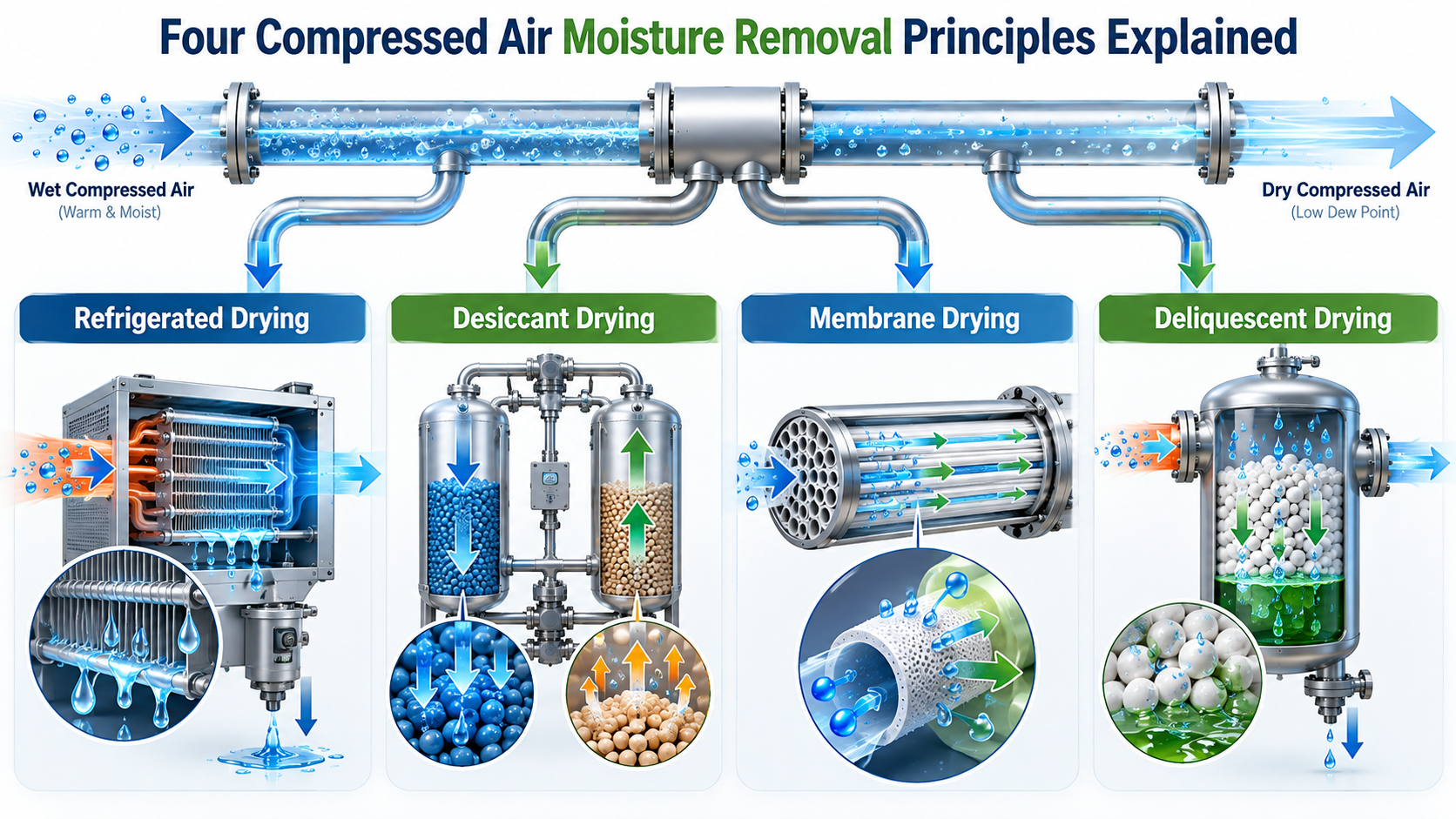
Compressed air should be appropriately treated before entering the PSA adsorption system.
Moisture, oil, and particulate contamination can affect filters, valves, instrumentation, piping, and the CMS adsorption bed.
Depending on the feed-air conditions, pretreatment may include:
- Condensate removal
- Compressed-air drying
- Pre-filtration
- Oil-removal filtration
- Fine particulate filtration
A suitable precision compressed-air filter can form part of the upstream treatment arrangement.
3. PSA Nitrogen Separation
Conditioned compressed air then enters the PSA adsorption towers.
Oxygen is preferentially adsorbed by the Carbon Molecular Sieve while the nitrogen-rich product stream passes through the adsorption bed.
Alternating adsorption and regeneration allow the unit to maintain continuous production.
4. Nitrogen Buffer Storage
Generated nitrogen may then enter a buffer or receiver tank.
Buffer storage can help stabilize supply pressure and accommodate short-duration differences between the generator’s production rate and downstream nitrogen demand.
However, storage should be correctly sized. A buffer tank should complement generator capacity rather than compensate for a fundamentally undersized nitrogen generator.
5. Gas Monitoring and Distribution
The product nitrogen can be monitored before being supplied to downstream processes.
Depending on system design, monitoring may include nitrogen purity or residual oxygen, flow, pressure, and operating status.
The nitrogen is then delivered through the plant distribution system to the actual point of use.
Nitrogen Purity: Higher Is Not Always Better
One of the most important specifications of a nitrogen generation unit is product purity.
Lingyu’s PSA nitrogen generator range supports different nitrogen purity requirements, including high-purity industrial applications.
However, the highest available purity is not automatically the best specification for every process.
Nitrogen purity should be selected according to the maximum allowable residual oxygen concentration in the actual application.
Increasing purity can affect:
- Nitrogen recovery
- Available production capacity
- Compressed-air consumption
- Generator sizing
- Operating cost
For this reason, nitrogen purity should be evaluated together with flow, pressure, compressed-air demand, and process requirements rather than comparing generators by purity alone.
For additional guidance on evaluating these parameters together, see the nitrogen generator specification guide.
Flow Rate and Capacity
A nitrogen generation unit must supply enough gas for the actual production process.
System capacity should be based on both average nitrogen consumption and peak demand.
A facility using nitrogen continuously at a relatively stable rate may require a different system arrangement from one where several machines consume large quantities intermittently.
When calculating capacity, consider:
- Average nitrogen consumption
- Peak nitrogen demand
- Number of nitrogen users
- Simultaneous equipment operation
- Production shifts
- Batch cycles
- Short-duration demand peaks
- Planned future expansion
- Required reserve capacity
Nitrogen purity must also be included in capacity calculations because available generator flow and compressed-air consumption can vary with the selected purity.
When comparing equipment, flow figures should therefore be evaluated at equivalent purity and operating conditions.
Compressed-Air Consumption and Energy Efficiency
Compressed air is one of the main operating inputs of a PSA nitrogen generation system.
Evaluating only the direct electrical consumption of the nitrogen generator itself can give an incomplete picture of total energy use.
A significant portion of the operating energy is associated with:
- Producing compressed air
- Treating the compressed air
- Overcoming pressure losses
- Operating downstream pressure-boosting equipment where required
For a meaningful comparison, the amount of compressed air required to produce a specified quantity of nitrogen at the required purity should be considered.
Two systems with similar nitrogen output can have different overall operating costs if their compressed-air requirements differ.
The relevant measure is therefore not simply equipment purchase price, but the efficiency of the complete nitrogen production system under the intended operating conditions.
Pressure and Dew Point
Nitrogen purity is only one part of the final gas specification.
The required nitrogen pressure must match the downstream process, while dew point may be important where moisture needs to be controlled.
For Lingyu PSA nitrogen generation systems, the inlet compressed-air pressure is approximately 0.5–0.8 MPa, the maximum inlet-air temperature is approximately 40°C, and nitrogen dew-point performance can reach approximately −40°C or lower under the applicable operating conditions.
The generator’s inlet-air pressure should not be confused with the nitrogen pressure required at the final point of use.
If a process requires higher downstream pressure, the complete system may need:
- Additional nitrogen storage
- Pressure-boosting equipment
- Pressure-control equipment
- Properly sized downstream piping
The correct dew point should likewise be selected according to the actual process rather than simply specifying the driest gas available.
Automatic Monitoring and Off-Spec Protection
Industrial users should also consider how nitrogen quality is monitored during operation.
Depending on configuration, a nitrogen generation system may include:
- Nitrogen purity monitoring
- Residual oxygen monitoring
- Nitrogen flow monitoring
- Pressure monitoring
- Operating-status indication
- Alarm functions
- Off-spec gas handling
- Automatic operating controls
These functions help operators confirm whether the generated nitrogen remains within the required process conditions.
Where downstream production depends on maintaining defined nitrogen quality, the system’s response to off-spec gas should be considered during equipment selection.
Nitrogen-generator monitoring can also be integrated with the facility’s process-control and quality-management requirements where necessary.
Applications of Nitrogen Generation Units
The same basic PSA technology can be configured for different industrial purity, flow, pressure, and operating requirements.
Food and Beverage Processing
Nitrogen can be used for packaging, flushing, storage blanketing, and selected preservation applications where reducing oxygen exposure is beneficial.
The required gas specification depends on the food product, packaging system, residual oxygen target, production speed, and applicable quality requirements.
Explore Lingyu’s food and beverage applications for more information about this sector.
Pharmaceutical and Biopharmaceutical Manufacturing
Nitrogen can support selected production, vessel blanketing, packaging, storage, and laboratory applications where a controlled low-oxygen atmosphere is required.
Different pharmaceutical processes can require different specifications for purity, moisture, contamination control, and monitoring.
Nitrogen purity alone should therefore not be treated as evidence that a gas supply is suitable for every pharmaceutical process.
Explore Lingyu’s pharmaceutical and biopharmaceutical applications.
Electronics and Precision Manufacturing
Nitrogen can be used in electronics manufacturing where oxygen control is beneficial to selected production processes.
Requirements can vary significantly between electronics applications, so nitrogen purity should be determined according to the actual equipment and process.
Explore Lingyu’s electronics and precision manufacturing applications.
Metal Fabrication and Laser Cutting
Nitrogen is widely used as an assist gas in selected laser-cutting processes where oxidation of the cut edge needs to be minimized.
Flow and delivery pressure can be particularly important in laser cutting.
The nitrogen generation system should therefore be designed around the actual laser equipment, material type, thickness, cutting parameters, and production demand.
Explore Lingyu’s metal fabrication and laser cutting applications.
Chemical and Petrochemical Processing
Nitrogen may be used for tank blanketing, vessel purging, pipeline operations, and other processes where oxygen concentration needs to be controlled.
The required purity, flow, pressure, and operating procedure depend on the materials and process involved.
Explore Lingyu’s petrochemical and chemical processing applications.
Advantages of an On-Site Nitrogen Generation Unit
For industrial facilities with sufficiently regular nitrogen consumption, an on-site generation system can provide several practical benefits.
Potential advantages include:
- Reduced dependence on external gas deliveries
- Greater control over nitrogen availability
- Reduced cylinder handling
- Reduced reliance on cylinder storage
- Nitrogen production according to operating demand
- System configuration matched to process requirements
- Greater visibility into gas production and consumption
Operating-cost benefits may also be possible where nitrogen demand is regular enough to justify on-site production.
A complete economic evaluation should include:
- Compressor electricity
- Compressed-air treatment
- Generator maintenance
- Filter replacement
- Nitrogen storage
- Pressure boosting where required
- Installation
- Annual operating hours
- Delivered-gas alternatives
The relevant comparison is the lifecycle cost of usable nitrogen at the point of use.
What to Consider When Selecting a Nitrogen Generation Unit
A practical system-selection process should begin with production requirements rather than a generator model.
Important parameters include:
- Required nitrogen purity
- Maximum allowable residual oxygen
- Average nitrogen flow
- Peak nitrogen flow
- Required point-of-use pressure
- Required dew point
- Existing compressed-air pressure
- Existing compressed-air capacity
- Feed-air quality
- Operating schedule
- Installation environment
- Available space
- Monitoring requirements
- Future demand
Once these parameters are defined, the compressor, compressed-air treatment equipment, PSA generator, buffer storage, controls, and downstream distribution system can be sized as one complete solution.
This system-level approach helps ensure that generator capacity, feed-air supply, gas quality, storage, and point-of-use requirements work together effectively.
Maintenance and Long-Term Reliability
Routine maintenance helps maintain stable nitrogen production over the service life of the equipment.
Typical maintenance considerations include:
- Filter-element replacement
- Drain inspection
- Pneumatic-valve inspection
- Gas-analyzer calibration
- Compressed-air dryer maintenance
- Pressure-instrument verification
- Flow-instrument verification
- CMS condition
- Inspection of storage and distribution equipment
The nitrogen generator and upstream compressed-air treatment system should therefore be maintained as one integrated utility.
Wet, oily, or contaminated feed air can affect downstream components, so maintaining the air-treatment system is an important part of maintaining the nitrogen generator itself.
Conclusion
A nitrogen generation unit provides an on-site approach to supplying nitrogen for a wide range of industrial processes.
The right system is not simply the generator with the highest purity or the largest nominal capacity.
Nitrogen purity, residual oxygen, average and peak flow, pressure, dew point, compressed-air consumption, feed-air quality, monitoring, storage, and operating conditions should all be evaluated together.
For facilities with regular nitrogen demand, a properly selected PSA nitrogen generation system can provide a stable and controllable alternative to depending entirely on delivered gas.
Explore Lingyu’s PSA nitrogen generator or contact Lingyu with your required nitrogen purity, flow, pressure, dew point, compressed-air conditions, and operating schedule for system-selection support.