In modern manufacturing, nitrogen has become an important process gas across industries such as food and beverage, electronics, pharmaceuticals, metal fabrication, chemical processing, oil and gas, and marine operations.
As more companies evaluate on-site generation as an alternative to cylinders or bulk liquid nitrogen, understanding nitrogen generator specifications becomes increasingly important.
Choosing the right nitrogen generator is not simply about finding a machine that produces nitrogen. The system must deliver the required purity, flow rate, pressure, dew point, and operating stability while matching the available compressed-air conditions.
A properly selected system can improve production reliability, control operating costs, and provide a more dependable nitrogen supply. The correct configuration should therefore be selected according to the actual process requirement rather than nominal capacity or maximum purity alone.
What Is a Nitrogen Generator?
A nitrogen generator separates nitrogen from compressed air and supplies it directly to the production process.
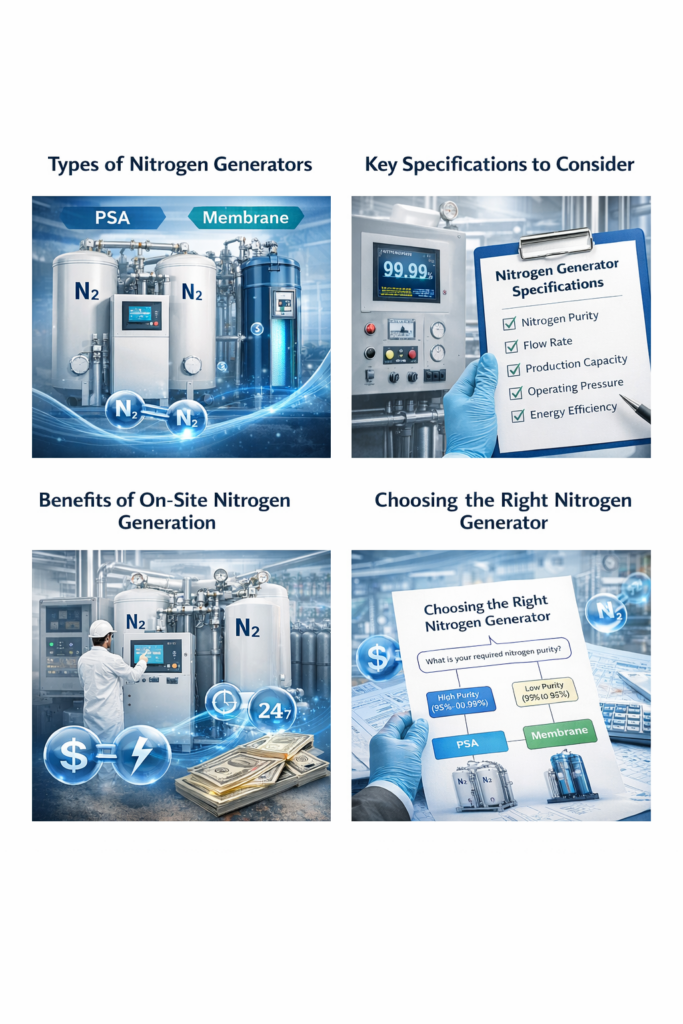
For many industrial applications, Pressure Swing Adsorption (PSA) is a widely used on-site nitrogen-generation technology. Lingyu’s PSA nitrogen generator uses two adsorption towers filled with Carbon Molecular Sieve (CMS).
Oxygen is preferentially adsorbed by the CMS while nitrogen passes through the adsorption bed as product gas. While one tower is producing nitrogen, the other depressurizes and regenerates. The towers alternate automatically to maintain continuous nitrogen production.
For a more detailed explanation, see how a PSA nitrogen generator works and why it uses Carbon Molecular Sieve.
Regardless of configuration, the actual performance of a nitrogen generation system depends on its specifications and operating conditions.
Why Nitrogen Generator Specifications Matter
Every industrial process has different nitrogen requirements.
Some applications prioritize very high purity, while others require greater nitrogen volume, higher delivery pressure, or more stable supply under fluctuating demand.
Selecting a generator simply according to maximum purity or nominal capacity can therefore lead to unnecessary investment, excessive compressed-air consumption, or insufficient process performance.
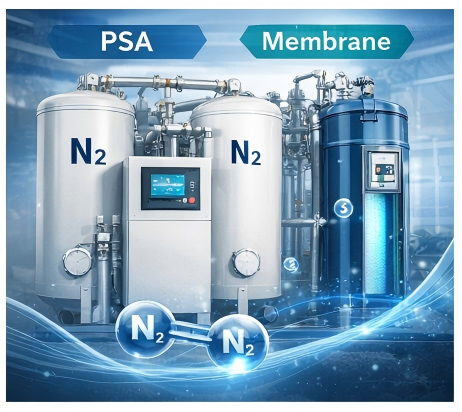
Understanding nitrogen generator specifications helps engineers and buyers select equipment for the actual application, avoid oversizing or undersizing, maintain stable nitrogen purity and pressure, match the generator to the compressed-air system, reduce unnecessary energy consumption, plan for peak and future nitrogen demand, and improve production continuity.
The objective is not to choose the largest or highest-purity generator available. It is to match nitrogen production to the actual operating requirement.
Key Nitrogen Generator Specifications to Evaluate
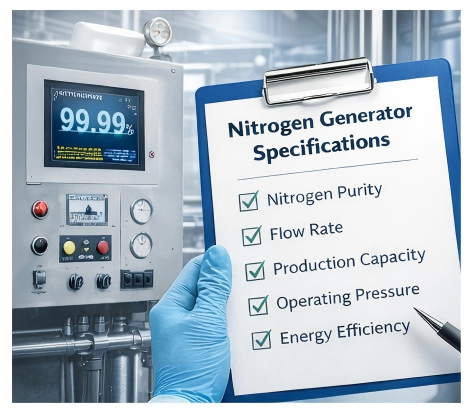
1. Nitrogen Purity
Nitrogen purity is usually one of the first specifications considered during equipment selection.
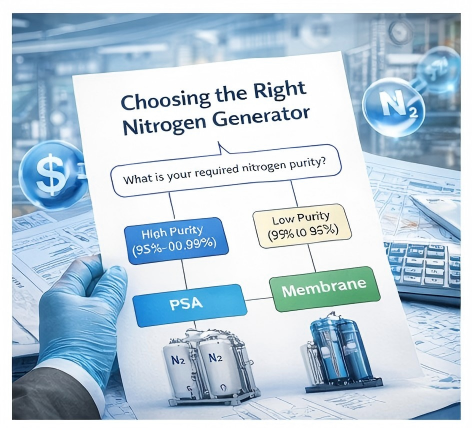
Industrial PSA nitrogen generation systems can be configured for different purity levels depending on the process. Lingyu’s PSA nitrogen generator range includes configurations from approximately 95% to 99.999% nitrogen purity.
Commonly requested configurations include 99%, 99.5%, 99.9%, and 99.99%, although the appropriate purity should always be determined by the application.
Higher purity does not automatically mean a better system.
As purity requirements increase, nitrogen recovery and available production capacity may decrease while compressed-air consumption can increase. Specifying substantially higher purity than the process actually needs can therefore increase operating cost without providing a meaningful production benefit.
For applications where this specification matches the process requirement, Lingyu provides a dedicated 99.5% nitrogen generator. Applications requiring higher-purity gas can instead evaluate a 99.99% nitrogen generator.
The correct approach is to determine the allowable residual oxygen concentration first and then select the corresponding nitrogen purity.
2. Nitrogen Flow Rate
Flow rate indicates how much nitrogen the generator can produce within a specified period and is commonly expressed in Nm³/h, m³/h, or SCFM, depending on the market and application.
Required generator capacity should be based on actual nitrogen consumption rather than a rough estimate of equipment size.
The calculation should consider average nitrogen consumption, maximum or peak consumption, continuous versus intermittent demand, simultaneous use by multiple production lines, and expected future expansion.
For processes with fluctuating demand, a nitrogen buffer tank can help stabilize supply and accommodate short-duration peaks.
Rated nitrogen capacity must also be considered together with purity. A generator capable of producing a certain flow at one purity level may provide a different capacity when configured for substantially higher purity.
When comparing quotations, nitrogen flow and purity should therefore be compared under equivalent operating conditions.
3. Inlet and Outlet Pressure
Pressure is another essential nitrogen generator specification.
PSA nitrogen generation depends on compressed-air pressure to drive the adsorption process. Lingyu’s standard PSA operating conditions include an inlet-air pressure range of approximately 0.5–0.8 MPa.
The required nitrogen outlet pressure, however, is determined by the downstream process.
Food packaging equipment, tank blanketing systems, laboratory equipment, chemical processes, and laser-cutting machines may all operate at different pressure requirements.
If the pressure available from the PSA system is lower than the required point-of-use pressure, additional pressure-boosting equipment may be required.
The complete system should also account for pressure losses through air-treatment equipment, filters, piping, valves, nitrogen storage, and long distribution lines.
Evaluating generator outlet pressure without considering downstream pressure losses can result in insufficient pressure at the actual point of use.
4. Compressed-Air Requirement
A PSA nitrogen generator uses compressed air as its feed gas, which means the upstream compressed-air system is an important part of nitrogen generator selection.
The specification should identify required inlet pressure, required compressed-air volume, maximum inlet temperature, moisture requirements, oil contamination limits, and particle-filtration requirements.
Compressed-air consumption is particularly important when estimating operating cost.
Two nitrogen generators producing the same nitrogen flow and purity may require different quantities of compressed air. That difference directly affects compressor load and energy consumption.
For this reason, the nitrogen generator should not be evaluated in isolation. The complete nitrogen generation system—including compressed-air generation and air treatment—should be considered.
5. Dew Point and Compressed-Air Quality
Clean and dry compressed air is important for reliable PSA operation.
Water, oil, and particulate contamination can affect valves, filtration equipment, piping, and the Carbon Molecular Sieve inside the adsorption towers.
A typical upstream air-treatment arrangement may include an air receiver, refrigerated or desiccant air dryer, pre-filtration, oil-removal filtration, and high-efficiency particulate filtration.
Lingyu PSA systems can provide nitrogen dew-point performance reaching approximately −40°C or lower under applicable operating conditions. The actual dew-point requirement should be determined according to the downstream process and complete system configuration.
If additional moisture control is required before the PSA generator, the appropriate compressed-air drying equipment should be selected according to inlet conditions and required air quality.
Filtration is equally important. A suitable precision compressed-air filter can help control particles, oil, and other contaminants in the upstream compressed-air system.
6. Air-to-Nitrogen Ratio and Energy Consumption
When evaluating nitrogen generator efficiency, buyers sometimes focus only on the electrical consumption of the nitrogen generator itself.
For PSA systems, however, a substantial portion of total energy consumption is associated with producing the compressed air used as feed gas.
An important efficiency consideration is therefore the amount of compressed air required to produce a given quantity of nitrogen at the specified purity.
The air-to-nitrogen ratio can be influenced by nitrogen purity, adsorption pressure, CMS performance, adsorption-cycle design, pressure equalization, operating load, and feed-air conditions.
A lower equipment purchase price does not necessarily result in a lower lifecycle cost if the system requires substantially more compressed air throughout its operating life.
Long-term system evaluation should therefore consider specific air consumption and total operating cost rather than equipment price alone.
For a broader financial comparison, see Lingyu’s guide to nitrogen generator cost and ROI.
7. Control and Monitoring System
Modern industrial nitrogen generators can incorporate more than basic automatic start and stop functions.
Depending on system configuration, control and monitoring functions may include PLC automatic control, touchscreen operation, real-time nitrogen purity monitoring, nitrogen flow monitoring, pressure monitoring, operating-status indication, alarm records, and off-spec nitrogen handling.
Lingyu PSA systems are designed to monitor key operating parameters such as nitrogen purity and flow.
Where process quality depends on maintaining a specified nitrogen concentration, monitoring and off-spec gas management become important parts of the overall system design.
8. Nitrogen Purity Protection
Purity monitoring deserves separate attention because the displayed nitrogen purity is not merely an informational value.
A properly configured system should provide an appropriate response when product gas falls outside the required specification.
Depending on the selected configuration, this may include online oxygen or nitrogen analysis, adjustable purity setpoints, off-spec nitrogen venting or diversion, alarm functions, and protective control logic.
These functions can provide an additional layer of process protection where production depends on maintaining a defined residual oxygen level.
9. System Size and Installation Requirements
Physical installation should also be considered during nitrogen generator selection.
Important factors include generator footprint, air receiver and nitrogen receiver size, required maintenance clearance, ventilation, ambient operating temperature, piping arrangement, drainage, electrical supply, and access for valve and CMS maintenance.
The nitrogen generator itself may occupy relatively limited space, but the complete nitrogen-production system can also require a compressor, dryer, filters, air receiver, nitrogen buffer tank, and optional pressure booster.
Planning the complete installation rather than only the generator footprint reduces the risk of layout changes after equipment arrives.
10. Maintenance Requirements
A nitrogen generation system is intended for long-term industrial operation, so maintenance requirements should form part of the specification review.
Typical maintenance considerations include filter-element replacement, valve inspection, oxygen-analyzer calibration, automatic-drain inspection, CMS condition, air-dryer maintenance, and instrument and sensor inspection.
The condition of the upstream compressed-air treatment system is particularly important because wet or contaminated feed air can affect downstream components and system performance.
Supplier evaluation should therefore consider not only the nitrogen generator itself but also service requirements, technical support, and spare-parts availability.
How to Match Nitrogen Generator Specifications to Your Application
A practical selection process starts with the production requirement rather than the generator model.
Before requesting a quotation, determine the required nitrogen purity or maximum allowable oxygen content, average nitrogen flow, peak nitrogen flow, required point-of-use pressure, operating hours per day, available compressed-air pressure and capacity, compressed-air quality, required nitrogen dew point, site temperature and installation environment, and expected future capacity expansion.
Once these values are known, the nitrogen-generation system can be sized more accurately.
For PSA systems in particular, models should be compared under equivalent inlet pressure, ambient conditions, and nitrogen-purity requirements. Nominal capacity should not be treated as an independent specification without considering the conditions under which it is achieved.
For a more detailed engineering approach, see the PSA nitrogen generator selection guide.
Applications That Depend on Correct Nitrogen Generator Specifications
Food and Beverage
Nitrogen can be used for modified-atmosphere packaging, tank blanketing, beverage processing, and other applications where reducing oxygen exposure helps protect product quality.
The exact nitrogen purity requirement depends on the product, packaging process, acceptable residual oxygen level, and production equipment.
See Lingyu’s food and beverage applications for broader compressed-air and gas-treatment requirements in this sector.
Pharmaceutical Manufacturing
Pharmaceutical and biopharmaceutical processes may use nitrogen for inerting, blanketing, material protection, process vessels, and other operations requiring controlled gas conditions.
In these applications, nitrogen purity, dew point, filtration, supply reliability, and applicable process requirements should be considered together.
See Lingyu’s pharmaceutical and biopharmaceutical applications.
Metal Fabrication and Laser Cutting
Nitrogen is widely used as an assist gas in selected laser-cutting processes, particularly where oxidation control and cut-edge quality are important.
Nitrogen flow and delivery-pressure requirements can be substantial, so sizing based only on purity is not sufficient. Peak demand and final point-of-use pressure should also be evaluated.
See Lingyu’s metal fabrication and laser cutting applications.
Electronics and Precision Manufacturing
Electronics manufacturing can use nitrogen to reduce oxidation and maintain controlled process conditions during production.
Because different electronics processes can have different residual-oxygen requirements, nitrogen purity should be specified according to the actual process rather than using one universal value.
See Lingyu’s electronics and precision manufacturing applications.
Semiconductor and PCB Manufacturing
Semiconductor and PCB manufacturing can place demanding requirements on gas quality and process stability.
In addition to nitrogen purity, system evaluation may need to consider moisture content, particulate filtration, pressure stability, and continuous monitoring.
See Lingyu’s semiconductor and PCB manufacturing applications.
Chemical and Petrochemical Processing
Nitrogen is commonly used for selected tank blanketing, purging, inerting, and low-oxygen process environments in chemical processing.
The correct specification should be determined from the actual process requirement, vessel volume, purge procedure, required oxygen concentration, flow, and operating pressure.
See Lingyu’s petrochemical and chemical processing applications.
Oil, Gas, Offshore and Marine
Nitrogen generation can also support selected inerting, purging, blanketing, and process operations in offshore and marine environments.
Because these installations can involve limited space and demanding environmental conditions, system footprint, utilities, automation, corrosion considerations, installation requirements, and applicable project standards may become particularly important.
See Lingyu’s oil, gas, offshore, and marine applications.
Benefits of Choosing the Right Nitrogen Generator Specification
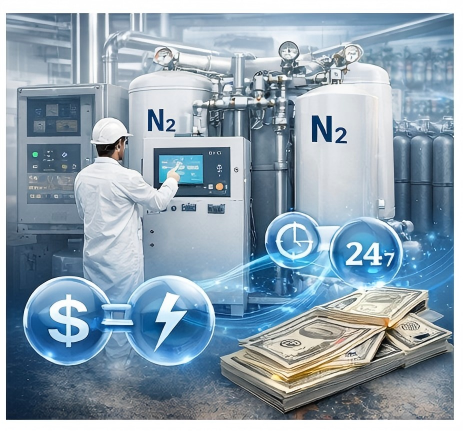
When a nitrogen generation system is correctly matched to its application, it can provide a more stable on-site nitrogen supply while reducing dependence on cylinder deliveries or bulk-gas logistics.
Proper selection can also improve nitrogen purity consistency, pressure stability, energy efficiency, production continuity, equipment utilization, maintenance planning, and long-term operating cost.
Most importantly, the generator becomes part of a properly engineered compressed-air and gas-treatment system rather than being treated as a standalone piece of equipment.
Conclusion
Understanding nitrogen generator specifications is essential when choosing an on-site nitrogen system that delivers the required balance of purity, flow, pressure, dew point, efficiency, and operating reliability.
A nitrogen generator should not be selected according to purity or nominal capacity alone. The complete operating condition—including compressed-air availability, air quality, peak nitrogen demand, point-of-use pressure, controls, installation environment, and long-term energy consumption—should be evaluated together.
For many industrial users, PSA nitrogen generation provides a configurable on-site solution because purity and capacity can be matched to different production requirements.
Lingyu PSA configurations cover approximately 95%–99.999% nitrogen purity, including 99%, 99.5%, 99.9%, and 99.99% requirements. Key operating parameters in the source also include approximately 0.5–0.8 MPa inlet-air pressure and nitrogen dew-point performance reaching approximately −40°C or lower under applicable operating conditions.
Explore Lingyu’s nitrogen generator range or contact Lingyu with your required nitrogen purity, flow rate, pressure, compressed-air conditions, and operating requirements for system selection support.