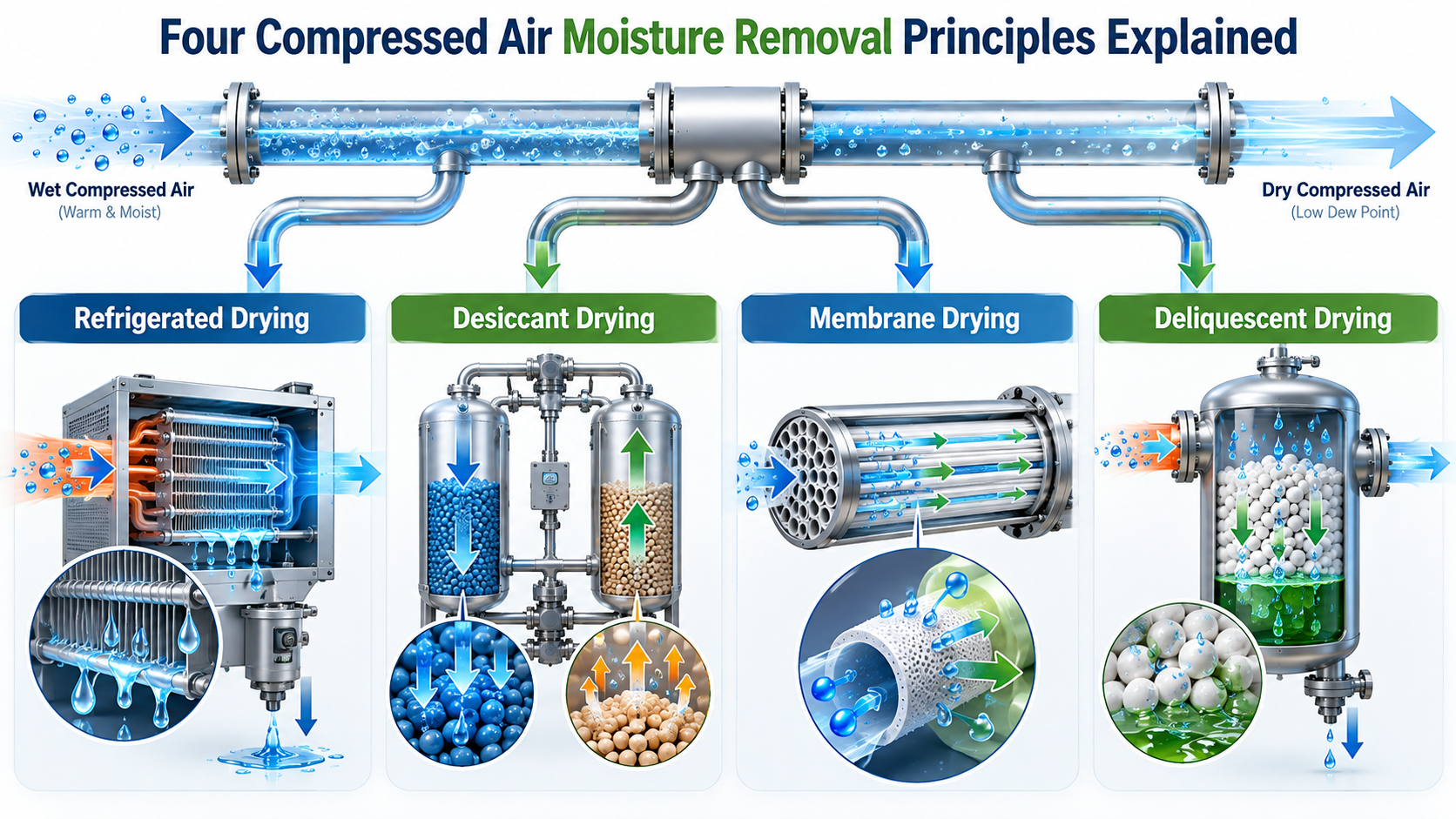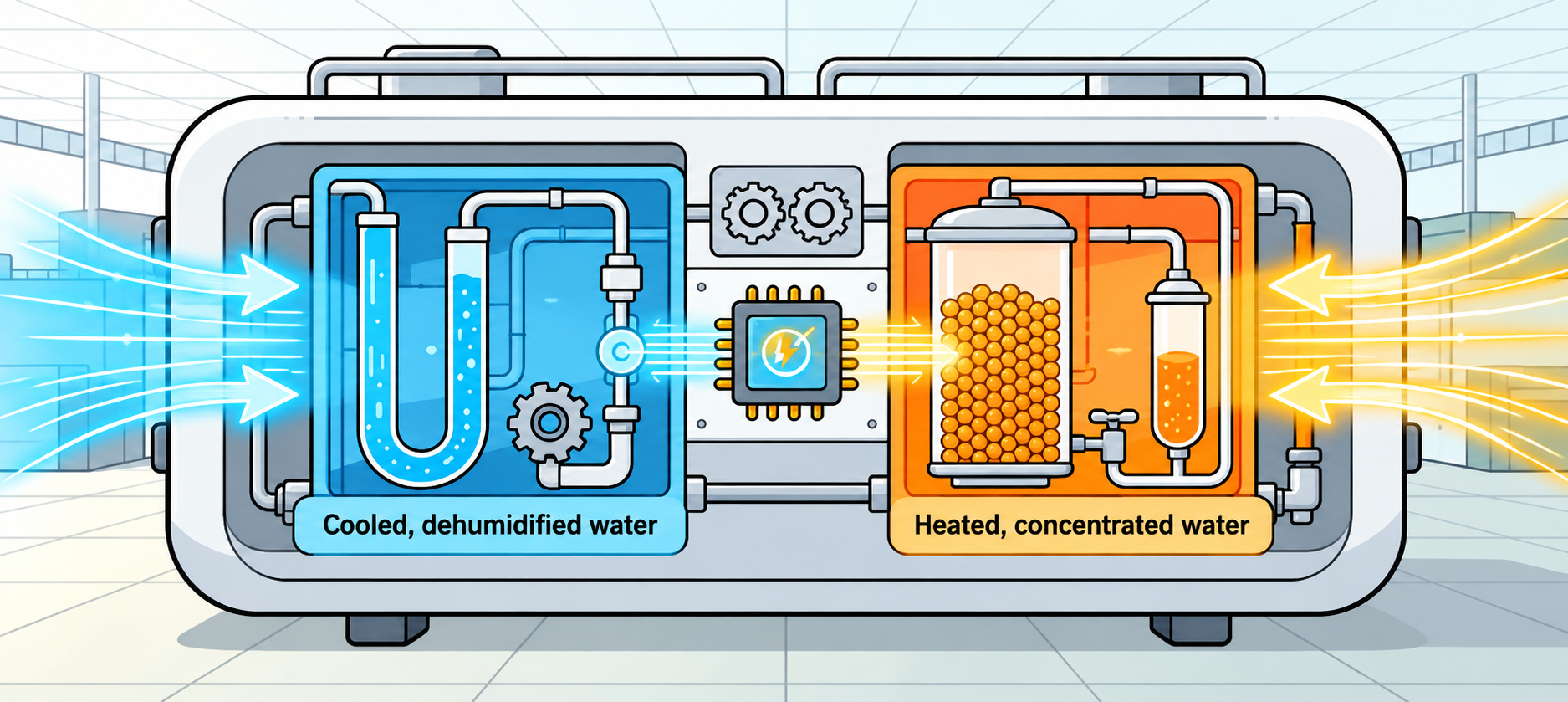
A non-cycling refrigerated air dryer uses a continuously operating refrigeration system to cool compressed air, condense water vapor, separate the resulting liquid, and deliver air at a controlled pressure dew point. Unlike cycling or variable-capacity designs, the refrigeration compressor does not normally shut down simply because compressed-air demand falls.
This operating principle makes non-cycling technology relatively straightforward and particularly suitable for compressed-air systems with stable or consistently high demand. However, continuous refrigeration also means that part-load energy consumption deserves careful consideration when comparing dryer technologies.
What Is a Non-Cycling Refrigerated Air Dryer?
A non-cycling refrigerated air dryer is a type of refrigerated air dryer in which the refrigeration circuit remains continuously available during operation rather than repeatedly stopping and starting according to compressed-air demand.
Its purpose is to lower the compressed air temperature sufficiently for water vapor to condense.
The liquid water is then separated and automatically discharged.
The dryer does not make compressed air completely moisture-free. Instead, it reduces water vapor to a specified pressure dew point (PDP) appropriate for the system.
For many conventional industrial refrigerated dryers, this means a PDP several degrees above freezing rather than the much lower values associated with adsorption drying.
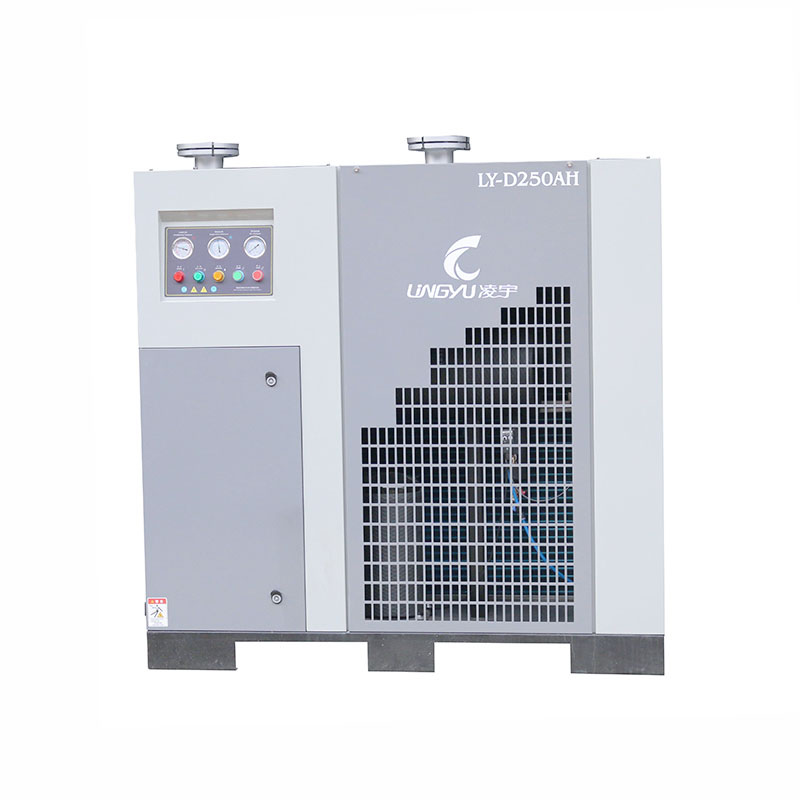
How a Non-Cycling Refrigerated Air Dryer Works
The basic process is:
hot wet compressed air → pre-cooling → refrigeration cooling → moisture condensation → separation → automatic drainage → reheating
1. Warm Compressed Air Enters the Dryer
Compressed air entering the dryer contains water vapor and may also contain condensed moisture, particles, and oil contamination.
An effective aftercooler, moisture separator, receiver, and suitable filtration upstream can reduce the load entering the dryer.
2. The Air Is Pre-Cooled
Incoming compressed air typically exchanges heat with the colder dried air leaving the refrigeration section.
This lowers the temperature of the incoming air before it reaches the evaporator and reduces the refrigeration load.
3. Refrigeration Cools the Air
The evaporator further reduces compressed-air temperature.
As the air cools, it reaches conditions where part of the water vapor condenses into liquid droplets.
This is the fundamental moisture-removal mechanism of a refrigerated dryer.
4. Condensed Water Is Separated
The liquid condensate is removed from the compressed-air stream by a gas-liquid separator.
An automatic drain then discharges the collected condensate.
Effective separation and drainage are essential because cooling alone is not sufficient if condensed water remains entrained in the airflow.
5. The Dry Air Is Reheated
The cooled compressed air is reheated before leaving the dryer.
This improves downstream operating conditions and helps reduce external condensation on compressed-air piping.
Pressure Dew Point of a Refrigerated Air Dryer
Pressure dew point is more useful than simply describing the air as “dry.”
Lingyu’s conventional AH air-cooled and WH water-cooled refrigerated dryer technology specifies a 2–10°C PDP under the stated operating conditions.
Typical parameters include:
| Parameter | Specification |
|---|---|
| Rated inlet pressure | 0.7 MPa |
| Operating pressure | 0.6–1.0 MPa |
| Rated inlet temperature | 50°C |
| Maximum inlet temperature | ≤80°C |
| Pressure dew point | 2–10°C |
| Rated ambient temperature | 32°C |
| Ambient operating range | 2–45°C |
| Pressure drop | ≤0.025 MPa |
This PDP range can be appropriate for many indoor industrial systems where downstream air lines remain above the delivered pressure dew point.
A fixed value such as 3°C should not automatically be assumed for every non-cycling refrigerated dryer or every operating condition.
What Does “Non-Cycling” Actually Mean?
The term can be confusing because it does not mean that every component runs continuously at exactly the same output under every condition.
It primarily describes the refrigeration operating strategy.
In a conventional non-cycling design, the refrigeration compressor remains in operation rather than switching off whenever compressed-air demand falls.
The dryer may still use controls, bypass mechanisms, fans, valves, or other components to maintain appropriate refrigeration conditions.
Therefore, “non-cycling” should not be interpreted as “no controls” or “no regulation.”
Non-Cycling vs. Cycling Refrigerated Air Dryers
The main difference is how refrigeration capacity responds when compressed-air demand changes.
| Factor | Non-Cycling Dryer | Cycling Dryer |
|---|---|---|
| Refrigeration operation | Generally continuous | Adjusted or interrupted according to demand |
| Best load profile | Relatively steady demand | Substantial load variation |
| Control complexity | Typically simpler | Generally more involved |
| Part-load energy use | Can remain relatively high | Can decrease with reduced demand |
| Moisture-removal principle | Cooling and condensation | Cooling and condensation |
| Main selection consideration | Simplicity and stable-load operation | Part-load energy performance |
Both technologies use refrigeration to remove water vapor. The distinction is mainly how refrigeration capacity is managed.
Non-Cycling vs. Variable-Frequency Refrigerated Dryers
A variable-frequency dryer represents another approach to changing demand.
Instead of operating the refrigeration compressor at essentially fixed speed, a variable-frequency design can adjust compressor speed according to refrigeration load.
Lingyu’s frequency-conversion refrigerated air dryer uses variable-frequency compressor control to match refrigeration output more closely to load.
This can be advantageous when plant demand fluctuates significantly during the day.
For a plant with nearly constant compressed-air consumption, however, the potential part-load benefit may be much smaller.
The comparison should therefore be based on the actual annual load profile, not simply the presence of a variable-speed drive.
Advantages of a Non-Cycling Refrigerated Air Dryer
Straightforward Operating Principle
Continuous refrigeration avoids the need to repeatedly store and release cooling capacity or stop and restart the refrigeration system solely according to compressed-air demand.
This can simplify operation and troubleshooting.
Suitable for Stable Loads
Facilities operating close to a consistent compressed-air flow for long periods can be well suited to non-cycling technology.
Where demand does not vary greatly, there may be less opportunity for sophisticated part-load control to generate significant savings.
Predictable Refrigeration Availability
The refrigeration system remains available while the dryer is running.
This can provide consistent operating behavior when compressed-air load and environmental conditions are relatively stable.
Broad Industrial Applicability
Non-cycling refrigerated drying can support many ordinary industrial compressed-air applications where a low adsorption-dryer dew point is unnecessary.
Limitations of Non-Cycling Technology
Higher Part-Load Energy Consumption
The most important limitation appears when compressed-air demand falls substantially.
If the refrigeration compressor continues operating while the air-treatment load is low, electrical consumption may not decline proportionally with compressed-air flow.
A facility operating at 30% of peak demand for much of the day can therefore have a very different energy case from a continuously loaded production plant.
Not Intended for Very Low Dew Points
Conventional refrigerated dryers are designed for above-freezing pressure dew points.
If the compressed air must remain dry through freezing outdoor conditions or a process requires very low moisture levels, refrigeration may not be sufficient.
A desiccant air dryer should then be evaluated.
Performance Still Depends on Operating Conditions
Continuous compressor operation does not guarantee constant PDP regardless of load.
Excessive inlet temperature, high ambient temperature, inadequate cooling water, airflow above rated capacity, dirty heat exchangers, or refrigeration faults can still raise the outlet dew point.
When Is a Non-Cycling Refrigerated Air Dryer a Good Choice?
A non-cycling dryer is worth considering when:
compressed-air demand is relatively stable, the required PDP is within refrigerated-dryer capability, simplicity is valued, and part-load operation is limited.
Typical examples can include production lines operating continuously near a consistent flow, centralized plant-air systems with predictable demand, and processes where the dryer remains heavily loaded throughout most operating hours.
The specific application should still be evaluated using actual operating data.
When Might Another Dryer Design Be Better?
If compressed-air demand changes dramatically over shifts, weekends, or production cycles, variable-capacity refrigeration can deserve closer consideration.
If the required PDP is significantly below the capability of refrigerated technology, adsorption drying is more appropriate.
If suitable compressor heat is available and extremely dry air is required, other technologies such as heat-of-compression dryers may also be evaluated.
The dryer should match the moisture requirement and operating profile rather than being selected by technology name alone.
Air-Cooled Non-Cycling Refrigerated Dryers
Air-cooled refrigerated dryers use ambient air to reject heat from the refrigeration condenser.
Lingyu’s conventional AH design specifies:
- Rated ambient temperature: 32°C
- Ambient operating range: 2–45°C
- Indoor installation
- Level concrete floor
- Minimum clearance of approximately 1.5 m
An air-cooled refrigerated dryer requires adequate ventilation.
Hot compressor exhaust air should not be allowed to recirculate into the dryer condenser, and condenser surfaces should be kept sufficiently clean for effective heat rejection.
Water-Cooled Non-Cycling Refrigerated Dryers
A water-cooled refrigerated dryer rejects refrigeration heat through cooling water.
Lingyu’s conventional WH Series specifies:
- Cooling-water pressure: 0.2–0.4 MPa
- Rated cooling-water temperature: ≤32°C
- Cooling-water operating range: 2–38°C
A water-cooled refrigerated dryer can be useful where plant cooling water is available or where rejecting additional heat into the compressor room is undesirable.
Water flow, quality, fouling tendency, and heat-rejection capacity should be evaluated for the selected model.
Large-Flow Water-Cooled Refrigerated Dryers
For larger compressed-air stations, water cooling can become particularly relevant.
Lingyu offers high-capacity refrigerated dryer configurations such as the 3885 CFM water-cooled refrigerated air dryer for industrial compressed-air treatment.
Model selection should not be based on nominal flow alone.
Actual flow, operating pressure, inlet temperature, cooling-water conditions, required PDP, and applicable correction factors must all be considered.
How to Size a Non-Cycling Refrigerated Air Dryer
Determine Maximum Actual Airflow
The dryer should handle the maximum realistic compressed-air flow passing through it.
Do not size solely from average air consumption.
If several compressors can operate simultaneously into a common header, their combined output may need to be included.
Check Inlet Temperature
Higher inlet temperature increases both thermal and moisture load.
Lingyu’s conventional AH and WH refrigerated dryers are rated at a 50°C inlet temperature, with a specified maximum of ≤80°C.
Actual dryer capacity should be corrected when conditions differ from rated values.
Check Operating Pressure
The conventional rated inlet pressure is 0.7 MPa with a 0.6–1.0 MPa operating range.
Dryer capacity changes with pressure, so the actual operating pressure must be considered during selection.
Evaluate Ambient or Cooling-Water Conditions
Air-cooled dryer capacity is influenced by ambient temperature.
Water-cooled dryer capacity depends on cooling-water temperature, pressure, flow, and heat-transfer condition.
Define the Required PDP
Do not size a refrigerated dryer before verifying that refrigerated technology can achieve the process moisture requirement.
If the required PDP is far below freezing, changing dryer size will not convert refrigeration into adsorption drying.
Avoid Arbitrary Oversizing
Installing a dryer substantially larger than necessary does not automatically improve drying performance.
Sizing should use manufacturer correction factors for actual inlet temperature, operating pressure, ambient conditions, and flow.
Future expansion can be considered where it is realistically planned, but arbitrary oversizing can increase capital cost without delivering useful benefits.
Pressure Drop Matters
A dryer affects system energy consumption not only through its refrigeration compressor but also through pressure drop.
Lingyu’s conventional AH and WH designs specify pressure drop of ≤0.025 MPa under rated conditions.
If treatment equipment creates excessive pressure loss, the plant compressor may have to operate at higher discharge pressure to maintain the required point-of-use pressure.
For systems where low pressure loss is especially important, Lingyu’s 3-in-1 plate heat exchange refrigerated air dryer specifies pressure drop below 0.015 MPa.
Annual energy analysis should therefore consider both refrigeration electricity and compressed-air system pressure loss.
Filtration Before a Refrigerated Dryer
A refrigerated dryer primarily removes water vapor.
It does not replace filtration for particles and oil contamination.
Suitable compressed air filters can be installed upstream according to compressor type, contamination level, and final air-quality requirement.
Proper pre-filtration also helps protect heat exchangers, separators, and condensate systems from contamination.
The exact filter sequence should be determined by the process rather than automatically installing every filtration grade.
Maintenance of a Non-Cycling Refrigerated Air Dryer
Inspect Automatic Drains
The dryer depends on effective removal of condensed water.
A failed-closed drain can allow liquid to accumulate and eventually carry downstream.
A failed-open drain continuously wastes compressed air.
Keep Condensers Clean
For air-cooled dryers, dust and oil deposits on the condenser reduce heat rejection.
Inspection and cleaning frequency should reflect actual site conditions.
Check Heat Exchanger Performance
Internal contamination can reduce heat-transfer efficiency and contribute to higher outlet PDP or pressure drop.
Good upstream separation and filtration help limit contamination.
Monitor Pressure Dew Point
PDP monitoring provides direct information about drying performance.
Critical applications can benefit from continuous downstream dew-point sensing, while less sensitive systems may use periodic measurement.
Verify Actual Operating Conditions
When dryer performance changes, check:
airflow → inlet temperature → pressure → ambient/cooling water → condenser condition → drains → refrigeration system
before assuming the dryer itself is incorrectly sized.
Do Not Routinely “Top Up” Refrigerant
A sealed refrigeration system does not normally consume refrigerant during operation.
Low refrigerant charge generally indicates a leak or other refrigeration-system problem requiring diagnosis and repair.
Refrigerant addition should not be treated as routine preventive maintenance.
Common Problems and Troubleshooting
| Problem | Possible Cause |
|---|---|
| High outlet PDP | Excessive flow, high inlet temperature, refrigeration fault |
| PDP rises on hot days | Poor ventilation or high condenser temperature |
| Water downstream | Failed drain, moisture carryover, downstream cooling below PDP |
| High refrigeration pressure | Dirty condenser or inadequate cooling |
| Excessive system pressure drop | Fouled exchanger, filters, undersized piping or excessive flow |
| Dryer performs normally at low flow but poorly at peak flow | Insufficient corrected capacity |
| High electricity use at low production demand | Continuous refrigeration at part load |
Troubleshooting should use actual measurements rather than replacing components based on symptoms alone.
Applications for Non-Cycling Refrigerated Dryers
General Manufacturing
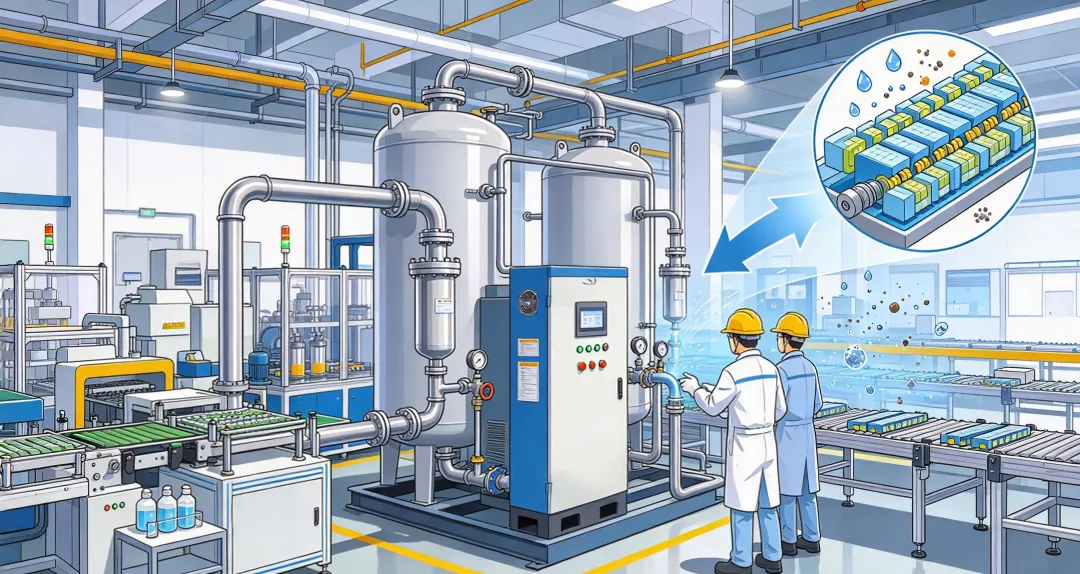
Manufacturing plants commonly use compressed air for pneumatic cylinders, tools, controls, packaging, and assembly equipment.
Where demand is relatively steady and the required PDP falls within refrigerated-dryer capability, non-cycling technology can be practical.
Automotive Production
In automotive and general manufacturing, moisture control helps protect pneumatic equipment and can support coating-related air treatment.
Painting applications also require appropriate oil and particle control, so a refrigerated dryer alone does not guarantee suitable paint air.
Wood and Paper Processing
In wood and paper applications, compressed air can support machinery, conveying, actuators, and production equipment.
Dryer selection should reflect plant demand, environmental conditions, and the actual moisture sensitivity of individual processes.
Electronics Manufacturing
For electronics and precision manufacturing, general pneumatic operations and moisture-sensitive production processes may have very different PDP requirements.
Where extremely low PDP is needed, adsorption technology may be more appropriate than conventional refrigeration.
Is a Non-Cycling Refrigerated Dryer Suitable for Food or Pharmaceutical Production?
Potentially—but the dryer technology alone does not determine whether compressed air meets a food or pharmaceutical process specification.
A refrigerated dryer controls moisture to its specified PDP.
It does not by itself guarantee control of particles, oil vapor, microbiological contamination, or sterility.
Applications with direct or indirect product contact require a complete air-treatment and quality-management strategy.
Frequently Asked Questions
What is the main difference between non-cycling and cycling refrigerated dryers?
A non-cycling design generally keeps its refrigeration compressor operating while the dryer is in service.
A cycling design adjusts refrigeration operation according to load or stored cooling capacity to reduce energy consumption during lower demand.
Does a non-cycling refrigerated air dryer waste energy?
Not inherently, but continuous refrigeration can make it less energy-efficient at very low loads than technologies capable of reducing refrigeration output.
The significance depends on the plant’s actual load profile.
Is a non-cycling dryer better for continuous production?
It can be a good fit when compressed-air demand remains consistently high and the required PDP is within refrigerated-dryer capability.
Actual sizing and operating economics should still be evaluated.
Can a refrigerated dryer operate with high inlet temperature?
Only within the selected dryer’s specified limits.
Lingyu’s conventional AH and WH high-inlet-temperature designs specify 50°C rated inlet temperature and ≤80°C maximum inlet temperature.
Can a non-cycling refrigerated dryer achieve −40°C PDP?
Conventional refrigerated drying is not designed for that requirement.
A low-PDP adsorption dryer should generally be evaluated instead.
Does continuous compressor operation guarantee constant dew point?
No.
Dew point can still change with airflow, inlet temperature, pressure, ambient or cooling-water conditions, heat-exchanger condition, and refrigeration performance.
How long does a non-cycling refrigerated dryer last?
There is no reliable universal service-life figure.
Operating hours, environment, refrigeration condition, maintenance quality, airflow, temperature, and component design all affect equipment life.
How often should it be serviced?
Maintenance should be based on the manufacturer’s requirements and actual equipment condition rather than an arbitrary universal interval.
Important indicators include PDP, filter differential pressure, drain operation, condenser cleanliness, refrigeration conditions, and heat-exchanger performance.
Choosing a Non-Cycling Refrigerated Air Dryer
A non-cycling refrigerated air dryer is most useful when the application requires conventional refrigerated drying and compressed-air demand remains relatively stable.
Its main attraction is a straightforward refrigeration strategy that can work well in continuously loaded industrial systems.
The decision should nevertheless consider more than initial equipment cost.
Compare:
required PDP → peak airflow → inlet temperature → operating pressure → load profile → cooling method → pressure drop → annual refrigeration energy → maintenance requirements
If the system spends long periods at low demand, variable-capacity technology may provide a better lifecycle energy profile. If the required PDP is significantly below freezing, adsorption drying should be considered instead.
For application-specific selection, contact Lingyu with your maximum airflow, operating pressure, inlet temperature, ambient or cooling-water conditions, required pressure dew point, and daily load profile.