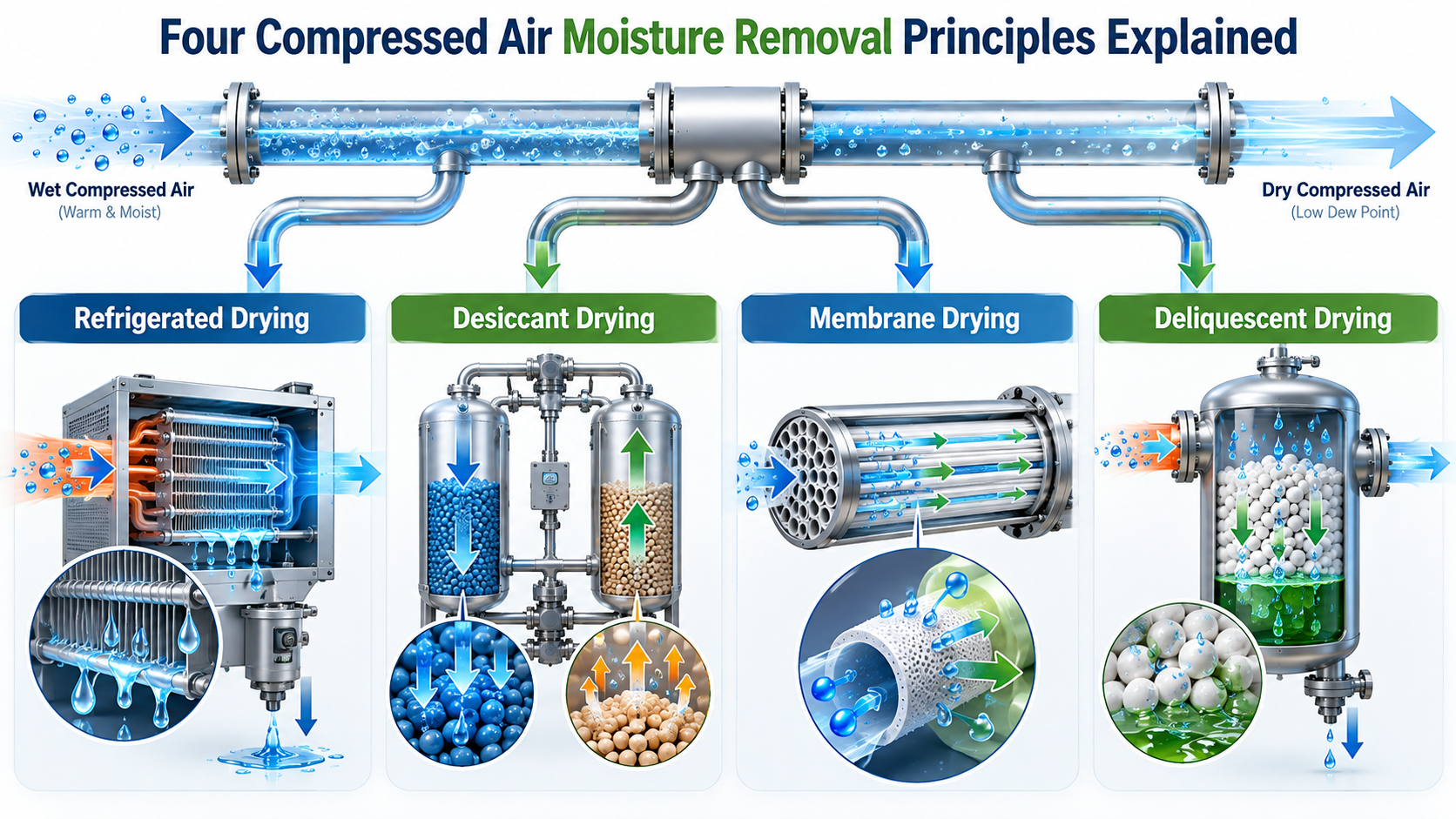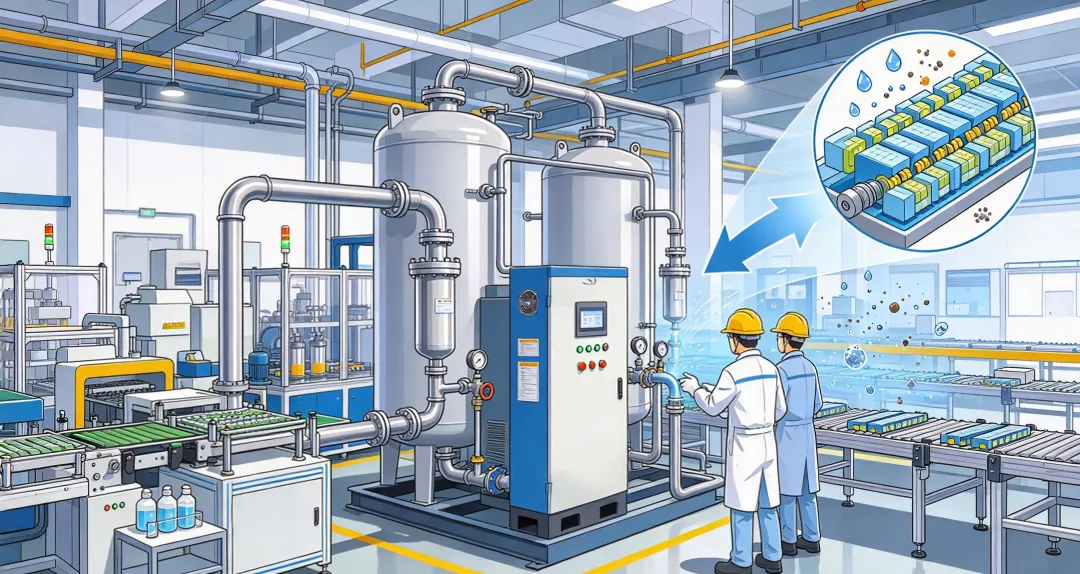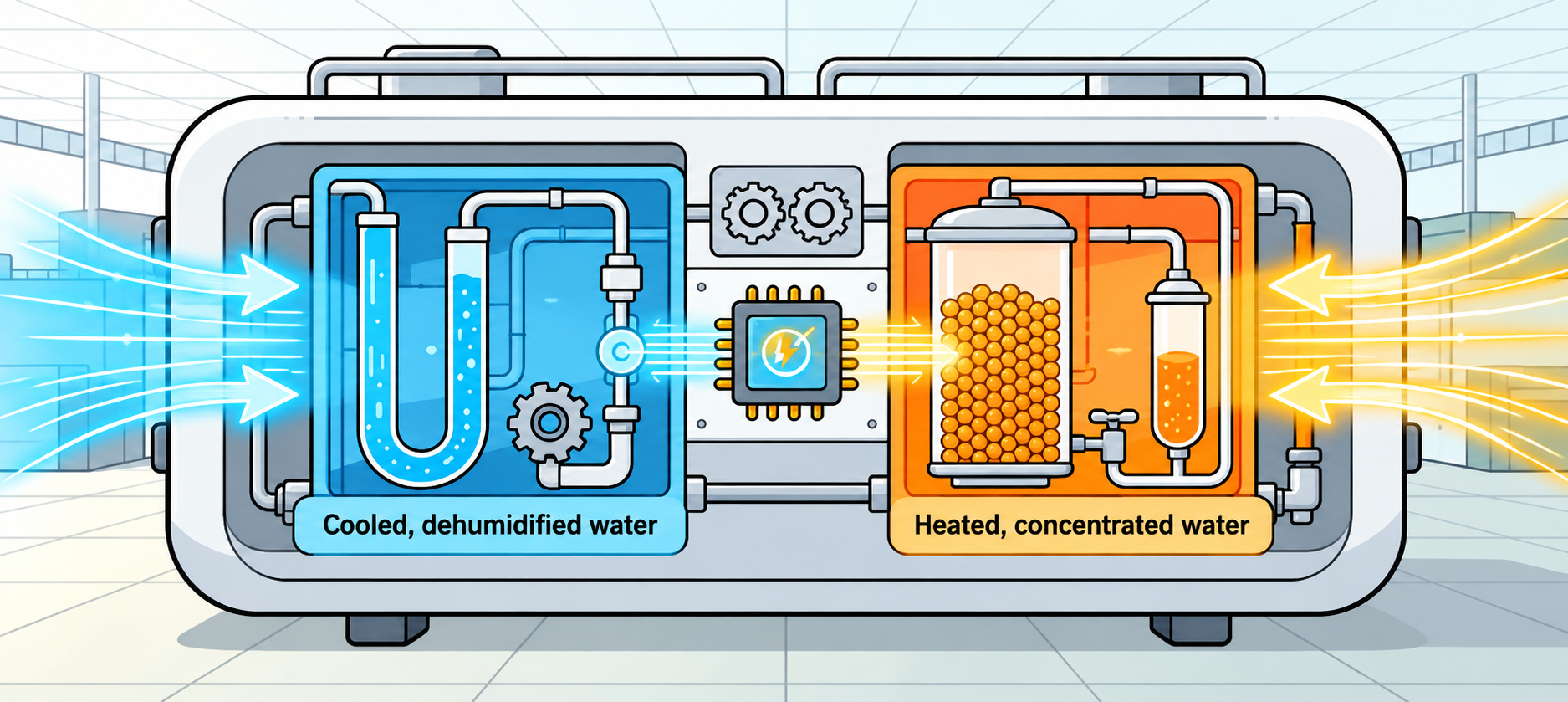
In any compressed air system, moisture control is important for protecting piping, pneumatic components, instruments, and production processes. As compressed air cools after compression, water vapor can condense into liquid, creating conditions that contribute to corrosion, equipment problems, contamination, and unplanned downtime.
A refrigerated air dryer controls this moisture by cooling compressed air, condensing water vapor, separating the resulting liquid, and automatically draining it from the system.
For general industrial applications where an ultra-low pressure dew point is not required, refrigerated drying can provide a practical balance between moisture control, system simplicity, and operating cost.
Lingyu offers a range of refrigerated air dryers for different airflow capacities and cooling requirements.
What Is a Refrigerated Air Dryer?
A refrigerated air dryer is a compressed air treatment device that removes moisture through cooling and condensation.
Compressed air entering the dryer contains water vapor. When the air is cooled sufficiently, part of that vapor condenses into liquid water.
The dryer then separates and drains the condensate before reheating the dried compressed air for delivery downstream.
This differs from filtration.
A filter can remove particles, liquid droplets, and oil aerosols according to its filtration grade, but it does not perform the same function as a refrigerated dryer in reducing water vapor.
For this reason, drying and filtration are normally considered complementary parts of a complete compressed air treatment system.
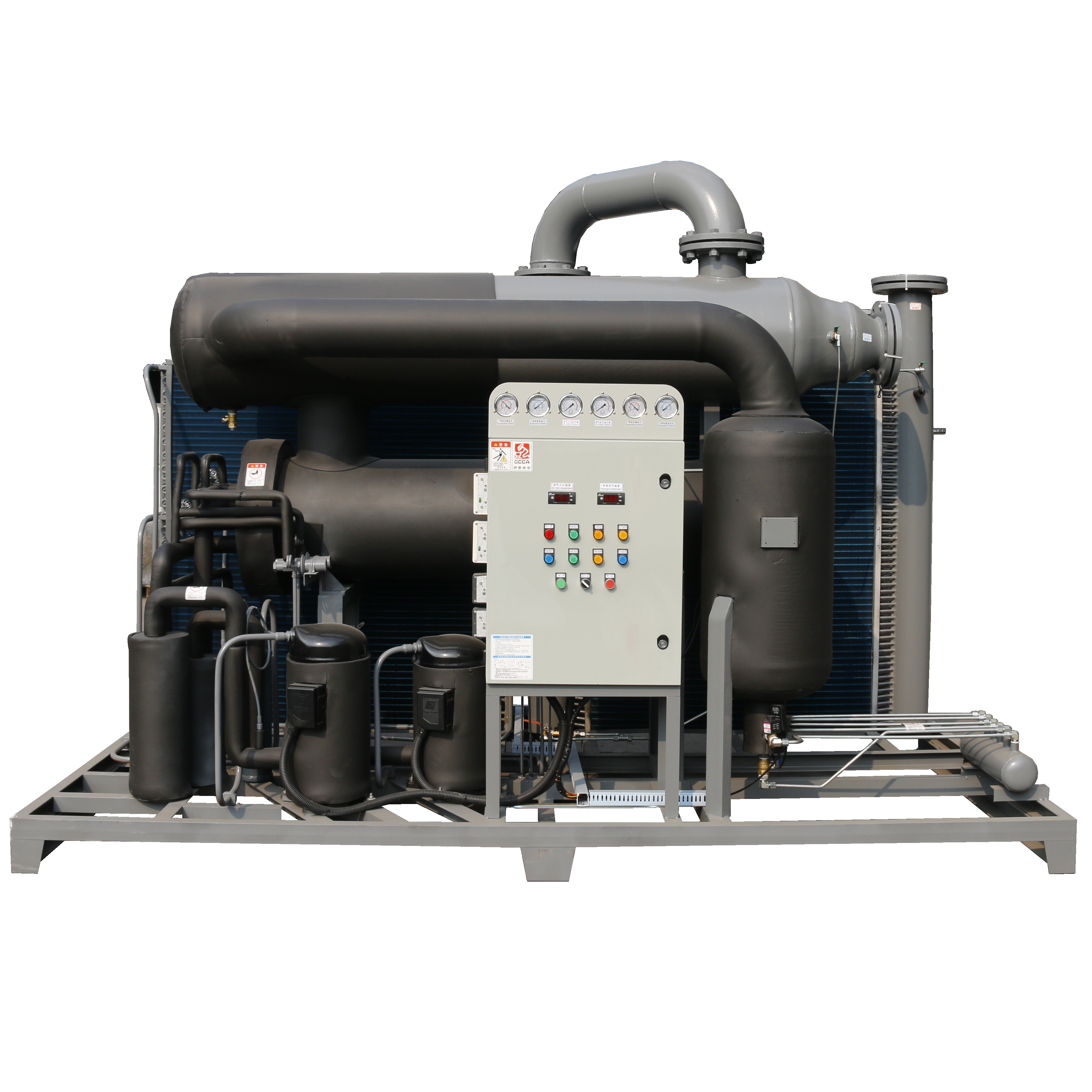
How Does a Refrigerated Air Dryer Work?
Lingyu’s conventional AH air-cooled and WH water-cooled high-inlet-temperature dryers use a multi-stage heat-exchange and separation process.
1. Hot, Moist Compressed Air Enters
Compressed air from the upstream system enters the dryer carrying water vapor and potentially oil and other contaminants.
In high-inlet-temperature designs, the air first passes through a pre-cooling stage and air-to-air heat exchanger.
2. The Compressed Air Is Cooled
The pre-cooled air enters the evaporator, where the refrigeration circuit reduces its temperature further.
As the air temperature falls, water vapor condenses into liquid droplets.
3. Condensate Is Separated
The cooled air passes through a gas-liquid separator.
Condensed moisture, oil, and some impurities are separated from the compressed air stream.
4. Condensate Is Automatically Drained
The separated liquid collects at the drainage point and is discharged through an automatic drain.
Reliable drainage is essential. A blocked or malfunctioning drain can allow accumulated condensate to carry downstream even when the refrigeration circuit is functioning correctly.
5. The Dry Air Is Reheated
Before leaving the dryer, the cold compressed air exchanges heat with the warmer incoming air.
The dried air therefore exits at a temperature closer to ambient conditions.
The overall process can be summarized as:
hot wet compressed air → pre-cooling → refrigeration cooling → condensation → gas-liquid separation → automatic drainage → reheating → dry compressed air
What Pressure Dew Point Does a Refrigerated Air Dryer Provide?
Pressure dew point (PDP) indicates the temperature at which water vapor in compressed air would begin to condense at operating pressure.
For Lingyu’s conventional AH and WH refrigerated dryer technologies, the specified PDP is 2–10°C under rated conditions.
This range is suitable for many general industrial compressed air applications.
It is more accurate to use the specified 2–10°C range than to assume every refrigerated dryer will always produce a fixed 2–4°C dew point.
Actual performance depends on dryer design and operating conditions.
Typical Operating Conditions
For Lingyu’s conventional AH and WH high-inlet-temperature refrigerated dryers, standard conditions include:
| Parameter | Specification |
|---|---|
| Rated inlet pressure | 0.7 MPa |
| Operating pressure range | 0.6–1.0 MPa |
| Rated inlet temperature | 50°C |
| Maximum inlet temperature | ≤80°C |
| Pressure dew point | 2–10°C |
| Rated ambient temperature | 32°C |
| Ambient operating range | 2–45°C |
| Pressure drop | ≤0.025 MPa |
| Installation | Indoor, level concrete floor |
Operating conditions are important because a dryer’s nominal airflow capacity should not be considered independently of pressure and temperature.
Air-Cooled Refrigerated Air Dryers
Air-cooled dryers reject refrigeration heat through an air-cooled condenser.
They can simplify installation because a separate cooling-water circuit is unnecessary.
However, condenser performance depends strongly on the surrounding environment.
Adequate ventilation should be provided, and hot condenser exhaust should not be allowed to recirculate into the dryer.
Lingyu’s AH Series installation guidance calls for approximately 1.5 m of clearance around the unit, helping provide sufficient airflow and maintenance access.
Air-cooled designs are particularly practical where:
- Cooling water is unavailable
- Ambient ventilation is adequate
- Installation simplicity is important
- The required airflow is within the selected model’s capacity
Users comparing these configurations can review the air-cooled refrigerated dryer category.
Water-Cooled Refrigerated Air Dryers
Water-cooled dryers transfer refrigeration heat to a cooling-water circuit.
This configuration can be appropriate for high-capacity installations and facilities that already have suitable cooling-water infrastructure.
For Lingyu’s WH Series, cooling-water conditions include:
- Cooling-water pressure: 0.2–0.4 MPa
- Rated cooling-water temperature: ≤32°C
- Operating water-temperature range: 2–38°C
The actual cooling-water flow and connection requirements depend on the selected model and should be confirmed during equipment selection.
Lingyu’s water-cooled refrigerated dryer category includes equipment for higher-flow compressed air installations.
Large-Capacity Water-Cooled Drying
High-flow compressed air systems require careful evaluation of both air-side and cooling-water conditions.
For example, Lingyu offers dedicated water-cooled models including the 3885 CFM refrigerated air dryer for large industrial compressed air systems.
For still higher airflow requirements, the 4238 CFM water-cooled high-temperature refrigerated air dryer provides another capacity option.
Large installations should not be selected on CFM alone. Cooling-water conditions, inlet temperature, pressure, actual peak flow, pressure drop, installation environment, and required PDP should all be evaluated.
Why Inlet Temperature Matters
Hotter compressed air increases both thermal and moisture load on a refrigerated dryer.
Lingyu’s conventional AH and WH Series are designed around a 50°C rated inlet temperature, with a maximum inlet temperature of ≤80°C.
Operating near the maximum allowable temperature is not necessarily the most efficient operating condition.
An effective compressor aftercooler and upstream condensate separator can remove a substantial amount of heat and liquid water before the air reaches the dryer.
Reducing unnecessary upstream thermal load helps the complete treatment system operate more effectively.
Benefits of Refrigerated Air Drying
Moisture Control
The primary benefit is reducing water vapor so that downstream condensation can be controlled under the intended operating conditions.
Equipment Protection
Reducing condensate can help protect piping, pneumatic valves, cylinders, tools, and other equipment from moisture-related corrosion and operating problems.
Stable Production
Processes that depend on compressed air can be disrupted by liquid water.
Maintaining an appropriate pressure dew point supports more consistent compressed air conditions.
Relatively Simple Operation
Compared with adsorption systems requiring periodic desiccant regeneration, conventional refrigerated dryers have a comparatively straightforward drying process.
However, this does not mean they are maintenance-free.
No Desiccant Regeneration Purge
Refrigerated dryers do not consume compressed air for desiccant regeneration.
Their energy requirements instead come primarily from the refrigeration system and associated components, while pressure drop also contributes indirectly to total compressed air system energy use.
Pressure Drop and Energy Cost
A refrigerated dryer should not automatically be described as saving compressor energy simply because it removes moisture.
The relationship is more complex.
One important efficiency factor is pressure drop.
Every filter, separator, dryer, valve, fitting, and pipe contributes some resistance to airflow.
If total pressure loss becomes excessive, compressor discharge pressure may need to be increased to maintain sufficient pressure at the point of use.
Lingyu’s conventional AH and WH refrigerated dryers specify pressure drop of ≤0.025 MPa under rated conditions.
When comparing equipment, consider both dryer power consumption and its effect on total system pressure.
Energy-Saving Refrigerated Dryer Designs
For applications where energy performance is a priority, dedicated designs can provide additional options.
Lingyu’s frequency-conversion refrigerated air dryer adjusts refrigeration compressor speed according to operating load.
This approach is particularly relevant where compressed air demand varies substantially rather than remaining near a constant load.
Variable-frequency technology should be evaluated according to the actual load profile because potential savings depend on how the dryer operates over time.
Refrigerated Air Dryer vs. Desiccant Air Dryer
A refrigerated dryer is not the correct choice for every application.
| Factor | Refrigerated Dryer | Desiccant Dryer |
|---|---|---|
| Moisture-removal principle | Cooling and condensation | Adsorption |
| Typical Lingyu PDP | 2–10°C | Much lower PDP available depending on series |
| Regeneration required | No | Yes |
| General industrial air | Often suitable | May be unnecessary |
| Below-freezing applications | Often insufficient | More appropriate when correctly specified |
| Purge-air consumption | No desiccant purge | Depends on regeneration method |
| System complexity | Generally lower | Generally higher |
If the compressed air piping will encounter temperatures below the refrigerated dryer’s delivered PDP, or the process itself requires much drier air, a desiccant air dryer may be more appropriate.
The goal is to select the required dew point—not simply the lowest achievable dew point.
How to Select a Refrigerated Air Dryer
Determine Maximum Airflow
Select according to the maximum compressed air flow expected through the dryer rather than average consumption alone.
Peak demand, simultaneous compressor operation, production changes, and realistic future capacity should be considered.
Check Operating Pressure
For Lingyu’s conventional AH and WH dryers, the rated inlet pressure is 0.7 MPa, with a standard operating range of 0.6–1.0 MPa.
Other pressure requirements should be confirmed for the specific equipment.
Check Inlet Temperature
Do not assume that every dryer rated for a certain CFM can handle the same inlet temperature.
Higher inlet temperature increases dryer load.
Check Ambient Conditions
Air-cooled dryers require effective ventilation and appropriate ambient conditions.
The conventional AH Series has a rated ambient temperature of 32°C and an operating range of 2–45°C.
Apply Capacity Correction Factors
Nominal airflow is based on specified rating conditions.
If actual pressure, inlet temperature, ambient temperature, or cooling-water conditions differ, effective dryer capacity can change.
Corrected capacity should therefore be calculated before final model selection.
Determine the Required Pressure Dew Point
A 2–10°C PDP is suitable for many indoor industrial applications.
If the process requires substantially lower moisture content, refrigerated drying alone may not meet the requirement.
Filtration Is Still Important
A refrigerated dryer addresses moisture, but compressed air may also contain oil and particles.
Appropriate precision compressed air filters can be selected according to compressor type and required downstream air quality.
Upstream filtration may protect the dryer from contamination, while downstream filtration can provide additional oil or particle control where required.
The correct treatment train depends on the final air specification.
Industrial Applications
Manufacturing and Automation
Refrigerated dryers are widely applicable to pneumatic machinery, cylinders, tools, valves, and automated production equipment where general industrial moisture control is required.
Automotive Manufacturing
In automotive and general manufacturing, compressed air supports assembly, pneumatic equipment, automation, and other production operations.
Painting and finishing processes may require additional filtration, so dryer selection should be coordinated with the final air-quality requirement.
Food and Beverage
In food and beverage production, compressed air may be used for pneumatic equipment, packaging, conveying, and process operations.
A refrigerated dryer controls moisture but does not by itself guarantee that compressed air meets hygiene requirements for every food-contact application. Particle, oil, and other relevant contamination requirements must also be considered.
Electronics and Precision Manufacturing
In electronics and precision manufacturing, moisture can affect pneumatic equipment and sensitive processes.
Where an application requires a substantially lower PDP than refrigerated drying can provide, adsorption drying should be considered.
Pharmaceutical Manufacturing
Compressed air can support packaging, pneumatic equipment, instrumentation, and process operations in pharmaceutical facilities.
The required drying and filtration system should be determined from the specific process and validated air-quality requirements. A refrigerated dryer alone should not be assumed to produce sterile compressed air.
Refrigerated Air Dryer Maintenance
Refrigerated dryers require regular inspection, but there is no universal maintenance interval suitable for every installation.
Maintenance frequency should reflect actual operating hours, environmental contamination, load, and equipment condition.
Important inspection points include the condenser, automatic drain, heat exchangers, filters, refrigeration circuit, and electrical components.
Keep the Condenser Clean
Dust and debris can restrict airflow across an air-cooled condenser.
Poor heat transfer may contribute to higher refrigeration pressure, reduced cooling capacity, and protection trips.
Inspection frequency should be increased in dusty industrial environments.
Check the Automatic Drain
Confirm that condensate is discharged correctly and that the drain is neither blocked nor continuously leaking compressed air.
Monitor Filters
Filter condition should be assessed using actual contamination and differential pressure.
Replacing elements according to condition and manufacturer recommendations is preferable to assuming the same fixed interval for every installation.
Do Not Routinely Replace Refrigerant
A correctly sealed refrigeration circuit should not require refrigerant to be replaced simply because a calendar interval has elapsed.
If the refrigerant charge is low, the system should be inspected for leakage and repaired before restoring the correct charge.
Frequently Asked Questions
What is the typical pressure dew point of a refrigerated air dryer?
For Lingyu’s conventional AH and WH technologies, the specified pressure dew point is 2–10°C under rated conditions.
Can a refrigerated dryer handle high inlet temperatures?
It depends on the design.
Lingyu’s conventional AH and WH high-inlet-temperature dryers specify a rated inlet temperature of 50°C and a maximum of ≤80°C.
Can a refrigerated air dryer remove oil and particles?
Its primary purpose is moisture control.
Oil and particle removal should be addressed with appropriately selected filtration.
Is a refrigerated dryer suitable for outdoor piping in winter?
Not necessarily.
If the downstream piping temperature falls below the compressed air pressure dew point, condensation and freezing can occur.
A lower-dew-point adsorption dryer may be necessary.
Are refrigerated air dryers energy-efficient?
They can provide an economical drying solution when their PDP range matches the application.
Actual efficiency depends on refrigeration design, load profile, pressure drop, inlet temperature, ambient conditions, maintenance, and system configuration.
How often should a refrigerated dryer be serviced?
There is no single interval appropriate for every installation.
Follow the equipment’s maintenance requirements and adjust inspections according to condenser condition, drain performance, operating hours, filtration, refrigeration performance, and the installation environment.
Choosing the Right Refrigerated Air Dryer
A refrigerated air dryer can provide reliable and economical moisture control for many industrial compressed air systems when it is correctly matched to the application.
The most important selection factors are:
peak airflow + operating pressure + inlet temperature + ambient or cooling-water conditions + required pressure dew point + acceptable pressure drop
For general industrial applications, a refrigerated dryer may be the most practical choice when a 2–10°C PDP is sufficient. Where substantially lower dew points are required, adsorption technology should be evaluated instead.
For application-specific selection, contact Lingyu with your airflow, operating pressure, inlet temperature, ambient conditions, cooling method, and required pressure dew point.