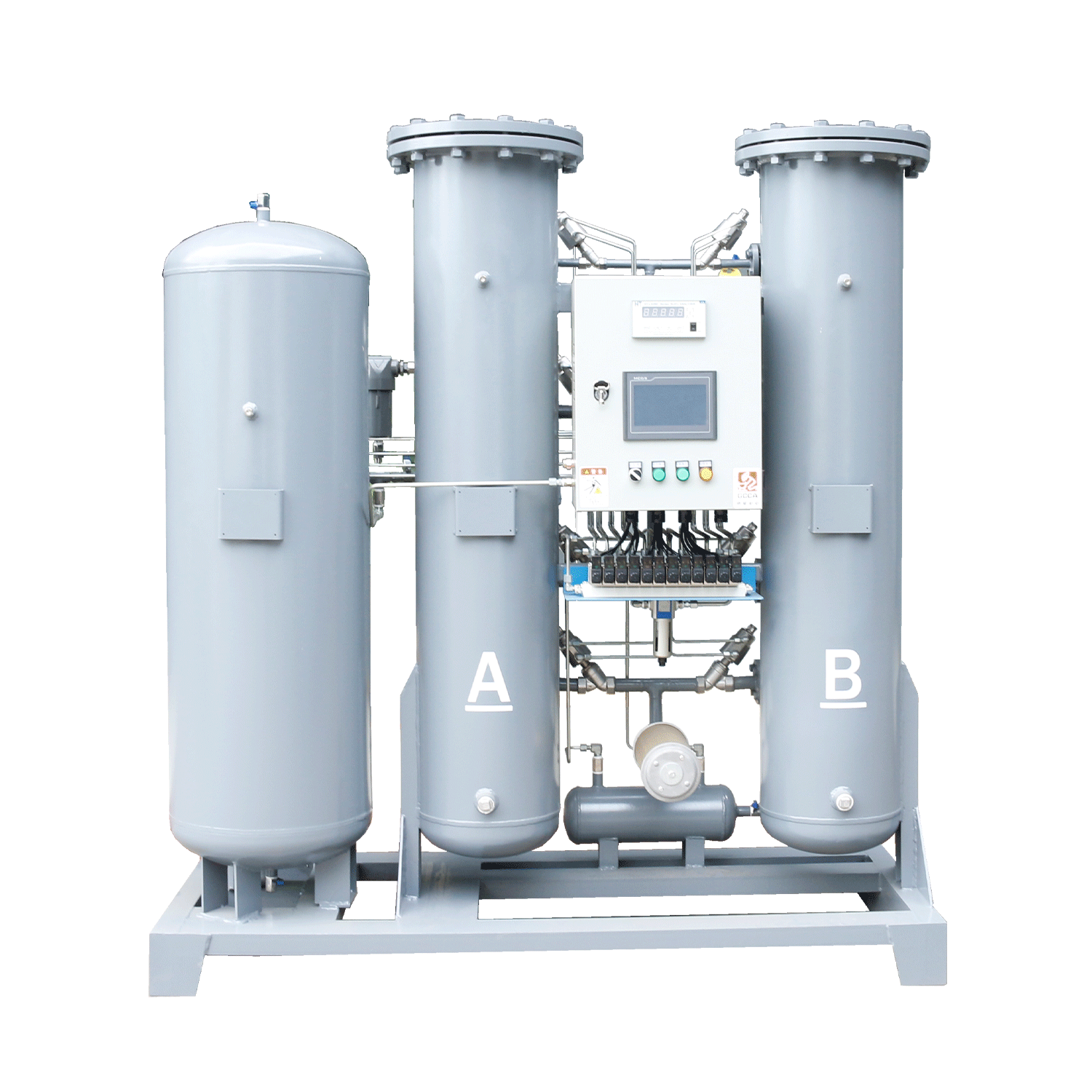
On-site PSA nitrogen generation allows industrial users to produce nitrogen directly from compressed air at a specified purity and flow rate.
For applications requiring 99.5% nitrogen purity, Lingyu’s LYZD-C configuration provides a dedicated capacity range with model-specific compressed-air consumption, pipe connections, and equipment dimensions.
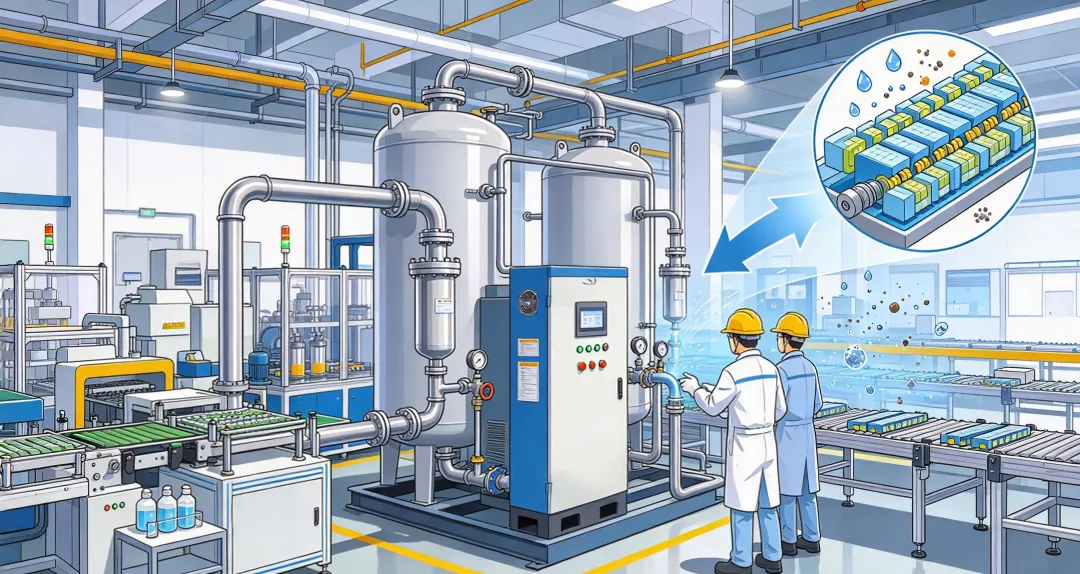
The PSA process uses two adsorption towers filled with Carbon Molecular Sieve (CMS). Oxygen is preferentially adsorbed while nitrogen passes through the adsorption bed as product gas. Automatic PLC-controlled switching between adsorption and regeneration maintains continuous nitrogen production.
Users evaluating other nitrogen purity grades can also review Lingyu’s nitrogen generator range.
How the PSA Nitrogen Generator Works
Pressure Swing Adsorption separates nitrogen from compressed air through alternating adsorption and regeneration cycles.
Adsorption
Compressed air enters one adsorption tower containing Carbon Molecular Sieve.
The CMS preferentially adsorbs oxygen molecules, while nitrogen passes through the adsorption bed and is collected as product gas.
Regeneration
At the same time, the second tower is depressurized and regenerated.
Oxygen previously retained by the CMS is released and discharged to atmosphere with assistance from a small quantity of nitrogen purge gas.
Automatic Tower Switching
When the active tower reaches its predetermined adsorption capacity, the control system automatically switches the functions of the two adsorption vessels.
The regenerated tower begins adsorption while the previously active tower enters regeneration.
This alternating cycle allows continuous nitrogen production without manually switching towers.
Why 99.5% Nitrogen Purity Requires Dedicated Sizing
The broader PSA nitrogen-generator range supports nitrogen purities from 95% to 99.999%, but nitrogen purity affects generator sizing and compressed-air demand.
A 99.5% nitrogen generator should therefore not be treated as the same configuration as a 99% or 99.99% system with only a different controller setting.
For a 99.5% application, model selection should be based on the dedicated LYZD-C capacity and effective air-consumption data.
Standard PSA Operating Conditions
The series-level operating requirements are:
| Parameter | Specification |
|---|---|
| Inlet air temperature | ≤40°C |
| Inlet air pressure | 0.5–0.8 MPa |
| Nitrogen purity range | 95%–99.999% |
| Nitrogen dew point | ≤−40°C |
| Ambient temperature | ≤40°C |
| Switching cycle | 45–60 s |
| Power supply | 220 V / 50 Hz |
| Noise level | ≤75 dB |
These conditions describe the broader PSA Series. The model-selection discussion in this article focuses specifically on the 99.5% LYZD-C configuration.
LYZD-C 99.5% Nitrogen Generator Technical Parameters
Representative LYZD-C specifications are shown below.
| Model | Nitrogen Production | Inlet Pipe | Outlet Pipe | Dimensions H × L × W | Effective Air Consumption |
|---|---|---|---|---|---|
| LYZD-C12 | 12 m³/h | DN15 | DN15 | 1500 × 850 × 500 mm | 0.60 m³/min |
| LYZD-C20 | 20 m³/h | DN20 | DN15 | 1800 × 900 × 600 mm | 1.00 m³/min |
| LYZD-C50 | 50 m³/h | DN25 | DN25 | 2456 × 1500 × 700 mm | 2.50 m³/min |
| LYZD-C100 | 100 m³/h | DN40 | DN40 | 2638 × 1750 × 765 mm | 5.00 m³/min |
| LYZD-C150 | 150 m³/h | DN50 | DN40 | 2750 × 1750 × 900 mm | 7.50 m³/min |
| LYZD-C250 | 250 m³/h | DN65 | DN50 | 2890 × 2200 × 1200 mm | 12.50 m³/min |
| LYZD-C400 | 400 m³/h | DN80 | DN65 | 2900 × 2500 × 1350 mm | 20.00 m³/min |
The LYZD-C range also includes intermediate models such as LYZD-C35, C60, C70, C90, C120, C130, C220, C290, C330, C370, and C440. The table above therefore presents representative models rather than the complete range.
In particular, the LYZD-C50 and LYZD-C100 dimensions are 2456 × 1500 × 700 mm and 2638 × 1750 × 765 mm, respectively.
Effective Air Consumption and Nitrogen Capacity
A PSA nitrogen generator depends directly on the upstream compressed-air system. Required nitrogen output therefore cannot be considered independently from available compressed-air capacity.
For representative LYZD-C models:
| Nitrogen Production | Effective Air Consumption |
|---|---|
| 12 m³/h | 0.60 m³/min |
| 50 m³/h | 2.50 m³/min |
| 150 m³/h | 7.50 m³/min |
| 250 m³/h | 12.50 m³/min |
| 400 m³/h | 20.00 m³/min |
As nitrogen-production capacity increases, the compressed-air requirement also increases.
The upstream compressor system must therefore provide sufficient flow at the required pressure while still meeting other plant compressed-air demands.
Design Conditions for Rated Performance
The LYZD-C performance data are based on the following design conditions:
Adsorption pressure: 0.8 MPa(g)
Ambient temperature: 20°C
Feed-air relative humidity: 80%
Actual site performance can vary with inlet pressure, temperature, humidity, compressed-air quality, and other operating conditions.
A nominal model should therefore be evaluated against the real operating environment rather than selected solely according to the required nitrogen flow.
PLC-Controlled Automatic Operation
The PSA nitrogen generator provides automatic start and stop as well as automatic switching between adsorption and regeneration cycles.
Pneumatic valves are controlled by the PLC to maintain accurate operating sequences.
45–60 Second Switching Cycle
The standard switching cycle is 45–60 seconds.
During operation, one adsorption tower produces nitrogen while the other regenerates. Automatic valve sequencing then reverses the tower functions at the required stage of the cycle.
This alternating operation supports continuous nitrogen production.
Real-Time Nitrogen Purity and Flow Monitoring
Nitrogen purity and flow rate are continuously monitored online in real time.
The digital touchscreen displays key operating parameters including:
- Pressure
- Nitrogen purity
- Nitrogen flow rate
- System operating status
For a 99.5% system, online monitoring gives operators direct visibility into whether the product gas continues to meet the required purity and flow conditions.
Off-Spec Nitrogen Protection
The PSA system includes an off-specification nitrogen alarm and protection function.
If nitrogen purity falls below the specified value, the control system activates an alarm.
If the off-spec condition continues for a preset period, the nitrogen generator automatically shuts down for protection.
This function is particularly important when downstream processes cannot accept nitrogen below the specified purity.
Automatic CMS Compaction and Adsorbent Stability
The nitrogen generator includes an automatic Carbon Molecular Sieve compaction device.
The system helps maintain proper CMS packing density and reduce pulverization caused by movement within the adsorption bed.
Stable packing is important to long-term adsorption performance. CMS condition should therefore be evaluated through actual purity performance, pressure behavior, operating history, and equipment inspection rather than according to a universal fixed replacement interval.
Pressure Equalization and Energy Efficiency
The PSA nitrogen generator uses an optimized unequal-pressure equalization process.
This process improves nitrogen recovery efficiency and can indirectly reduce overall energy consumption by approximately 5%.
The approximately 5% figure should not be treated as a guaranteed site-wide energy saving. Actual energy consumption depends on factors such as compressor efficiency, inlet pressure, nitrogen purity, required flow, and plant operating schedule.
Compressed-Air Pretreatment Protects the CMS
PSA performance depends on the quality of the compressed air entering the adsorption towers.
A complete nitrogen-generation system can incorporate compressed-air preparation equipment upstream of the PSA generator to reduce oil, particulate, liquid water, and other contaminants reaching the Carbon Molecular Sieve.
Where additional filtration is required, Lingyu’s precision compressed air filters can be integrated into the pretreatment train.
The appropriate filtration arrangement should be selected according to compressor type, compressed-air quality, and the nitrogen generator’s inlet requirements.
Nitrogen Dew Point Is Separate From Purity
The standard nitrogen dew point specification is:
≤−40°C
Nitrogen purity and nitrogen moisture content are separate gas-quality parameters.
A process may require 99.5% nitrogen while also specifying a particular dew point. System selection should therefore confirm both nitrogen purity and nitrogen dew point rather than evaluating purity alone.
Is 99.5% Nitrogen Suitable for Every Application?
Nitrogen is used across industries such as electronics, food processing, pharmaceuticals, laboratories, laser processing, beverages, oil and gas, but the required purity is process-specific.
A 99.5% PSA nitrogen generator should only be selected when the downstream process permits that purity level.
For example, different processes within an electronics facility can have different nitrogen requirements for inerting, storage, reflow, testing, or oxygen-sensitive manufacturing. The industry itself does not determine a universal nitrogen-purity requirement.
For broader industry context, users can review Lingyu’s electronics and precision manufacturing application.
Nitrogen Buffering and Delivery
PSA nitrogen-generation systems can be integrated with a downstream nitrogen buffer or receiver to balance generator production against changes in plant consumption.
The system design should consider nitrogen flow, demand fluctuations, required delivery pressure, buffer volume, pipeline pressure loss, and process operating patterns.
What the Buffer Tank Does
A nitrogen buffer does not increase nitrogen purity.
Its primary role is to help stabilize delivery and separate the cyclic behavior of PSA production from fluctuations in downstream nitrogen demand.
This can be particularly important where the process has intermittent or rapidly changing nitrogen consumption.
Scaling a PSA Nitrogen System
If future nitrogen demand is expected to increase, expansion requirements should be considered during the initial system design.
Scaling does not mean simply increasing the flow of an existing generator beyond its rated model capacity.
Depending on the required expansion, the system may need a larger PSA generator, additional generator trains, increased compressed-air capacity, larger pretreatment equipment, or greater nitrogen-buffer capacity.
The appropriate expansion strategy depends on both current and projected nitrogen demand.
99.5% PSA Nitrogen vs. Other Purity Configurations
The 99.5% LYZD-C configuration should remain technically distinct from 99%, 99.99%, and other nitrogen-purity configurations.
Although the broader PSA Series can cover purity levels from 95% to 99.999%, the relationship between nitrogen purity, production capacity, and effective compressed-air consumption means that model sizing should be based on the appropriate purity-specific configuration.
Users requiring a different purity level should therefore select the corresponding nitrogen-generator configuration instead of assuming that the LYZD-C ratings remain unchanged.
How to Select a 99.5% PSA Nitrogen Generator
Correct selection requires evaluating the complete nitrogen-generation system rather than nitrogen purity alone.
Required Nitrogen Purity
Confirm that 99.5% nitrogen meets the downstream process specification.
Where a higher or lower purity is required, use the corresponding configuration and capacity data.
Required Nitrogen Flow
Determine normal operating demand as well as peak and future nitrogen requirements.
Representative LYZD-C models shown here cover 12 to 400 m³/h, while the broader LYZD-C range includes additional intermediate capacities.
Available Compressed-Air Flow
Verify that the upstream compressor system can support the effective air consumption of the selected generator.
For example, the representative models range from 0.60 m³/min at 12 m³/h nitrogen production to 20.00 m³/min at 400 m³/h.
The broader LYZD-C table extends to 440 m³/h with 22.00 m³/min effective compressed-air consumption.
Inlet-Air Pressure
The standard inlet-air pressure range is 0.5–0.8 MPa.
The model performance data are based on an adsorption pressure of 0.8 MPa(g).
Inlet and Ambient Temperature
The standard inlet-air temperature and ambient temperature are both ≤40°C.
Actual site conditions should be considered during final model selection.
Nitrogen Dew Point
The standard nitrogen dew point is ≤−40°C.
Confirm that this moisture specification meets the downstream process requirement.
Pretreatment Quality
Confirm the filtration and compressed-air treatment required to protect the CMS adsorption bed.
Buffer and Distribution Requirements
Evaluate nitrogen delivery pressure, demand fluctuations, required buffer capacity, pipeline pressure loss, and the downstream consumption profile.
Monitoring and Controls
Confirm requirements for PLC automation, online nitrogen purity monitoring, flow monitoring, touchscreen display, alarms, and off-spec nitrogen protection.
Users focused specifically on this purity level can review Lingyu’s 99.5% PSA nitrogen generator.
For special capacity, purity, or system-integration requirements, the final configuration should be matched to the actual project conditions.
Conclusion
The LYZD-C 99.5% PSA nitrogen generator uses two CMS-filled adsorption towers operating alternately under automatic PLC control.
Oxygen is preferentially adsorbed by the Carbon Molecular Sieve while nitrogen passes through the adsorption bed as product gas. The opposite tower regenerates through depressurization and release of previously adsorbed oxygen before the towers automatically switch functions.
Standard PSA operating conditions include 0.5–0.8 MPa inlet pressure, ≤40°C inlet-air temperature, ≤−40°C nitrogen dew point, 45–60 second switching cycles, 220 V / 50 Hz power supply, and ≤75 dB noise.
The LYZD-C configuration combines 99.5% nitrogen purity with purity-specific production capacity and effective compressed-air requirements. The range includes models up to 440 m³/h with 22.00 m³/min effective air consumption.
For correct selection, the 99.5% purity requirement should be evaluated together with nitrogen flow, available compressed-air capacity, inlet conditions, pretreatment quality, nitrogen dew point, CMS protection, online monitoring, buffer requirements, and downstream delivery conditions.