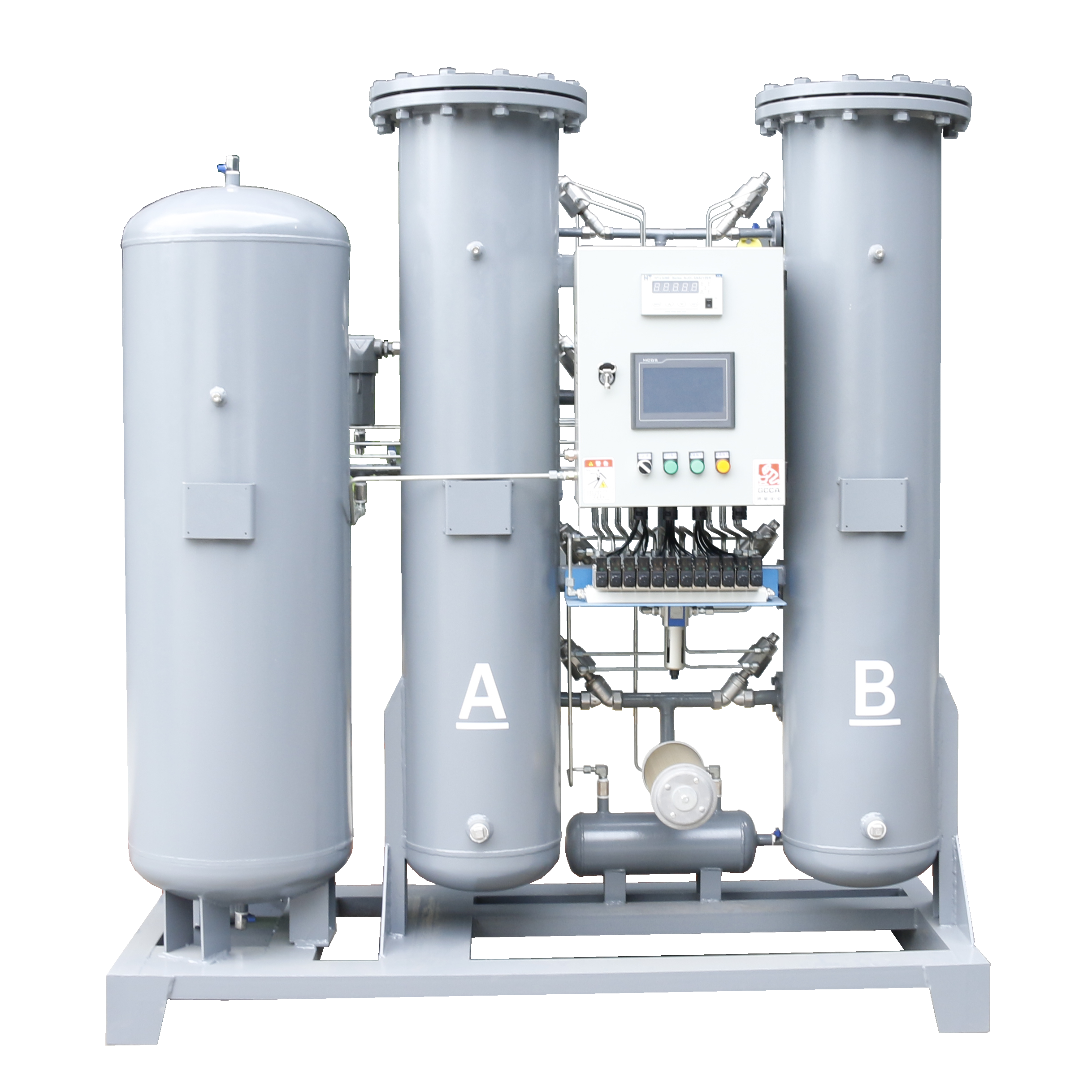
A PSA Nitrogen Generator produces nitrogen on site by separating oxygen from compressed air through Pressure Swing Adsorption. For industrial users, the key question is not simply which generator has the highest purity or largest capacity—it is which system can deliver the required nitrogen purity, flow, pressure, and stability under the actual operating conditions.
Correct selection also requires attention to compressed-air quality, feed-air consumption, peak nitrogen demand, installation conditions, monitoring, and lifecycle operating cost.
This guide focuses on those engineering factors so you can size a PSA nitrogen generation system more accurately and avoid unnecessary capacity or purity.
How a PSA Nitrogen Generator Works
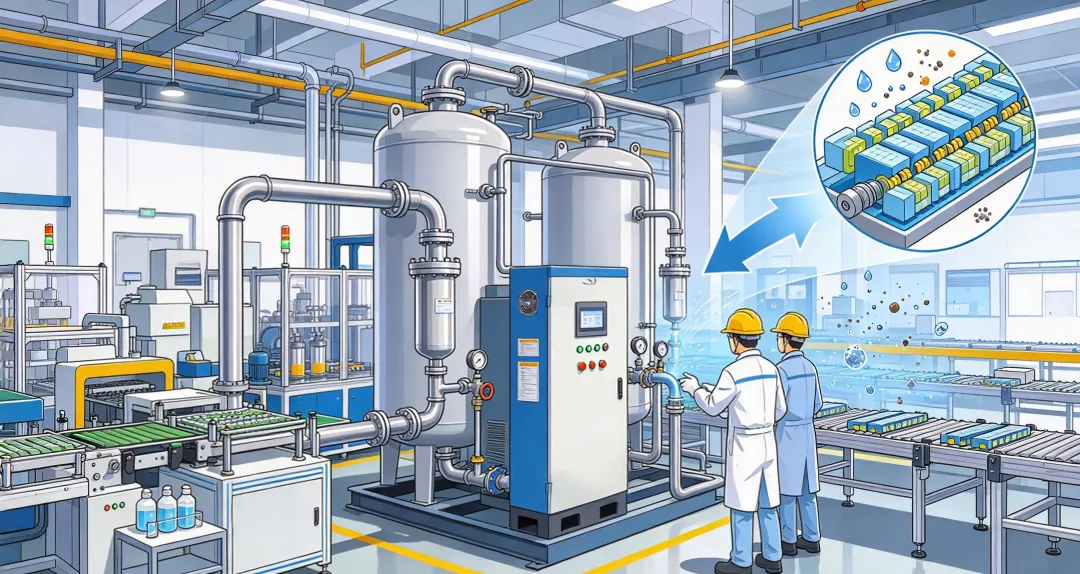
A PSA nitrogen generator normally uses two adsorption towers filled with Carbon Molecular Sieve (CMS).
Compressed air enters one tower, where CMS preferentially adsorbs oxygen while nitrogen passes through the adsorption bed as product gas.
At the same time, the second tower depressurizes and regenerates. Oxygen previously retained by the CMS is released and discharged.
The towers then switch functions:
Tower A adsorption / Tower B regeneration → pressure equalization and switching → Tower B adsorption / Tower A regeneration
This alternating cycle allows continuous nitrogen production.
Lingyu’s PSA system uses automatic PLC-controlled switching and provides online monitoring of nitrogen purity, flow, pressure, and operating condition. The specified PSA operating range includes inlet air pressure of 0.5–0.8 MPa, inlet air temperature ≤40°C, and available nitrogen purity from 95% to 99.999%, depending on configuration.
1. Start With the Required Nitrogen Purity
Purity is usually the first parameter discussed during PSA nitrogen generator selection, but specifying unnecessarily high purity can increase equipment size and compressed-air consumption.
The goal should be:
the lowest nitrogen purity that safely and consistently satisfies the process.
For example, a process that performs correctly at 99% nitrogen should not automatically be specified at 99.999%.
Lingyu provides multiple PSA nitrogen generator configurations covering different purity requirements.
Common PSA Nitrogen Purity Options
The available LYZD-A configurations include nominal purity levels such as:
| Nitrogen Purity | Selection Consideration |
|---|---|
| 99.0% | Suitable where relatively low residual oxygen is not required |
| 99.5% | Intermediate industrial purity requirement |
| 99.9% | Higher-purity industrial processes |
| 99.99% | Processes requiring much lower residual oxygen |
| 99.999% | Available for particularly high-purity requirements |
The product range includes a dedicated 99% nitrogen generator as well as a 99.5% nitrogen generator.
For applications requiring still lower oxygen concentration, a 99.99% nitrogen generator can also be evaluated.
Purity and Oxygen Content Are Closely Related
Nitrogen purity can also be considered in terms of residual oxygen concentration.
As required nitrogen purity increases, allowable residual oxygen decreases substantially.
This is important because moving from 99% to 99.99% is not a small performance change. The adsorption system must retain significantly more oxygen from the feed air.
Higher-purity requirements can therefore affect:
CMS quantity → adsorption cycle → compressed-air consumption → nitrogen recovery → generator size → lifecycle cost
Specify purity from the actual process requirement rather than treating the highest available figure as the default.
2. Determine the Required Nitrogen Flow Rate
After purity, flow capacity is one of the most important sizing parameters.
Nitrogen demand should be expressed under clearly defined standard conditions, typically in units such as Nm³/h.
Do not select the generator only from average consumption.
The system must support the real production profile.
Consider the normal operating demand, maximum simultaneous consumption, short-duration peaks, future confirmed production increases, and whether nitrogen storage will be used to buffer intermittent demand.
Peak Flow vs. Average Flow
Suppose a factory normally consumes 80 Nm³/h but periodically reaches 120 Nm³/h.
A generator selected only for the 80 Nm³/h average could experience supply instability during production peaks.
However, automatically installing a generator far larger than the peak demand is also inefficient.
Depending on the demand pattern, a properly sized nitrogen receiver can help manage short-duration peaks without unnecessarily increasing the continuous generator capacity.
Do Not Use an Arbitrary Safety Margin
A fixed rule such as “always oversize the PSA generator by 20%” is not ideal.
Instead, determine capacity from:
maximum sustained demand + realistic simultaneous consumption + storage strategy + verified future expansion
A short five-minute consumption spike and an eight-hour sustained increase should not be treated in the same way.
3. Understand the Purity–Capacity Trade-Off
One of the most important PSA selection principles is that nitrogen purity and nitrogen production capacity are interdependent.
With the same general equipment platform, producing higher-purity nitrogen normally reduces nitrogen recovery.
More of the feed-air nitrogen may effectively be sacrificed to keep oxygen concentration at the required low level.
Consequently, do not assume a generator capable of a particular flow at 99% purity will deliver the same flow at 99.99%.
The manufacturer’s capacity table must correspond to the exact required purity.
Lingyu’s PSA product data include separate capacity and effective air-consumption tables for different purity configurations, with design data referenced to defined operating conditions.
4. Calculate Feed Compressed-Air Demand
A PSA nitrogen generator does not create nitrogen without an energy input.
Its principal energy source is the compressed air supplied by the air compressor.
This means nitrogen-generator operating cost is closely related to:
effective compressed-air consumption × compressor specific power × annual operating hours
When comparing two PSA generators, looking only at nitrogen output is not enough.
Compare the amount of compressed air required to produce the specified volume of nitrogen at the required purity.
Why Feed-Air Consumption Changes With Purity
Higher nitrogen purity generally requires more aggressive oxygen removal and lower nitrogen recovery.
As a result, compressed-air consumption per unit of product nitrogen can increase as purity requirements become more demanding.
This is one reason why specifying 99.999% nitrogen for a process that only requires 99.5% can create unnecessary lifecycle energy cost.
5. Check Feed-Air Pressure
The pressure entering the PSA system affects adsorption performance and generator capacity.
Lingyu’s PSA nitrogen generator specifies an inlet-air pressure range of:
0.5–0.8 MPa
The equipment data are based on specified design conditions, so actual site pressure should be compared with those conditions during sizing.
Pressure should also be considered across the entire treatment system.
Compressor discharge pressure is not necessarily the same as the pressure available at the nitrogen generator after:
aftercooler → separator → receiver → filters → dryer → piping → valves
Pressure loss through upstream equipment must be included.
Avoid Increasing Compressor Pressure Without Analysis
If the generator does not receive sufficient pressure, simply increasing air-compressor discharge pressure should not be the first response.
Check for excessive filter differential pressure, undersized pipework, unnecessary valves or fittings, treatment-system pressure drop, and incorrect generator sizing first.
Higher compressor pressure can increase system energy consumption.
6. Verify Feed-Air Temperature
Feed-air temperature affects CMS adsorption performance and should remain within the generator’s specified operating range.
For Lingyu’s PSA nitrogen generator, the specified inlet-air temperature is:
≤40°C
Compressed air leaving the compressor can be substantially hotter, so an effective aftercooler and air-treatment system are important before the PSA generator.
Feed-air temperature should be measured at the nitrogen generator inlet—not assumed from compressor-room temperature.
7. Feed-Air Quality Is Critical
The CMS is one of the most important components inside a PSA nitrogen generator.
It should be protected from excessive water, oil, and particulate contamination.
A typical PSA nitrogen generation system can include:
air compressor → aftercooler → moisture separator → air receiver → compressed-air filters → dryer → PSA nitrogen generator → nitrogen receiver → final filtration/process
The exact treatment arrangement depends on compressor type and generator requirements.
Lingyu provides precision compressed air filtration for controlling particles and oil contamination upstream of sensitive equipment.
Why Water Is a Problem
Excess moisture entering the adsorption vessels can interfere with CMS performance.
Bulk liquid water should therefore be effectively removed upstream.
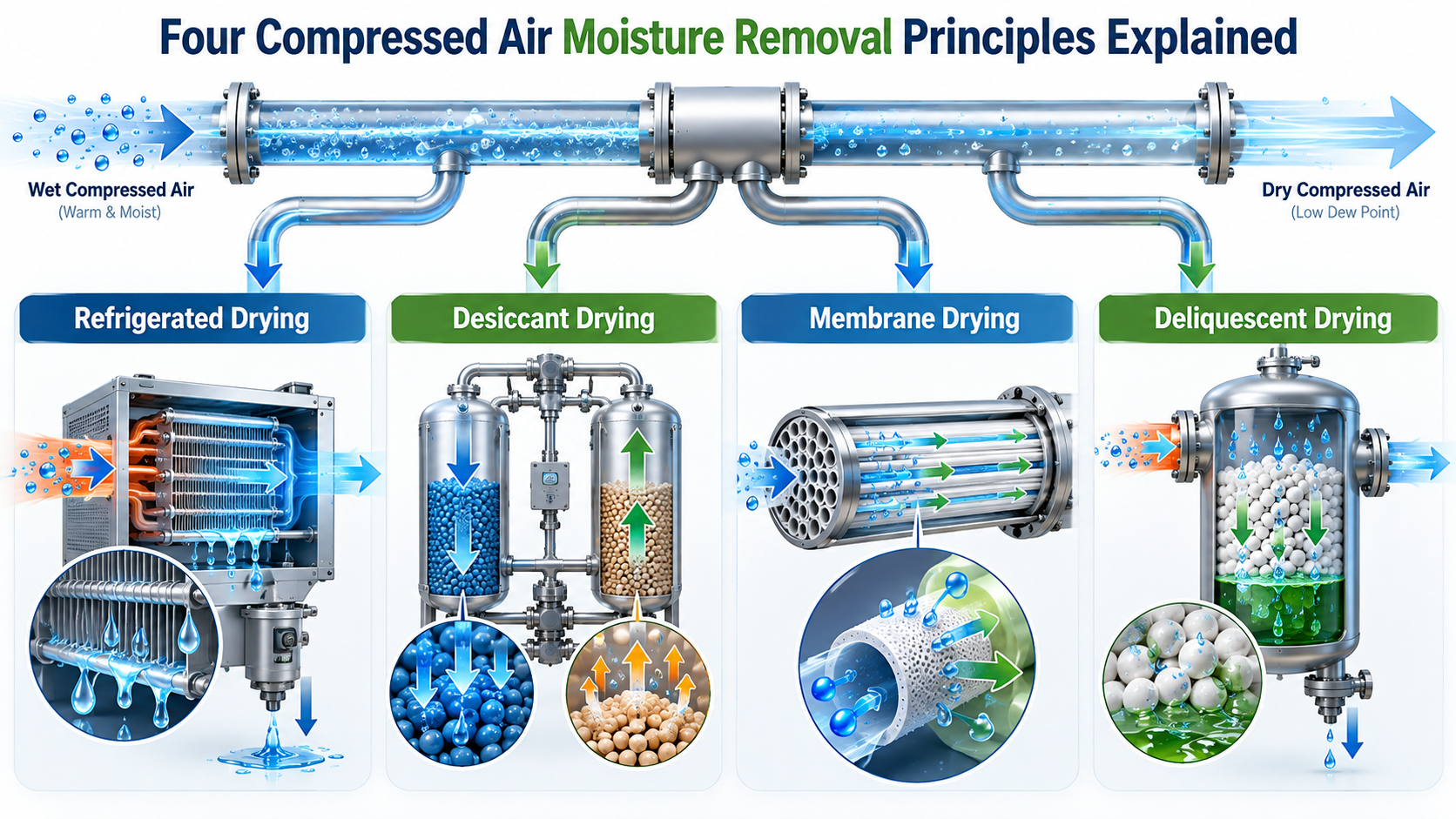
Compressed-air drying is also important because water vapor should be controlled before the air enters the nitrogen generator.
The required dryer technology should be selected according to the feed-air quality specified for the PSA system.
Why Oil Control Matters
Oil aerosols and other compressor-derived contamination can affect adsorption material and valve components.
Oil-contaminated CMS may not recover simply through a normal regeneration cycle.
Proper upstream filtration is therefore not optional system decoration—it helps protect one of the generator’s critical performance components.
8. Do Not Confuse Nitrogen Purity With Nitrogen Dew Point
Nitrogen purity describes primarily the proportion of nitrogen relative to other gas components.
Dew point describes moisture content.
A generator can meet its nitrogen purity target while still failing a separate moisture specification if feed-air treatment is inadequate.
Both requirements should therefore be specified independently:
Nitrogen purity: ___ %
Nitrogen dew point: ___ °C
Lingyu’s PSA nitrogen generator specification lists a nitrogen dew point of ≤−40°C for the referenced configuration.
9. Consider Nitrogen Outlet Pressure
The PSA generator’s inlet pressure and usable nitrogen delivery pressure are not identical.
There will be pressure losses through adsorption beds, valves, filtration, piping, and downstream equipment.
If the process requires nitrogen at a substantially higher pressure than the PSA system can provide directly, a nitrogen booster may need to be evaluated.
This is especially relevant for applications such as high-pressure process supply.
Do not select the PSA generator simply by matching its feed-air pressure to the required end-use nitrogen pressure.
10. Match Nitrogen Storage to the Demand Profile
A nitrogen receiver can improve system stability when demand fluctuates.
Storage can provide several functions:
buffering short demand peaks → stabilizing delivery pressure → reducing rapid process fluctuations → providing a limited reserve
Receiver sizing should reflect actual consumption patterns.
A process with highly intermittent valve actuation requires a different storage strategy from a process consuming nitrogen continuously at constant flow.
11. Evaluate Online Purity Monitoring
For many industrial applications, actual product purity should be monitored rather than assumed from generator operation.
Lingyu’s PSA system provides real-time online nitrogen purity and flow monitoring.
If nitrogen purity falls below the specified threshold, the system can generate an alarm. The system also incorporates protection for persistent off-spec operation.
This is particularly useful where off-spec nitrogen could affect product quality or process safety.
Why an Off-Spec Vent Strategy Matters
During startup or abnormal operation, product gas may temporarily fail to meet the required purity.
A well-designed nitrogen system should prevent unacceptable nitrogen from being sent directly into a sensitive process.
The appropriate response may involve venting, isolation, alarm, or shutdown depending on system design.
12. Evaluate the CMS and Vessel Design
Not all PSA generators should be compared solely by flow and purity.
The design of the adsorption beds affects long-term performance.
Repeated pressurization, depressurization, and gas flow can cause movement within the CMS bed if packing is not maintained correctly.
Lingyu’s PSA system includes an automatic CMS compaction system intended to maintain packing density and reduce CMS pulverization caused by bed movement.
This is relevant to long-term purity stability and adsorbent condition.
13. Consider Pressure Equalization and Nitrogen Recovery
The switching process between adsorption towers affects energy and nitrogen recovery.
Lingyu uses an optimized unequal-pressure equalization process designed to improve nitrogen recovery and indirectly reduce overall energy consumption.
The referenced design indicates approximately 5% indirect energy reduction from this pressure-equalization strategy under its defined comparison conditions.
This should be viewed as a specific system design characteristic rather than a guaranteed saving for every installation.
14. Compare Energy Use at the Required Purity
The PSA generator itself may have relatively modest direct electrical demand for controls and valves, but the system’s major energy input typically comes from the compressed air.
For meaningful comparison, calculate:
annual compressor electricity attributable to nitrogen production
rather than looking only at the electrical nameplate of the nitrogen generator.
A useful performance comparison is compressed-air consumption per Nm³ of nitrogen at the required purity.
Two systems with the same nitrogen production rating may have different operating costs.
15. Evaluate the Complete Nitrogen Generation Package
A PSA nitrogen generator should not be selected as an isolated piece of equipment.
A complete on-site system may include:
| System Component | Main Function |
|---|---|
| Air compressor | Provides compressed feed air |
| Aftercooler/separator | Removes heat and bulk condensate |
| Air receiver | Buffers compressed-air demand |
| Filters | Control particles, water droplets and oil |
| Dryer | Reduces water vapor |
| PSA generator | Separates nitrogen from oxygen |
| Nitrogen receiver | Buffers nitrogen demand |
| Purity analyzer | Verifies product quality |
| Final filter | Controls downstream particles where required |
| Booster | Raises nitrogen pressure where required |
The operating cost and reliability of the nitrogen system depend on all these components working together.
16. Choose Purity According to the Application
Food and Beverage
Nitrogen can be used in food and beverage production for applications such as blanketing or modified-atmosphere processes.
However, there is no single universal nitrogen-purity requirement for every food application.
The required purity should be determined by the specific product, process, residual oxygen target, and applicable quality requirements.
Electronics and Semiconductor Manufacturing
In electronics and precision manufacturing, nitrogen may be used for inerting and process protection.
Different production steps can have significantly different residual-oxygen and contamination requirements.
For particularly sensitive processes, purity should be specified from process engineering data rather than assuming that all electronics production requires the same nitrogen grade.
Pharmaceutical Manufacturing
For pharmaceutical and biopharmaceutical applications, nitrogen specification depends on its exact use.
The PSA generator itself should not be described as “FDA compliant” simply because nitrogen is used in pharmaceutical manufacturing.
The complete gas system and final nitrogen quality must satisfy the requirements applicable to the process.
Metal Fabrication and Laser Cutting
In metal fabrication and laser cutting, nitrogen purity and pressure can strongly influence the application.
High-flow or high-pressure laser applications should be sized from actual machine gas-consumption data rather than generic PSA capacity assumptions.
17. Do You Need 99.999% Nitrogen?
Sometimes—but not always.
Lingyu’s PSA system can provide purity up to 99.999% depending on configuration.
For applications requiring additional purification beyond conventional PSA operation, specialized downstream purification can also be considered.
Lingyu’s carbon-based deoxygenation purification system is designed to further purify approximately 99.9% feed nitrogen to ≥99.999%, with residual oxygen reduced to very low levels under its specified operating conditions.
This distinction matters because ultra-high-purity nitrogen may sometimes be more economical to produce using PSA followed by purification rather than forcing the entire generation stage toward an unnecessarily low nitrogen recovery.
The correct architecture should be evaluated from required flow, purity, oxygen concentration, and lifecycle cost.
18. On-Site PSA vs. Delivered Nitrogen
One reason companies evaluate PSA technology is to produce nitrogen directly from compressed air instead of relying entirely on delivered cylinders or bulk liquid nitrogen.
Potential advantages include reduced delivery dependence, on-demand generation, less cylinder handling, and the ability to match generation capacity to long-term plant requirements.
However, PSA is not automatically the lowest-cost solution in every situation.
The financial comparison should include:
capital investment + compressor energy + air treatment + maintenance + CMS/valve service + storage + backup supply + installation
and compare that lifecycle cost against the actual delivered-gas contract.
19. Reliability and Redundancy
A nitrogen system serving a production-critical process should be designed around the consequence of supply interruption.
For some plants, one PSA generator is sufficient.
Others may need dual units, standby capacity, stored nitrogen reserve, or a backup delivered-gas connection.
Redundancy is especially important when shutting down the nitrogen supply would shut down an entire production line.
Do not assume that purchasing an oversized single generator provides the same reliability as properly engineered redundancy.
20. Maintenance Should Be Condition- and Manufacturer-Based
There is no universal rule that every PSA nitrogen generator requires maintenance every six or twelve months.
Service requirements depend on operating hours, feed-air quality, switching frequency, valve condition, CMS condition, filter differential pressure, dryer performance, purity stability, and operating environment.
Routine inspection should pay particular attention to:
feed-air treatment → filters → drains → dryer → pneumatic valves → CMS condition → purity analyzer → pressure instruments → receiver and piping
Trend data can help identify deterioration before nitrogen purity falls outside specification.
How Long Does a PSA Nitrogen Generator Last?
A universal service life such as “10–15 years” should not be guaranteed for every PSA system.
Actual life depends on equipment design, operating hours, environmental conditions, air quality, switching cycles, CMS condition, valve maintenance, and whether the system is correctly sized.
A well-maintained generator can provide long industrial service, but useful life should be evaluated from the condition of the actual equipment rather than a fixed number of years.
Can a PSA Nitrogen Generator Be Expanded Later?
Possibly, but expandability depends on system design.
Before purchasing, consider future capacity requirements and ask whether expansion would involve additional adsorption modules, a parallel generator, larger air-compressor capacity, additional treatment equipment, increased storage, or pipework changes.
Do not assume every PSA system is inherently modular.
In many cases, installing a second parallel generator may provide both additional capacity and useful redundancy.
Certification and Compliance
Certifications should be checked against the actual project requirement.
For example, equipment-level CE or quality-management certification is different from demonstrating that the final nitrogen gas meets a specific food, pharmaceutical, electronics, or process requirement.
When evaluating a supplier, distinguish between:
manufacturer certification → equipment conformity → pressure-equipment requirements → final gas-quality specification → process-specific regulatory requirements
These are related but not interchangeable.
A Practical PSA Nitrogen Generator Selection Checklist
Before requesting a quotation, define at least:
| Selection Parameter | Information to Provide |
|---|---|
| Required nitrogen purity | % N₂ or maximum O₂ |
| Required nitrogen flow | Normal and maximum Nm³/h |
| Required outlet pressure | MPa or bar |
| Usage pattern | Continuous or intermittent |
| Feed-air pressure | Actual pressure at PSA inlet |
| Feed-air temperature | Maximum expected value |
| Required dew point | Nitrogen moisture specification |
| Ambient conditions | Temperature and installation environment |
| Operating hours | Hours/day and days/year |
| Expansion requirement | Confirmed future demand |
| Backup requirement | Required reserve/redundancy |
| Application | Exact nitrogen use |
This information allows the generator to be sized from actual process conditions instead of a generic capacity number.
Frequently Asked Questions
What purity can a PSA Nitrogen Generator produce?
Lingyu’s PSA nitrogen generator range supports nitrogen purity from approximately 95% to 99.999%, depending on the selected configuration and operating conditions.
The correct purity should be determined from the maximum residual oxygen acceptable to the process.
Is higher nitrogen purity always better?
No.
Higher purity can reduce nitrogen recovery and increase feed compressed-air consumption and equipment cost.
Specify only the purity the process actually requires.
What is the required feed-air pressure?
For Lingyu’s PSA nitrogen generator, the specified inlet-air pressure range is 0.5–0.8 MPa.
Actual generator selection should use the pressure available at the PSA inlet after upstream treatment-system losses.
What is the maximum inlet-air temperature?
The referenced PSA system specifies inlet air temperature of ≤40°C.
Does a PSA nitrogen generator require an air dryer?
The feed compressed air must meet the moisture specification required by the selected PSA system.
Appropriate drying and filtration are therefore important parts of a reliable nitrogen-generation installation.
How do I calculate the required nitrogen-generator capacity?
Determine maximum sustained nitrogen flow at the required purity and pressure, then account for the real demand profile and storage arrangement.
Do not size only from average consumption.
Should I add 20% extra capacity?
Not automatically.
Use realistic peak demand, process growth, storage capacity, and manufacturer performance data instead of an arbitrary oversizing percentage.
Does a PSA generator consume a lot of electricity?
The generator’s direct electrical consumption is only part of the picture.
A large portion of system energy is associated with producing its feed compressed air.
Compare compressed-air consumption per unit of nitrogen at the required purity.
Can PSA nitrogen replace liquid nitrogen?
For many continuous industrial gas applications, on-site PSA can reduce dependence on delivered nitrogen.
Whether it is economically preferable depends on purity, flow, pressure, consumption profile, electricity price, backup requirements, and delivered-gas cost.
Select the PSA Generator From Process Requirements, Not Just Nameplate Capacity
Choosing a PSA Nitrogen Generator should begin with four numbers:
required nitrogen purity → maximum flow → required delivery pressure → actual feed-air conditions
From there, evaluate compressed-air consumption, air treatment, storage, purity monitoring, equipment redundancy, and lifecycle operating cost.
The most expensive mistake is often not choosing a generator that is too small. It is specifying much higher purity or much greater capacity than the process actually requires, then paying for that excess through compressed-air energy for years.
For available PSA configurations, you can review the nitrogen generator range or contact Lingyu with your required nitrogen purity, normal and peak flow, outlet pressure, operating hours, feed-air pressure and temperature, and required dew point.