The refrigerated air dryer dew point is one of the most important indicators of moisture-control performance in a compressed air system.
More precisely, industrial compressed air dryers are normally evaluated by pressure dew point (PDP) rather than atmospheric dew point. PDP indicates the temperature at which water vapor in compressed air would begin to condense at system pressure.
For Lingyu’s conventional refrigerated dryer technology, the specified pressure dew point is typically 2–10°C under rated operating conditions. Maintaining the correct PDP helps prevent downstream condensation, corrosion, pneumatic equipment problems, and moisture-related production issues.
What Is Refrigerated Air Dryer Pressure Dew Point?
Pressure dew point describes the amount of water vapor remaining in compressed air after drying.
If compressed air has a PDP of 3°C, for example, additional condensation should not occur as long as the compressed air remains above approximately that temperature at the same pressure.
However, if downstream piping or equipment cools below the pressure dew point, water can begin to condense again.
This is why dew point should not be viewed simply as a dryer specification. It must also be compared with the lowest temperature the compressed air will encounter downstream.
A lower PDP means less remaining water vapor, but that does not automatically mean the system is better designed. The correct target is the PDP actually required by the process.
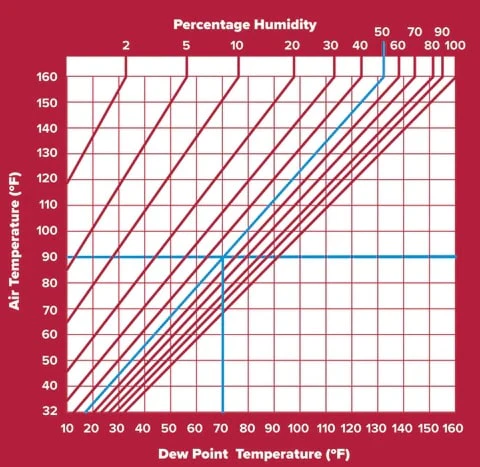
Refrigerated Air Dryer Dew Point vs. Atmospheric Dew Point
Pressure dew point and atmospheric dew point are not interchangeable.
Pressure dew point is measured while the air remains under compressed-air system pressure.
Atmospheric dew point refers to the dew point after the compressed air has expanded to atmospheric pressure.
Because pressure affects water-vapor behavior, the two values can differ considerably.
When evaluating an industrial dryer, always confirm whether the displayed or specified dew point is PDP at line pressure.
How a Refrigerated Air Dryer Controls Dew Point
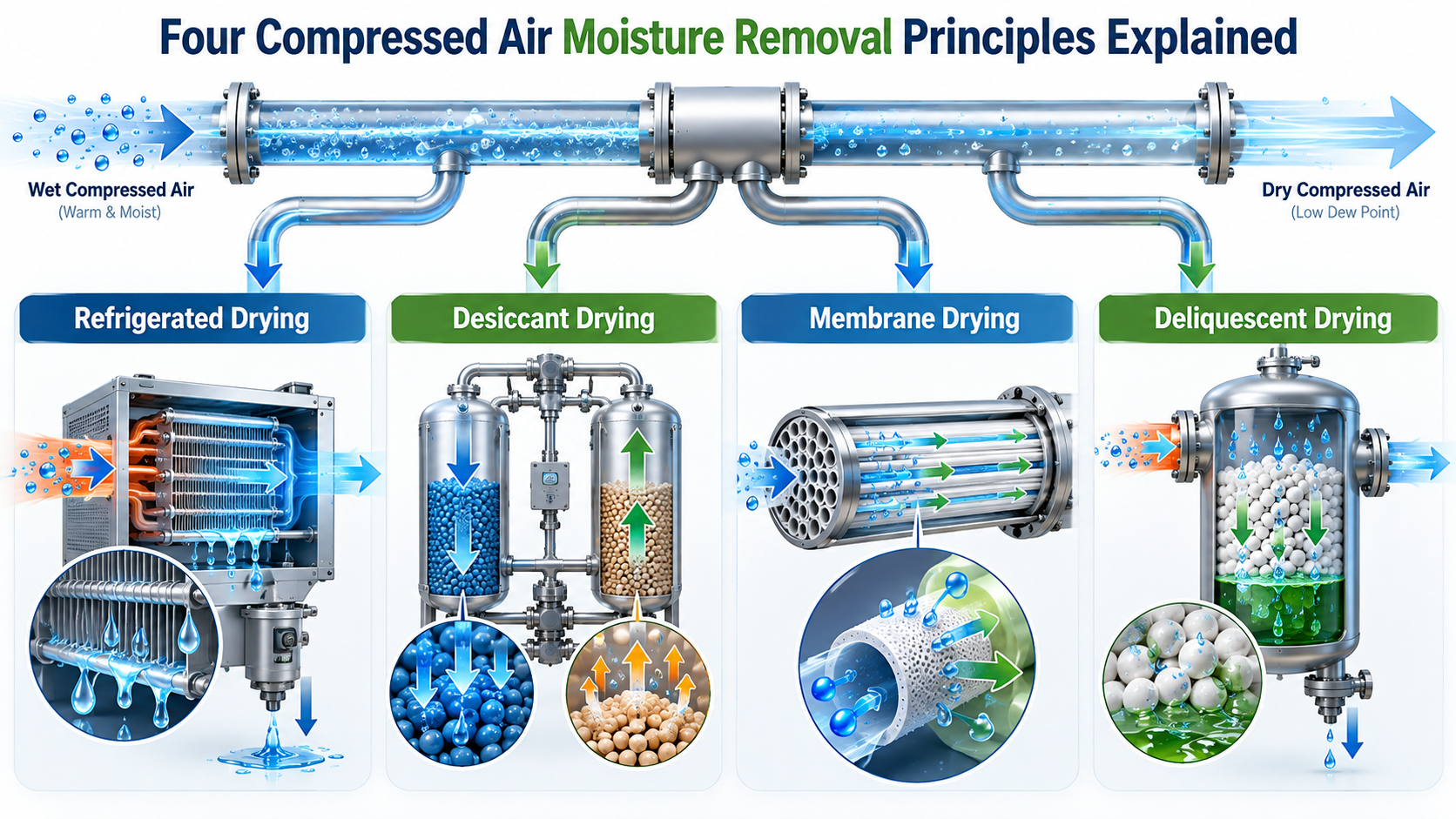
A refrigerated compressed air dryer removes water vapor by cooling compressed air until part of the vapor condenses into liquid.
In Lingyu’s conventional AH air-cooled and WH water-cooled dryer designs, the process can be summarized as:
hot wet compressed air → pre-cooling → evaporator cooling → condensation → gas-liquid separation → automatic drainage → reheating
Pre-Cooling
Incoming compressed air first passes through heat-exchange stages that reduce its temperature before the main refrigeration stage.
This lowers refrigeration load and improves overall heat utilization.
Evaporator Cooling
The air then enters the evaporator, where the refrigeration circuit lowers its temperature sufficiently for water vapor to condense.
Moisture Separation
The condensed water, together with some entrained oil and impurities, is separated from the compressed air.
An automatic drain removes the collected liquid.
Reheating
The dried compressed air is reheated toward ambient temperature before leaving the dryer.
This helps reduce the risk of external pipe sweating and improves downstream operating conditions.
Typical Refrigerated Air Dryer Dew Point Range
For Lingyu’s conventional AH and WH refrigerated dryer series, the specified PDP range is:
2–10°C
under rated operating conditions.
Typical operating parameters include:
| Parameter | Specification |
|---|---|
| Rated inlet pressure | 0.7 MPa |
| Operating pressure | 0.6–1.0 MPa |
| Rated inlet temperature | 50°C |
| Maximum inlet temperature | ≤80°C |
| Pressure dew point | 2–10°C |
| Rated ambient temperature | 32°C |
| Ambient operating range | 2–45°C |
| Pressure drop | ≤0.025 MPa |
A fixed 3°C PDP should therefore not be assumed for every refrigerated dryer or every operating condition.
Actual performance depends on dryer design, load, pressure, inlet temperature, cooling conditions, maintenance condition, and measurement method.
Is a 3°C Dew Point Always Necessary?
No.
A refrigerated dryer does not need to operate at exactly 3°C PDP to be suitable for an industrial application.
If the application requires a PDP within the dryer’s specified operating range and downstream temperatures remain safely above that PDP, the dryer may provide adequate moisture protection.
Driving the system toward the lowest achievable PDP without a process requirement can increase cost without delivering a practical benefit.
The correct question is:
What PDP is needed to prevent condensation and satisfy the application?
Why Refrigerated Air Dryer Dew Point Matters
Preventing Downstream Condensation
The primary purpose of controlling PDP is preventing additional water from condensing after the air leaves the dryer.
If the compressed air remains warmer than its PDP, water vapor stays in vapor form.
If it cools below PDP, condensation can occur.
Protecting Pneumatic Equipment
Liquid water can contribute to corrosion, lubricant degradation, sticking valves, and premature wear in pneumatic components.
Maintaining an appropriate PDP reduces this risk.
Protecting Production Processes
Moisture can affect processes such as painting, electronics manufacturing, instrumentation, packaging, and precision production.
The acceptable PDP depends on how directly compressed air interacts with the process.
Preventing Freezing
If piping is exposed to freezing temperatures, a conventional refrigerated dryer may not provide sufficiently low PDP.
For example, compressed air with a +3°C PDP passing through piping at −10°C can still form condensation and ice.
In such cases, adsorption drying should be considered.
Refrigerated vs. Desiccant Dryer Dew Point
The required pressure dew point often determines whether refrigerated or adsorption technology is appropriate.
| Dryer Type | Typical Lingyu PDP |
|---|---|
| Conventional refrigerated dryer | 2–10°C |
| CH heatless adsorption dryer | −50 to −20°C |
| CH heated adsorption dryer | −50 to −20°C |
| HH heatless adsorption dryer | ≤−40°C |
If the application requires substantially lower PDP than refrigerated drying can provide, a desiccant air dryer is normally the appropriate technology family to evaluate.
The decision should be based on actual downstream temperature and process requirements rather than assuming lower PDP is always better.
Factors That Affect Refrigerated Air Dryer Dew Point
Inlet Air Temperature
Higher inlet temperature increases both the thermal load and the amount of water vapor the dryer must process.
Lingyu’s conventional AH and WH refrigerated dryers are rated at an inlet temperature of 50°C, with a specified maximum of ≤80°C.
If inlet temperature rises significantly above the condition used for dryer sizing, outlet PDP may increase.
An effective aftercooler and moisture separator upstream can therefore have a major influence on dryer performance.
Airflow Rate
A dryer must be sized for the actual airflow passing through it.
If airflow exceeds corrected dryer capacity, the compressed air may move through the heat exchanger and separator too quickly for the system to achieve its intended moisture-removal performance.
A high PDP during peak production but normal PDP at low load can indicate that the dryer is overloaded or incorrectly sized.
Operating Pressure
Dryer capacity changes with operating pressure.
Lingyu’s conventional AH and WH dryers use 0.7 MPa as the rated inlet pressure and specify an operating range of 0.6–1.0 MPa.
If the dryer was selected using rated conditions but actual pressure is different, applicable correction factors should be considered.
Ambient Temperature
For an air-cooled refrigerated dryer, condenser performance depends heavily on surrounding air conditions.
Lingyu’s conventional AH Series specifies a rated ambient temperature of 32°C and an operating range of 2–45°C.
High ambient temperature or poor ventilation can reduce condenser heat rejection and cause refrigeration pressure and PDP to rise.
Cooling-Water Conditions
For water-cooled refrigerated dryers, cooling-water conditions directly affect condenser performance.
Lingyu’s WH Series specifies:
- Cooling-water pressure: 0.2–0.4 MPa
- Rated cooling-water temperature: ≤32°C
- Operating water-temperature range: 2–38°C
Insufficient water flow, high water temperature, fouling, or poor heat rejection can raise outlet PDP.
Condenser Cleanliness
An air-cooled condenser covered in dust, oil residue, or debris cannot reject heat effectively.
This can increase refrigeration condensing pressure and reduce dryer performance.
Cleaning frequency should be based on the actual environment rather than a fixed calendar interval.
Heat Exchanger Condition
Contaminated heat exchangers reduce heat-transfer efficiency.
Oil, dirt, scale, or internal fouling can prevent compressed air from reaching the required cooling temperature and can contribute to an elevated PDP.
Good upstream compressed air filtration helps protect the dryer from contamination.
Condensate Drain Performance
A refrigerated dryer can cool air correctly but still send water downstream if condensate is not removed properly.
A blocked or failed-closed drain allows liquid water to accumulate in the separator.
A drain stuck open wastes compressed air.
Both conditions should be corrected promptly.
Refrigeration-System Condition
Refrigeration performance affects the temperature achieved inside the evaporator.
Potential refrigeration-related causes of abnormal PDP can include compressor problems, heat-exchanger issues, refrigerant leakage, expansion-control faults, fan or condenser problems, and sensor/control faults.
However, refrigerant should not be routinely replaced or topped up as normal maintenance.
A sealed refrigeration circuit should retain its charge. Low refrigerant normally indicates leakage or another fault that should be diagnosed and repaired.
How to Measure Refrigerated Air Dryer Dew Point
For industrial systems, PDP should be measured with equipment designed for compressed-air moisture measurement.
Inline Dew Point Sensor
An inline sensor provides continuous monitoring and is particularly useful for critical processes.
It can also be connected to alarms, plant controls, or data logging.
Portable Dew Point Meter
Portable instruments can be used for commissioning, troubleshooting, verification, and periodic spot measurements.
They are useful when several compressed-air systems need to be checked with one instrument.
Local Dryer Display
Some dryers may display refrigeration temperature or another internal process value.
Do not automatically assume that this value is the same as measured outlet pressure dew point.
For critical air-quality verification, use an appropriate downstream PDP measurement.
Where Should Dew Point Be Measured?
Measurement location matters.
For dryer-performance verification, PDP is typically measured downstream of the dryer after the treatment process has stabilized.
For critical production applications, a second measurement closer to the point of use can help identify moisture entering through distribution piping or changes caused by downstream conditions.
Avoid sampling locations where liquid water can directly enter and damage or distort the sensor.
The sample line and instrument installation should follow the dew-point meter manufacturer’s recommendations.
Why Is My Refrigerated Air Dryer Dew Point Too High?
A high outlet PDP is not always caused by the refrigeration circuit.
Possible causes include:
| Symptom / Condition | Possible Cause |
|---|---|
| PDP high during peak production | Dryer overloaded |
| PDP high on very hot days | High ambient temperature |
| PDP rises with inlet temperature | Excessive thermal/moisture load |
| PDP poor with normal refrigeration | Dirty heat exchanger or poor separation |
| Water downstream despite acceptable PDP | Drain problem or downstream cooling |
| Performance improves after condenser cleaning | Restricted condenser heat rejection |
| Water only appears far downstream | Air temperature falling below PDP |
| PDP consistently above design | Incorrect sizing, refrigeration or control issue |
Troubleshooting should verify operating conditions before concluding that refrigerant charge is low.
Water Downstream Does Not Always Mean High Dryer Dew Point
This distinction is important.
Suppose a dryer produces compressed air at a PDP of 5°C.
If downstream piping later cools to 0°C, condensation can form even though the dryer itself is performing according to specification.
Similarly, liquid water from an upstream receiver or failed drain can be carried downstream and appear to be a dew-point problem.
When water is observed, check:
dryer PDP + downstream temperature + drains + separators + piping configuration
rather than replacing or adjusting the dryer immediately.
Dew Point and Refrigerated Dryer Sizing
A dryer cannot maintain its intended PDP when operated beyond its corrected capacity.
Sizing should consider maximum airflow, inlet temperature, operating pressure, ambient temperature or cooling-water conditions, and required PDP.
Manufacturer correction factors should be applied when actual working conditions differ from rated conditions.
Avoid relying on a universal rule such as installing a dryer 10% or 20% larger.
Corrected capacity is more important than arbitrary oversizing.
Variable-Frequency Control and Dew Point Stability
Compressed air systems often operate at changing load.
A conventional fixed-speed refrigeration system may experience different operating behavior at low and high loads.
Lingyu’s frequency-conversion refrigerated air dryer adjusts compressor speed according to refrigeration demand.
Matching refrigeration output more closely to load can be useful for systems with substantial demand variation.
The actual energy and PDP benefits depend on operating profile, so load data should be considered during selection.
Low Pressure Drop and Dew Point Performance
Moisture removal is not the only performance factor worth monitoring.
Pressure drop through the treatment train also affects compressed-air system efficiency.
Lingyu’s 3-in-1 plate heat exchange refrigerated air dryer integrates the evaporator, air-to-air heat exchanger, and water separator and specifies pressure drop below 0.015 MPa.
The PD Series also specifies a 2–10°C PDP.
When comparing dryers, evaluate both PDP performance and pressure loss rather than selecting solely on one parameter.
Dew Point Requirements in Different Applications
Automotive and Painting
In automotive and general manufacturing, moisture can contribute to pneumatic equipment problems and coating defects.
However, painting air also requires appropriate control of oil and particles.
A low PDP alone does not guarantee suitable paint air.
Electronics Manufacturing
In electronics and precision manufacturing, acceptable PDP depends on the process.
General pneumatic equipment may require moderate drying, while moisture-sensitive production steps can require much lower PDP.
Food and Beverage
For food and beverage compressed air, dew point is only one aspect of air quality.
Particles, oil, and microbiological considerations may also need to be addressed depending on whether compressed air has direct or indirect product contact.
Pharmaceutical Applications
The same principle applies to pharmaceutical and biopharmaceutical manufacturing.
A refrigerated dryer does not by itself produce sterile or pharmaceutical-grade compressed air.
PDP must be considered together with the complete treatment, filtration, monitoring, and validation strategy.
How to Maintain Stable Refrigerated Air Dryer Dew Point
A stable PDP depends on maintaining both the dryer and the system around it.
Monitor actual inlet temperature, flow, pressure, and ambient conditions. Keep air-cooled condensers clean and verify cooling-water conditions on water-cooled units. Inspect heat exchangers and separators for contamination. Confirm automatic drain operation. Monitor filter differential pressure. Check refrigeration performance when abnormal conditions appear.
For important applications, trend outlet PDP rather than relying only on occasional observation.
A slowly increasing PDP can reveal deteriorating performance before visible liquid water appears downstream.
Frequently Asked Questions
What is the normal refrigerated air dryer dew point?
For Lingyu’s conventional AH and WH refrigerated dryer technology, the specified PDP is 2–10°C under rated operating conditions.
The appropriate target within or beyond that range depends on the application.
Is 3°C the ideal dew point for every industrial application?
No.
A 3°C PDP can be suitable for many systems, but there is no universal ideal value.
The required PDP should be lower than the minimum relevant downstream temperature by an appropriate margin and should satisfy the process specification.
Can a refrigerated air dryer reach −40°C PDP?
Conventional refrigerated drying is not intended for this level of dryness.
Where a PDP around −40°C or lower is required, adsorption technology is normally used.
Does lower dew point always mean better compressed air?
Not necessarily.
Lower PDP means less water vapor, but compressed-air quality also includes particles and oil.
Generating a much lower PDP than the process needs can add unnecessary capital and operating cost.
Why does my dew point increase during hot weather?
For an air-cooled dryer, higher ambient temperature reduces the temperature difference available for condenser heat rejection.
If the dryer is already operating near its capacity limit, PDP may rise.
Check ambient conditions, airflow around the condenser, condenser cleanliness, and dryer loading.
Can a dirty filter increase dew point?
A severely restricted or contaminated treatment system can affect airflow, pressure, and overall dryer operation.
Filters should therefore be inspected as part of the system.
However, high PDP should not automatically be attributed to a filter without checking the other operating conditions.
Should refrigerant be replaced during scheduled maintenance?
Normally, no.
A properly sealed refrigeration system does not consume refrigerant during normal operation.
Low refrigerant charge usually indicates a leak or refrigeration-system fault requiring diagnosis and repair.
How often should dew point be checked?
There is no universal weekly or monthly interval suitable for every system.
Critical processes may benefit from continuous monitoring, while less sensitive applications can use periodic measurements.
Frequency should reflect process risk, historical stability, and maintenance requirements.
Control Dew Point Based on the Actual Process
The refrigerated air dryer dew point is best understood as a measure of how much water vapor remains in compressed air after drying.
For conventional Lingyu AH and WH refrigerated dryers, a 2–10°C pressure dew point is specified under rated operating conditions. That range is suitable for many indoor industrial compressed-air systems.
The correct PDP should be selected by comparing:
required process dryness → lowest downstream temperature → actual dryer capability → operating conditions
If a refrigerated dryer cannot provide a sufficiently low PDP for the application, deeper-drying technology should be considered rather than trying to force the refrigeration system outside its intended operating range.
For troubleshooting or project-specific dew-point selection, contact Lingyu with your airflow, operating pressure, inlet temperature, ambient or cooling-water conditions, measured PDP, and minimum downstream temperature.