Compressed air is widely used in industrial manufacturing, processing, packaging, automation, and instrumentation. However, compressed air naturally contains water vapor, and uncontrolled moisture can contribute to corrosion, pneumatic equipment problems, unstable processes, and increased maintenance.
A regenerative compressed air dryer removes water vapor through adsorption and then restores the drying capacity of the desiccant through a regeneration cycle. Compared with refrigerated drying, regenerative adsorption systems can achieve substantially lower pressure dew points, making them suitable for applications that require very dry compressed air.
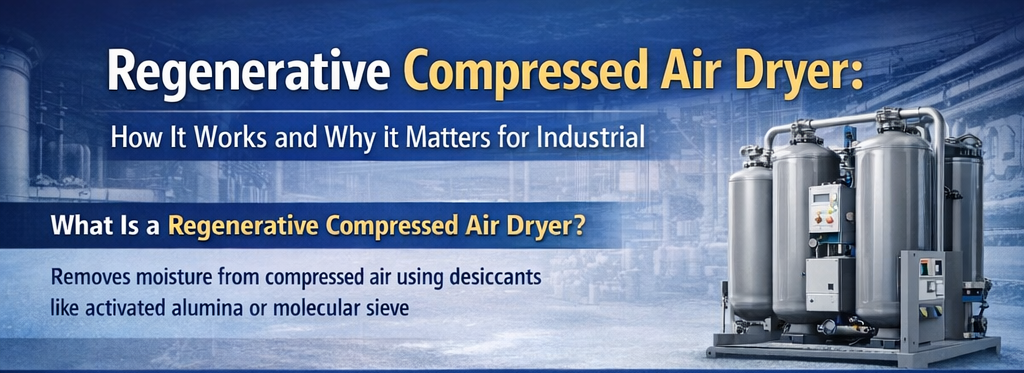
What Is a Regenerative Compressed Air Dryer?
A regenerative compressed air dryer is a type of adsorption or desiccant dryer.
Compressed air passes through a vessel containing desiccant, such as activated alumina or a combination of activated alumina and molecular sieve, depending on the dryer configuration. Water vapor is adsorbed onto the desiccant while the dried compressed air continues downstream.
The term regenerative refers to restoring the desiccant’s adsorption capacity after moisture has accumulated.
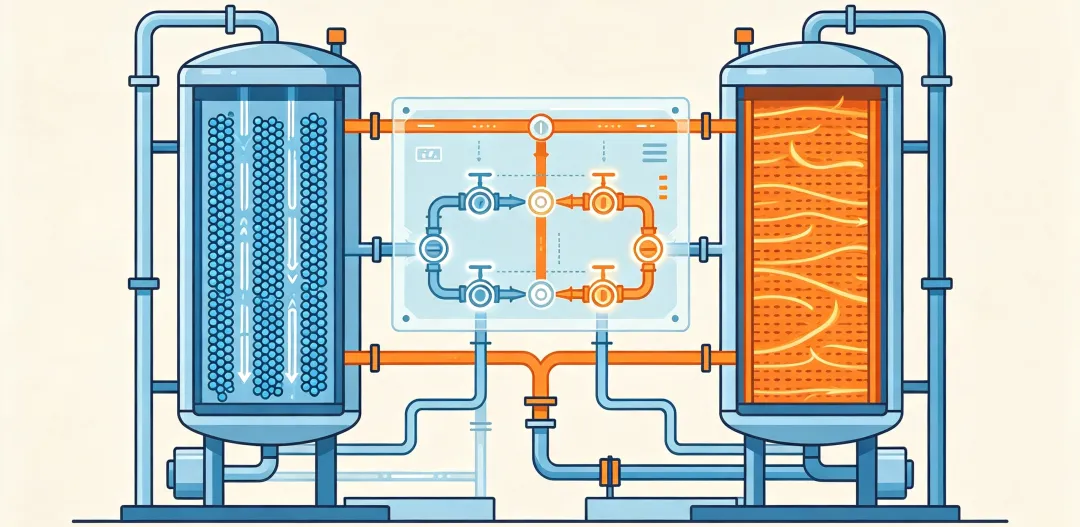
Most industrial regenerative dryers use two vessels. While one tower is drying compressed air, the other is undergoing regeneration. The towers alternate between these functions so the dryer can provide a continuous supply of low-dew-point compressed air.
For example, Lingyu’s HH heatless regenerative dryer uses activated alumina plus high-performance molecular sieve and provides an outlet pressure dew point of ≤−40°C under the applicable operating conditions.
How Does a Regenerative Compressed Air Dryer Work?
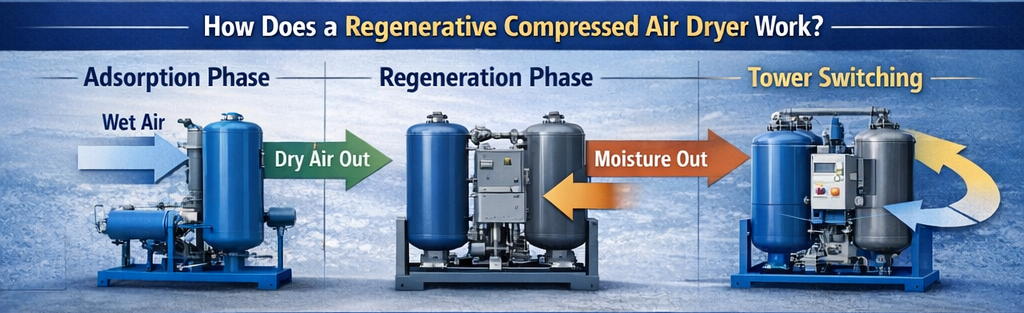
Although regeneration methods vary, most twin-tower dryers follow the same basic cycle.
Adsorption
Wet compressed air enters the online tower.
As the air moves through the desiccant bed, water vapor is adsorbed. The resulting dry compressed air leaves the vessel and continues to the downstream compressed-air network.
Regeneration
At the same time, the second tower is regenerated so that it can be used for the next adsorption cycle.
The regeneration method depends on the dryer design. It may use dry purge air, external heat, heated ambient air from a blower, or another source of regeneration energy.
Repressurization and Tower Switching
Before switching, many regenerative dryers repressurize and equalize the regenerated vessel to reduce pressure disturbance.
The regenerated tower then becomes the drying tower while the previously active tower enters regeneration.
This alternating sequence enables continuous drying.
For a closer look at this process, see how twin-tower adsorption drying maintains continuous operation.

Why Use a Regenerative Compressed Air Dryer?
The main reason to select regenerative drying is the requirement for a substantially lower pressure dew point than refrigerated drying normally provides.
Lingyu refrigerated systems can provide approximately 2–10°C pressure dew point, while selected regenerative adsorption configurations provide ≤−40°C or other low-dew-point ranges depending on the model.
Lower pressure dew points can be important when compressed air is used in moisture-sensitive processes or when downstream piping may be exposed to low temperatures.
Proper drying can also help reduce moisture-related corrosion, protect pneumatic equipment, and maintain more stable instrumentation and production conditions.
Regenerative vs. Refrigerated Air Dryers
Refrigerated and regenerative dryers address the same general moisture problem but provide different levels of drying.
A refrigerated dryer removes moisture by cooling compressed air until water vapor condenses, after which the liquid is separated and discharged. This technology is suitable for many general industrial applications.
A regenerative dryer removes residual water vapor through adsorption and is selected when substantially lower pressure dew points are required.
In practical terms, the choice should be based on the required pressure dew point rather than simply assuming that the dryer capable of producing the driest air is always the best option.
For a detailed comparison, see the refrigerated and desiccant dryer comparison.
Common Types of Regenerative Compressed Air Dryers
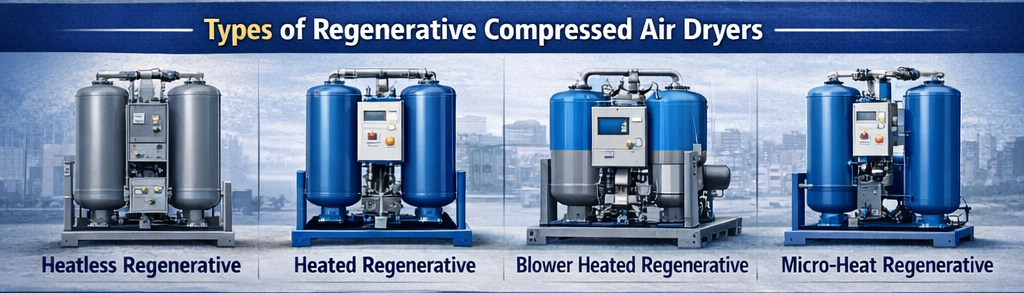
Different regenerative dryer designs use different methods to restore the adsorption capacity of the desiccant.
Heatless Regenerative Dryer
A heatless dryer uses part of the dry product air as purge air.
The purge air passes through the regeneration tower at reduced water-vapor partial pressure, allowing moisture to desorb from the desiccant and leave the system.
Lingyu’s HH heatless configuration has an average purge-air consumption of 8–14% and an outlet pressure dew point of ≤−40°C.
Heated-Purge Regenerative Dryer
A heated-purge dryer uses an external heat source to assist moisture desorption.
Dry product air is still used as the regeneration carrier, but the addition of heat can reduce the required purge-air quantity compared with a heatless design.
Lingyu’s HH heated-purge configuration has an average purge-air consumption of 4–8% and an outlet pressure dew point of ≤−40°C.
Low-Purge Blower-Heated Dryer
A blower-heated dryer uses ambient air drawn in by a blower and heated before it passes through the regeneration tower.
Lingyu’s HRB-E design uses approximately 2% of system airflow as dry cooling purge air during the cooling stage. This substantially reduces compressed-air consumption, but it is not a zero-purge dryer.
For more detail on this regeneration technology, see the blower-heated adsorption dryer guide.
Zero-Purge Blower-Heated Dryer
Zero-purge blower-heated systems use a different cooling arrangement.
In Lingyu’s HRB-Z design, ambient air is heated for desorption, while the cooling stage uses a closed-loop circuit through an intercooler and regeneration tower. No dry product air is consumed during the regeneration process.
This distinction is important because a blower-heated dryer does not automatically operate with zero purge.
Lingyu’s regenerative dryer range also includes heat-of-compression adsorption dryers, providing another regeneration approach for suitable compressed-air systems.
Applications of Regenerative Dryers
Regenerative dryers are considered where compressed-air moisture needs to be tightly controlled.
Typical applications can include electronics and semiconductor production, pharmaceutical manufacturing, instrument and control air, chemical and petrochemical processing, precision manufacturing, low-temperature compressed-air networks, selected food and beverage processes, and other moisture-sensitive production systems.
The required pressure dew point should still be determined from the actual process rather than simply from the industry name.

How to Choose the Right Regenerative Dryer
Selection begins with the required pressure dew point.
After that, important factors include actual airflow, inlet pressure, inlet temperature, ambient conditions, lowest downstream temperature, regeneration method, purge-air consumption, electrical or heating energy, pressure drop, maintenance requirements, and expected load variation.
For example, a relatively small system may accept the simplicity of heatless regeneration, while a larger continuously operating installation may justify evaluating blower-heated or other low-purge technologies.
For more detailed selection guidance, see the desiccant air dryer sizing guide.
Why Inlet Air Treatment Matters
Regenerative dryers work best when the incoming compressed air is properly treated.
Liquid water, oil aerosols, and particulate contamination can interfere with adsorption performance and reduce desiccant service life.
Appropriate moisture separation and filtration should therefore be selected according to compressor type, dryer configuration, and required outlet air quality.
There is no single pre-filter arrangement that applies to every regenerative dryer. The treatment configuration should match the actual dryer and compressed-air system requirements.
Maintenance of a Regenerative Compressed Air Dryer
Maintenance should focus on the components that directly affect adsorption and regeneration.
Important areas include pressure-dew-point monitoring, inlet and outlet filters, switching and purge valves, regeneration performance, heaters or blowers where installed, controller and sensor operation, pressure drop, and desiccant condition.
Desiccant should not be replaced simply because it becomes saturated during a normal adsorption cycle. Saturation is part of the normal drying process, and regeneration should restore the desiccant’s adsorption capacity.
Replacement becomes relevant when the desiccant is contaminated, physically degraded, excessively powdered, or no longer maintains the required performance despite correct regeneration.

Is a Regenerative Dryer the Right Choice?
A regenerative dryer should be selected because the process requires its low-dew-point capability, not simply because it is technically capable of producing drier air.
Compared with refrigerated drying, regenerative systems may involve purge-air losses, heating energy, blower power, additional valves, or increased maintenance depending on the regeneration method.
The correct choice therefore balances the required pressure dew point, operating conditions, energy consumption, maintenance requirements, and lifecycle cost.
Conclusion
A regenerative compressed air dryer removes water vapor through adsorption and continuously restores desiccant performance through regeneration.
Most systems use alternating towers so that one vessel can dry compressed air while the other is regenerated. Heatless, heated-purge, low-purge blower-heated, zero-purge blower-heated, and heat-of-compression designs provide different ways to perform this regeneration.
The main reason to use a regenerative dryer is the need for a low pressure dew point that refrigerated drying cannot provide economically or technically for the application.
Lingyu’s HH heatless configuration uses 8–14% average purge air and provides an outlet pressure dew point of ≤−40°C, while the HH heated-purge configuration reduces average purge consumption to 4–8% while also providing ≤−40°C outlet pressure dew point. The HRB-E blower-heated design reduces dry cooling purge air to approximately 2% of system airflow, while the HRB-Z design eliminates dry product-air consumption during regeneration.
Choosing the correct regeneration method according to pressure dew point, airflow, operating conditions, purge consumption, energy requirements, and maintenance needs helps provide stable dry compressed air without unnecessarily increasing operating cost.