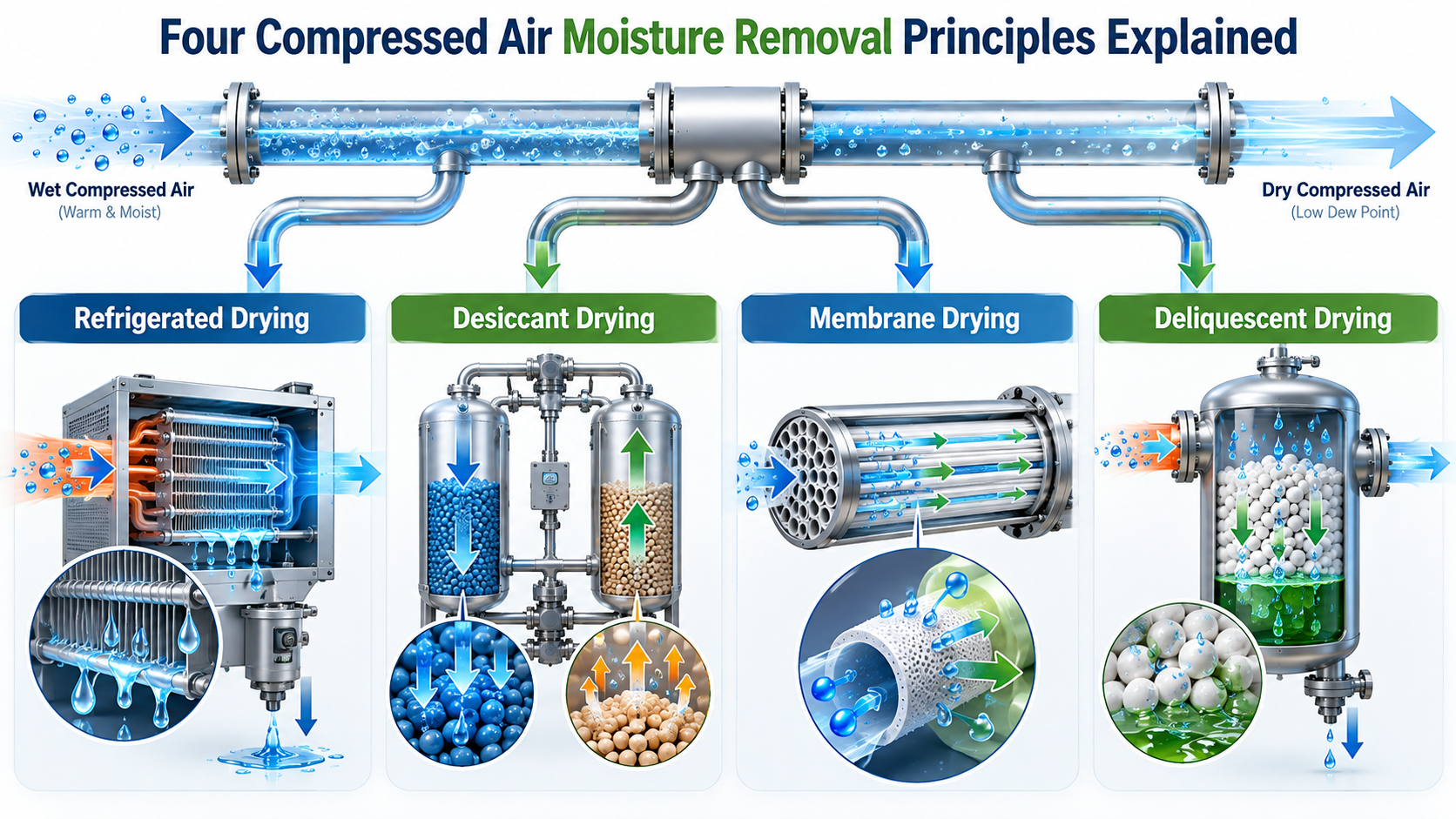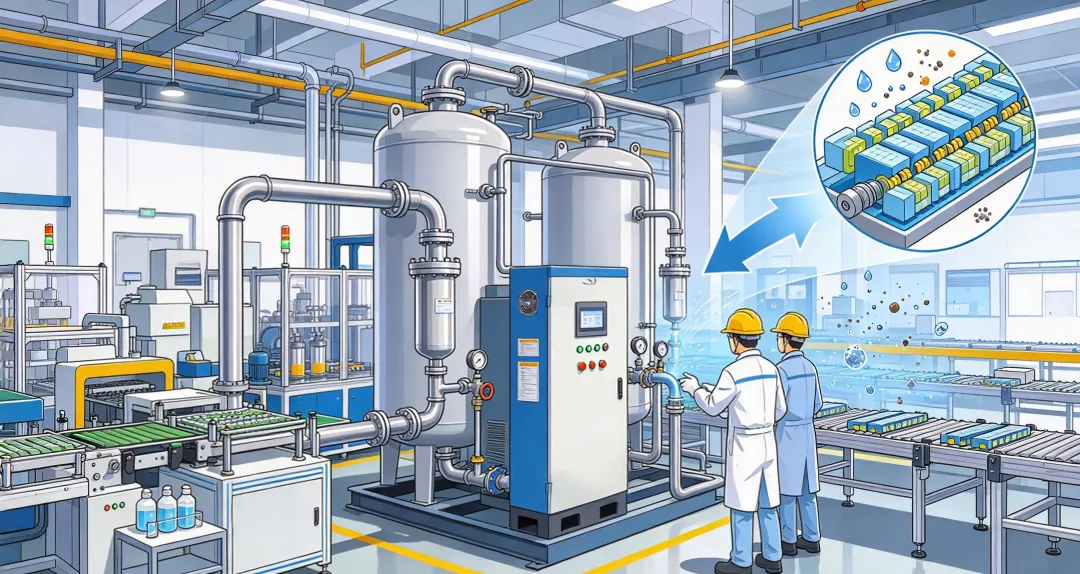
Compressed air always contains water vapor. If this moisture is not properly removed, it can condense inside piping, contribute to corrosion, interfere with pneumatic equipment, and affect production quality.
When an application requires a much lower pressure dew point than standard refrigerated drying can provide, adsorption drying becomes an important solution.
This article explains what a desiccant air dryer is, how adsorption and regeneration work, which desiccants are commonly used, and how different regeneration methods affect energy consumption and system selection.
What Is a Desiccant Air Dryer?
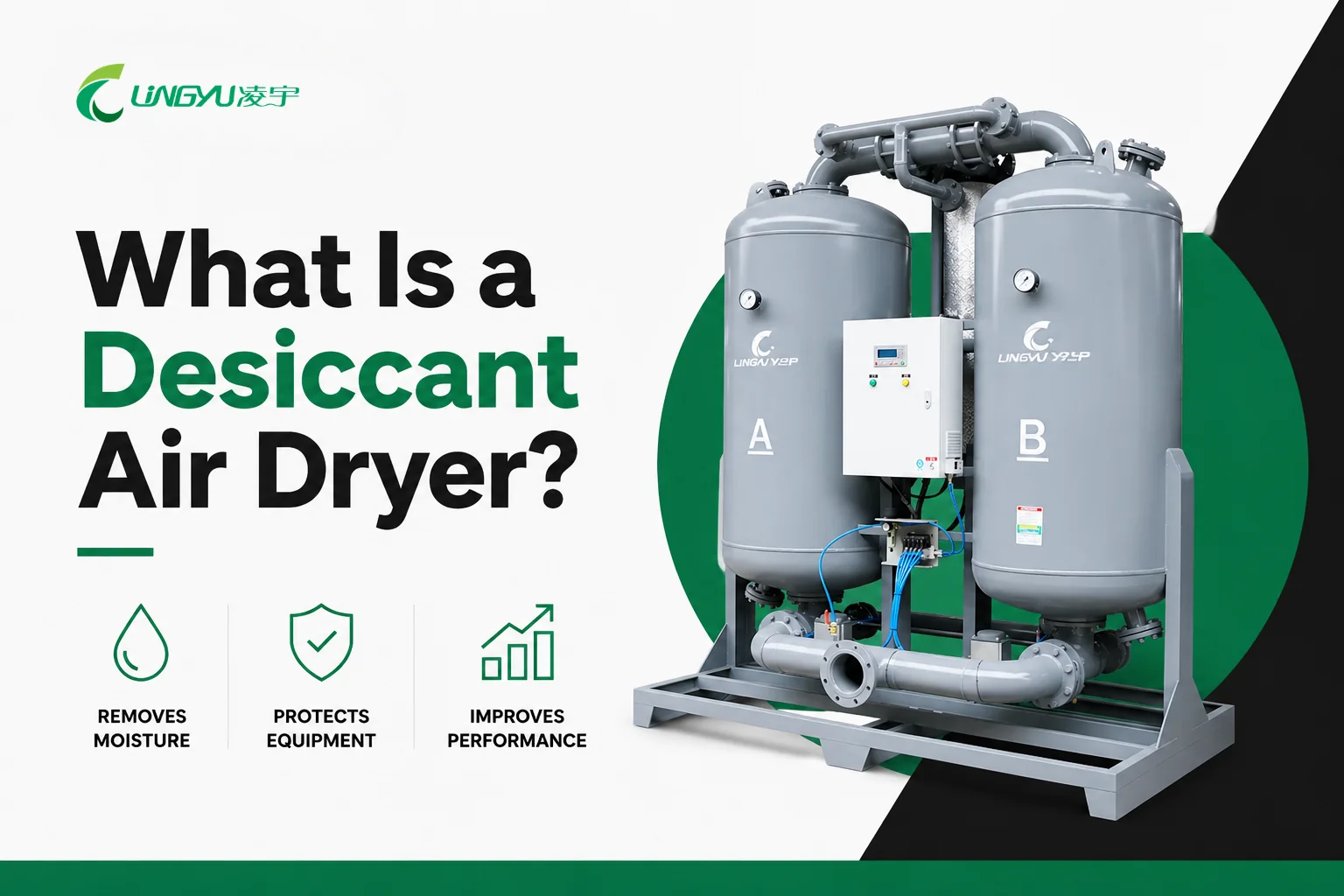
A desiccant air dryer, also known as an adsorption air dryer, removes water vapor from compressed air by passing it through a bed of moisture-adsorbing material.
Rather than cooling the compressed air until water condenses, the dryer captures water molecules on the surface of the desiccant.
This allows the system to achieve a substantially lower pressure dew point than typical refrigerated drying.
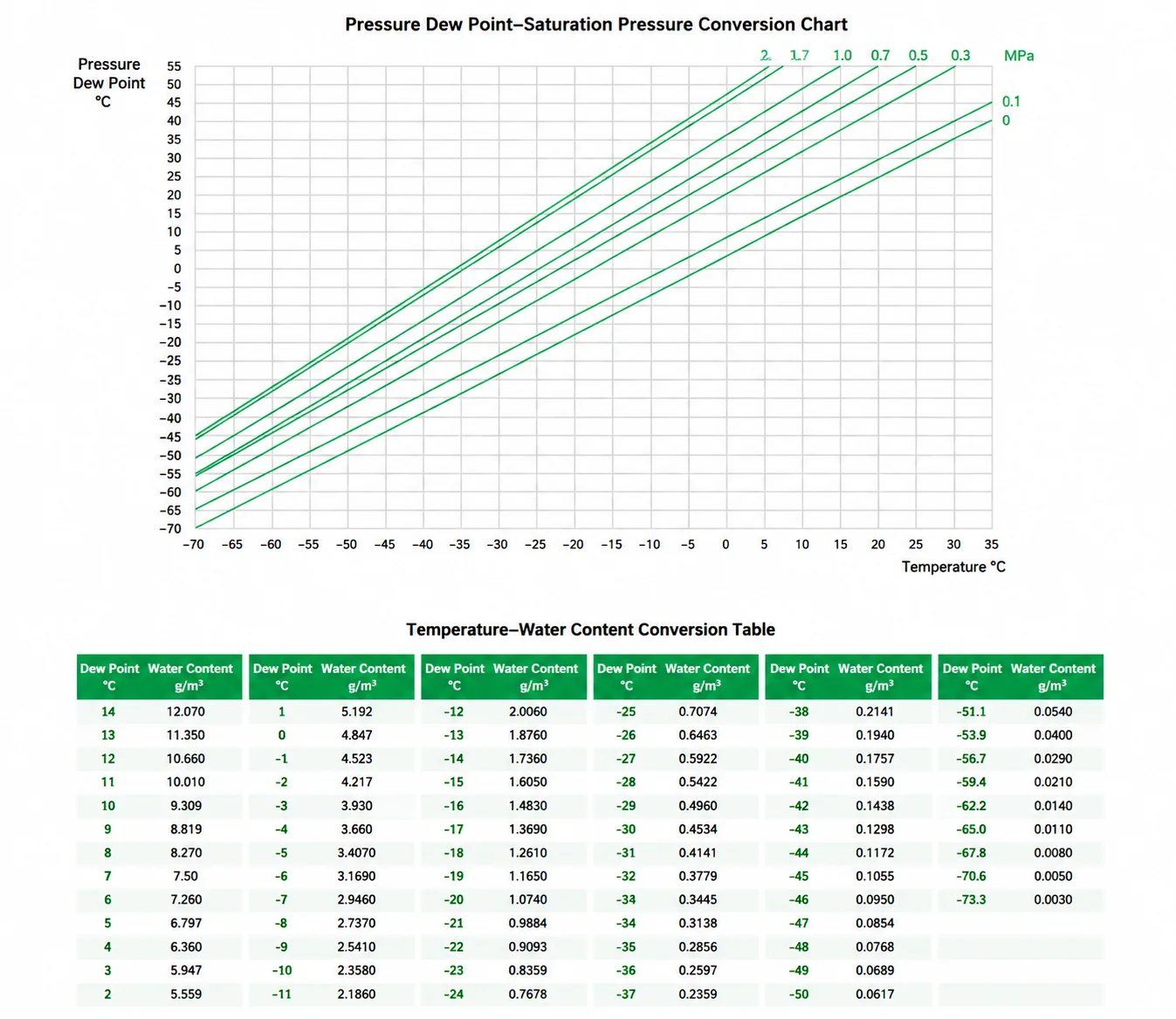
For comparison, Lingyu refrigerated dryers provide a pressure dew point of approximately 2–10°C, while adsorption dryer ranges are designed for substantially lower outlet pressure dew points, commonly around −20°C to −40°C, depending on the dryer series and configuration.
Applications that require help choosing between the two technologies can refer to this refrigerated and adsorption dryer comparison.
Adsorption drying is widely used when moisture-sensitive equipment, processes, or environmental conditions require consistently dry compressed air.
How Does a Desiccant Air Dryer Work?
Most regenerative adsorption dryers use two pressure vessels filled with desiccant.
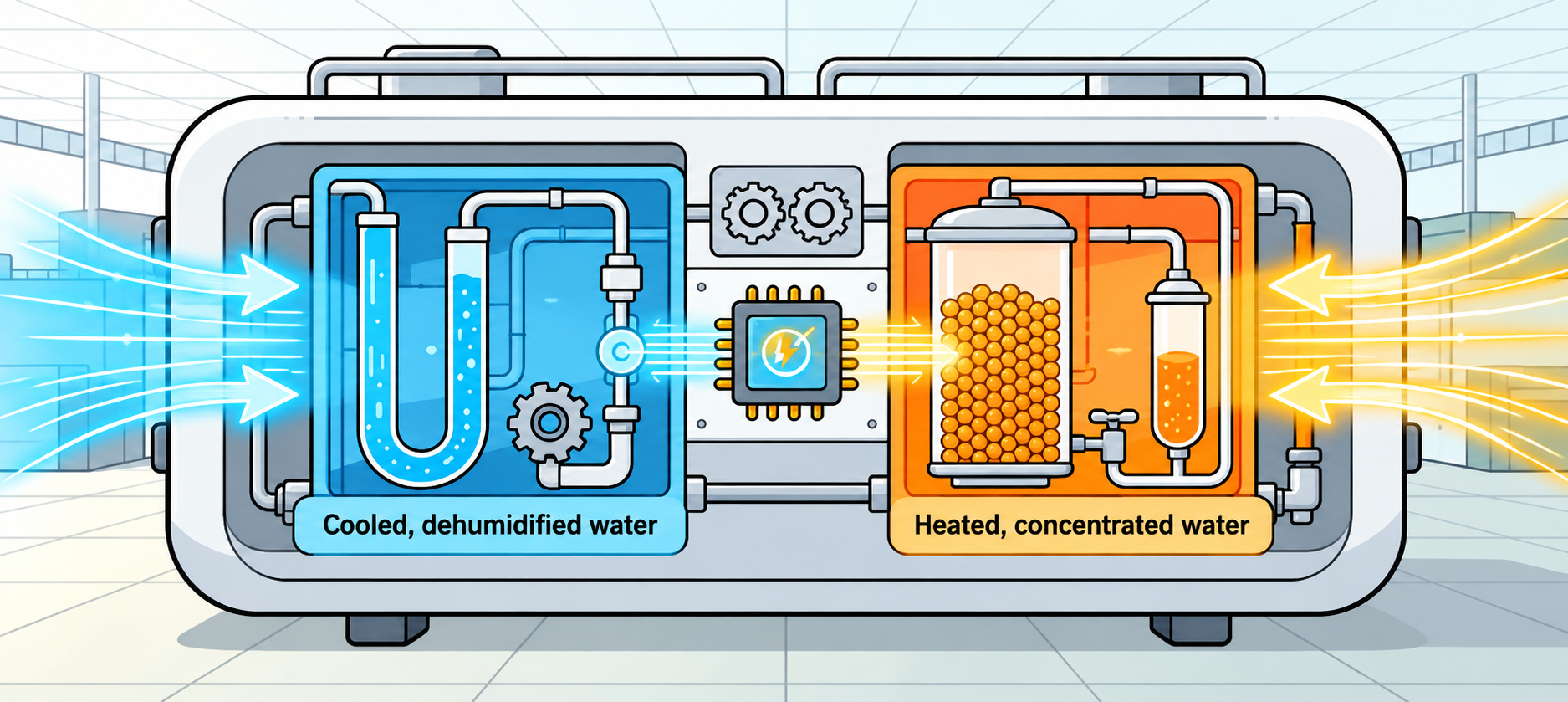
One vessel dries the compressed air while the other is regenerated. After a preset operating period or control condition is reached, the towers switch functions.
The basic cycle can be summarized in four stages:
- Wet compressed air enters the adsorption vessel and passes through the desiccant bed.
- Water vapor is captured by the desiccant while dry compressed air leaves the dryer.
- The second vessel is regenerated so that previously adsorbed moisture is removed.
- The towers switch roles, allowing continuous compressed-air drying.
Heatless dryers operate according to Pressure Swing Adsorption. At higher water-vapor partial pressure, the desiccant adsorbs moisture. At lower partial pressure during regeneration, moisture is desorbed and removed using a portion of the dry product air.
For a more detailed explanation of the adsorption process and regeneration cycle, see desiccant air dryer working principle.
Typical system components include:
- Two adsorption vessels
- Desiccant beds
- Switching valves and actuators
- Programmable controller
- Regeneration circuit
- Inlet and outlet filtration
- Silencers and exhaust components
- Pressure and dew-point monitoring, depending on configuration
Pre-filtration is particularly important because liquid water, oil aerosols, and particles can negatively affect adsorption performance and desiccant service life. Downstream particulate filtration is also commonly used to control desiccant dust carried from the dryer.
What Desiccants Are Commonly Used?
The adsorption material has a direct effect on moisture-removal performance, service life, pressure dew point, and operating stability.
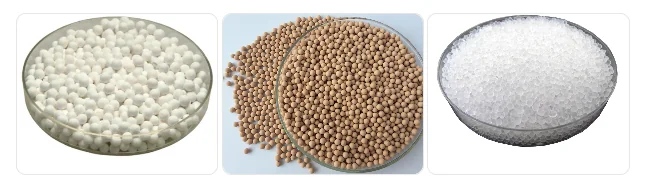
Activated Alumina
Activated alumina is widely used in industrial compressed-air adsorption drying because it combines moisture adsorption capability with good mechanical strength and durability.
Lingyu’s CH Series heated purge dryer, for example, uses activated alumina and provides an outlet pressure dew point range of −50°C to −20°C.
Molecular Sieve
Molecular sieve has a highly controlled pore structure and is particularly effective when lower residual moisture levels are required.
Some Lingyu systems combine activated alumina with high-performance molecular sieve. The HH Series heatless dryer, for example, uses this combination and provides an outlet pressure dew point of ≤−40°C.
The M Series modular dryer also uses activated alumina combined with high-performance molecular sieve.
What Types of Desiccant Air Dryers Are Available?
The main difference between regenerative adsorption dryers is how the saturated desiccant is regenerated.
That choice affects purge-air consumption, installed power, control complexity, operating cost, and suitability for the plant.
1. Heatless Regenerative Dryer
A heatless dryer uses a portion of the dry product air for regeneration.
Dry compressed air is expanded to a lower pressure and passed through the saturated desiccant bed. The lower water-vapor partial pressure enables moisture to desorb from the desiccant and exit through the exhaust system.
Lingyu’s HH Series specifies an average purge-air consumption of 8–14% and an outlet pressure dew point of ≤−40°C.
Typical advantages include simple operation, no external regeneration heater, and proven reliability.
Its main operating-cost consideration is compressed-air loss during regeneration.
For applications where simplicity is the priority, see Lingyu’s HH Series heatless regeneration adsorption dryer.
2. Heated Purge Regenerative Dryer
A heated purge dryer uses external heat to improve desiccant regeneration.
Because heat assists moisture desorption, less dry compressed air is generally required than with a heatless design.
Lingyu’s CH Series heated purge dryer specifies average purge-air consumption of 4–8%, compared with 8–14% for the HH heatless series. Its outlet pressure dew point range is −50°C to −20°C.
This makes heated regeneration particularly relevant where a facility wants to reduce compressed-air purge loss but still accepts electrical heater consumption.
For this configuration, see the CH Series heated regeneration adsorption air dryer.
Key design features include high-efficiency adsorbents with strong adsorption capacity and wear resistance, heater pressure protection, low operating noise, pneumatic valves, programmable control, and automatic pressure charging.
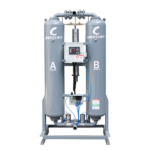
High-efficiency adsorbents are used, with strong adsorption capacity and wear resistance, ensuring stable dew point and no powdering during long-term use;
The heater is equipped with pressure protection to prevent the heater from dry burning, which increases the service life of the heater.
Low operating noise;
High-performance pneumatic valves are used;
Fully electronic programmable controller is used;
Automatic pressure charging function ensures the service life of the adsorbent;
3. Blower-Heated Regenerative Dryer
A blower-heated dryer uses ambient air supplied by an independent blower and heated before it passes through the regeneration vessel.
It is important to distinguish between low-purge blower-heated and zero-purge blower-heated designs.
In Lingyu’s HRB-E low-purge design, ambient air is used for heating and regeneration, while approximately 2% of dry product air is used during cooling. This reduces compressed-air loss substantially compared with conventional purge-based regeneration.
The HRB-Z zero-purge design adds a closed-loop cooling process. During both heating and cooling, no dry product air is required, resulting in regeneration air consumption of approximately 0%.
Facilities where regeneration-air loss is a major operating-cost concern can review Lingyu’s blower zero-purge adsorption dryers.
Depending on configuration, these systems can incorporate dew-point monitoring, touchscreen control, RS-485 communication, pneumatic valve control, and operating-status monitoring.
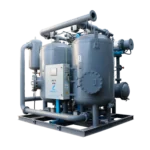
Equipped with a dew point meter, it can be adjusted to normal pressure dew point or pressure dew point, and the dew point is stable
The display controller uses a Siemens touch screen, has an RS-485 communication interface, and provides a communication protocol;
The pneumatic valve control solenoid valve uses a double-coil structure, a double-eccentric high-temperature resistant high-performance butterfly valve, and is equipped with a valve position switch reply device. The abnormal shutdown and power-off valve can maintain the valve action, and short-term maintenance does not affect the ventilation state, and the reliability is stronger;
4. Heat-of-Compression Regenerative Dryer
Heat-of-compression, or HOC, dryers recover thermal energy contained in high-temperature compressed air discharged from the compressor.
This available heat is used to regenerate the desiccant rather than relying entirely on a separate regeneration heater.
Lingyu offers both low-purge and zero-purge HOC configurations.
In the HOC-E low-purge design, no compressed air is consumed during the heating stage, while a small quantity of dry product air is used during cooling.
The HOC-Z system uses compression heat for regeneration and is designed for 0% regeneration air consumption. Its specified inlet temperature range is 110–180°C, with −20°C / −40°C outlet pressure dew point options.
For plants with suitable high-temperature compressor discharge conditions, see the HOC-Z zero-gas-consumption heat-of-compression dryer.
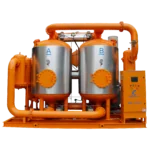
The Blower & Zero Purge Adsorption Dryer is an advanced solution for industrial compressed air systems, designed to provide continuous, energy-efficient moisture removal.
This dryer combines blower-assisted regeneration with a zero purge cycle, ensuring the regeneration process consumes no compressed air. Ambient air is drawn in by the blower, heated to desorb moisture from the adsorbent, and then cooled through an intermediate cooler in a continuous closed-loop cycle. The result is a stable low dew point with minimal energy usage, protecting downstream equipment and ensuring consistent air quality in industrial operations.
5. Modular Adsorption Dryer
A modular dryer uses multiple compact adsorption modules instead of relying only on two conventional large vessels.
This approach can be useful where installation footprint, modular capacity arrangement, or service accessibility are important.
Lingyu’s M Series covers capacities from compact industrial units to larger modular arrangements. Its rated outlet pressure dew point is ≤−20°C, with −40°C available as an option, and it uses activated alumina together with high-performance molecular sieve.
For installations that favor a modular configuration, see Lingyu’s modular adsorption air dryer.
What Makes an Adsorption Dryer Energy Efficient?
The initial purchase price is only one part of the cost of compressed-air drying.
For regenerative dryers, long-term energy performance is strongly influenced by regeneration air consumption, electrical heating requirements, blower power, pressure drop, control strategy, and actual load profile.
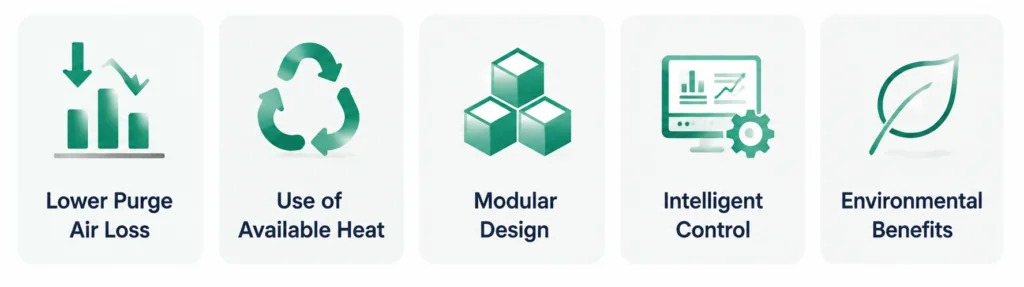
Important efficiency factors include:
- Lower regeneration-air consumption
- Effective use of available compression heat
- Dew-point-based control
- Optimized airflow distribution
- Low pressure drop
- Proper dryer sizing
- Matching regeneration technology to operating hours and plant load
The differences between technologies can be substantial.
For example, Lingyu’s HH heatless series uses approximately 8–14% purge air, while the CH heated series specifies approximately 4–8%.
The HRB-E blower-heated system reduces dry-air cooling demand to around 2%, while the HRB-Z zero-purge configuration is designed for approximately 0% regeneration air consumption.
Therefore, a dryer with a higher initial cost may provide better long-term economics when the facility operates continuously and compressed air is expensive to produce.
How to Select the Right Regeneration Method
A practical selection should compare more than pressure dew point alone.
Consider:
- Required outlet pressure dew point
- Actual compressed-air flow
- Inlet pressure and temperature
- Daily operating hours
- Cost of compressed air
- Acceptable purge-air loss
- Available electrical power
- Availability of compressor discharge heat
- Installation space
- Maintenance resources
- Expected load variation
For plants still determining equipment size and configuration, a desiccant air dryer sizing guide can help identify important sizing and selection factors.
Which Lingyu Solution Fits Different Needs?
For applications that prioritize simple operation and conventional regeneration, a heatless regenerative dryer provides a straightforward solution.
Where compressed-air purge loss needs to be reduced, heated purge regeneration can lower purge demand compared with heatless operation.
For installations where a modular arrangement is preferred, the M Series provides a compact adsorption configuration with −20°C standard and −40°C optional pressure dew point capability.
For larger systems where compressed-air conservation is a major priority, low-purge or zero-purge blower-heated designs can significantly reduce regeneration-related air loss.
Where sufficiently hot compressor discharge air is available, HOC designs can recover compression heat and further reduce the energy associated with desiccant regeneration.
The most appropriate solution depends on plant conditions, required pressure dew point, energy availability, regeneration strategy, and total operating cost.
Conclusion
A desiccant air dryer is designed for compressed-air applications that require substantially lower pressure dew points than standard refrigerated drying can provide.
Its operating principle is based on adsorption and regeneration: one desiccant bed removes water vapor while another is regenerated so that dry compressed air can be supplied continuously.
The main design choices are heatless, heated purge, blower-heated, heat-of-compression, and modular configurations. Each has a different balance of purge-air consumption, installed power, complexity, and energy performance.
For buyers comparing adsorption technologies, the correct choice should be based on required pressure dew point, operating flow, inlet conditions, regeneration-air cost, available heat, maintenance requirements, and long-term energy use rather than purchase price alone.