The HH Series heated regenerative adsorption dryer is designed for compressed-air systems that require a stable pressure dew point of ≤−40°C while reducing the purge-air demand associated with conventional heatless regeneration.
This guide focuses specifically on the HH Series operating principle, technical conditions, design features, model specifications, and selection considerations.
For users comparing adsorption drying technologies at a broader level, Lingyu’s externally heated desiccant dryer range provides additional options for different dew point, airflow, and regeneration requirements.
How the HH Series Heated Regenerative Adsorption Dryer Works
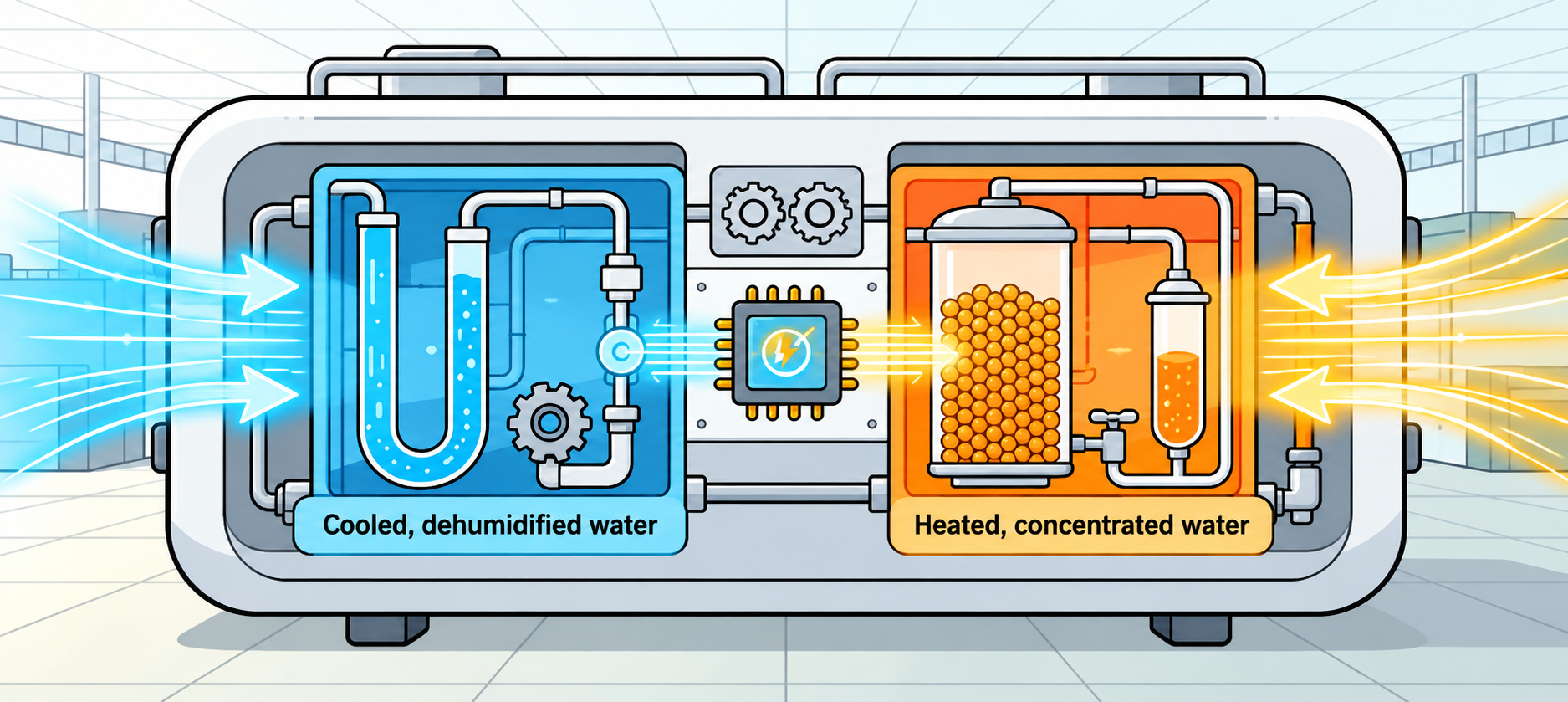
The HH Series operates on the Temperature Swing Adsorption (TSA) principle.
During the adsorption stage, moisture in the compressed air is captured by the desiccant at a relatively low temperature. When regeneration begins, an external heater raises the temperature of the regeneration air. Part of the dry product air acts as the carrier gas, transferring heat through the desiccant bed and allowing the adsorbed moisture to be released.
However, moisture desorption alone does not complete the regeneration process.
After heating, the desiccant must cool back toward its adsorption temperature before its adsorption capacity is fully restored. The complete regeneration process therefore contains two important stages:
Heating and desorption → cooling and regeneration
During heating and desorption, moisture is released from the desiccant. During cooling, the desiccant returns toward a condition suitable for the next adsorption cycle.
This heating-and-cooling sequence helps maintain stable adsorption performance and consistent outlet dew point over repeated operating cycles.
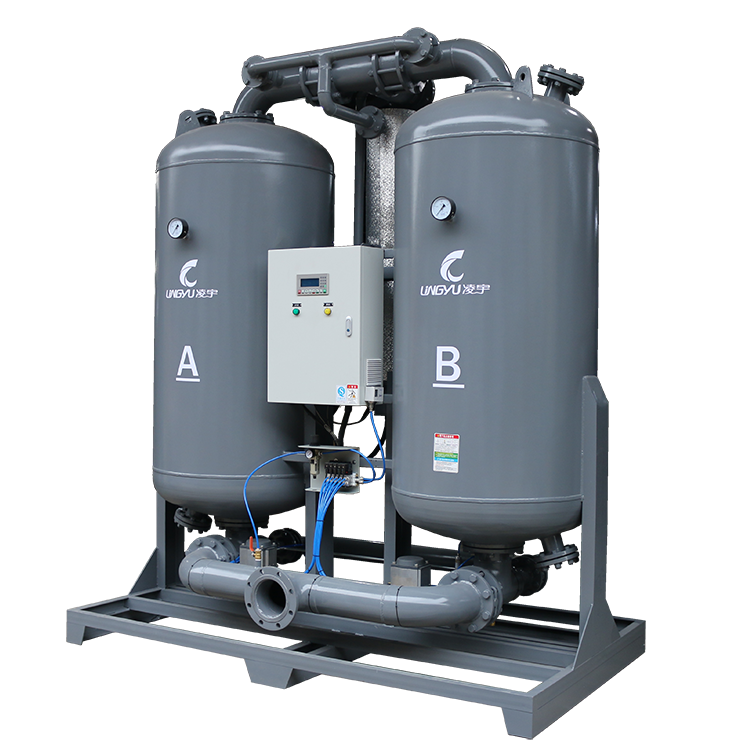
Main Design Features of the HH Series
The HH Series is not defined only by its heater. Several supporting components help maintain stable operation throughout adsorption, regeneration, depressurization, repressurization, and vessel switching.
High-Performance Pneumatic Valves
Responsive pneumatic valves support fast and stable switching between the two adsorption vessels.
Reliable valve operation is particularly important because repeated pressure cycling is part of the normal operating process.
High-Efficiency Desiccant
The HH Series uses activated alumina combined with high-performance molecular sieve.
The desiccant is selected to provide reliable adsorption capacity, abrasion resistance, and stable dew point performance while reducing excessive dust generation.
Intelligent Programmable Control
An electronic programmable controller manages the operating sequence, helping simplify monitoring, operation, and routine maintenance.
Automatic Repressurization
Before vessel switching, the system automatically equalizes and restores vessel pressure.
This reduces sudden pressure fluctuations and limits mechanical impact on the desiccant bed.
Heater Pressure Protection
The heater includes pressure protection designed to prevent dry heating, improving operating reliability and protecting the heating system during regeneration.
HH Series Operating Conditions
The standard HH Series technical conditions are:
| Parameter | Standard Condition |
|---|---|
| Applicable medium | Compressed air / non-corrosive air |
| Rated inlet pressure | 0.7 MPa |
| Operating pressure range | 0.6–1.0 MPa |
| Rated inlet temperature | 10–30°C |
| Maximum inlet temperature | ≤40°C |
| Average purge-air consumption | 4–8% |
| Outlet pressure dew point | ≤−40°C |
| Desiccant | Activated alumina + high-performance molecular sieve |
| Rated ambient temperature | 35°C |
| Ambient operating range | 2–45°C |
For pressure ratings or operating conditions outside the standard range, dryer selection should be based on actual inlet pressure, airflow, temperature, and required pressure dew point rather than nominal compressor capacity alone.
HH Series Technical Specifications
The HH Series covers a wide airflow range. Representative models illustrate how equipment dimensions, heater power, connection size, and weight change as treatment capacity increases.
| Model | Airflow | Power Supply | Total Power | Inlet / Outlet | Weight | Dimensions (L×W×H) |
|---|---|---|---|---|---|---|
| LY-HH10HX | 1.5 m³/min | 380 V / 50 Hz | 1.7 kW | G1″ | 125 kg | 726×520×1802 mm |
| LY-HH20HX | 2.5 m³/min | 380 V / 50 Hz | 1.7 kW | G1″ | 180 kg | 840×500×1691 mm |
| LY-HH50HX | 6.5 m³/min | 380 V / 50 Hz | 3.7 kW | G1½” | 436 kg | 1160×600×1847 mm |
| LY-HH120HX | 17.0 m³/min | 380 V / 50 Hz | 10.0 kW | DN65 | 850 kg | 1346×970×2390 mm |
| LY-HH450HX | 50.0 m³/min | 380 V / 50 Hz | 20.1 kW | DN100 | 2000 kg | 2040×1240×2780 mm |
| LY-HH1500HX | 150.0 m³/min | 380 V / 50 Hz | 55.1 kW | DN200 | 6100 kg | 3100×1580×3274 mm |
The standard HH range extends from 1.5 to 150 m³/min. For capacities above 150 m³/min, or where special materials, pressures, or temperatures are required, a customized technical evaluation is appropriate.
For detailed equipment information, users can also review Lingyu’s heated regeneration adsorption air dryer product page.
What Should Be Considered When Selecting an HH Series Dryer?
Selecting the correct dryer involves more than matching nominal airflow to the compressor’s rated capacity.
Required Pressure Dew Point
The HH Series is designed for applications requiring an outlet pressure dew point of ≤−40°C under its specified operating conditions.
Users should first determine whether this dew point is actually required by the process. Specifying a substantially lower dew point than necessary can increase equipment and operating costs without providing a corresponding process benefit.
Actual Inlet Airflow
Dryer capacity should be based on actual compressed-air demand and operating conditions rather than compressor nameplate capacity alone.
Where demand varies significantly, both peak consumption and normal operating load should be considered.
Inlet Temperature
The standard rated inlet temperature is 10–30°C, with a maximum inlet temperature of 40°C.
Higher inlet temperatures increase the moisture load entering the dryer and can affect adsorption performance. The upstream compressor station and aftercooling arrangement should therefore be considered during dryer selection.
Operating Pressure
The standard rated inlet pressure is 0.7 MPa, with a normal operating range of 0.6–1.0 MPa.
If the system operates at another pressure, actual treatment capacity should be confirmed rather than assuming that the nominal airflow remains unchanged.
Purge-Air Consumption
The HH Series has an average regeneration purge-air consumption of 4–8%.
This parameter matters because regeneration air is compressed air that has already consumed compressor energy.
When evaluating long-term operating cost, both electrical heating power and purge-air consumption should therefore be considered rather than comparing heater power alone.
Upstream Filtration Matters
Adsorption dryers perform best when liquid water, oil aerosols, and solid contaminants are properly controlled before compressed air enters the desiccant vessels.
Contamination can affect desiccant performance, increase pressure drop, and shorten maintenance intervals.
A properly designed compressed-air treatment train may therefore include moisture separation and appropriate precision compressed-air filters before or after the adsorption dryer according to the required air quality.
Water, oil, and solid particles should be treated as distinct compressed-air contaminants, with treatment equipment selected according to the required contamination limits.
Maintenance Points for Stable HH Series Operation
Routine maintenance should focus on the components that directly affect regeneration and dew point stability.
Important checks include valve switching, heater operation, exhaust condition, controller alarms, filter condition, and the physical condition of the desiccant.
Users should also pay attention to unusual pressure fluctuations or increased pressure drop. Because the HH Series automatically repressurizes the vessels before switching, abnormal switching behavior may indicate that valves, control components, or air passages require inspection.
Desiccant should not be replaced solely according to a fixed calendar interval. Its actual condition depends on inlet-air quality, operating hours, oil contamination, moisture loading, regeneration effectiveness, and overall system operating conditions.
Where the HH Series Fits in an Industrial Compressed-Air System
The HH Series should be considered as one component of a complete compressed-air purification system rather than as an isolated machine.
A complete treatment configuration may involve an air receiver, pre-filtration, refrigerated drying or upstream cooling where required, adsorption drying, and downstream precision filtration.
The actual arrangement depends on inlet conditions and the air-quality requirements at the point of use.
Different industrial applications may require different combinations of refrigerated dryers, adsorption dryers, combined dryers, receivers, and filter grades. Equipment should therefore be selected around actual operating and point-of-use requirements rather than a generic industry list.
When Should You Consider a Different Regeneration Technology?
The HH Series is particularly relevant when a plant requires a low pressure dew point but can accept a controlled amount of compressed-air consumption during regeneration.
Projects with different priorities may require another adsorption technology. For example, facilities that place greater emphasis on minimizing purge-air losses may evaluate blower-heated or heat-of-compression regeneration technologies.
No single regeneration method is universally better.
Selection should consider required pressure dew point, actual airflow, inlet pressure and temperature, available electrical power, purge-air cost, operating load profile, maintenance capability, and required level of automation.
This keeps the decision focused on total system performance rather than a single equipment parameter.
Getting the Right HH Series Configuration
Before requesting a dryer quotation, it is useful to prepare the required airflow, inlet pressure, inlet temperature, outlet pressure dew point, ambient conditions, operating hours, and any special material or control requirements.
Providing these parameters makes it easier to identify the appropriate HH model and determine whether a standard configuration is suitable.
For non-standard capacities or special operating requirements, a customized technical configuration can be evaluated.
Conclusion
The HH Series heated regenerative adsorption dryer combines Temperature Swing Adsorption, external heating, controlled dry-air regeneration, and a two-stage heating-and-cooling regeneration process to achieve an outlet pressure dew point of ≤−40°C.
Its standard operating conditions include 0.7 MPa rated inlet pressure, 0.6–1.0 MPa operating pressure, 10–30°C rated inlet temperature, ≤40°C maximum inlet temperature, 4–8% average purge-air consumption, 35°C rated ambient temperature, and a 2–45°C ambient operating range.
For equipment selection, the most important factors are not simply dryer size or heater power. Actual airflow, inlet pressure, inlet temperature, required dew point, purge-air consumption, filtration, and operating conditions should all be evaluated together.
By treating the HH Series as part of the complete compressed-air purification system, users can select a configuration that provides stable drying performance while balancing energy consumption, maintenance requirements, and long-term operating reliability.