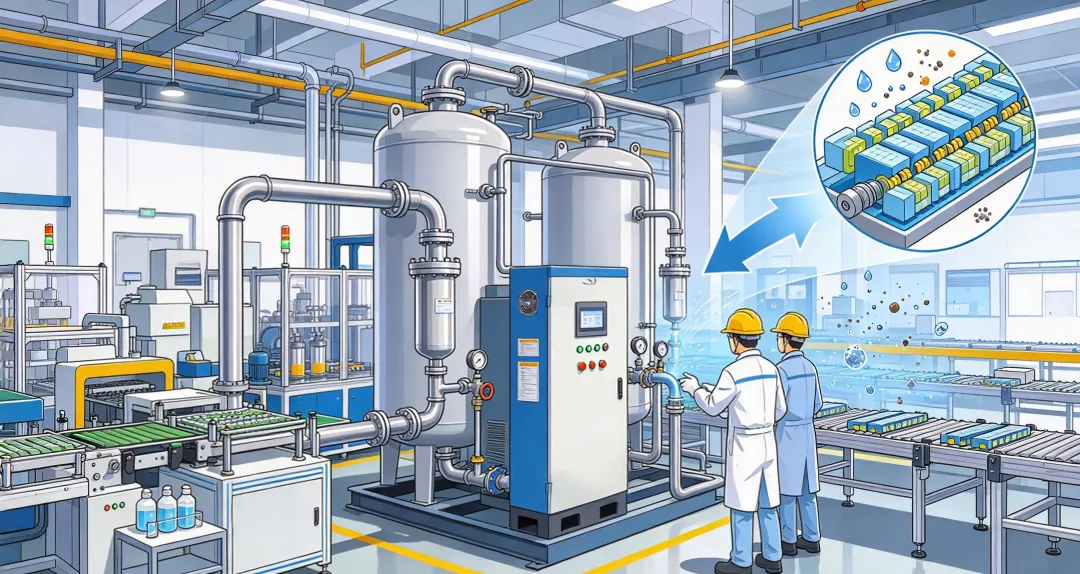
Compressed air is used in many healthcare-related environments, including hospitals, dental facilities, laboratories, pharmaceutical production areas, and medical-equipment operations.
Because atmospheric air naturally contains moisture and other contaminants, compressed air must be properly treated before it is used in sensitive applications.
A medical air dryer plays an important role in controlling water vapor within a medical or healthcare compressed-air system. However, drying is only one part of air-quality management. Depending on the intended use, filtration, oil control, monitoring, system design, validation, and applicable healthcare requirements may also need to be considered.
For healthcare-related compressed-air applications, Lingyu provides dedicated medical and dental solutions.
What Is a Medical Air Dryer?
“Medical air dryer” is a broad application term rather than one universal dryer design.
In a healthcare compressed-air system, the dryer is used to reduce water vapor and maintain the pressure dew point required by the intended application.
Depending on system requirements, the drying technology may include refrigerated or adsorption/desiccant methods.
However, the dryer should not be described as independently removing every possible contaminant.
Moisture, oil, and solid particles are separate compressed-air contamination concerns. A complete air-treatment system may therefore require dryers, filters, separators, drains, monitoring devices, and other equipment.
Lingyu’s air-treatment portfolio follows this system-level approach, with refrigerated air dryers, regenerative adsorption dryers, combined dryers, and precision filters serving different treatment requirements.
Why Moisture Control Matters in Healthcare Compressed Air
When ambient air is compressed, the amount of water contained in a given volume increases.
As compressed air subsequently cools, some of that moisture can condense into liquid water.
In compressed-air systems, uncontrolled moisture can contribute to corrosion, unstable equipment operation, and contamination problems.
In healthcare-related environments, these issues can become particularly important because compressed air may serve sensitive instruments, pneumatic equipment, dental systems, laboratory devices, or other applications where consistent air quality matters.
Corrosion and Equipment Damage
Liquid water can contribute to corrosion inside piping, receivers, valves, and downstream pneumatic components.
Over time, this can increase maintenance requirements and introduce additional contaminants into the air system.
Unstable Performance of Pneumatic Equipment
Precision pneumatic equipment depends on controlled pressure and air quality.
Excessive moisture can interfere with valves, instruments, and other components, particularly when condensate accumulates downstream.
Condensation in Distribution Systems
If the compressed-air dew point is not sufficiently below the lowest temperature encountered in the distribution system, moisture can condense further downstream.
This is one reason dryer selection should be based on the required pressure dew point, rather than simply on whether a dryer is installed.
Microbiological Control Requires More Than a Dryer
Moisture control can be relevant to overall contamination management, but a dryer alone cannot guarantee microbiologically safe or sterile compressed air.
Microbiological control in healthcare-related systems depends on the complete system design, operating conditions, filtration, maintenance, hygiene practices, monitoring, validation, and applicable requirements.
A dryer should therefore be described as supporting moisture control—not as independently eliminating microbiological or infection risk.
Refrigerated Air Dryers for Healthcare-Related Applications
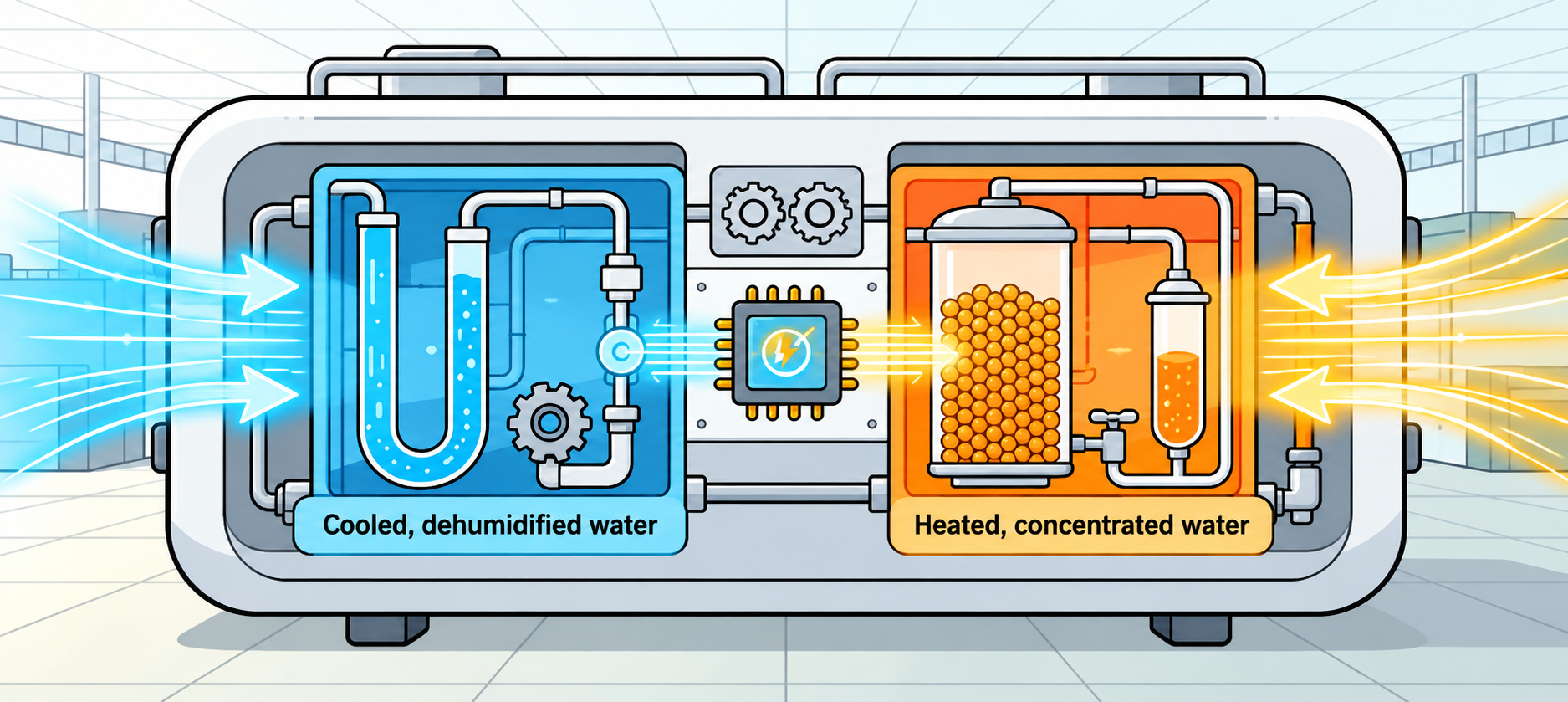
A refrigerated air dryer removes moisture by cooling compressed air until water vapor condenses.
The condensed water is separated and discharged before the treated compressed air is reheated toward ambient temperature.
Lingyu refrigerated dryer systems generally provide pressure dew points in the 2–10°C range, depending on the specific series and operating conditions.
This type of dryer may be appropriate where a moderate pressure dew point satisfies the actual system requirement.
However, a refrigerated dryer should not automatically be considered suitable for every medical compressed-air application solely because it removes moisture. The required air quality must be determined from the actual point of use.
Desiccant Air Dryers for Lower Dew Point Requirements
Where a substantially lower pressure dew point is required, a desiccant air dryer can provide deeper drying.
Adsorption dryers use desiccant material to capture water vapor from compressed air. In regenerative designs, one adsorption bed dries the compressed air while another bed regenerates.
Lingyu provides heatless, heated-purge, modular, blower-heated, zero-purge blower-heated, and heat-of-compression regenerative adsorption dryer configurations.
Depending on the series, pressure dew point configurations around −20°C and −40°C are available.
For example, Lingyu’s DH combined compressed-air dryer provides an outlet pressure dew point of ≤−40°C under its specified operating conditions and uses activated alumina plus high-performance molecular sieve as the desiccant combination.
Adsorption drying can therefore be considered where a healthcare, pharmaceutical, or laboratory process requires a pressure dew point substantially below that typically provided by refrigeration drying.
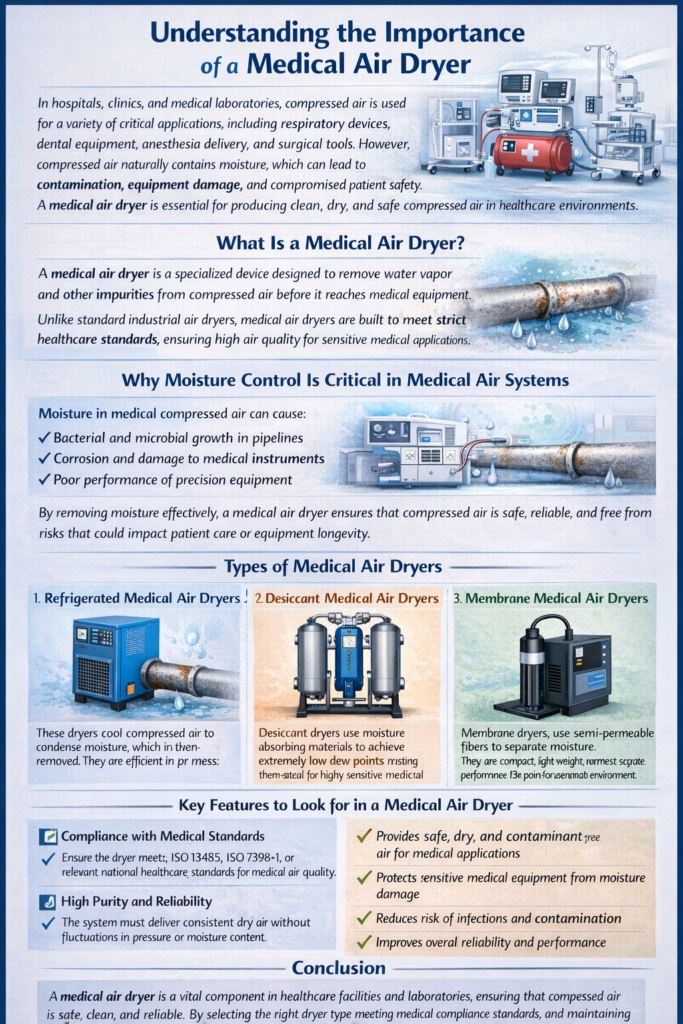
What About Membrane Medical Air Dryers?
Membrane drying is an established compressed-air technology in the wider market and can be used in certain specialized or low-flow applications.
Lingyu’s current dryer range, however, centers on refrigerated, regenerative adsorption, and combined compressed-air drying technologies.
For a Lingyu-based system evaluation, these are therefore the primary dryer technologies to compare.
Dry Air Is Only One Part of Medical Compressed-Air Quality
A common mistake is to assume that a low dew point automatically means high-quality medical air.
It does not.
A dryer primarily controls moisture.
Oil aerosols, oil vapor, solid particles, microorganisms, and other contaminants involve different treatment and quality-control requirements.
Appropriate filtration should therefore be considered as part of the complete system. Lingyu’s precision compressed air filter can form part of a broader compressed-air purification arrangement.
The exact filtration and treatment configuration should be determined by the intended use of the compressed air and the applicable air-quality specification.
Medical, Dental, and Laboratory Applications Are Not Identical
The phrase “medical compressed air” can cover several very different applications.
Compressed air used in a dental facility may have different requirements from air used in laboratory instrumentation, pharmaceutical manufacturing, general hospital pneumatic equipment, or patient respiratory applications.
For example, Lingyu provides separate medical and dental compressed-air solutions and laboratory and analytical equipment solutions.
A dryer should therefore not be selected simply because a facility is described as “medical.”
The actual point of use and its air-quality requirements should be defined first.
Pharmaceutical Production Is a Separate Application
Pharmaceutical manufacturing is also frequently grouped broadly under healthcare, but it should be treated as a distinct industrial process application.
Compressed air may be used for instruments, processing equipment, packaging, production utilities, and other purposes, each potentially having different air-quality requirements.
Lingyu’s pharmaceutical and biopharmaceutical solutions provide application-specific context for this sector.
This approach is more technically accurate than assuming that hospital, laboratory, dental, and pharmaceutical systems share one universal “medical dryer” specification.
Medical Air Dryers and ISO Requirements
Healthcare compressed-air requirements need to be evaluated at the system and application level.
Lingyu holds the following management-system certifications:
ISO 9001 — Quality Management System
ISO 14001 — Environmental Management System
ISO 45001 — Occupational Health & Safety Management System
These are company management-system certifications. They should not be presented as proof that an individual air dryer is certified as a medical device or that every dryer independently satisfies a particular medical-gas-system standard.
Healthcare facilities may have requirements that apply to the complete medical-gas or compressed-air system, including the air source, purification equipment, redundancy, distribution, monitoring, commissioning, testing, documentation, and maintenance.
Supplier management-system certifications are not substitutes for application-specific system qualification.
The dryer and complete compressed-air treatment system should therefore be selected and engineered according to the healthcare facility’s applicable medical-gas, air-quality, safety, and regulatory requirements.
How to Select a Dryer for a Medical or Healthcare Application
Selection should begin by defining exactly how the compressed air will be used.
Important parameters include:
- Required pressure dew point
- Actual and peak airflow
- Operating pressure
- Inlet temperature
- Contamination limits
- Filtration requirements
- Acceptable pressure drop
- System redundancy
- Monitoring requirements
- Maintenance requirements
- Applicable facility or medical-gas specifications
If a moderate pressure dew point is sufficient, refrigerated drying may be appropriate.
If a substantially lower pressure dew point is required, adsorption drying may be more suitable.
Where the initial moisture load and low-dew-point requirements both need to be managed, a combined refrigerated and adsorption dryer can also be considered.
In Lingyu’s combined systems, the refrigerated stage removes a substantial portion of the initial moisture load before the downstream adsorption stage performs deeper drying.
For facilities comparing technologies, the compressed air dryer selection guide provides a broader selection framework.
Pressure Dew Point Should Be Specified, Not Assumed
It can be tempting to specify the lowest possible dew point for every sensitive application.
That is not always the most efficient approach.
Different dryer technologies serve different moisture-control requirements.
Lingyu refrigerated dryers generally provide pressure dew points in the 2–10°C range under their specified operating conditions.
Adsorption and combined dryers can provide substantially lower pressure dew points, including −20°C and −40°C configurations, with certain combined dryer systems providing ≤−40°C.
The correct target should therefore be determined by the actual process and applicable specification.
Over-specifying pressure dew point can increase equipment complexity and energy consumption without necessarily providing additional process benefit.
Reliability and Redundancy Matter
Healthcare-related compressed-air applications may require high availability.
For critical systems, choosing a suitable dryer may not be enough by itself. The overall system design may also need to consider:
- Redundancy
- Isolation for maintenance
- Standby capacity
- Alarms
- Air-quality monitoring
- Pressure monitoring
- Contingency operation
The exact redundancy requirement depends on the application and applicable system requirements.
This is another reason a medical air dryer should be considered part of a complete engineered compressed-air system rather than as a standalone component that independently guarantees medical-air quality.
Maintenance Is Part of Air Quality
Dryer performance can deteriorate if maintenance is neglected.
For refrigerated systems, maintenance may involve drains, heat exchangers, condensers, refrigeration components, and controls.
For adsorption systems, valves, desiccant, filters, silencers, heaters or blowers where fitted, and dew-point monitoring equipment may require periodic inspection.
Filters should also be maintained according to their actual condition and specified service requirements.
In healthcare-related environments, maintenance procedures and any required verification following maintenance should be determined by the facility’s quality and safety requirements.
What a Medical Air Dryer Can—and Cannot—Do
A correctly selected dryer can:
- Control moisture
- Maintain the required pressure dew point
- Reduce the risk of downstream condensation
- Help limit moisture-related corrosion
- Help protect moisture-sensitive pneumatic equipment
- Form part of a broader compressed-air purification system
A dryer alone cannot guarantee that compressed air is:
- Sterile
- Free from every contaminant
- Medically certified
- Suitable for direct patient use
- Compliant with every healthcare or medical-gas requirement
Those outcomes depend on the complete compressed-air generation, purification, distribution, monitoring, maintenance, testing, and qualification system.
Terms such as “medical-grade,” “sterile,” “safe for breathing,” and “ISO compliant” should therefore only be applied when the specific equipment and complete system have appropriate supporting qualification.
Conclusion
A medical air dryer can be an important part of compressed-air treatment in hospitals, dental facilities, laboratories, pharmaceutical production environments, and other healthcare-related operations.
Its primary function is moisture control.
Refrigerated dryers can provide moderate pressure dew points for suitable applications, while desiccant and combined dryers can provide substantially deeper drying where the process requires it.
However, dry compressed air should not automatically be described as medical-grade air.
Healthcare compressed-air quality depends on the complete system—including moisture control, filtration, contamination limits, pressure stability, monitoring, redundancy, maintenance, commissioning, and applicable facility or medical-gas requirements.
Lingyu provides refrigerated, adsorption, combined, and filtration technologies that can form part of industrial or healthcare-related compressed-air treatment systems. Individual equipment suitability must still be evaluated against the requirements of the specific medical, dental, laboratory, or pharmaceutical application.
The correct approach is therefore to define the point of use first and then select the dryer and downstream treatment system according to the required air quality, operating conditions, and applicable compliance requirements.