Have you ever heard a pneumatic tool operating on a factory floor or watched an air-powered drill at a construction site? Both depend on compressed air, one of the most widely used sources of power and process air in industry.
Compressed air is atmospheric air that has been mechanically compressed to a pressure higher than the surrounding atmosphere. The stored pressure energy can then be transported through piping and released where it is needed.
This article explains what compressed air is, how it is produced, which components make up an industrial compressed-air system, where it is used, and how proper air treatment and maintenance improve system reliability.
What Is Compressed Air?
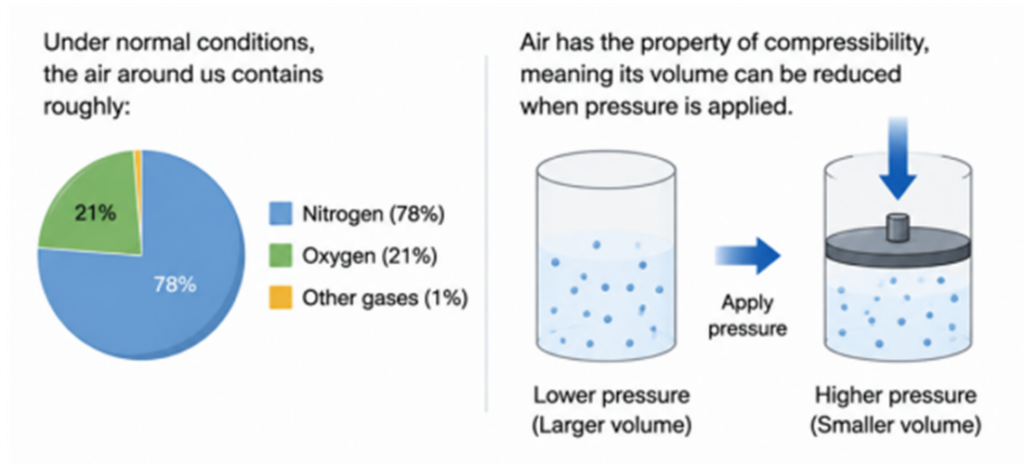
Compressed air is air maintained at a pressure above atmospheric pressure.
Ambient air consists mainly of nitrogen and oxygen, together with smaller amounts of other gases and water vapor. Because gases are compressible, the volume occupied by air can be reduced by applying mechanical force.
During compression, several changes occur:
- Air volume decreases
- Pressure increases
- Temperature rises
- Water vapor becomes more concentrated
The pressure energy stored in compressed air can later be converted into mechanical motion, airflow, or process energy.
This is why compressed air is frequently used to operate pneumatic tools, cylinders, actuators, valves, conveying equipment, production machinery, and automated systems.
Gauge Pressure and Absolute Pressure
Two pressure references are commonly used in compressed-air engineering.
Gauge pressure measures pressure relative to the surrounding atmosphere.
Absolute pressure measures pressure relative to a perfect vacuum.
Their relationship can be expressed as:
Absolute Pressure = Gauge Pressure + Atmospheric Pressure
Understanding which pressure reference is being used is important when comparing equipment specifications, compressor performance, and air-treatment requirements.
Why Does Compression Generate Heat?
Compressing air requires mechanical energy.
As the air is forced into a smaller volume, its temperature increases. This compression heat is an important consideration in industrial systems because air leaving the compressor may be much hotter than the surrounding environment.
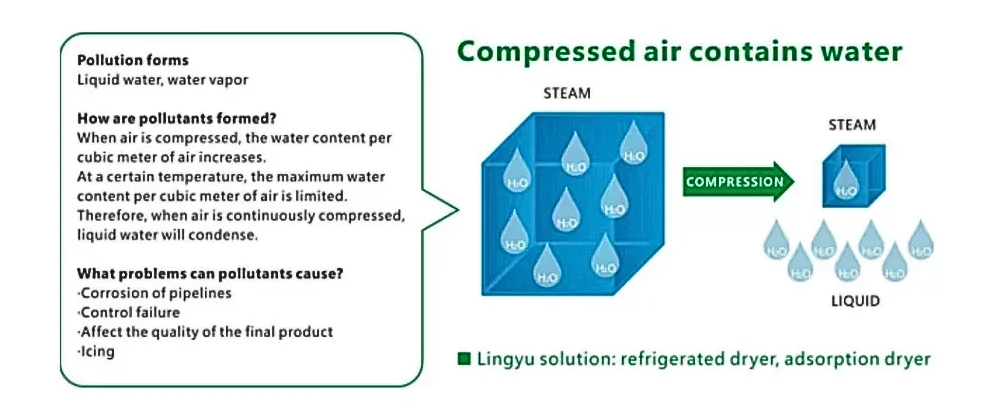
As the compressed air subsequently cools in an aftercooler, receiver, piping system, or treatment equipment, some of the water vapor can condense into liquid water.
This is one of the main reasons moisture management is necessary in compressed-air installations.
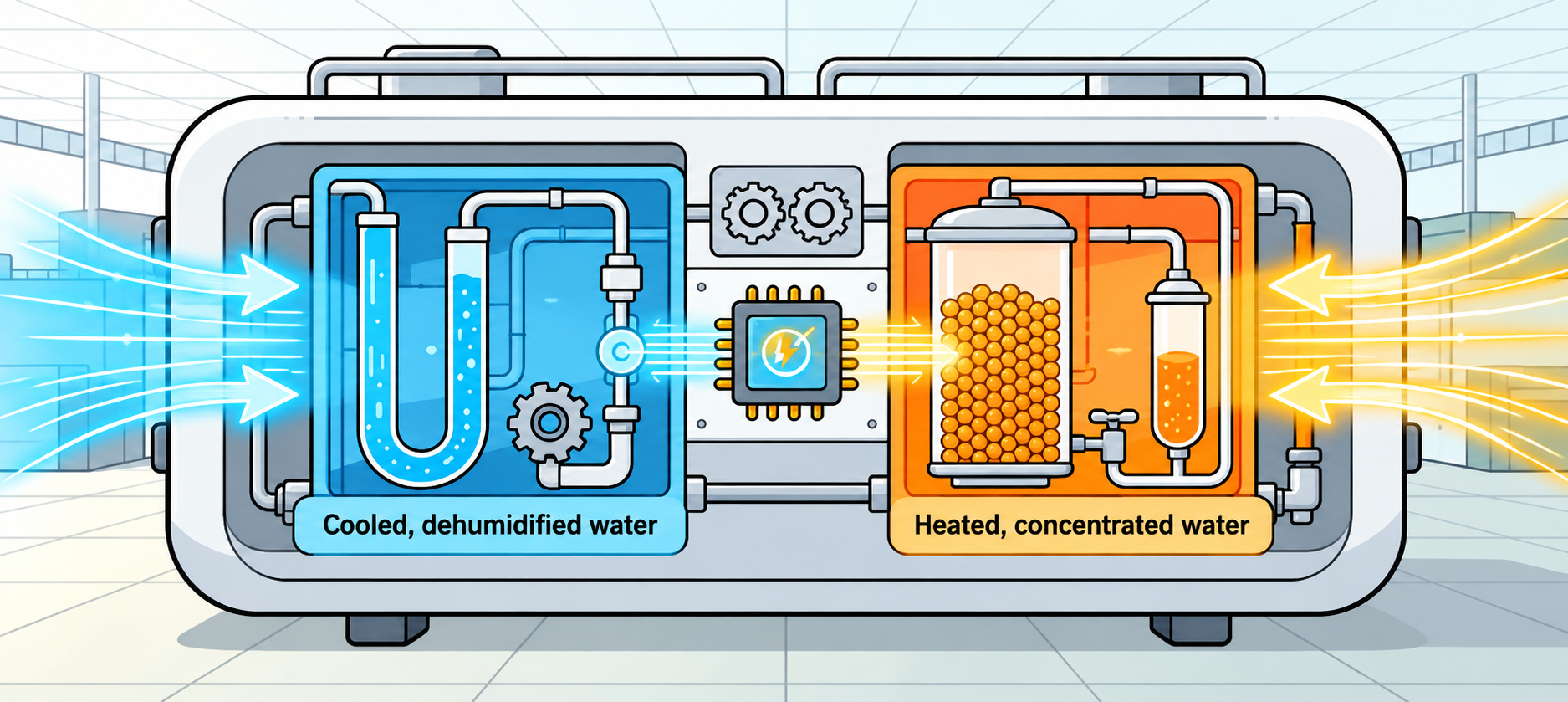
Compression heat can also be recovered in certain air-treatment processes. For example, heat-of-compression regenerative dryers can use thermal energy contained in high-temperature compressor discharge air to regenerate the desiccant.
How Is Compressed Air Produced?
Compressed air is produced by an air compressor.
The compressor draws ambient air into the machine and applies mechanical energy to increase its pressure. An electric motor is commonly used as the prime mover in industrial compressor installations.
Compressors can generally be divided into two broad categories.
Positive Displacement Compressors
Positive displacement compressors trap a quantity of air and mechanically reduce its volume.
Common examples include:
- Reciprocating piston compressors
- Rotary screw compressors
Rotary screw compressors are widely used in industrial plants where continuous and relatively stable airflow is required.
Dynamic Compressors
Dynamic compressors increase air velocity first and then convert part of that velocity into pressure.
Centrifugal compressors are a common example and are frequently associated with higher-flow industrial installations.
Regardless of compressor type, the compressed air leaving the machine normally requires further cooling, moisture separation, storage, filtration, and sometimes drying before reaching the point of use.
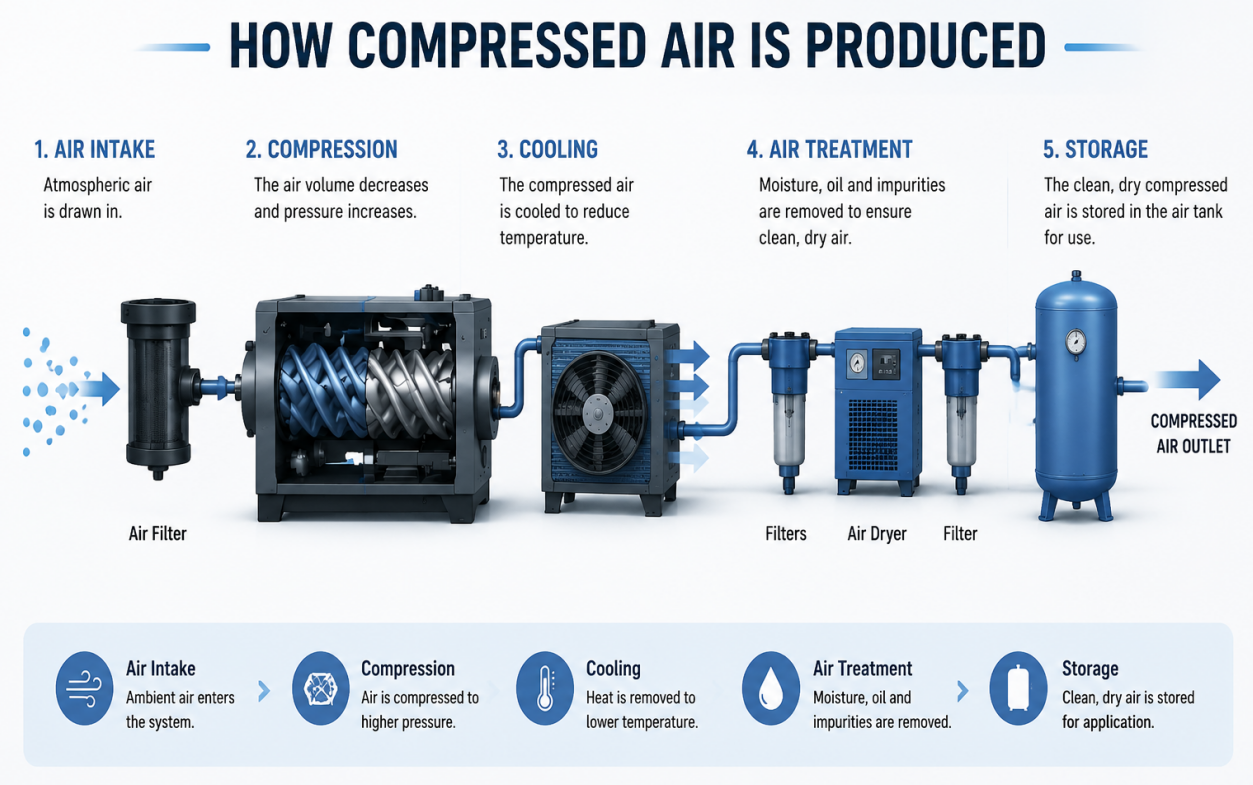
Components of a Compressed Air System
An industrial compressed-air system involves more than the compressor itself. Its exact configuration depends on required flow, pressure, air quality, pressure dew point, and application conditions.
A typical system can contain the following equipment.
1. Air Intake Filter
The intake filter helps prevent atmospheric dust and larger particles from entering the compressor.
Keeping the intake side clean helps protect compressor components and supports stable operation.
2. Air Compressor
The compressor generates the required compressed-air pressure and flow.
Selection should consider:
- Required flow
- Required operating pressure
- Load profile
- Duty cycle
- Air-quality requirements
- Future demand
3. Aftercooler
Compressed air leaves the compressor at an elevated temperature.
The aftercooler removes heat from the compressed air. As the temperature decreases, some water vapor condenses and can then be separated from the airflow.
4. Air Receiver
An air receiver provides temporary compressed-air storage and helps stabilize system operation.
Depending on the installation, it can help:
- Buffer changes in air demand
- Reduce rapid pressure fluctuations
- Support compressor control
- Provide additional cooling time
- Allow condensate to collect for drainage
5. Compressed Air Dryer
Even after cooling and initial condensate separation, compressed air still contains water vapor.
A dryer reduces this remaining moisture to an acceptable pressure dew point.
Two important technologies are refrigerated and adsorption drying.
Refrigerated Drying
A refrigerated dryer cools compressed air so additional water vapor condenses and can be separated.
In the refrigerated drying process, compressed air is cooled in the refrigerant evaporator to a pressure dew point of approximately 2–10°C, after which condensed moisture is separated and discharged.
For a more detailed explanation, see how refrigerant air drying works.
Adsorption Drying
Where significantly lower pressure dew points are required, adsorption technology can be used.
Compressed air passes through a desiccant bed, where residual water vapor is adsorbed.
For example, the M Series modular adsorption dryer provides an outlet pressure dew point of ≤−20°C, with −40°C available as an option.
For applications needing deeper drying, see the guide to desiccant air dryer systems.

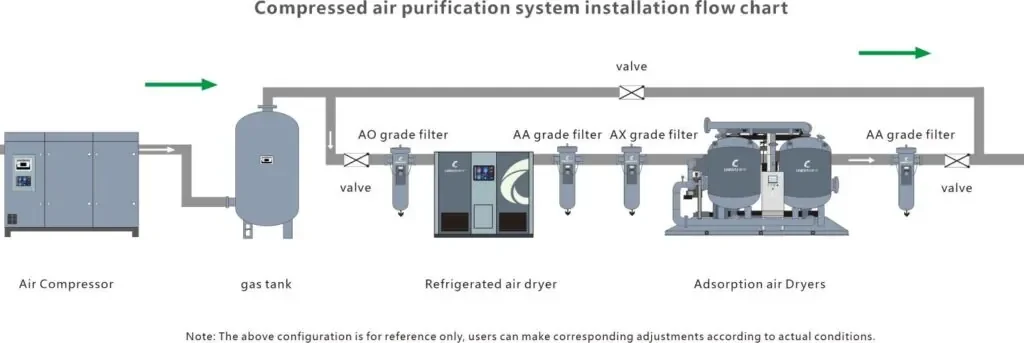
6. Compressed Air Filters
Drying alone does not address every contaminant.
Compressed-air filters can be used to remove solid particles, liquid aerosols, oil aerosols, and other contaminants depending on the required air quality.
Different filtration grades can be combined according to particle- and oil-removal requirements.
Plants evaluating filtration maintenance can refer to the compressed air filter replacement guide.
7. Condensate Drains and Distribution Piping
Condensate collected in coolers, receivers, separators, filters, and dryers must be discharged reliably.
Automatic drains help remove collected liquid without requiring continuous manual operation.
The piping network then distributes treated compressed air to production areas and points of use.
For a broader look at treatment-system architecture, see the core components of a compressed air purification system.
Why Does Compressed Air Need Treatment?
Air treatment is necessary because the compressor does not create perfectly clean, dry air.
The final compressed-air stream can contain:
- Water vapor
- Condensed water
- Atmospheric particles
- Oil aerosols, depending on the system
- Rust and pipeline debris
- Other contaminants introduced downstream
Moisture can contribute to corrosion, interfere with pneumatic equipment, contaminate processes, and create problems in cold environments.
The appropriate treatment level depends on the end use.
General workshop equipment may tolerate a comparatively moderate pressure dew point, while electronics, pharmaceuticals, instrumentation, specialty manufacturing, or other moisture-sensitive processes can require much drier compressed air.
A useful next step is to review how to select a compressed air dryer according to flow, pressure, temperature, and required pressure dew point.
What Is Compressed Air Used For?
Compressed air can generally be used either as a source of mechanical power or as part of an industrial process.
Power and Automation
Compressed air can drive:
- Impact tools
- Drills
- Grinders
- Sanders
- Pneumatic cylinders
- Control valves
- Clamping systems
- Conveyors
- Automated production equipment
Because pneumatic systems can provide fast and repeatable movement, they are widely used in industrial automation.
Manufacturing
Compressed air supports assembly, machine operation, cleaning, conveying, positioning, instrumentation, and production equipment in many manufacturing plants.
Applications extend across machinery, electronics, automotive manufacturing, steel production, power generation, battery manufacturing, and many other industries.
Food and Pharmaceutical Production
Compressed air can support packaging, conveying, pneumatic operation, and other manufacturing processes.
In applications where compressed air may affect the product or production environment, air-quality requirements should be evaluated carefully.
Electronics and Precision Manufacturing
Moisture and contamination control can be particularly important for electronics and other precision processes.
Dry, properly treated compressed air can help protect sensitive pneumatic equipment and support stable manufacturing conditions.
Petrochemical and Chemical Processing
Compressed air is used for pneumatic control, instrumentation, process equipment, and other plant operations.
The appropriate dryer and filtration system should be selected according to process safety and required air quality.
Other Industrial Uses
Additional applications can include:
- Pneumatic conveying
- Painting
- Material handling
- Mining
- Wastewater treatment
- Packaging
- Machine tools
- Instrumentation
The correct air-treatment configuration can vary substantially among these applications.
Maintenance Tips for Compressed Air Systems
Efficient operation depends on both the compressor and the downstream treatment equipment.
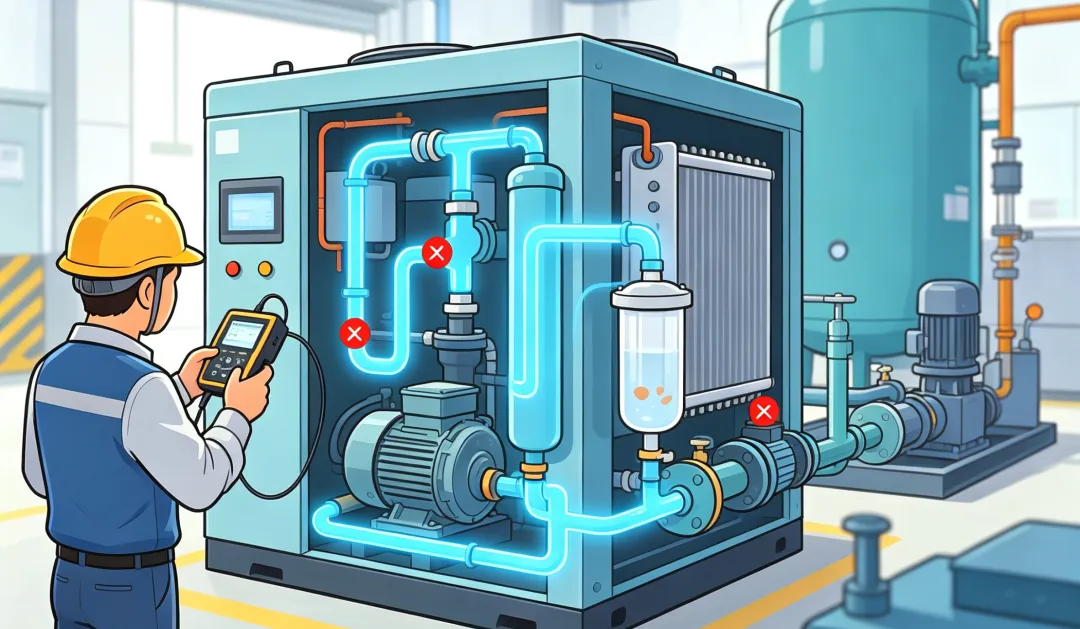
1. Inspect and Repair Air Leaks
Leaks waste compressor capacity and force the system to produce more air than the plant actually uses.
Regular leak surveys should include:
- Piping joints
- Flexible hoses
- Couplings
- Valves
- Regulators
- Point-of-use connections
Ultrasonic leak detection can help identify leaks that are difficult to hear in noisy production environments.
Instead of assuming a universal percentage of energy loss, plants should measure their own system leakage and prioritize repairs according to actual air loss.
2. Maintain Filters
Dirty filters can increase differential pressure and restrict airflow.
Inspect and replace filter elements according to actual operating conditions and manufacturer recommendations.
Pressure drop across treatment equipment should also be monitored because unnecessary pressure losses increase the compressor pressure required to maintain adequate pressure at the point of use.
For more detail, see compressed air pressure drop and system efficiency.
3. Monitor Dryer Performance
Do not judge dryer condition only by whether liquid water is visible.
Monitor relevant parameters such as:
- Pressure dew point
- Inlet temperature
- Ambient temperature
- Airflow
- Pressure
- Drain operation
- Refrigeration or regeneration condition
For adsorption equipment, desiccant condition, switching valves, purge or regeneration systems, and filters also require routine inspection.
4. Check Condensate Drains
Blocked or failed drains can allow condensate to accumulate and move downstream.
Inspect drains installed on:
- Aftercoolers
- Moisture separators
- Air receivers
- Filters
- Dryers
Ensure condensate is removed reliably under actual operating conditions.
5. Avoid Unnecessarily High System Pressure
Producing air at a pressure higher than the process requires increases compressor workload and can also increase leakage losses.
The objective should be to maintain sufficient pressure at the point of use while minimizing unnecessary pressure throughout generation, treatment, and distribution.
6. Monitor Heat Exchangers and Cooling Systems
Dirty heat exchangers, insufficient ventilation, or inadequate cooling water can reduce dryer and compressor performance.
For refrigerated air dryers in particular, condenser condition and cooling performance directly affect the refrigeration cycle.
7. Keep Maintenance Records
Record key information such as:
- Compressor pressure
- Flow demand
- Dryer pressure dew point
- Filter differential pressure
- Drain inspections
- Leak repairs
- Service dates
- Abnormal alarms
Trend data can reveal gradual deterioration before it develops into a production problem.
Frequently Asked Questions About Compressed Air
1. Why Is Compressed Air Widely Used in Industry?
Compressed air is easy to distribute through piping and can operate a wide variety of pneumatic components, tools, valves, actuators, and automation equipment.
It is particularly useful where simple, fast mechanical motion or centralized pneumatic power distribution is required.
However, compressed air is not inherently the most energy-efficient source for every task. Its suitability should be evaluated according to the application and overall system operating cost.
2. What Is the Pressure Dew Point of Compressed Air?
Pressure dew point, or PDP, is the temperature at which water vapor begins to condense while the air remains at operating pressure.
A lower PDP indicates drier compressed air.
The required pressure dew point depends on the application and dryer technology. Refrigerated systems typically provide moderate dew points, including approximately 2–10°C PDP for Lingyu refrigerated dryers, while adsorption systems can provide substantially lower dew points.
3. Why Does Compressed Air Need to Be Dried?
Moisture can condense as compressed air cools.
This water can contribute to pipeline corrosion, pneumatic-equipment problems, process contamination, and freezing where piping is exposed to low temperatures.
Drying reduces the risk by lowering the amount of water vapor remaining in the compressed air.
4. Do Different Applications Need Different Dew Points?
Yes.
There is no single correct pressure dew point for every compressed-air system.
A refrigerated dryer may be appropriate where moderate moisture control is sufficient. Adsorption or combined drying is more suitable when significantly lower pressure dew points are required.
Combined drying systems use refrigerated pre-drying followed by adsorption, reducing the moisture load on the desiccant stage while achieving a much lower final pressure dew point.
5. How Do I Choose an Air Dryer?
Important selection factors include:
- Required pressure dew point
- Actual airflow
- Inlet pressure
- Inlet temperature
- Ambient conditions
- Cooling conditions
- Operating hours
- Energy cost
- Pressure drop
- Maintenance requirements
Selecting equipment according to only compressor horsepower or nominal airflow can result in poor performance if actual inlet conditions differ from the dryer rating.
Lingyu Compressed Air Treatment Solutions
Guangdong Lingyu Energy Equipment Co., Ltd. provides equipment for compressed-air purification and separation, including refrigerated air dryers, regenerative adsorption dryers, combined drying systems, nitrogen generators, and precision compressed-air filters.
Different dryer configurations are available for different moisture-removal and energy requirements, including refrigerated, heatless, heated purge, blower-heated, heat-of-compression, modular, and combined technologies.
Depending on the model and configuration, selected equipment can support functions such as RS-485 communication, IoT connectivity, programmable controls, dew-point monitoring, and energy-saving control.
Lingyu also provides technical consultation, equipment commissioning, repair and maintenance support, spare parts, and customized maintenance solutions.
For project-specific dryer selection, system configuration, or technical requirements, users can contact Lingyu.