Heat of Compression Desiccant Air Dryers for Industrial Compressed Air Systems
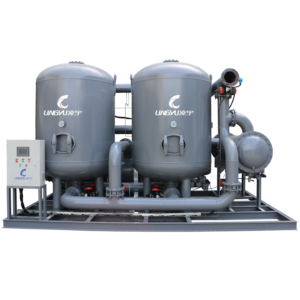
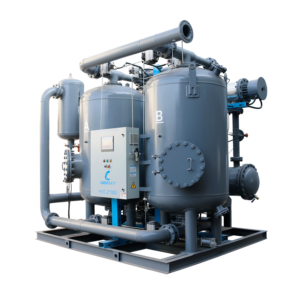
Heat of Compression (HOC) desiccant air dryers use the high-temperature heat generated during air compression to regenerate the desiccant.
Instead of relying primarily on electric heaters or large amounts of compressed purge air, the dryer recovers available compressor discharge heat and uses it during desiccant regeneration.
Lingyu offers two Heat of Compression configurations:
- HOC-E Low-Purge Series: regeneration air consumption ≤3%
- HOC-Z Zero-Purge Series: regeneration air consumption 0%
They are particularly suitable for large, continuously operating compressed air systems where high-temperature compressor discharge air is available.
How Does a Heat of Compression Desiccant Air Dryer Work?
During adsorption, compressed air passes through one desiccant tower, where water vapor is removed before the dry air continues downstream.
During regeneration, high-temperature compressed air from the compressor is directed through the saturated desiccant bed. The available compression heat releases the adsorbed moisture and regenerates the desiccant.
The regenerated bed is then cooled before the towers switch automatically.
Process Flow:
Hot Compressor Discharge Air → Heating / Regeneration → Cooling → Adsorption → Tower Switching
Because regeneration energy is recovered from the compression process, HOC dryers can significantly reduce dependence on external regeneration energy when correctly matched with the compressor system.
HOC-E Low-Purge vs HOC-Z Zero-Purge
| Parameter | HOC-E Low-Purge | HOC-Z Zero-Purge |
|---|
| Regeneration energy | Compression heat | Compression heat |
| Regeneration air consumption | ≤3% | 0% |
| Rated inlet pressure | 0.7 MPa | 0.7 MPa |
| Operating pressure | 0.6–1.0 MPa | 0.6–1.0 MPa |
| Rated inlet temperature | 120°C | 120°C |
| Allowable inlet temperature | 110–180°C | 110–180°C |
| Pressure dew point | -20°C / -40°C optional | -20°C / -40°C optional |
| Cooling-water temperature | ≤32°C | ≤32°C |
| Cooling-water pressure | 0.2–0.6 MPa | 0.2–0.6 MPa |
| Standard airflow range | 13.5–210 m³/min | 13.5–260 m³/min |
| Approx. airflow range | 477–7,416 CFM | 477–9,181 CFM |
| Cooling-water flow | Approx. 5.5–86 t/h | Approx. 10–156 t/h |
The HOC-E Series uses a small amount of product air during the regeneration and cooling process, with regeneration air consumption limited to ≤3%.
The HOC-Z Series uses a zero-purge regeneration configuration so that compressed product air is not consumed during regeneration.
How to Select a Heat of Compression Dryer
Heat of compression dryers should be selected according to the compressor and dryer as one integrated system, rather than according to airflow alone.
Key parameters include:
| Selection Parameter | What to Check |
| Airflow | CFM / SCFM / m³/min |
| Working pressure | Standard 0.6–1.0 MPa |
| Compressor discharge temperature | 110–180°C allowable |
| Required PDP | -20°C / -40°C |
| Regeneration air requirement | ≤3% or 0% |
| Cooling-water temperature | ≤32°C |
| Cooling-water pressure | 0.2–0.6 MPa |
| Cooling-water flow | Depends on selected model |
| Compressor load profile | Continuous / variable |
| Annual operating hours | Important for TCO |
The compressor discharge temperature must remain high enough to provide sufficient regeneration heat.
For systems with highly variable loads or insufficient discharge temperature, another regeneration technology may be more suitable.
Low-Purge vs Zero-Purge HOC Dryer
Choose the HOC-E Low-Purge Series when:
- Compression heat is available
- A small regeneration air loss of ≤3% is acceptable
- Lower system complexity is preferred
- Large continuous compressed air capacity is required
Choose the HOC-Z Zero-Purge Series when:
- Eliminating compressed-air regeneration loss is a priority
- The system operates continuously for long hours
- Large airflow capacity is required
- Suitable cooling-water conditions are available
- Long-term compressed air energy cost is important
Zero purge does not mean zero energy consumption. Cooling-water circulation, controls, pressure loss, and the overall compressor/dryer operating condition should still be included in the energy evaluation.
HOC vs Other Desiccant Dryer Technologies
| Factor | Heatless | Externally Heated | Blower Heated | HOC |
| Main regeneration source | Dry purge air | Heater | Blower + heater | Compression heat |
| Purge air | 8–14%* | 4–8%* | 0–3%* | 0–3%* |
| External regeneration heat | No | Yes | Yes | Recovered compressor heat |
| Compressor dependency | Low | Low | Low | High |
| Typical system size | Small–medium | Medium–large | Medium–large | Large |
| Best operating profile | General | Continuous | Continuous | Continuous high-load |
| Main TCO consideration | Purge loss | Purge + heater | Blower/heater | Compressor integration |
*Based on the corresponding Lingyu product series technical data.
HOC technology generally becomes more attractive as airflow and annual operating hours increase, provided sufficient compression heat is continuously available.
Frequently Asked Questions
What inlet temperature does a Heat of Compression dryer require?
The Lingyu HOC-E and HOC-Z Series have a rated inlet temperature of 120°C and an allowable inlet temperature range of 110–180°C.
What pressure dew point can the HOC dryer achieve?
Both series are available with -20°C or -40°C pressure dew point configurations.
Does a Heat of Compression dryer use purge air?
The HOC-E Series uses ≤3% regeneration air, while the HOC-Z Series specifies 0% regeneration air consumption.
Does an HOC dryer require cooling water?
Yes. The provided HOC-E and HOC-Z configurations use cooling water. The specified cooling-water temperature is ≤32°C, with a pressure range of 0.2–0.6 MPa.
What capacity range is available?
The HOC-E Series covers 13.5–210 m³/min, while the HOC-Z Series covers 13.5–260 m³/min in the standard technical range provided.
When should I choose HOC instead of a blower-heated dryer?
HOC should be considered when high-temperature compressor discharge air is continuously available and heat recovery can be integrated into the drying system. Blower-heated dryers are less dependent on compressor discharge heat and can therefore be easier to apply where compressor operating conditions vary.
Regarding Heat of Compression Desiccant Air Dryers
Heat of Compression (HOC) Desiccant Air Dryer: Working Principle & Energy Savings
A Heat of Compression (HOC) desiccant air dryer, also known as a compression heated adsorption air d […]
Read More