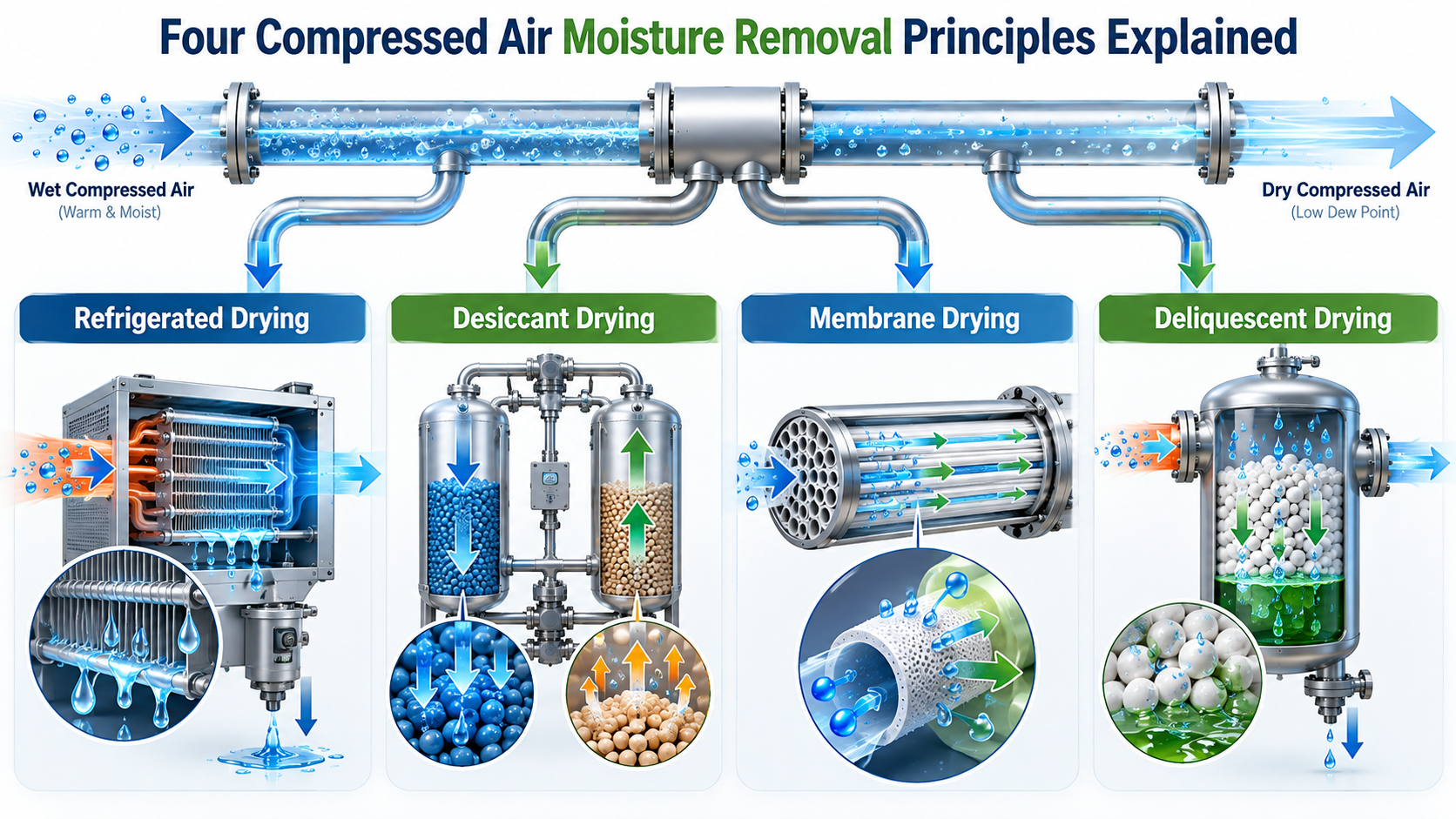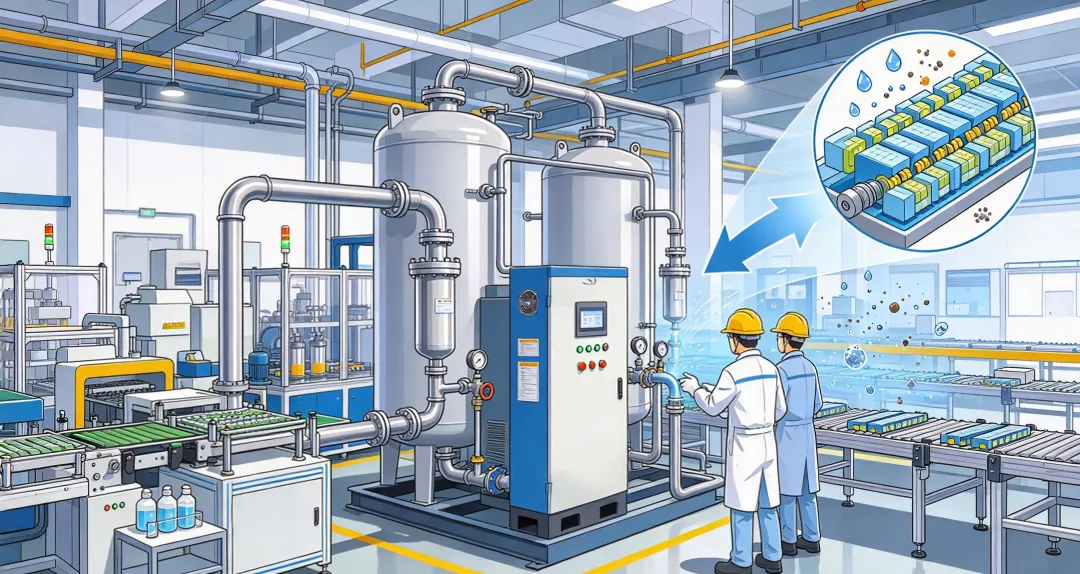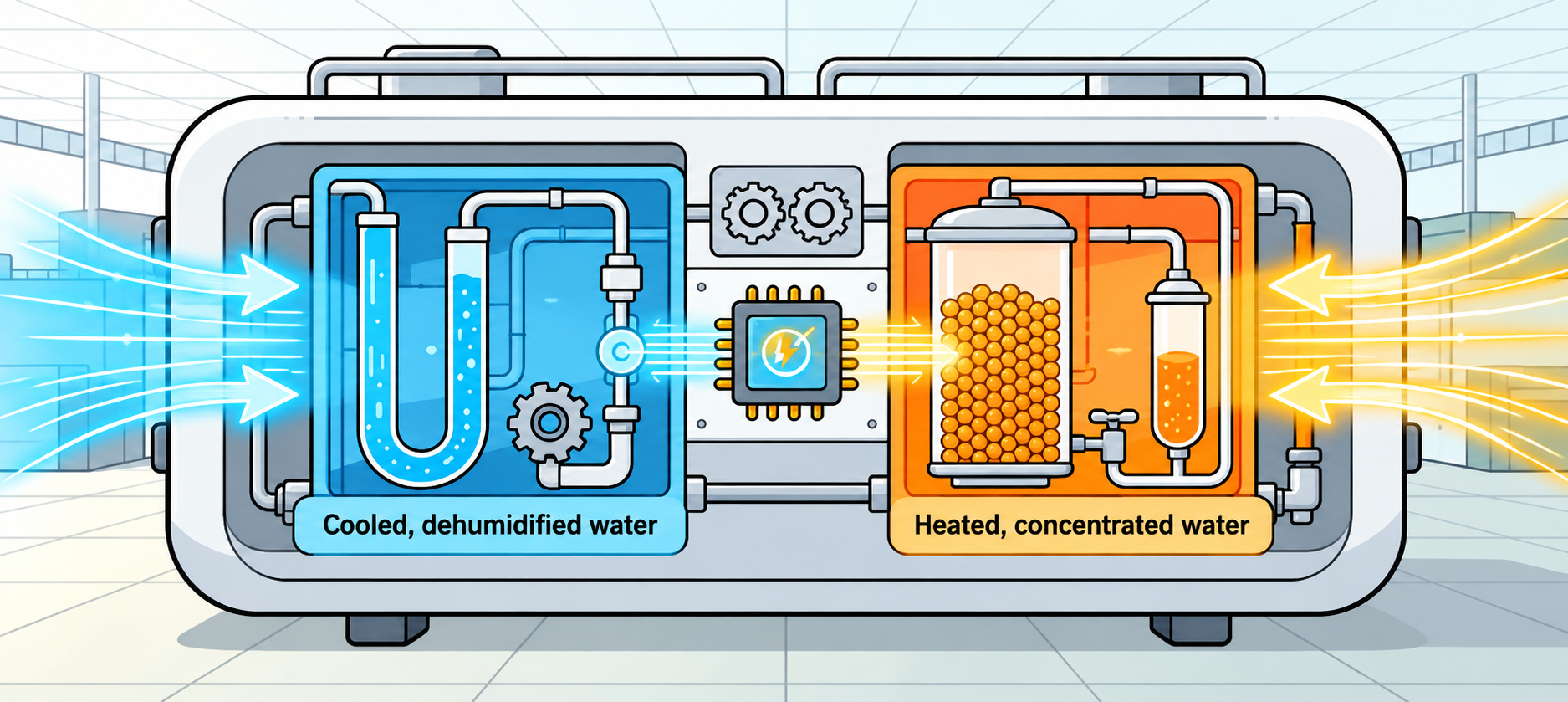
A Heat of Compression (HOC) desiccant air dryer is an adsorption dryer that uses thermal energy already present in high-temperature compressed air to regenerate its desiccant.
Instead of depending primarily on large quantities of dry purge air or a separate regeneration heat source, HOC technology recovers heat generated during compression and uses it as part of the drying cycle. This makes HOC dryers especially relevant to large industrial compressed air systems where a low pressure dew point and reduced regeneration losses are both important.
Lingyu’s product range includes both HOC-E Low-Purge Heat-of-Compression Regenerative Desiccant Air Dryers and HOC-Z Zero-Purge Heat-of-Compression Regenerative Desiccant Air Dryers.
What Is a Heat of Compression Desiccant Air Dryer?
A Heat of Compression dryer is a regenerative adsorption dryer that uses the heat contained in hot compressed air discharged from the air compressor to regenerate a saturated desiccant bed.
The basic energy path can be summarized as:
High-temperature compressed air → desiccant regeneration → moisture desorption → cooling → return to adsorption
The main difference between HOC technology and conventional regenerative dryer designs is therefore not the adsorption process itself. The key difference is where the regeneration energy comes from.
For a broader introduction to adsorption drying, see what a desiccant air dryer is.
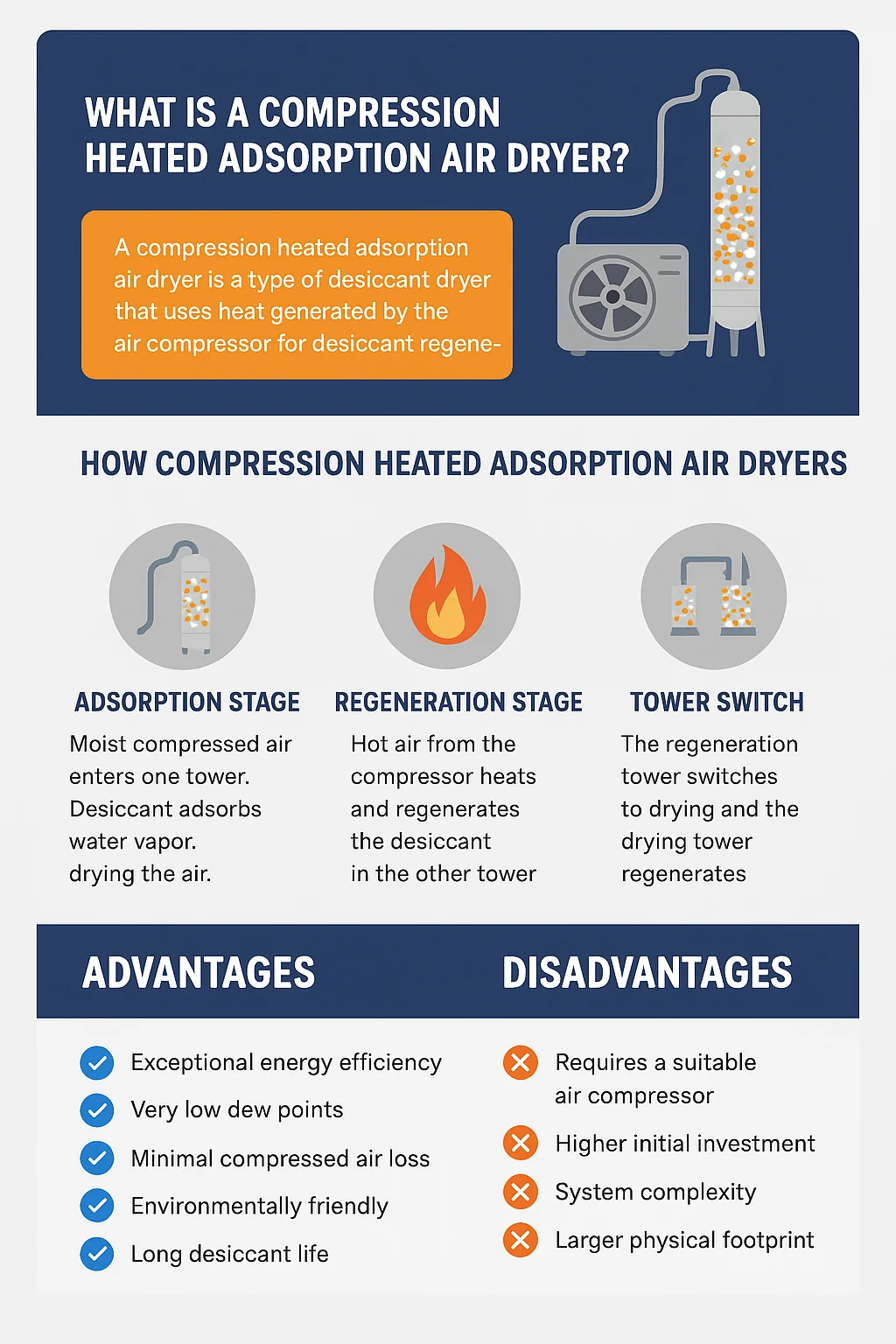
How Does a Heat of Compression Dryer Work?
HOC dryers rely on alternating adsorption and regeneration cycles.
One adsorption vessel removes water vapor from compressed air while the other vessel undergoes regeneration. Once regeneration and cooling are complete, the operating roles switch.
What makes the HOC cycle different is the use of hot compressor discharge air during regeneration.
Step 1: Compression Produces High-Temperature Air
Air temperature rises during compression.
An HOC system is designed to make use of this high-temperature compressed air before its thermal energy is completely rejected through the cooling system.
Lingyu’s HOC dryers have a rated inlet temperature of 120°C, with an allowable inlet-temperature range of 110–180°C.
This is why compressor operating conditions are a critical part of HOC dryer selection.
Step 2: One Tower Adsorbs Moisture
While one tower is being regenerated, the other is in adsorption service.
Compressed air passes through the desiccant bed, where water vapor is adsorbed onto the adsorption material. Dry compressed air then continues to the downstream system.
The desiccant gradually accumulates moisture and must eventually be regenerated before it reaches its useful adsorption capacity.
Step 3: Compression Heat Regenerates the Saturated Desiccant
During regeneration, hot compressed air from the compressor is directed through the saturated desiccant bed.
In the HOC-E process, thermal energy contained in the high-temperature compressor discharge air directly heats the desiccant after adsorption. The heat desorbs accumulated moisture and regenerates the adsorption material.
Rather than generating all regeneration heat separately, the system makes use of thermal energy already present in the compressed air stream.
Step 4: The Desiccant Bed Is Cooled
Regeneration is not complete simply because moisture has been driven from the desiccant.
After being heated, the adsorption bed must return to an appropriate temperature before it resumes effective drying.
This cooling stage is important because adsorption capacity is temperature-dependent. A bed that remains too hot when it returns to service may not immediately provide the required pressure dew point.
A complete HOC cycle should therefore be understood as:
Adsorption → heating/regeneration → cooling → switching
HOC-E: Low-Purge Heat of Compression Dryer
Lingyu’s HOC-E Series uses compressor heat during the heating and regeneration stage.
No compressed air is consumed during the heating and regeneration stage. Only a small amount of dry product air is required during cooling.
The specified regeneration-air consumption is ≤3%.
This reduces compressed-air consumption compared with conventional heatless regeneration, where a larger percentage of dried compressed air may be continuously consumed as purge air.
For comparison with that technology, see the ultimate guide to heatless desiccant air dryers.
HOC-Z: Zero-Purge Heat of Compression Dryer
Lingyu’s HOC-Z Series also uses high-temperature compressor discharge air to regenerate the desiccant, but its cooling method differs from the HOC-E configuration.
During cooling, HOC-Z uses compressed air that has passed through the cooler rather than consuming dry product air.
As a result, no dry product air is consumed during either the heating/regeneration stage or the cooling stage, and the specified regeneration-air consumption is 0%.
For more information about this configuration, see the HOC-Z zero-gas-consumption compression heat regeneration adsorption dryer.
HOC-E vs. HOC-Z
“Heat of Compression dryer” should not automatically be interpreted as “zero purge.” Lingyu’s two HOC configurations use the same fundamental heat-recovery principle but differ during the cooling stage.
| Parameter | HOC-E | HOC-Z |
|---|---|---|
| Regeneration heat | Compressor discharge heat | Compressor discharge heat |
| Air use during heating/regeneration | No compressed-air consumption | No dry-product-air consumption |
| Cooling | Small amount of dry product air | Cooled compressed air |
| Regeneration-air consumption | ≤3% | 0% |
| Outlet pressure dew point | −20°C / −40°C optional | −20°C / −40°C optional |
| Rated inlet temperature | 120°C | 120°C |
| Allowable inlet temperature | 110–180°C | 110–180°C |
The two configurations therefore serve different efficiency and system-integration requirements.
For more information on the low-purge configuration, see the HOC-E adsorption dryer technical guide.
What Pressure Dew Point Can an HOC Dryer Achieve?
For both Lingyu HOC product lines, the specified outlet pressure dew point is:
- −20°C
- −40°C optional
These are the appropriate reference values for the HOC-E and HOC-Z systems.
The lowest possible dew point should not be selected automatically. The correct pressure dew point should match the actual downstream process requirement.
Specifying a lower dew point than the process requires can increase equipment and operating requirements without providing a corresponding production benefit.
How Does HOC Technology Save Energy?
The main energy advantage comes from reusing compression heat.
A compressor has already consumed electrical energy to compress the air, and heat is generated as part of that process. An HOC dryer captures part of this thermal energy and uses it for desiccant regeneration.
This can improve system efficiency in several ways.
Reduced Compressed-Air Loss
A conventional heatless dryer may consume a significant amount of already compressed and dried air for regeneration.
Lingyu’s HOC-E reduces regeneration-air consumption to ≤3%, while HOC-Z specifies 0% regeneration-air consumption.
The compressor can therefore supply a greater proportion of its output to the plant rather than using part of that compressed air for desiccant regeneration.
Reduced Dependence on Separate Regeneration Heat
Because compressor discharge heat supplies the primary thermal energy used to regenerate the desiccant, HOC technology reduces dependence on separately generated regeneration heat.
This does not mean that every HOC configuration operates without auxiliary heating under every condition. Auxiliary heating can still be relevant to particular designs or operating conditions.
For more detail on this point, see why a zero-air-loss compression heat regeneration dryer may need an electric heater.
Intelligent Control Can Reduce Energy Use Further
Lingyu’s HOC-E includes an EBZ200-2 multi-core control system.
Its energy-saving control can reduce overall energy consumption by more than 10% compared with conventional fixed-cycle operation. An optional dew-point-based control mode can extend adsorption cycles under fluctuating load and can reduce overall energy consumption by more than 30% under applicable conditions.
These figures also reinforce an important selection principle: actual energy savings depend not only on regeneration technology but also on load profile and control strategy.
HOC Dryer vs. Heatless Dryer
The primary difference is the regeneration method.
A heatless dryer uses part of its dry compressed-air output to regenerate the desiccant. An HOC dryer instead uses heat already contained in compressor discharge air as its main regeneration energy source.
For example, Lingyu’s HH heatless regenerative dryer specifies average purge-air consumption of 8–14%, whereas HOC-E specifies ≤3% and HOC-Z specifies 0% regeneration-air consumption.
This does not mean an HOC dryer is automatically the better choice for every installation.
Heatless systems have simpler integration requirements, whereas an HOC system depends more heavily on compressor discharge temperature and the overall compressed-air system configuration.
HOC Dryer vs. Heated Regeneration Dryer
A conventional heated regenerative dryer uses an external heat source to raise the temperature of the regeneration gas.
Lingyu’s heated-purge dryer, for example, uses an external heat source and dry product air during regeneration and specifies average purge consumption of 4–8%.
HOC technology instead makes direct use of compression heat.
Users comparing the two technologies can read the ultimate guide to heated regeneration adsorption air dryers.
HOC Dryer vs. Blower-Heated Dryer
A blower-heated dryer uses ambient air supplied by a blower, typically combined with heating, to regenerate the desiccant.
This reduces the amount of compressed product air consumed during regeneration.
Lingyu also offers low-purge and zero-purge blower-heated systems, so the practical comparison is based on where regeneration energy and cooling air come from.
HOC dryers recover compressor heat, whereas blower-based systems use a dedicated blower and their own regeneration-air circuit.
For a detailed comparison point, see the ultimate guide to blower-heated adsorption air dryers.
Compressor Compatibility Is Critical
An HOC dryer requires a reliable source of sufficiently hot compressed air.
For Lingyu’s HOC-E and HOC-Z systems, the rated inlet temperature is 120°C, with an allowable range of 110–180°C.
This means the dryer and compressor should be evaluated as a single thermal system.
Compressor technology, discharge temperature, load profile, operating pressure, cooling arrangement, airflow, discharge-air quality, and expected operating hours can all influence whether sufficient regeneration heat is available.
Compressor compatibility, discharge-air quality, and available discharge temperature should therefore be confirmed for the selected HOC system rather than assuming one compressor configuration is universally required.
Operating Conditions Matter
For both HOC-E and HOC-Z, the rated inlet pressure is 0.7 MPa, with an operating pressure range of approximately 0.6–1.0 MPa.
Cooling-water requirements include:
- Water temperature: ≤32°C
- Water pressure: 0.2–0.6 MPa
These parameters matter because HOC dryer performance depends on both regeneration heating and subsequent cooling.
A dryer should therefore not be selected based only on nominal flow capacity and pressure dew point.
Why Cooling Is Part of HOC Dryer Performance
It is easy to focus entirely on heat recovery, but the cooling stage is equally important.
Once the desiccant has been regenerated at high temperature, it needs to be cooled before it can return efficiently to adsorption.
Insufficient cooling can affect outlet dew-point stability and tower-switching performance.
The HOC-Z system specifically uses compressed air that has been cooled by a cooler to reduce the temperature of the regenerated adsorption bed.
Cooling-water temperature, cooling-water pressure, cooler condition, and control strategy should therefore all be considered in system design.
Pressure Drop Should Be Included in Energy Analysis
Energy efficiency should not be evaluated only from regeneration-air consumption.
The complete cost of compressed air includes compressor power, regeneration losses, cooling energy, and system pressure drop.
Lingyu’s HOC-E design includes an optimized flow distributor intended to improve desiccant utilization while minimizing compressed-air pressure drop.
Even an efficient regeneration system can increase total compressor energy if the dryer introduces excessive resistance.
For broader system-design context, see how compressed air pressure drop affects system efficiency.
How to Select an HOC Dryer
A Heat of Compression dryer should be selected from the combined perspective of the dryer, compressor, and plant operating profile.
Important selection factors include:
- Required airflow
- Operating pressure
- Compressor discharge temperature
- Required pressure dew point
- Regeneration-air consumption
- Cooling-water availability
- Pressure drop
- Load variation
- Monitoring requirements
- Available installation space
The lowest purge rate alone should not determine the choice.
For example, HOC-Z offers 0% regeneration-air consumption, but it is also a more integrated system whose operation depends on controlled high-temperature air, cooling, valves, sensors, and automatic flow management.
The HOC-Z automatic flow-distribution control adjusts the flow-diverting valve according to airflow and heating temperature and is designed to accommodate approximately 30–110% load variation.
For broader selection advice, see the desiccant air dryer sizing guide.
Where Are HOC Dryers Most Useful?
HOC technology is particularly relevant when a facility has a large and relatively continuous compressed-air demand, sufficiently high compressor discharge temperature, a requirement for a low pressure dew point, a strong incentive to reduce compressed-air regeneration loss, and suitable cooling and control infrastructure.
Lingyu’s project portfolio includes six 150 m³/min zero-air-loss HOC regenerative adsorption dryers for a project requiring clean, oil-free, low-dew-point compressed air, as well as customized 110 m³/min zero-air-loss HOC/blower-heated installations.
These project capacities demonstrate the relevance of HOC technology to large-scale industrial compressed-air applications.
Maintenance Priorities
HOC dryers depend on more than the adsorption material itself.
Maintenance should include inspection of the desiccant, switching valves, cooler and heat-transfer components, drains and moisture separation, temperature and pressure instrumentation, dew-point monitoring, and differential pressure.
Lingyu’s HOC-E includes dynamic monitoring of parameters such as outlet temperature, heating temperature, regeneration exhaust temperature, tower pressure, and optional pressure dew point.
HOC-Z also includes dew-point monitoring, Siemens touchscreen control, valve-position feedback, and automatic flow-distribution control.
Maintaining these control and heat-transfer functions is essential to preserving both drying performance and energy efficiency.
Conclusion
A Heat of Compression desiccant air dryer uses the thermal energy contained in high-temperature compressor discharge air to regenerate the desiccant.
Lingyu offers two important HOC configurations.
HOC-E uses compression heat for regeneration and a small amount of dry product air for cooling, with regeneration-air consumption of ≤3%.
HOC-Z uses compression heat for regeneration and cooled compressed air during the cooling stage, achieving 0% regeneration-air consumption.
Both product lines are specified for −20°C / −40°C optional outlet pressure dew point, a 120°C rated inlet temperature, and an allowable high-temperature inlet range of 110–180°C.
The key advantage is not simply lower electricity use. It is the ability to recover compressor heat while reducing the amount of valuable compressed air consumed for regeneration.
When evaluating an HOC dryer, compressor compatibility, available discharge heat, required dew point, airflow, cooling conditions, purge consumption, pressure drop, load profile, and control strategy should be considered as one integrated system.