Heatless Desiccant Air Dryers for Industrial Compressed Air Systems
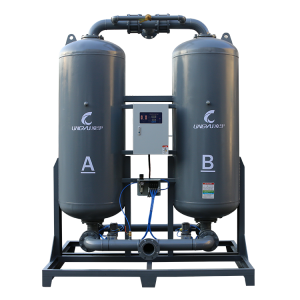
Heatless desiccant air dryers remove water vapor from compressed air through Pressure Swing Adsorption (PSA). Unlike heated regeneration dryers, they use a portion of the dried compressed air to regenerate the desiccant without an external heater or blower.
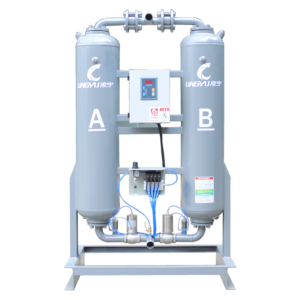
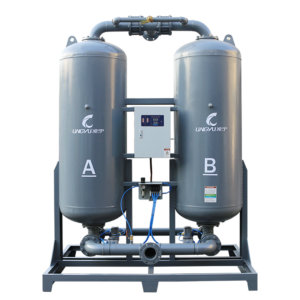
Lingyu CH and HH Series heatless desiccant air dryers provide an average purge air consumption of 8–14% and are designed for industrial applications requiring low pressure dew points with a simple twin-tower regeneration system.
They are commonly used for instrument air, pneumatic controls, electronics, chemical processing, precision manufacturing, and other moisture-sensitive compressed air applications.
How Does a Heatless Desiccant Air Dryer Work?
A heatless dryer uses two desiccant towers that alternate between drying and regeneration.
Adsorption: Wet compressed air passes through one tower, where the desiccant adsorbs water vapor and dry compressed air flows downstream.
Regeneration: A portion of the dry compressed air is expanded to near atmospheric pressure and passed through the second tower. This purge air removes the moisture previously adsorbed by the desiccant.
Repressurization & Switching: Before the towers switch, the regenerated vessel is repressurized and pressure is equalized between the two towers. The cycle then repeats automatically to provide continuous dry compressed air.
No external heat is required during regeneration.
Heatless Desiccant Air Dryer Specifications
| Parameter | CH Series | HH Series |
|---|
| Drying principle | Pressure Swing Adsorption (PSA) | Pressure Swing Adsorption (PSA) |
| Capacity | 3.8–150 m³/min | 1.5–130 m³/min |
| Approx. capacity | 134–5,297 CFM | 53–4,591 CFM |
| Rated inlet pressure | 0.7 MPa | 0.7 MPa |
| Operating pressure | 0.6–1.0 MPa | 0.6–1.0 MPa |
| Rated inlet temperature | 10–30°C | 10–30°C |
| Maximum inlet temperature | ≤40°C | ≤40°C |
| Average purge air | 8–14% | 8–14% |
| Pressure dew point | -50°C to -20°C | ≤-40°C |
| Desiccant | Activated alumina | Activated alumina + high-performance molecular sieve |
| Rated ambient temperature | 35°C | 35°C |
| Ambient operating range | 2–45°C | 2–45°C |
For applications beyond the standard CH and HH Series ranges, custom-engineered heatless desiccant air dryer systems are available for project capacities up to 15,900 CFM, as well as special operating pressures and site requirements.
Purge Air Consumption & Operating Cost
Heatless dryers require very little electrical power for regeneration because no heater or blower is used. However, part of the dried compressed air is consumed as purge air.
The Lingyu CH and HH Series specify an average purge air consumption of 8–14%.
For example, for a dryer processing 100 m³/min:
| Average Purge Rate | Approx. Purge Air |
| 8% | 8 m³/min |
| 10% | 10 m³/min |
| 12% | 12 m³/min |
| 14% | 14 m³/min |
This purge air has already been compressed, so it represents an indirect energy cost at the air compressor.
For smaller systems or applications where simplicity is the priority, heatless regeneration can be an economical solution. For larger systems operating continuously, the cost of purge air should be compared with the heater or blower energy required by other regeneration technologies.
Heatless vs Externally Heated Desiccant Air Dryers
| Factor | Heatless | Externally Heated |
| Regeneration method | Dry compressed purge air | Heater + purge air |
| External heater | No | Yes |
| Average purge air* | 8–14% | 4–8% |
| Regeneration electrical demand | Very low | Higher |
| System complexity | Lower | Higher |
| Maintenance | Simpler | Heater system also requires maintenance |
| Initial investment | Generally lower | Generally higher |
| Main operating cost | Compressed air loss | Heater power + reduced purge air |
| Typical selection | Small / medium or simple systems | Medium / large continuous systems |
*Based on Lingyu CH / HH technical data for the corresponding heatless and externally heated series.
Neither technology is automatically more energy-efficient in every application. The correct choice depends on airflow, annual operating hours, compressor efficiency, electricity cost, required PDP, and maintenance requirements.
How to Select a Heatless Desiccant Air Dryer
Key selection parameters include:
- Airflow: CFM, SCFM, or m³/min
- Working pressure
- Inlet compressed air temperature
- Required pressure dew point
- Purge air consumption
- Desiccant configuration
- Annual operating hours
- Ambient temperature
- Power supply and frequency
For applications requiring a PDP within approximately -50°C to -20°C, select the appropriate CH Series configuration according to the required air quality.
For applications requiring ≤-40°C PDP, the HH Series uses activated alumina combined with high-performance molecular sieve.
For high-flow systems operating continuously, purge air consumption should also be included in the selection calculation.
Frequently Asked Questions
How much purge air does a heatless desiccant air dryer use?
Lingyu CH and HH Series specify an average purge air consumption of 8–14% under the applicable operating conditions.
What pressure dew point can a heatless desiccant dryer achieve?
The CH Series specifies a pressure dew point range of -50°C to -20°C. The HH Series is designed for ≤-40°C PDP.
Does a heatless desiccant dryer require a heater?
No. Heatless regeneration uses a portion of the dried compressed air to regenerate the desiccant, so no external regeneration heater is required.
What desiccant is used?
The CH Series uses activated alumina. The HH Series uses activated alumina combined with high-performance molecular sieve.
What is the difference between heatless and heated regeneration?
Heatless dryers use more compressed air for regeneration but do not require heater power. Externally heated dryers use an external heater to reduce purge air consumption. The better choice depends on system size, operating hours, and energy costs.
Related Articles About Heatless Desiccant Air Dryers
Heatless Desiccant Air Dryer Guide: How It Works, Purge Air & Dew Point
Compressed air systems are vital to a wide range of industries—from pharmaceuticals and food process […]
Read More