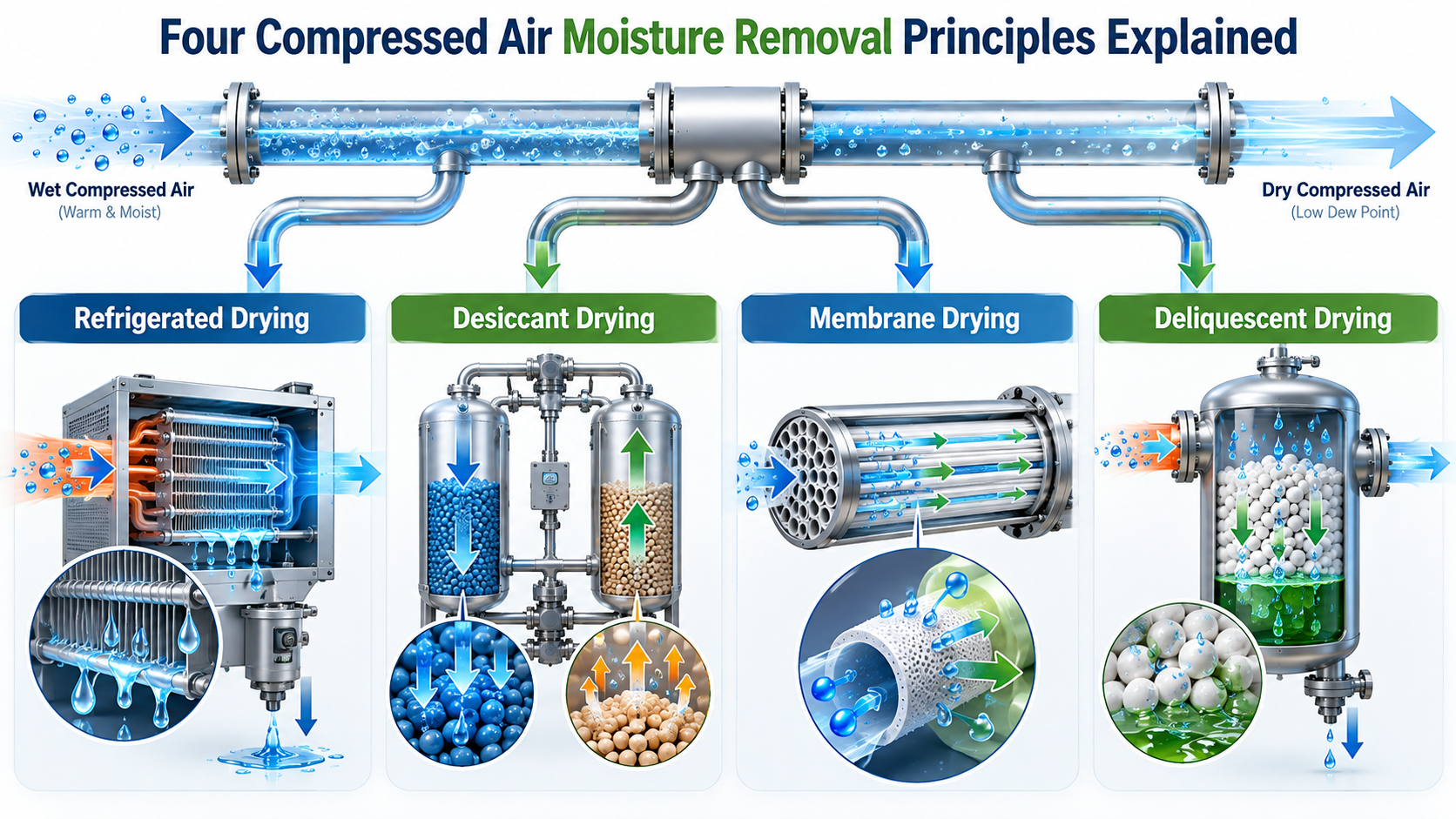
Compressed air naturally contains water vapor. As compressed air cools, moisture can condense inside piping and equipment, contributing to corrosion, pneumatic component problems, product-quality issues, and process instability.
Where a refrigerated dryer cannot provide a sufficiently low pressure dew point, a heatless desiccant air dryer can provide a deeper level of moisture removal through adsorption.
Heatless dryers are widely used because their regeneration process does not require an external heater. Instead, part of the already dried compressed air is expanded and used as purge air to regenerate the desiccant.
Lingyu offers both CH Series and HH Series heatless regenerative adsorption dryers within its heatless desiccant dryer product range.
What Is a Heatless Desiccant Air Dryer?
A heatless desiccant air dryer is a regenerative adsorption dryer that removes water vapor from compressed air using an adsorbent material.
Lingyu describes its heatless regeneration process as Pressure Swing Adsorption (PSA).
At higher water-vapor partial pressure, the desiccant adsorbs moisture from the compressed air. During regeneration, the pressure around the desiccant is reduced and a portion of dry product air is used to carry the released moisture out of the system.
Because no external heat is used, desorption and regeneration can occur without a separate heating and cooling cycle.
This relatively straightforward operating principle is one of the key distinctions between heatless regeneration and heated or blower-assisted desiccant drying technologies.
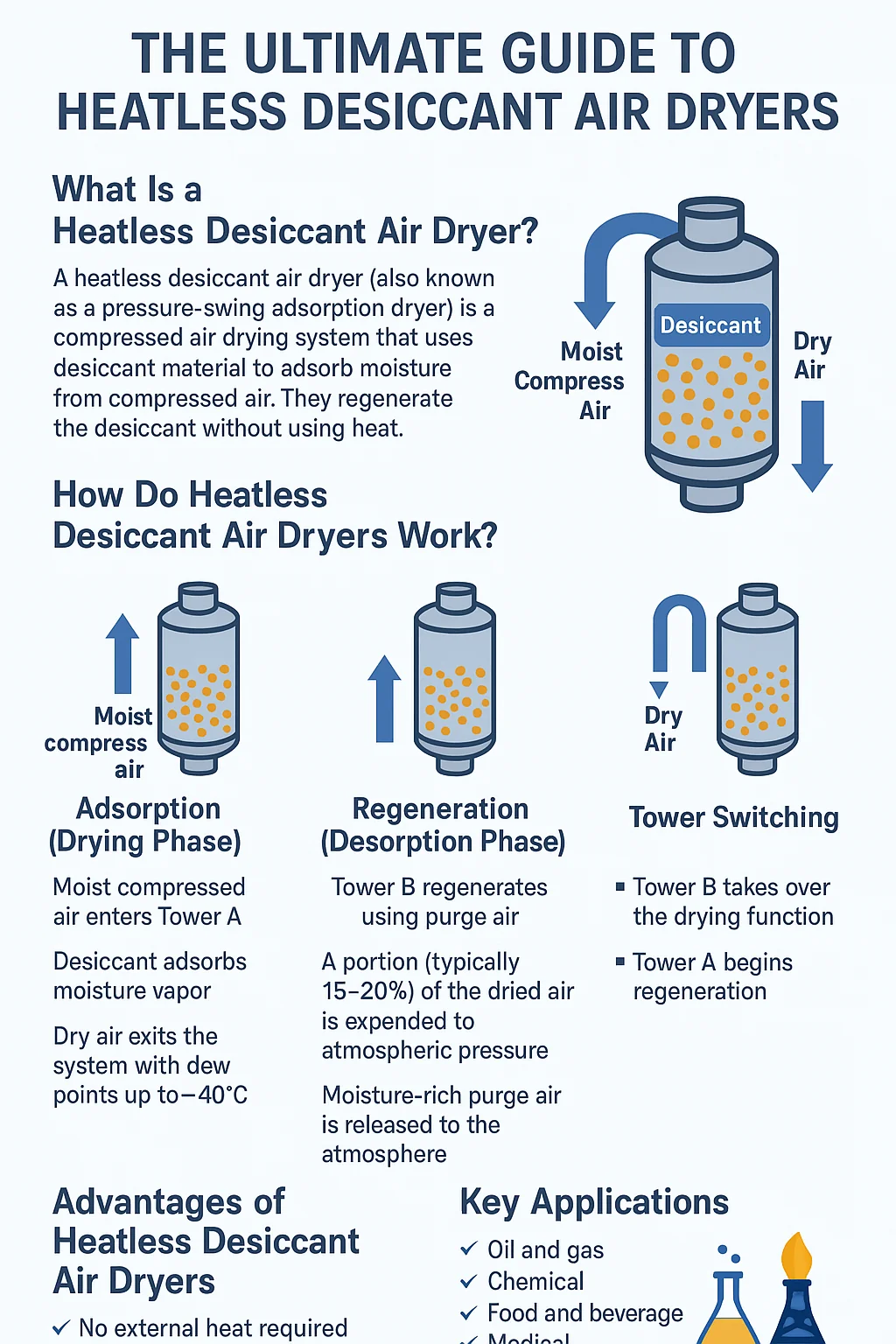
How Does a Heatless Desiccant Air Dryer Work?
A conventional heatless regenerative dryer uses two adsorption vessels that alternate between drying and regeneration.
1. Adsorption
Wet compressed air enters the active adsorption tower.
As the air passes through the desiccant bed, water vapor is adsorbed onto the desiccant surface. The dried compressed air then leaves the adsorption vessel and continues toward the downstream compressed-air system.
2. Purge-Air Regeneration
At the same time, the second vessel is regenerated.
A portion of the dry product air is diverted into the regeneration side. After its pressure is reduced, the dry purge air passes through the moisture-loaded desiccant.
The lower water-vapor partial pressure promotes desorption, while the purge airflow carries the released moisture out through the exhaust system.
3. Repressurization and Tower Switching
Before switching, the regenerated vessel is repressurized so that its pressure approaches that of the vessel currently in adsorption.
Lingyu’s heatless dryer design includes automatic repressurization and pressure equalization before switching. This helps limit sudden pressure fluctuations and reduces mechanical impact on the desiccant.
The regenerated tower then takes over the drying duty, while the previously active tower begins regeneration. This repeating cycle allows continuous production of dry compressed air.
How Much Purge Air Does a Heatless Dryer Use?
For Lingyu’s CH and HH heatless regenerative dryers, average purge-air consumption is specified at 8–14%.
That purge air is an important operating-cost factor because it has already been compressed and treated before being diverted for regeneration.
For example, if a process requires 100 units of usable downstream airflow, the compressor and dryer system must account for both the process demand and the air needed for regeneration.
This is why purge consumption becomes increasingly important as system airflow and annual operating hours increase.
What Dew Point Can a Heatless Desiccant Dryer Achieve?
The achievable pressure dew point depends on the actual dryer configuration.
Lingyu’s CH and HH Series have different specified dew-point performance and desiccant configurations.
CH Series
The CH Series heatless regenerative desiccant dryer uses activated alumina and is specified for an outlet pressure dew point range of approximately −50°C to −20°C, with average purge-air consumption of 8–14%.
See the CH Series heatless regeneration adsorption dryer for the corresponding product.
HH Series
The HH Series combines activated alumina with high-performance molecular sieve and is specified for an outlet pressure dew point of ≤−40°C, again with average purge consumption of 8–14%.
Buyers evaluating this configuration can see the HH Series heatless regeneration adsorption dryer.
The appropriate pressure dew point should be selected according to the actual process requirement rather than assuming that the lowest possible value is always better.
Key Advantages of Heatless Desiccant Air Dryers
The main advantage of heatless technology is simple regeneration without an external heater.
Purge air and product air come from the same compressed-air source, giving the system a relatively straightforward structure and operating principle.
Heatless dryers also avoid the blower, regeneration heater, and heat-management components found in more complex regenerative technologies.
Other practical advantages include continuous twin-tower operation, low pressure dew point capability, programmable control, automatic repressurization, and relatively simple system integration.
These advantages should still be evaluated against the actual installation conditions and operating requirements.
The Main Limitation: Purge-Air Cost
The biggest efficiency trade-off of a heatless dryer is its use of dry compressed air for regeneration.
Lingyu’s heatless dryers specify average purge consumption of 8–14%. At higher flow rates or long annual operating hours, producing this additional compressed air can represent a meaningful energy cost.
This is why a heatless dryer should not automatically be chosen solely because it has no heater.
Total operating cost depends on how much energy the upstream compressor must use to supply both production air and regeneration air.
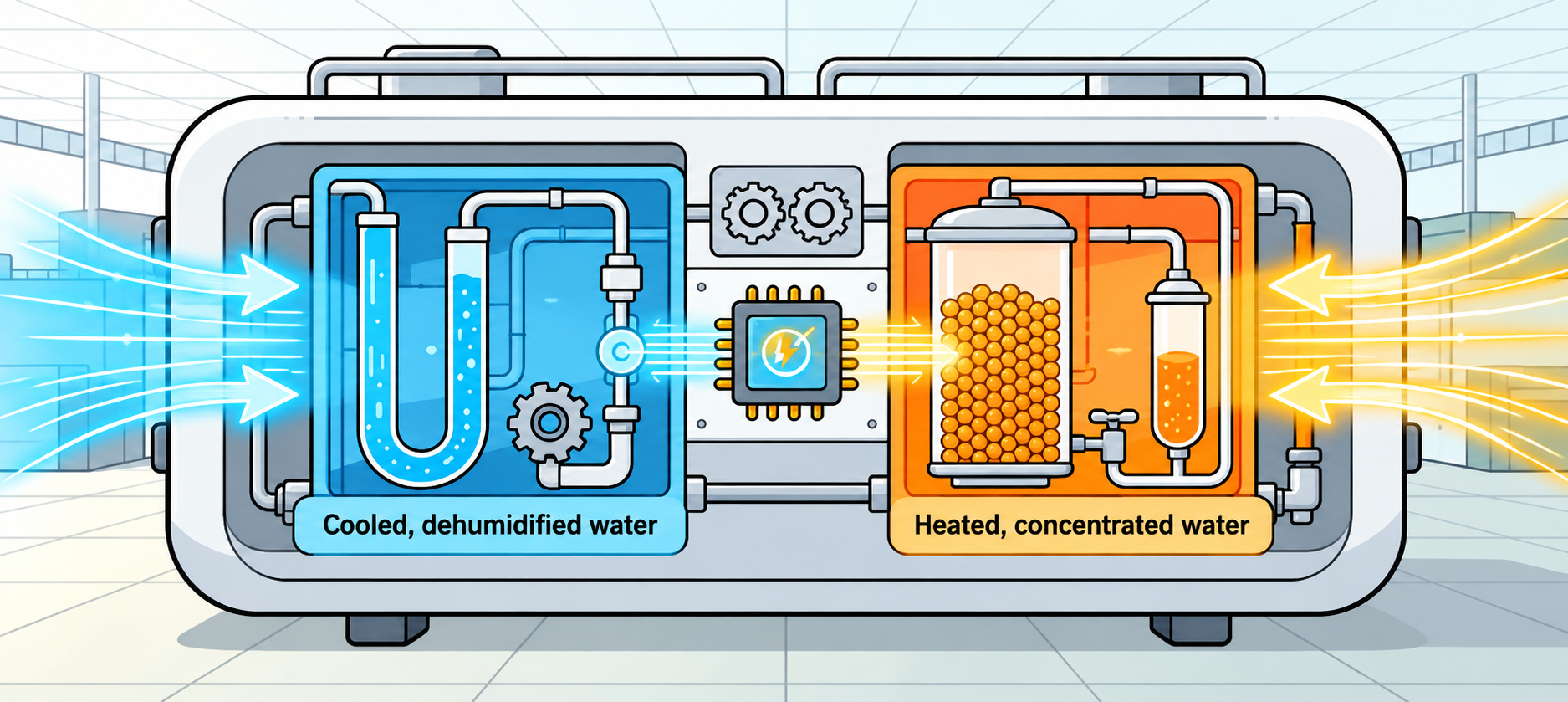
Heatless vs. Heated Regeneration
A heated regenerative dryer reduces purge-air demand by adding thermal energy to the regeneration process.
Lingyu’s HH heated-purge configuration, for example, specifies average purge-air consumption of 4–8%, compared with 8–14% for its heatless configurations.
The trade-off is that heated regeneration introduces a heater and a more complex regeneration cycle.
Customers considering this alternative can review Lingyu’s externally heated desiccant dryer range.
The right comparison is therefore not simply “heatless is cheaper” or “heated is more efficient.” Initial equipment cost, purge-air loss, energy consumption, system size, and maintenance requirements all matter.
Heatless vs. Blower-Heated Regeneration
For larger systems where purge-air cost becomes more significant, blower-heated regeneration may offer another option.
Instead of relying primarily on dry compressed air, Lingyu’s low-purge blower-heated system uses ambient air supplied by a blower during regeneration and only a small quantity of dry product air during cooling.
Its specified regeneration-air consumption is 2–3%, while the zero-purge blower-heated configuration reduces compressed-air regeneration consumption to approximately 0%.
This can make blower-heated technology attractive when compressed-air loss has a high economic value, although the blower, heater, cooling equipment, and controls increase system complexity.
See Lingyu’s blower-heated and zero-purge adsorption dryer range for this regeneration technology.
Heatless vs. Heat of Compression
Heat-of-Compression systems take another approach by using high-temperature compressor discharge air as the regeneration-energy source.
This can substantially reduce regeneration-air loss, but the dryer must be properly integrated with a compatible high-temperature compressed-air system.
Facilities evaluating this technology can review Lingyu’s Heat of Compression dryer range.
For smaller or less complex installations, a heatless dryer may still provide the better balance between equipment simplicity and operating requirements.
Why Inlet Air Quality Matters
A desiccant dryer is designed primarily to remove water vapor, not to solve every type of compressed-air contamination.
Liquid water, oil contamination, and particles reaching the desiccant can adversely affect adsorption performance and service life.
Appropriate condensate separation and filtration should therefore be considered as part of the complete compressed-air treatment system.
Lingyu’s product range includes a precision compressed air filter for compressed-air purification applications.
The exact filtration grade and arrangement should be selected according to the compressor type, dryer configuration, contamination level, and required downstream air quality.
Desiccant Type Matters
The desiccant configuration differs between Lingyu’s two heatless product series.
For the CH Series, the specified desiccant is activated alumina.
For the HH Series, the specified bed uses activated alumina + high-performance molecular sieve.
Desiccant selection should therefore follow the specifications of the selected dryer series rather than assuming that every adsorption material is standard across all Lingyu heatless dryers.
Operating Conditions and Sizing
Dryer sizing should not be based only on nominal compressor flow.
For the Lingyu HH heatless dryer, the key operating specifications include:
- Rated inlet pressure: 0.7 MPa
- Operating pressure range: 0.6–1.0 MPa
- Rated inlet temperature: 10–30°C
- Maximum inlet temperature: ≤40°C
- Average purge-air consumption: 8–14%
- Outlet pressure dew point: ≤−40°C
- Ambient operating range: 2–45°C
These conditions matter because inlet temperature, operating pressure, flow, and moisture load all influence dryer performance.
For flows above 150 m³/min, or for special pressure, material, or temperature requirements, the system should be selected according to the specific project conditions.
Ambient Conditions Still Matter
The absence of a regeneration heater simplifies the heatless regeneration process, but it does not mean the dryer has unlimited low-temperature operating capability.
Lingyu’s listed ambient operating range for these heatless systems is approximately 2–45°C.
Heatless regeneration therefore avoids dependence on a regeneration heater while still requiring operation within the specified environmental conditions.
Control Strategy
Lingyu’s CH and HH heatless dryers support programmable electronic control.
The standard heatless operating principle is based on controlled adsorption, depressurization, regeneration, repressurization, and tower switching.
Control functions should be selected according to the actual dryer configuration rather than assuming that every heatless model includes the same demand-based purge or dew-point-control functions available on other regenerative dryer technologies.
Pressure and Special Installation Requirements
The standard operating pressure range described for Lingyu’s heatless dryers is 0.6–1.0 MPa.
Other pressure ratings may be available for specific requirements, but special high-pressure or hazardous-area applications should be evaluated according to the actual product configuration and project documentation.
This avoids treating a special engineered solution as a standard feature of every CH or HH heatless dryer.
Where Are Heatless Desiccant Dryers Used?
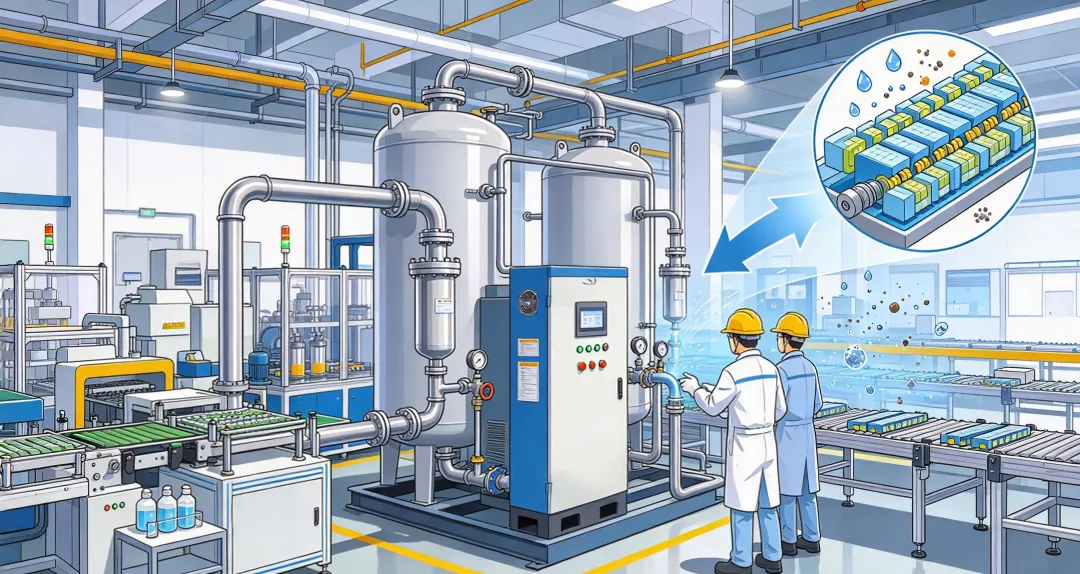
Heatless dryers can be considered for industrial processes where the required pressure dew point falls within the dryer’s performance range and where the simplicity of heatless regeneration is attractive.
Electronics and Precision Manufacturing
In electronics and precision production environments, moisture control can be important for pneumatic and process systems.
See Lingyu’s electronics and precision manufacturing application.
Petrochemical and Chemical Processing
Chemical and petrochemical installations can also require dependable low-dew-point compressed air for instrumentation and process applications.
See Lingyu’s petrochemical and chemical processing application.
Similar selection logic applies to pharmaceutical, food, power, manufacturing, and other industries. The dryer should be selected according to actual air-quality, dew-point, pressure, and process requirements rather than industry name alone.
Maintenance Requirements
Heatless dryers have a comparatively straightforward regeneration system, but they still require regular maintenance.
Important areas include desiccant condition, switching valves, pneumatic actuators, silencers, filters, drains, the purge circuit, pressure equalization system, and outlet dew-point performance.
Lingyu’s high-performance desiccant is designed to support stable long-term dew-point performance with low dusting.
Desiccant replacement should be based on operating conditions, contamination, pressure dew-point performance, mechanical deterioration, and the manufacturer’s maintenance guidance rather than a universal fixed replacement interval.
Heatless vs. Heated Dryer: Quick Comparison
| Factor | Heatless Regeneration | Heated Regeneration |
|---|---|---|
| Main regeneration method | Dry compressed purge air | Heat + purge air |
| External regeneration heater | No | Yes |
| Lingyu purge-air reference | 8–14% | 4–8% for HH heated-purge |
| Lingyu low-dew-point reference | CH: −50°C to −20°C; HH: ≤−40°C | HH heated-purge: ≤−40°C |
| System complexity | Lower | Higher |
| Key operating trade-off | More compressed-air loss | Heater energy + lower purge demand |
| Selection priority | Simplicity and suitable flow | Lower purge consumption at appropriate scale |
Neither dryer type is universally more economical.
The correct choice depends on compressor energy cost, airflow, operating hours, required dew point, maintenance capability, and capital investment.
Conclusion
A heatless desiccant air dryer removes water vapor through pressure-swing adsorption and regenerates the desiccant without external heat.
During adsorption, the desiccant captures moisture from compressed air. During regeneration, part of the dry product air is depressurized and passed through the saturated desiccant, carrying released moisture out of the dryer. The two adsorption vessels then alternate to maintain continuous drying.
For Lingyu’s current heatless dryer range, the key specifications are:
CH Series: 8–14% average purge-air consumption, −50°C to −20°C outlet pressure dew point, and activated alumina.
HH Series: 8–14% average purge-air consumption, ≤−40°C outlet pressure dew point, and activated alumina + high-performance molecular sieve.
The right heatless dryer should therefore be selected according to required pressure dew point, actual airflow, inlet temperature, operating pressure, purge-air cost, inlet-air quality, desiccant configuration, and maintenance requirements.
For many industrial compressed-air systems, heatless regeneration remains an effective solution when simple operation and low pressure dew point are required, but purge-air consumption should always be included in the total operating-cost calculation.