The 200 CFM Air-Cooled Refrigerated Air Dryer is designed for industrial compressed air systems that require reliable moisture removal without a cooling-water circuit.
For long-term performance, however, nominal airflow is only one consideration. Actual airflow, inlet temperature, operating pressure, ambient temperature, condenser ventilation, filtration, condensate drainage, and pressure drop all influence how effectively a refrigerated dryer performs.
The 200 CFM Air-Cooled Refrigerated Air Dryer can be integrated into general manufacturing and other industrial compressed air systems where a refrigerated pressure dew point is appropriate.
How Does a 200 CFM Refrigerated Air Dryer Work?
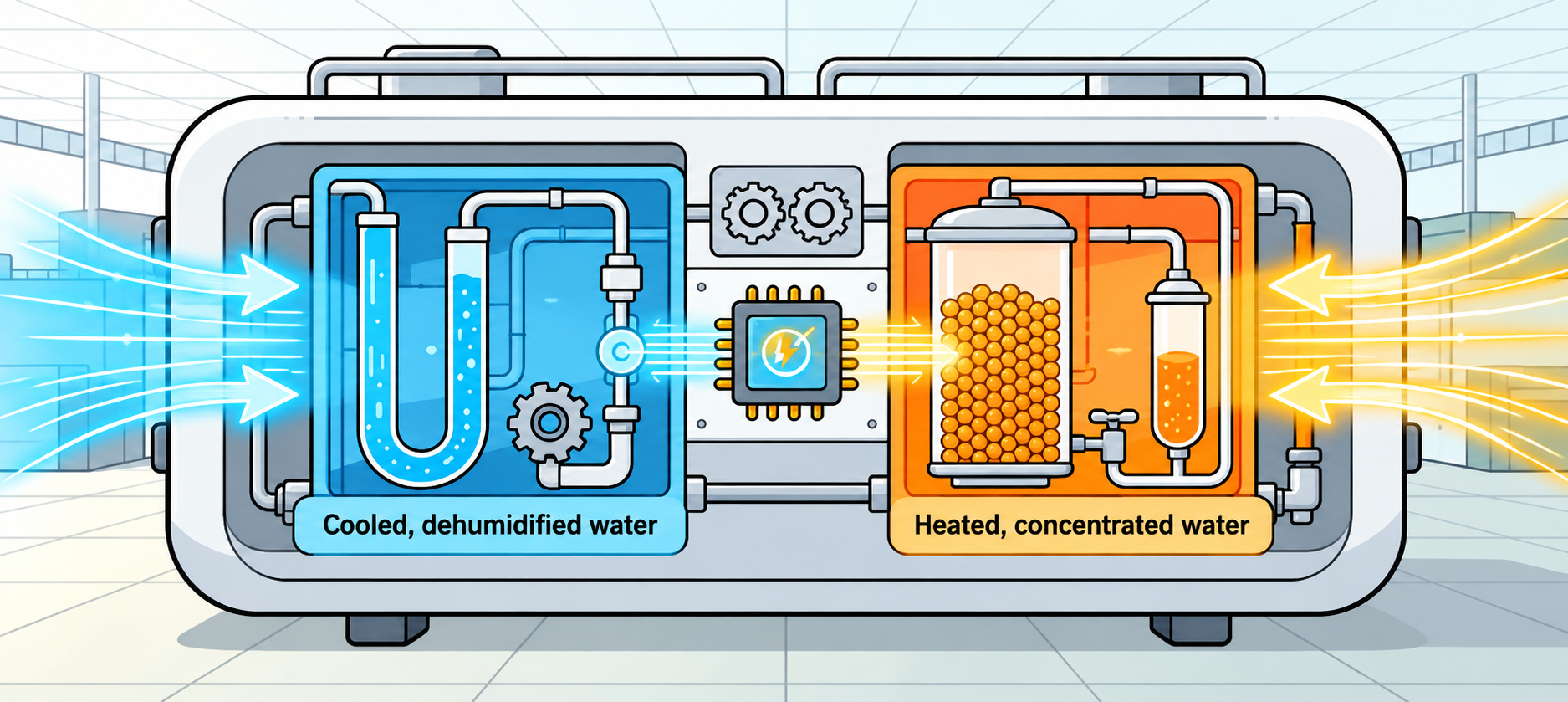
An air-cooled refrigerated dryer removes moisture by reducing the temperature of compressed air.
High-temperature compressed air first enters a pre-cooling section and air-to-air heat exchanger. It is then further cooled in the evaporator.
As the compressed air temperature falls, water vapor condenses into liquid. Oil and some other contaminants may also condense during this process.
An air-water separator removes the liquid condensate, which is discharged through an automatic drain.
The dried compressed air then passes back through the air-to-air heat exchanger, where it is reheated closer to ambient temperature before entering the downstream compressed air network.
Under specified operating conditions, this drying process provides a pressure dew point of approximately 2–10°C.
Typical Operating Conditions
For Lingyu’s AH Series air-cooled refrigerated drying technology, the principal operating conditions include:
- Rated inlet pressure: 0.7 MPa
- Operating pressure range: 0.6–1.0 MPa
- Rated inlet temperature: 50°C
- Maximum inlet temperature: ≤80°C
- Pressure dew point: 2–10°C
- Rated ambient temperature: 32°C
- Ambient operating range: 2–45°C
- Pressure drop: ≤0.025 MPa
- Cooling method: Air-cooled
- Installation: Indoor installation on a level concrete floor
- Recommended clearance: At least 1.5 m around the unit
Actual model configuration should be confirmed according to the installation and operating conditions.
Installation and Setup
Correct installation helps the dryer maintain stable refrigeration performance and simplifies future maintenance.
Provide Adequate Ventilation
An air-cooled dryer rejects heat through its condenser directly into the surrounding air.
Install the dryer in a clean, ventilated indoor area where hot exhaust air can escape rather than recirculate through the condenser.
Avoid placing the unit immediately next to heat-producing machinery or in enclosed areas where heat can accumulate.
Maintain Sufficient Clearance
Maintain approximately 1.5 m of clearance around the dryer where possible, in accordance with the standard installation requirements.
Adequate clearance supports:
- Condenser airflow
- Heat dissipation
- Inspection
- Condenser cleaning
- Electrical servicing
- Refrigeration maintenance
A small clearance such as 30–50 cm may not provide adequate access or ventilation for all installations.
Use a Level Installation Surface
Install the dryer on a level concrete floor.
A stable installation helps avoid unnecessary vibration and supports reliable condensate drainage.
Design the Piping for Low Pressure Loss
Compressed air piping should be appropriately sized for actual system airflow.
Avoid unnecessary restrictions such as:
- Undersized pipe
- Excessive elbows
- Sharp changes in direction
- Restrictive valves
- Unnecessary reducers
Good piping design helps preserve the low pressure drop expected from the dryer.
Confirm Airflow Direction
Always connect the compressed air inlet and outlet according to the markings on the dryer.
Reversing the intended flow path can prevent the internal heat exchangers, separator, and condensate system from operating as designed.
How to Select the Right Dryer Capacity
A 200 CFM label should not be the only basis for selection.
The dryer should be evaluated according to the maximum airflow and actual operating conditions.
Match Actual Peak Airflow
If the compressed air system regularly approaches 200 CFM, verify that the dryer can handle this demand under the site’s actual inlet temperature, pressure, and ambient conditions.
A reasonable capacity margin may be useful for fluctuating demand, but excessive oversizing should not be treated as an automatic efficiency improvement.
Consider Inlet Temperature
Hot compressed air creates a larger thermal and moisture load.
Although the AH Series can accept inlet temperatures up to 80°C, the rated inlet condition is 50°C.
A properly functioning compressor aftercooler and upstream moisture separator can reduce the load on the refrigerated dryer.
Consider Ambient Temperature
The rated ambient temperature is 32°C, with an operating range of 2–45°C.
As ambient temperature rises, an air-cooled condenser has less ability to reject heat.
This makes adequate compressor-room ventilation particularly important during hot operating conditions.
Where Is a 200 CFM Refrigerated Dryer Used?
A dryer in this capacity range can support many medium-sized industrial compressed air systems.
Automotive and General Manufacturing
In automotive and general manufacturing, dry compressed air can help protect pneumatic tools, actuators, control valves, assembly equipment, and production machinery.
Metal Fabrication
Compressed air is widely used for machine tools, pneumatic controls, and other metal-processing equipment.
For metal fabrication and laser cutting, the required final dew point should be checked carefully because some laser-related processes may require a different or more advanced air-treatment configuration.
Electronics Manufacturing
Moisture can interfere with sensitive pneumatic equipment and production processes.
In electronics and precision manufacturing, refrigerated drying can provide one stage of the complete compressed air treatment system.
Glass and Plastics Manufacturing
Compressed air is frequently used for pneumatic controls, molding equipment, material handling, and general production operations.
For glass and plastics applications, controlling moisture can help improve compressed air system reliability and protect downstream components.
Why Pre-Filtration Matters
A refrigerated dryer is primarily a moisture-control device. It should not be expected to remove every contaminant from compressed air.
Oil aerosols, dust, rust, and other particles can enter from the compressor and piping network.
Appropriate precision compressed air filtration can reduce contamination before or after the dryer according to the required air-quality level.
Upstream filtration can help protect the dryer, while downstream filtration can provide finer contamination control for sensitive equipment.
The exact filter sequence should be selected according to compressor type and final air-quality requirements.
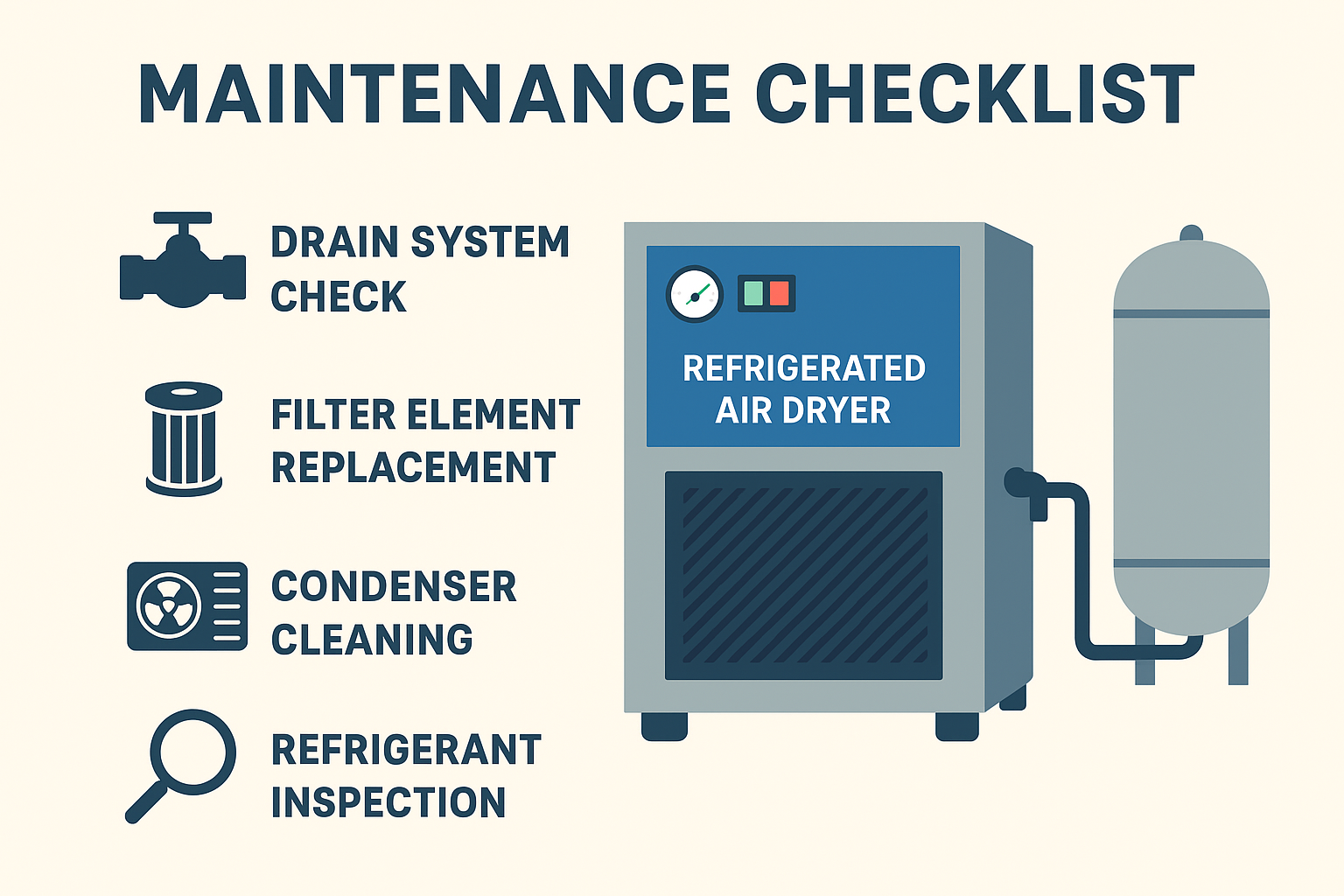
Condensate Drain Maintenance
The automatic drain is critical to refrigerated dryer performance.
Moisture separation is only useful if the resulting condensate can leave the dryer reliably.
Inspect the drain for:
- Blockage
- Contamination
- Valve malfunction
- Restricted discharge piping
- Continuous compressed air leakage
Maintenance intervals should reflect actual operating conditions. A humid or contaminated system may require more frequent inspection than a clean, lightly loaded installation.
Condenser Cleaning
Because the dryer is air-cooled, condenser condition directly affects refrigeration performance.
Dust, oil mist, fibers, and other debris can restrict airflow through the condenser.
Inspect the condenser regularly and clean it when contamination begins to interfere with heat transfer.
There is no universal basis for assuming that cleaning automatically reduces energy consumption by a fixed percentage such as 15%. The actual benefit depends on how contaminated the condenser was and the operating conditions.
Refrigeration System Maintenance
The refrigeration circuit should be inspected if cooling performance deteriorates.
Relevant components include:
- Refrigeration compressor
- Condenser
- Evaporator
- Expansion valve
- Refrigerant filter drier
- Pressure switches
- Hot-gas bypass valve
- Refrigerant piping and connections
Refrigerant should not require routine replacement or topping up in a properly sealed refrigeration system.
If refrigerant loss is suspected, qualified personnel should identify and repair the leak before restoring the correct refrigerant charge.
Electrical Inspection
Electrical components should be periodically inspected for signs of:
- Loose connections
- Overheating
- Damaged wiring
- Contactor wear
- Protection-device faults
- Abnormal fan operation
Inspection frequency should be determined according to operating hours, environment, and maintenance requirements rather than one fixed annual interval for every facility.
Energy-Saving Best Practices
Efficient dryer operation requires looking at the complete compressed air system.
Avoid Continuous Overloading
Operating above the dryer’s effective capacity can increase outlet dew point and reduce moisture-removal performance.
If production demand has increased permanently, evaluate whether a larger dryer is required.
Maintain Good Condenser Airflow
Keep the condenser clean and make sure discharged hot air does not recirculate into the dryer.
Good ventilation is especially important during high ambient temperatures.
Reduce Excessive Inlet Temperature
Effective aftercooling before the dryer reduces refrigeration load.
It also allows more liquid condensate to be removed before compressed air enters the drying system.
Minimize Pressure Drop
The AH Series specifies a pressure drop of ≤0.025 MPa under its rated conditions.
However, total compressed air system pressure drop also includes filters, piping, valves, fittings, and other treatment equipment.
Maintaining these components helps reduce the compressor discharge pressure needed to supply downstream equipment.
Repair Air Leaks
Leaks increase both compressor demand and the amount of air passing through the dryer.
A plant with significant leakage may unintentionally operate its dryer close to or beyond its intended capacity.
Troubleshooting Moisture in the Outlet Air
Moisture downstream does not necessarily mean the dryer has failed.
Possible causes include:
- Excessive airflow
- High inlet temperature
- High ambient temperature
- Dirty condenser
- Poor ventilation
- Automatic drain failure
- Refrigeration-system problems
- Downstream piping condensation
- Dryer bypass leakage
Check actual operating conditions systematically before replacing components.
Troubleshooting a High Dew Point
If outlet dew point begins to rise, compare current conditions with normal operating data.
Check:
- Actual airflow
- Inlet temperature
- Ambient temperature
- Condenser cleanliness
- Fan operation
- Drain operation
- Refrigeration condition
This approach can distinguish an operating-condition problem from an actual refrigeration-system fault.
Frequent Refrigeration Compressor Cycling
Repeated cycling may result from:
- Changing compressed air demand
- Abnormal ambient conditions
- Refrigeration controls
- Condenser problems
- Protection-device operation
- Refrigeration-system faults
Do not assume high ambient temperature is the only possible cause.
If cycling becomes abnormal or significantly different from previous operation, inspect the system before continuing extended operation.
Unusual Noise or Vibration
Abnormal noise may come from the fan, refrigeration compressor, enclosure panels, loose fasteners, or other mechanical components.
Check that the dryer remains level and inspect the source of the vibration before replacing parts.
Do You Need an Activated Carbon Filter?
Activated carbon filtration can be useful when extremely low residual oil vapor is required, but it is not automatically necessary after every refrigerated dryer.
Lingyu’s ACS activated carbon filtration is intended for applications requiring very low residual oil content.
The decision to use it should depend on the final compressed air specification rather than being treated as a standard accessory for every 200 CFM installation.
Can a Refrigerated Dryer Guarantee an ISO 8573-1 Class?
A dryer alone does not establish the complete ISO 8573-1 purity classification.
Compressed air purity involves separate requirements for contaminants such as:
- Particles
- Water
- Oil
The final class depends on the complete compressor and treatment system, including filtration, drying, piping, and actual operating conditions.
Where a specific ISO 8573-1 class is required, the entire treatment train should be selected and verified against that requirement.
When Is Refrigerated Drying Not Enough?
A 2–10°C pressure dew point is appropriate for many industrial compressed air applications, but some processes need significantly drier air.
Examples may include extremely moisture-sensitive manufacturing, low-temperature outdoor piping, and processes with stringent instrument-air requirements.
In those situations, a desiccant air dryer may be more suitable.
The correct technology should be selected according to the required pressure dew point rather than assuming that a lower dew point is always better.
A Practical Approach to 200 CFM Dryer Maintenance
Instead of applying the same maintenance interval to every dryer, use a combination of scheduled inspection and condition monitoring.
Track parameters such as:
- Inlet temperature
- Ambient temperature
- Operating pressure
- Airflow
- Outlet pressure dew point
- Pressure drop
- Drain operation
- Condenser condition
Keeping a maintenance record makes it easier to identify gradual changes before they become production problems.
Reliable Moisture Control for Medium-Flow Compressed Air Systems
The 200 CFM Air-Cooled Refrigerated Air Dryer provides practical moisture control for industrial compressed air systems where a 2–10°C pressure dew point meets the process requirement.
Correct capacity selection, adequate ventilation, clean condenser surfaces, reliable condensate drainage, appropriate filtration, and low system pressure drop all contribute to stable operation and energy efficiency.
For assistance matching the dryer to actual site conditions, contact Lingyu with your airflow, operating pressure, inlet temperature, ambient temperature, and required pressure dew point.