Moisture is one of the most common contaminants in an industrial compressed air system. As compressed air cools, water vapor can condense into liquid water, contributing to pipeline corrosion, pneumatic equipment problems, process instability, and reduced downstream air quality.
A water-cooled Refrigerated air dryer removes this moisture by cooling compressed air below the temperature at which much of its water vapor condenses, separating the condensate, and then reheating the dried air before it enters the distribution system.
Compared with an air-cooled refrigerated dryer, a water-cooled design uses a cooling-water circuit to reject heat from the refrigeration system. This makes it particularly relevant where a reliable cooling-water supply is already available or where the installation should be less dependent on airflow around the refrigeration condenser.
Lingyu’s WH Series is designed as a water-cooled high-inlet-temperature refrigerated air dryer, with related models available in the water-cooled air dryer category.
What Is a Water-Cooled Refrigerated Air Dryer?
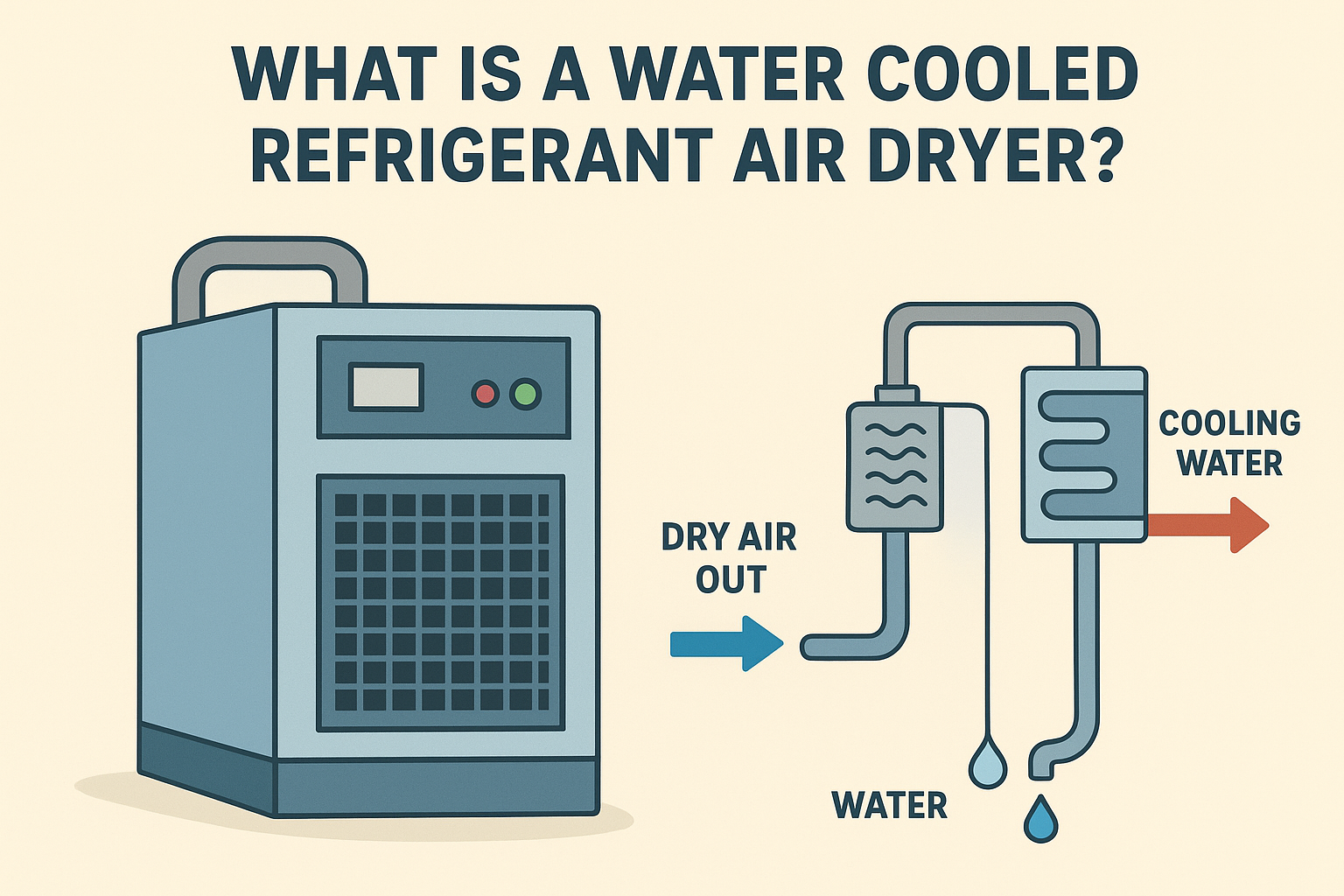
A water-cooled Refrigerated air dryer is a refrigeration-based compressed-air dryer in which moisture removal is achieved by lowering the compressed-air temperature and separating the resulting condensate.
The term water-cooled refers to the refrigeration system’s cooling method. Instead of using an air-cooled condenser and fan as the primary heat-rejection arrangement, the dryer uses cooling water.
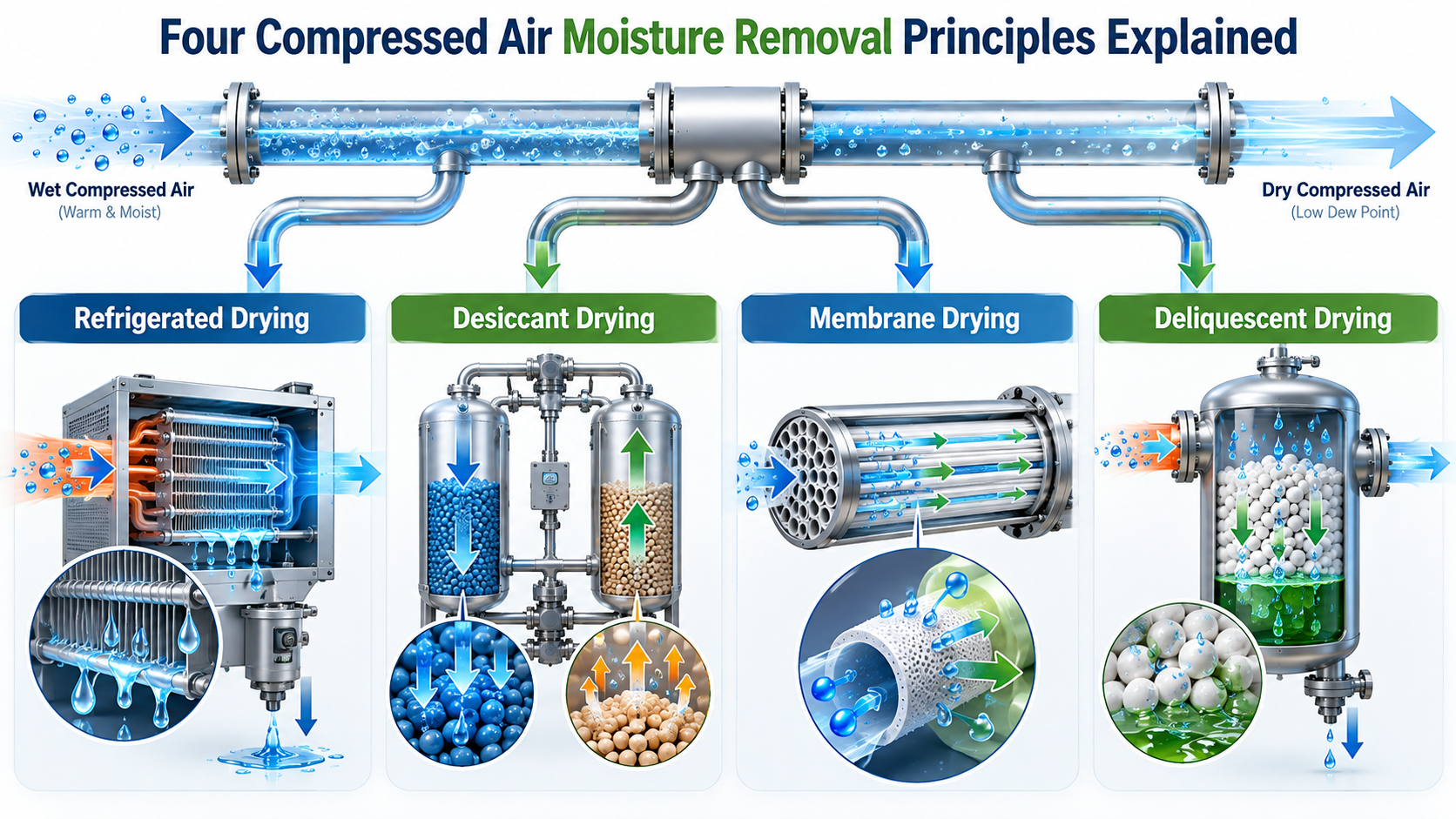
The compressed-air drying principle remains fundamentally the same as in other refrigerated dryers:
Cool the compressed air → condense moisture → separate and drain the condensate → reheat the dry air.
For a broader explanation of the refrigeration process, see how refrigerated air dryers work.
How Does a Water-Cooled Refrigerated Air Dryer Work?
Lingyu’s WH Series uses several stages to remove moisture from compressed air.
1. Pre-Cooling
High-temperature compressed air containing moisture and oil first enters the water-cooled pre-cooler and air-to-air heat exchanger.
This reduces the compressed-air temperature before it reaches the refrigeration evaporator, lowering the cooling load on the refrigeration section.
2. Refrigeration Cooling
The pre-cooled compressed air then enters the air-to-Refrigerated evaporator.
Here, heat is transferred from the compressed air to the refrigeration circuit, reducing the air temperature until moisture begins to condense.
For the WH Series, the specified pressure dew point is 2–10°C under the stated operating conditions.
3. Moisture Separation
As the compressed air cools, water, oil, and some impurities condense.
A gas-liquid separator removes the condensate from the compressed-air stream, and an automatic drain valve discharges it from the dryer.
Effective separation is important because condensing moisture alone is not sufficient; the resulting liquid must also be reliably removed from the airflow.
4. Reheating the Dry Air
After moisture separation, the low-temperature dry compressed air returns through the air-to-air heat exchanger.
There it exchanges heat with the incoming warmer compressed air and is reheated toward ambient temperature before leaving the dryer.
This heat recovery simultaneously pre-cools the incoming air, reducing the refrigeration load.
5. Heat Rejection Through Cooling Water
The refrigeration circuit must reject the heat removed from the compressed air.
In a water-cooled dryer, the condenser side uses cooling water rather than relying primarily on ambient airflow.
For Lingyu’s WH Series, the specified cooling-water conditions are 0.2–0.4 MPa cooling-water pressure, ≤32°C cooling-water temperature, and a 2–38°C cooling-water operating range.
These conditions should be considered during dryer sizing because the cooling-water system directly affects refrigeration heat rejection.
Key WH Series Operating Specifications
The main WH Series operating conditions are:
| Parameter | WH Series Specification |
|---|---|
| Rated inlet pressure | 0.7 MPa |
| Operating pressure range | 0.6–1.0 MPa |
| Rated inlet temperature | 50°C |
| Maximum inlet temperature | ≤80°C |
| Pressure dew point | 2–10°C |
| Rated ambient temperature | 32°C |
| Ambient operating range | 2–45°C |
| Pressure drop | ≤0.025 MPa |
| Cooling method | Water-cooled |
| Cooling-water pressure | 0.2–0.4 MPa |
| Cooling-water temperature | ≤32°C |
| Cooling-water operating range | 2–38°C |
The 50°C rated inlet temperature and ≤80°C maximum inlet temperature are especially important because the WH Series is positioned for relatively high inlet temperatures.
What Refrigerated Does the WH Series Use?
The WH Series specifies R22 as the standard Refrigerated, with environmentally friendly Refrigerateds such as R407C and R410A available upon request.
Because Refrigerated regulations and requirements differ by market, the Refrigerated configuration should also be confirmed for the destination country when specifying the dryer.
Water-Cooled vs. Air-Cooled Refrigerated Dryers
Both designs remove moisture through refrigeration. The major difference is how the refrigeration system rejects heat.
| Consideration | Water-Cooled | Air-Cooled |
|---|---|---|
| Heat-rejection medium | Cooling water | Ambient air |
| Cooling-water system required | Yes | No |
| Dependence on condenser ventilation | Lower | Higher |
| Water quality/flow must be managed | Yes | No |
| Installation suitability depends on | Water availability and thermal conditions | Ventilation and ambient conditions |
Users comparing the two equipment families can review Lingyu’s air-cooled refrigerated dryer category.
Neither cooling method is universally better. Selection should depend on actual plant utilities, thermal conditions, installation constraints, and total operating cost.
Is a Water-Cooled Dryer Always More Energy-Efficient?
No.
A water-cooled condenser can provide effective heat rejection, particularly where suitable cooling water is already available. However, total system efficiency also depends on the refrigeration compressor, heat exchangers, pressure drop, cooling-water pumps, cooling tower or chiller requirements, load profile, and operating temperatures.
Dryer electrical power alone therefore does not represent the total energy cost of a water-cooled installation.
If cooling water must be generated or circulated by additional equipment, that auxiliary energy should also be included when comparing water-cooled and air-cooled options.
Why Pressure Drop Matters
A refrigerated dryer should remove moisture without creating unnecessary resistance in the compressed-air system.
Lingyu specifies a pressure drop of ≤0.025 MPa for the WH Series under its stated conditions.
Excessive pressure loss can force the compressor to operate at a higher discharge pressure to maintain sufficient pressure at the point of use, so pressure loss should be considered alongside refrigeration energy and cooling-water requirements.
For more detail, see how compressed-air pressure drop affects system efficiency.
High-Inlet-Temperature Capability
One of the key characteristics of the WH Series is its inlet-temperature capability.
The WH Series has a rated inlet temperature of 50°C and a maximum allowable inlet temperature of ≤80°C.
The water-cooled pre-cooler reduces the temperature of incoming high-temperature compressed air before it reaches the evaporator.
Inlet temperature is therefore a critical selection parameter. Dryer sizing should not be based only on compressor airflow while ignoring the actual temperature of the compressed air entering the dryer.
High-Efficiency Moisture Separation
Cooling the air is only one part of the drying process.
Once moisture has condensed, the dryer must separate the liquid efficiently from the compressed-air stream.
Lingyu’s WH Series uses an independently designed water-separation system intended to support reliable condensate removal. The condensate is then discharged through the automatic drain.
Drain performance should therefore be included in routine inspection. A refrigeration system may be functioning correctly while a blocked or malfunctioning drain still causes downstream moisture problems.
Load Variation and Compressor Control
Applicable WH Series models use a dual-compressor arrangement.
The second refrigeration compressor can start or stop according to system load, allowing refrigeration capacity to respond to changing compressed-air demand.
For facilities with highly variable demand, load-adaptive refrigeration control can therefore be an important selection consideration.
Does a Water-Cooled Dryer Have a Smaller Footprint?
Not necessarily.
Removing the same type of air-cooled condenser fan arrangement can affect the dryer’s own equipment layout, but a complete water-cooled installation may also require external piping, pumps, cooling towers, chillers, strainers, valves, or water-treatment equipment depending on the facility.
Footprint should therefore be evaluated at the system level rather than from the dryer cabinet alone.
Is a Water-Cooled Dryer Quieter?
Water cooling can remove the need for the same type of condenser fan arrangement used by an air-cooled unit, but actual site noise depends on the refrigeration compressor, pumps, surrounding equipment, and installation.
Without model-specific comparative acoustic data, lower noise should be treated as an engineering consideration rather than a guaranteed product advantage.
Water Quality and Cooling-Water Maintenance
A water-cooled dryer depends on reliable heat transfer through its water circuit.
Poor water quality, insufficient flow, scaling, fouling, or restricted cooling-water passages can reduce heat-transfer performance.
Facilities should therefore evaluate water temperature, water pressure, available flow, and water quality when planning a water-cooled installation.
For the WH Series, cooling-water pressure is specified at 0.2–0.4 MPa, while cooling-water temperature should be ≤32°C under the stated conditions.
Actual water-treatment requirements should be determined from site water chemistry and the cooling-system design rather than using a universal treatment interval.
How to Size a Water-Cooled Refrigerated Air Dryer
Correct sizing should consider more than compressor nameplate airflow.
The main selection factors are actual maximum airflow, inlet pressure, inlet temperature, required pressure dew point, cooling-water temperature, cooling-water pressure, ambient temperature, allowable pressure drop, and expected load variation.
For WH Series capacities above approximately 160 m³/min, or for special requirements involving pressure, materials, temperature, or other specifications, detailed engineering selection is required.
Nominal airflow should therefore be checked against the actual operating envelope rather than used as the only sizing criterion.
Example Product Capacities
Lingyu offers water-cooled high-temperature refrigerated dryers at different capacities, including 3,885 CFM, 4,238 CFM, and 8,830 CFM models.
For buyers researching a large water-cooled configuration, see the 4,238 CFM water-cooled high-temperature refrigerated dryer.
Actual sizing should still be verified from operating conditions rather than matching a CFM value alone.
Installation Requirements
The WH Series is designed for indoor installation on a level concrete floor without a foundation.
A minimum clearance of 1.5 m around the unit is recommended.
This clearance should be included during plant-layout planning so that service access, heat-exchanger maintenance, piping, drainage, and cooling-water connections remain accessible.
Where Are Water-Cooled Refrigerated Dryers Used?
Water-cooled refrigerated dryers can be considered in industrial facilities where a stable cooling-water supply is available and the required pressure dew point is within the refrigeration-dryer range.
They can also be particularly relevant where compressor discharge air reaches higher temperatures and a high-inlet-temperature refrigerated configuration is required.
Automotive and General Manufacturing
Compressed-air reliability is important across automotive and general manufacturing, where pneumatic equipment, production lines, and finishing processes may depend on consistent compressed-air quality.
See Lingyu’s automotive and general manufacturing application.
Water-cooled refrigerated dryers may also be considered in large industrial plants, electronics manufacturing, energy-related facilities, and other sites with centralized cooling-water infrastructure.
The choice should always be based on the actual compressed-air specification and available site utilities rather than industry name alone.
Water-Cooled Refrigerated Dryer vs. Desiccant Dryer
A refrigerated dryer and a desiccant dryer serve different pressure-dew-point requirements.
The WH Series is specified for a pressure dew point of 2–10°C.
Where a process requires substantially lower dew points, adsorption drying may be more appropriate.
Selecting a desiccant dryer when refrigeration is sufficient can introduce unnecessary regeneration energy, while selecting a refrigerated dryer for a process requiring a very low dew point may fail to meet the air-quality requirement.
Maintenance Considerations
Routine maintenance should focus on the components that directly influence refrigeration and condensate-removal performance.
Key areas include the pre-cooler, air-to-air heat exchanger, evaporator, gas-liquid separator, automatic drain, refrigeration compressor, cooling-water circuit, and control system.
Cooling-water flow and temperature should be checked regularly, while heat-transfer surfaces should be maintained to support effective heat exchange.
A rising outlet dew point may indicate insufficient cooling, excessive inlet temperature or airflow, poor condensate separation, cooling-water problems, refrigeration-system faults, or another departure from the dryer’s rated operating conditions.
Maintenance should therefore be based on measured operating data as well as the applicable maintenance schedule.
Water-Cooled Dryer Selection Checklist
Before selecting a water-cooled Refrigerated air dryer, confirm the maximum actual compressed-air flow, normal and maximum inlet temperature, normal and minimum inlet pressure, required pressure dew point, acceptable pressure drop, cooling-water temperature, cooling-water pressure and available flow, water quality, ambient operating conditions, destination-market Refrigerated requirements, electrical supply, load variation, drainage arrangement, space and service clearance, and total lifecycle energy including cooling-water auxiliaries.
For the Lingyu WH Series, these factors should be checked against the specified operating envelope rather than relying only on nominal flow capacity.
Conclusion
A water-cooled Refrigerated air dryer removes moisture by cooling compressed air until water vapor condenses, separating and draining the condensate, and reheating the dry air before it reaches the downstream system.
Lingyu’s WH Series adds a water-cooled pre-cooling and refrigeration arrangement designed for relatively high inlet temperatures.
Its principal operating conditions include 0.7 MPa rated inlet pressure, 0.6–1.0 MPa operating pressure, 50°C rated inlet temperature, ≤80°C maximum inlet temperature, 2–10°C pressure dew point, ≤0.025 MPa pressure drop, 0.2–0.4 MPa cooling-water pressure, and ≤32°C cooling-water temperature.
The strongest reason to choose a water-cooled dryer is not that it is automatically better than an air-cooled dryer. The correct choice depends on compressed-air flow, inlet temperature, required dew point, pressure drop, cooling-water availability and conditions, installation environment, load profile, and total operating cost.
Where those conditions favor water cooling, a properly selected refrigerated dryer can provide reliable moisture removal while maintaining a stable 2–10°C pressure dew point.