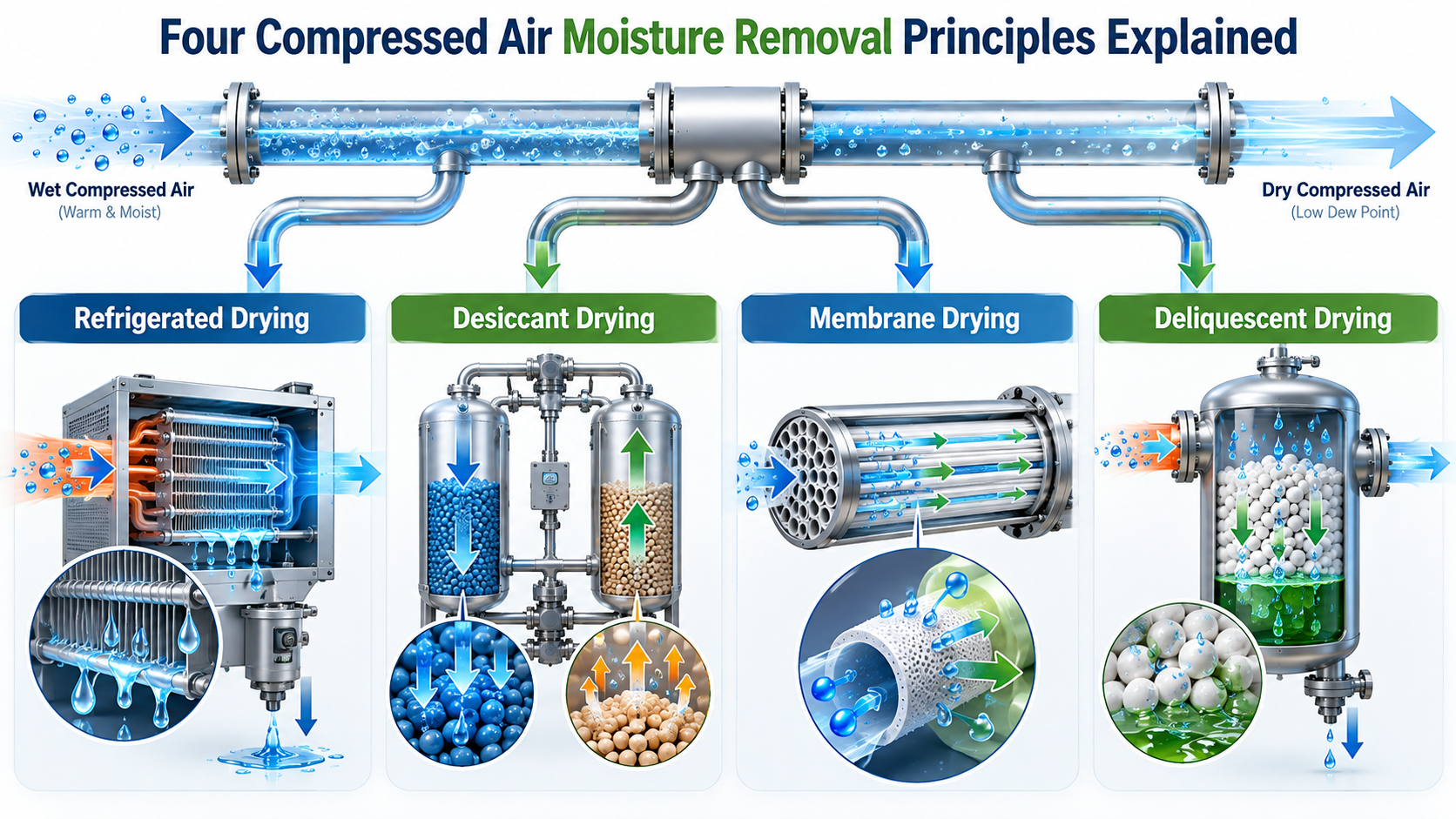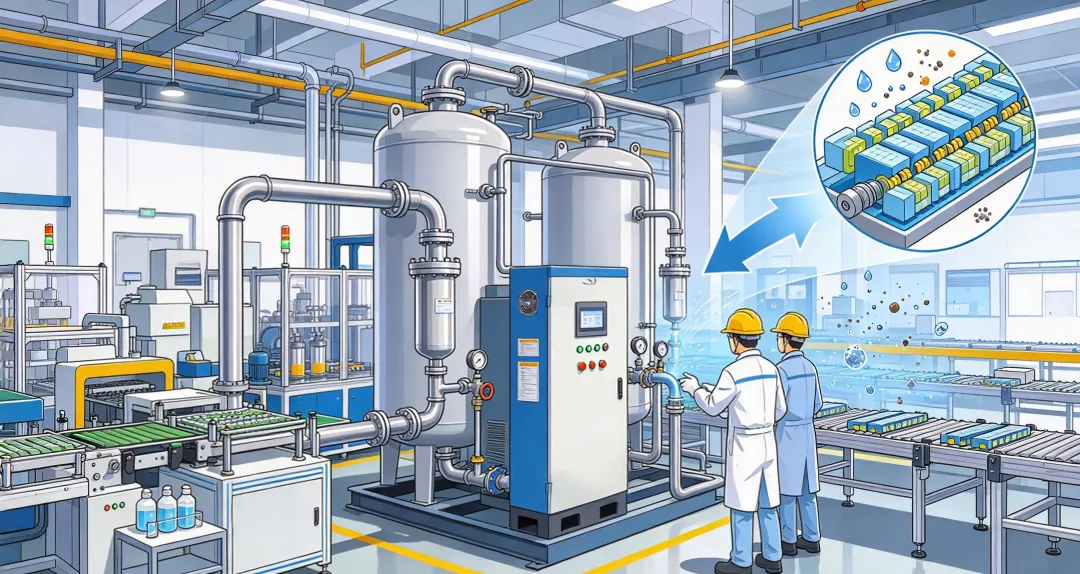
Compressed air is widely used in manufacturing, automotive production, food and beverage plants, electronics, packaging, and many other industrial systems. However, compressed air also carries water vapor.
As compressed air cools after compression, excess moisture can condense into liquid water. If that moisture is not controlled, it can contribute to pipeline corrosion, pneumatic-control problems, equipment failures, and product-quality issues.
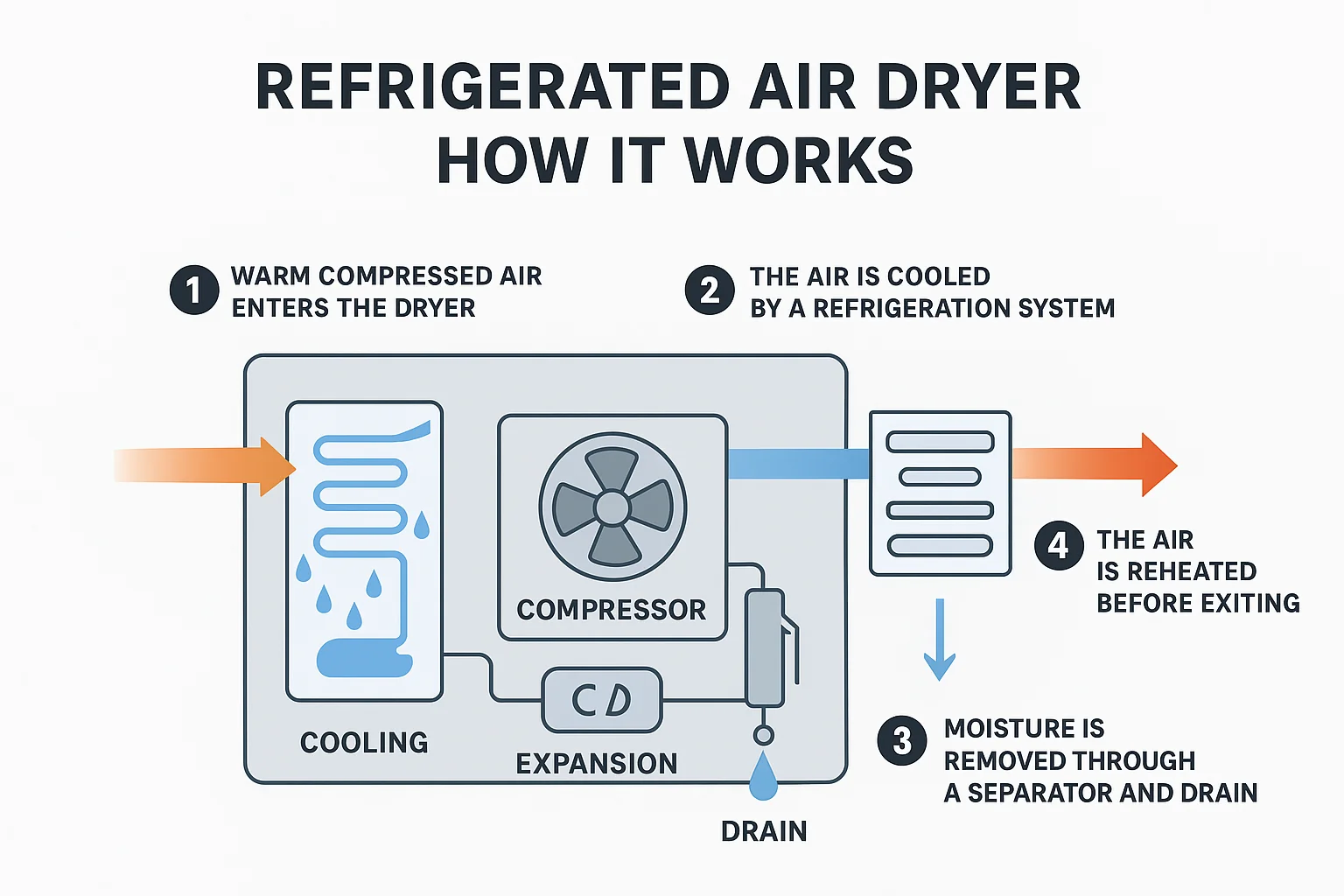
A refrigerated air dryer is one of the most common technologies used to control this moisture. It works by cooling compressed air, condensing water vapor into liquid, separating the condensate, draining it, and reheating the dried air before it enters the downstream system.
Lingyu’s refrigerated dryer portfolio includes AH Series air-cooled, WH Series water-cooled, and several energy-saving refrigerated dryer configurations.
What Is a Refrigerated Air Dryer?
A refrigerated air dryer is a compressed-air treatment device that removes moisture primarily through cooling and condensation.
The dryer lowers the compressed-air temperature until a portion of the water vapor condenses into liquid. That liquid is then separated and discharged.
The basic process is:
Hot wet compressed air → pre-cooling → refrigeration cooling → condensation → gas-liquid separation → drainage → reheating → dry compressed air
For Lingyu’s AH and WH Series, the specified pressure dew point is 2–10°C under the stated operating conditions.
This makes refrigerated drying suitable where the process does not require the substantially lower pressure dew points provided by adsorption drying.
Why Moisture Forms in Compressed Air
Ambient air naturally contains water vapor.
When that air is compressed, the amount of water contained in each cubic meter increases. As the compressed air later cools, it may no longer be able to retain all that moisture as vapor, so the excess moisture condenses.
Uncontrolled moisture can contribute to pipeline corrosion, reduced product quality, control-system failures, and freezing under suitable low-temperature conditions.
A refrigerated dryer is designed to remove a substantial portion of this moisture before the compressed air reaches downstream equipment.
How Does a Refrigerated Air Dryer Work?
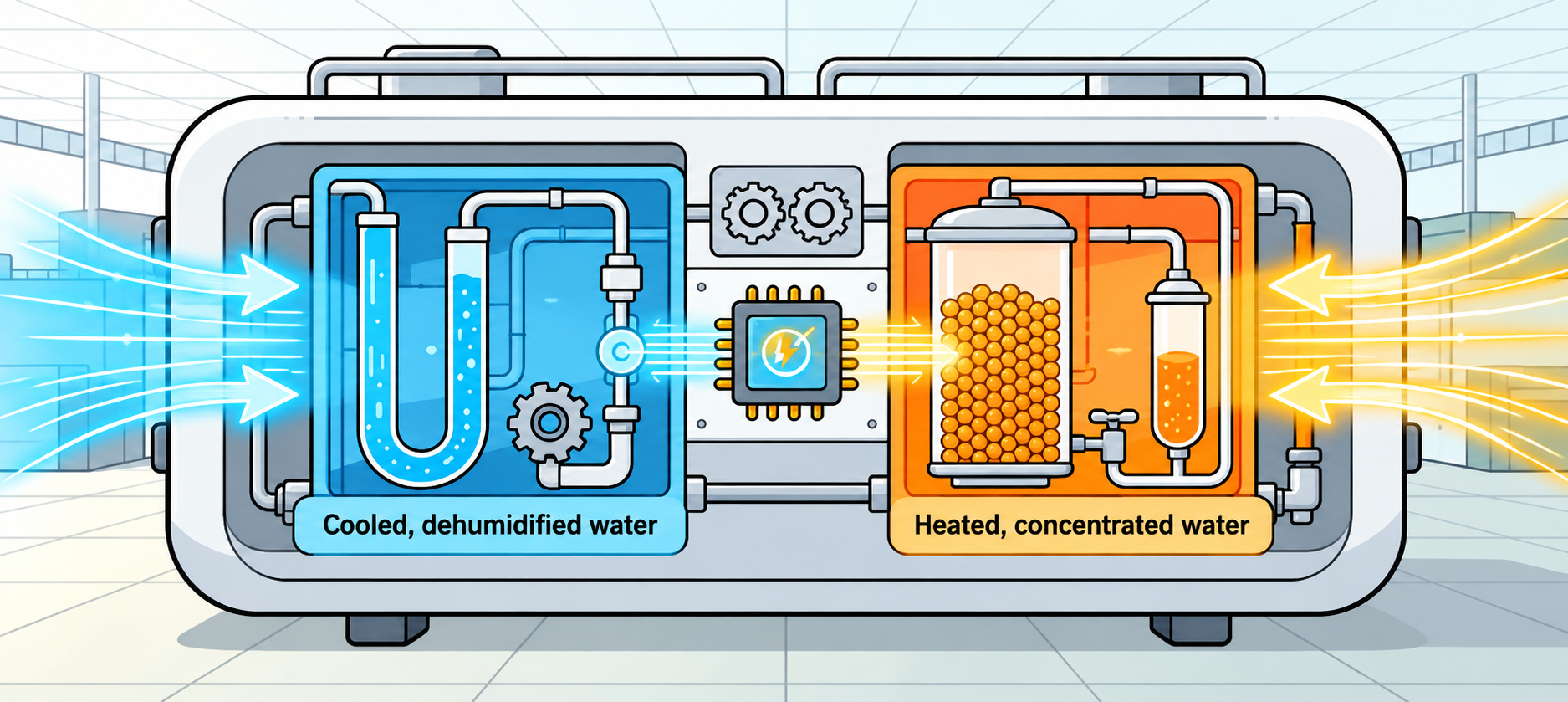
A refrigerated dryer contains two interacting systems: the compressed-air circuit and the refrigeration circuit.
The compressed-air circuit is where moisture is removed. The refrigeration circuit provides the cooling required to make condensation occur.
Step 1: Warm, Moist Compressed Air Enters the Dryer
Compressed air enters the dryer carrying water vapor and potentially other contaminants depending on the compressor and upstream treatment system.
The air should not be assumed to enter directly from the compressor at one universal temperature. Actual dryer inlet temperature depends on the compressor, aftercooler, receiver, piping, ambient conditions, and overall system arrangement.
For Lingyu’s AH and WH Series, the rated inlet temperature is 50°C, with a maximum inlet temperature of ≤80°C.
Step 2: The Incoming Air Is Pre-Cooled
Before entering the evaporator, compressed air passes through a pre-cooling and air-to-air heat-exchange stage.
Heat transfers from the warmer incoming compressed air to the colder dry air leaving the dryer.
This reduces the refrigeration system’s cooling load:
Incoming warm air loses heat ↔ outgoing cold dry air gains heat
This internal heat recovery is an important part of refrigerated dryer operation.
Step 3: The Evaporator Cools the Compressed Air
The pre-cooled air then enters the air-to-refrigerant evaporator.
Cold refrigerant absorbs heat from the compressed air, reducing its temperature until water vapor begins to condense.
For Lingyu’s AH and WH Series, the process is designed around a 2–10°C pressure dew point.
The evaporator, rather than the condenser, is the component that directly cools the compressed air.
Step 4: Moisture Condenses
As the air cools in the evaporator, water vapor condenses into liquid.
Moisture, oil, and some impurities may condense during this stage. However, condensation alone does not remove the liquid from the airflow.
The condensate must still be physically separated.
Step 5: The Gas-Liquid Separator Removes Condensate
After refrigeration cooling, compressed air passes through a gas-liquid separation stage.
The separator removes condensed liquid droplets from the compressed-air stream.
Lingyu’s AH and WH designs include a water-separation system intended to provide reliable moisture separation. If separation performance deteriorates, liquid carryover can occur even when the refrigeration circuit itself is cooling correctly.
Step 6: The Automatic Drain Removes the Liquid
Collected condensate is discharged through an automatic drain.
This prevents separated water from accumulating inside the dryer and being carried back into the airflow.
Drain condition is therefore an important part of refrigerated dryer maintenance. A blocked or malfunctioning drain can cause downstream moisture problems even when evaporator cooling remains normal.
Step 7: The Dry Air Is Reheated
After moisture separation, the compressed air is still relatively cold.
It passes back through the air-to-air heat exchanger, where it absorbs heat from the warmer incoming compressed air.
In the AH and WH process, the dry compressed air is reheated toward ambient temperature before leaving the dryer.
This reheating stage simultaneously warms the outlet air and pre-cools the incoming air, making it part of the internal heat-recovery process.
The Refrigeration Circuit
The compressed-air side explains how moisture is removed. The refrigeration side explains how the required cooling is produced.
A simplified refrigeration circuit is:
Refrigeration compressor → condenser → expansion device → evaporator → compressor
Refrigeration Compressor
The refrigeration compressor circulates the refrigerant and creates the pressure conditions required for the refrigeration cycle.
Condenser
The condenser rejects heat from the refrigerant.
How this heat is rejected determines one of the main differences between air-cooled and water-cooled refrigerated dryers.
Expansion Device
The refrigerant passes through an expansion or throttling device, reducing its pressure before entering the evaporator.
Evaporator
The refrigerant absorbs heat from the compressed air in the evaporator.
This is the point where the refrigeration circuit and compressed-air circuit interact thermally.
Air-Cooled Refrigerated Air Dryers
An air-cooled refrigerated dryer rejects refrigeration-system heat to ambient air.
Lingyu’s AH Series is the company’s standard air-cooled refrigerated dryer family.
| Parameter | AH Series |
|---|---|
| Rated inlet pressure | 0.7 MPa |
| Operating pressure range | 0.6–1.0 MPa |
| Rated inlet temperature | 50°C |
| Maximum inlet temperature | ≤80°C |
| Pressure dew point | 2–10°C |
| Ambient operating range | 2–45°C |
| Pressure drop | ≤0.025 MPa |
| Cooling method | Air-cooled |
Users specifically considering this configuration can review Lingyu’s air-cooled refrigerated dryer category.
Because condenser heat is rejected to ambient air, installation ventilation and condenser cleanliness are important operating considerations.
Water-Cooled Refrigerated Air Dryers
A water-cooled refrigerated dryer rejects refrigeration heat through a cooling-water circuit.
Lingyu’s WH Series is designed as a water-cooled high-inlet-temperature refrigerated air dryer.
Its operating data include:
| Parameter | WH Series |
|---|---|
| Pressure dew point | 2–10°C |
| Rated inlet temperature | 50°C |
| Maximum inlet temperature | ≤80°C |
| Pressure drop | ≤0.025 MPa |
| Cooling-water pressure | 0.2–0.4 MPa |
| Cooling-water temperature | ≤32°C |
Facilities with appropriate cooling-water infrastructure can evaluate Lingyu’s water-cooled refrigerated dryer category.
Neither cooling method is universally more efficient. The correct choice depends on ambient conditions, ventilation, cooling-water infrastructure, pumping energy, maintenance, and the overall plant system.
How Lingyu Refrigerated Dryer Configurations Are Organized
The broader refrigerated-dryer market often uses terms such as non-cycling and cycling dryers.
For Lingyu’s product portfolio, however, it is more useful to distinguish the documented equipment families and configurations, including AH Series air-cooled, WH Series water-cooled, and energy-saving refrigerated configurations such as PD, DD, and PB Series.
This product-based structure provides a clearer basis for comparing actual Lingyu refrigerated dryer technologies.
Energy-Saving and Variable-Frequency Refrigerated Dryers
Not every refrigerated dryer operates with the same control strategy.
Variable-frequency refrigeration can be useful where compressed-air flow and cooling load change significantly over time. Rather than assuming the refrigeration compressor must always operate at full capacity, a variable-frequency configuration can adapt refrigeration output to actual demand.
The energy benefit depends on the load profile and actual operating conditions.
For a specific Lingyu configuration, see the frequency-conversion refrigerated air dryer.
Load-Responsive Dual-Compressor Design
Lingyu’s AH and WH configurations also include a 1+1 dual-compressor arrangement on models from 5 to 180 m³/min.
The second refrigeration compressor starts or stops according to system load, helping the refrigeration system respond to changing compressed-air demand.
This is a specific product feature and is more technically useful than making a general claim that every refrigerated dryer is automatically energy-efficient.
Energy performance should always be evaluated from the actual dryer configuration and duty cycle.
Pressure Dew Point: Why 2–10°C Matters
Pressure dew point is one of the most important dryer specifications.
Lingyu’s AH and WH Series are specified at 2–10°C PDP.
This range is appropriate for many general industrial compressed-air applications, but it should not be confused with ultra-dry compressed air.
If a process requires substantially lower pressure dew points such as −20°C or −40°C, adsorption drying may be more appropriate.
Lingyu’s combined DC Series, for example, is specified at ≤−40°C PDP by combining a refrigerated drying stage with adsorption drying.
Refrigerated Dryer vs. Desiccant Dryer
The main difference is the required drying depth.
A refrigerated dryer removes moisture through cooling and condensation. A desiccant dryer removes residual water vapor through adsorption.
A refrigerated dryer may be the better choice when a 2–10°C PDP satisfies the process. A desiccant dryer becomes more appropriate where a substantially lower PDP is necessary.
Choosing −40°C air when the process only requires refrigerated drying can increase equipment and operating costs unnecessarily.
For a direct technology comparison, see Lingyu’s refrigerated air dryer vs. desiccant air dryer guide.
Does a Refrigerated Dryer Produce Clean, Oil-Free Air?
Not by itself.
A refrigerated dryer primarily controls moisture.
Some oil and other contaminants may condense during cooling and be separated with the condensate, but the dryer should not be treated as a substitute for properly selected filtration.
Where oil and particles need to be controlled to specific limits, appropriate filters should be included in the compressed-air treatment system.
Drying, oil removal, and particle filtration should therefore be treated as separate but coordinated purification functions.
Why Refrigerated Air Dryers Matter
The primary value of refrigerated drying is practical moisture control without the regeneration cycle required by conventional adsorption dryers.
When correctly selected, a refrigerated dryer can help reduce liquid-water accumulation, pipeline corrosion, moisture-related pneumatic problems, and process instability.
However, claims such as “low maintenance,” “long service life,” or “low operating cost” should not be treated as universal characteristics.
Actual lifecycle performance depends on dryer size, ambient temperature, inlet temperature, airflow, pressure drop, refrigeration controls, condenser condition, drain maintenance, and annual operating hours.
Pressure Drop and Energy Efficiency
Electrical consumption is only one part of refrigerated dryer energy performance.
Pressure drop also matters.
Lingyu’s AH and WH Series specify a pressure drop of ≤0.025 MPa under their stated operating conditions.
If a dryer creates excessive pressure loss, the compressor may need to operate at a higher discharge pressure to maintain the required downstream pressure.
A practical energy evaluation should therefore consider:
Refrigeration power + fan or pump energy + pressure drop + annual operating profile
rather than electrical consumption alone.
Where Refrigerated Air Dryers Are Used
Refrigerated dryers are widely applicable where the required PDP fits their operating range.
Typical uses include general manufacturing, automotive production, pneumatic tools, CNC equipment, packaging systems, plastics processing, food and beverage utility air, and other factory compressed-air systems.
However, industry name alone should not determine the dryer.
One food-processing application may only require 2–10°C PDP, while another moisture-sensitive process could require adsorption drying. Similarly, electronics and laser-cutting applications should be checked against their actual air-quality specifications rather than assuming refrigerated drying is automatically sufficient.
How to Select a Refrigerated Air Dryer
A refrigerated dryer should be selected from actual system conditions rather than compressor nameplate flow alone.
Important factors include maximum actual airflow, inlet pressure, inlet temperature, ambient temperature, required pressure dew point, allowable pressure drop, cooling method, load variation, ventilation or cooling-water availability, electrical supply, and downstream filtration requirements.
Sizing only from compressor nameplate flow can lead to poor dryer performance if temperature, pressure, and site conditions are ignored.
For a detailed sizing methodology, see Lingyu’s refrigerated air dryer sizing guide.
Refrigerated Air Dryer Maintenance
Routine maintenance should focus on components that directly affect heat transfer, condensate removal, and refrigeration performance.
Important areas include the condenser, pre-cooler, air-to-air heat exchanger, evaporator, gas-liquid separator, automatic drain, refrigeration compressor, refrigerant circuit, and controls.
For air-cooled units, condenser airflow and cleanliness are particularly important. For water-cooled units, cooling-water conditions and heat-exchanger condition also matter.
A rising outlet dew point can result from excessive airflow, high inlet temperature, high ambient temperature, cooling problems, poor condensate drainage, separator issues, or refrigeration-system faults. It should therefore not automatically be attributed to a single cause.
Conclusion
A refrigerated air dryer removes moisture from compressed air through a sequence of pre-cooling, refrigeration cooling, condensation, gas-liquid separation, drainage, and reheating.
In Lingyu’s AH and WH Series, compressed air is dried to a 2–10°C pressure dew point, condensate is separated and automatically drained, and the dried air is reheated toward ambient temperature before leaving the dryer.
The technology is especially useful where this dew-point range satisfies the downstream process without requiring deeper adsorption drying.
The correct refrigerated dryer should be selected according to airflow, inlet pressure and temperature, ambient conditions, cooling method, pressure drop, required PDP, and actual load profile.
Rather than assuming every refrigerated dryer is automatically low-cost, low-maintenance, or energy-efficient, the complete compressed-air system should be evaluated so that the selected configuration provides the required moisture control with appropriate lifecycle performance.