Clean and dry compressed air normally depends on more than one treatment component.
The dryer controls moisture, while filters remove contaminants such as oil aerosols and solid particles. In many compressed air systems, these components are installed together, which is why users often refer to maintenance of upstream or downstream filter elements as air dryer filter replacement.
Replacing the correct filter element at the right time helps maintain air quality, control pressure drop, protect downstream equipment, and support reliable dryer operation.
However, filter replacement should not be based on a universal fixed schedule alone. The correct interval depends on the filter grade, actual operating conditions, contamination load, differential pressure, and the manufacturer’s maintenance requirements.
What Is an Air Dryer Filter?
An “air dryer filter” is best understood as a compressed air filter installed before, after, or as part of a dryer system.
The dryer and filter perform different functions.
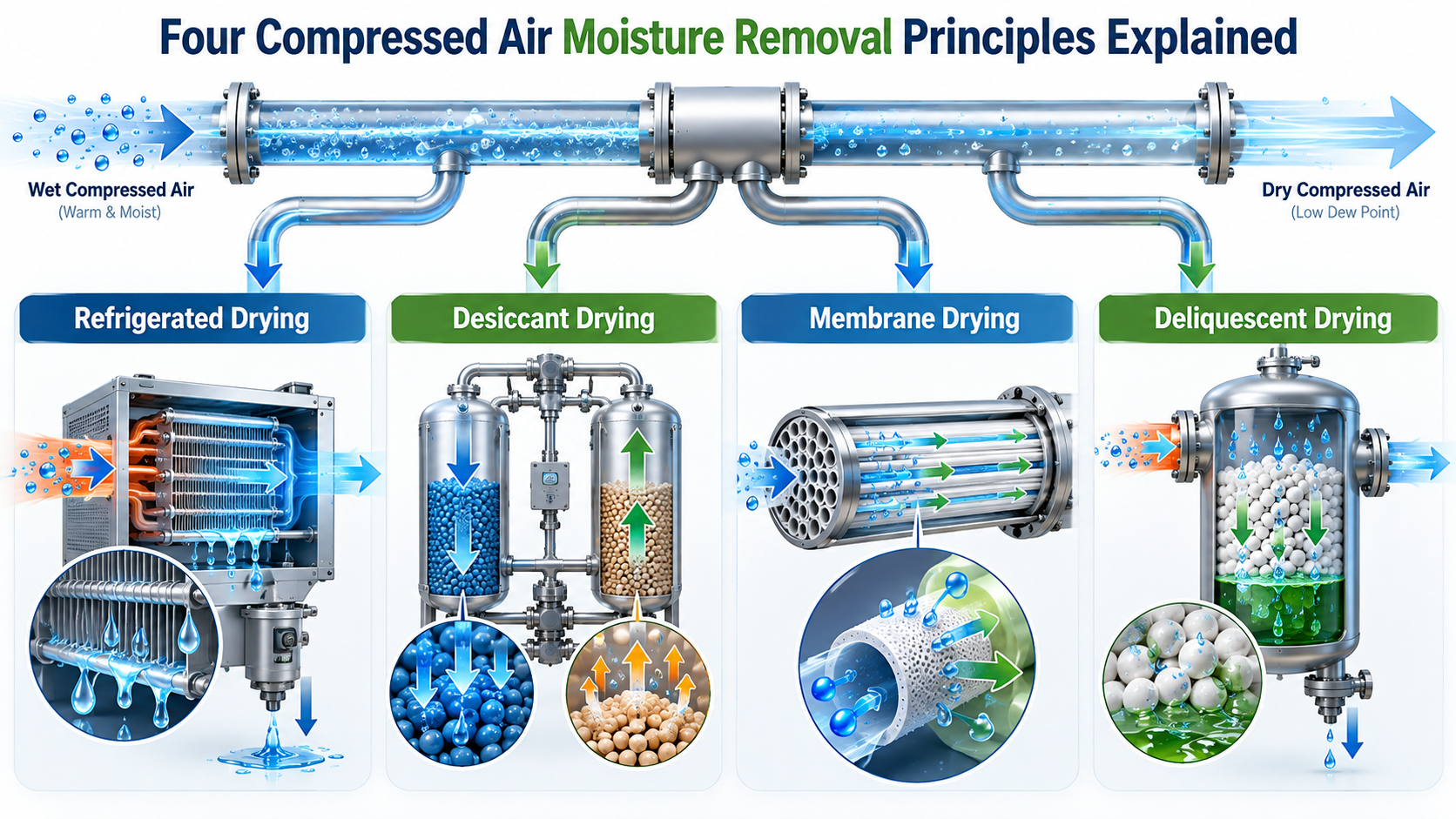
A refrigerated or adsorption dryer primarily removes moisture from compressed air. Filters are used to control other contaminants such as oil aerosols and solid particles.
Lingyu’s D Series compressed air filtration range includes:
- AO-grade pre-filters
- AA-grade oil and particulate removal filters
- AX-grade high-efficiency oil removal filters
- ACS activated-carbon oil removal filters
These filtration grades have different particle and residual-oil performance levels and should be selected according to the required compressed air quality.
Users evaluating the filter itself can review the precision compressed air filter product page.
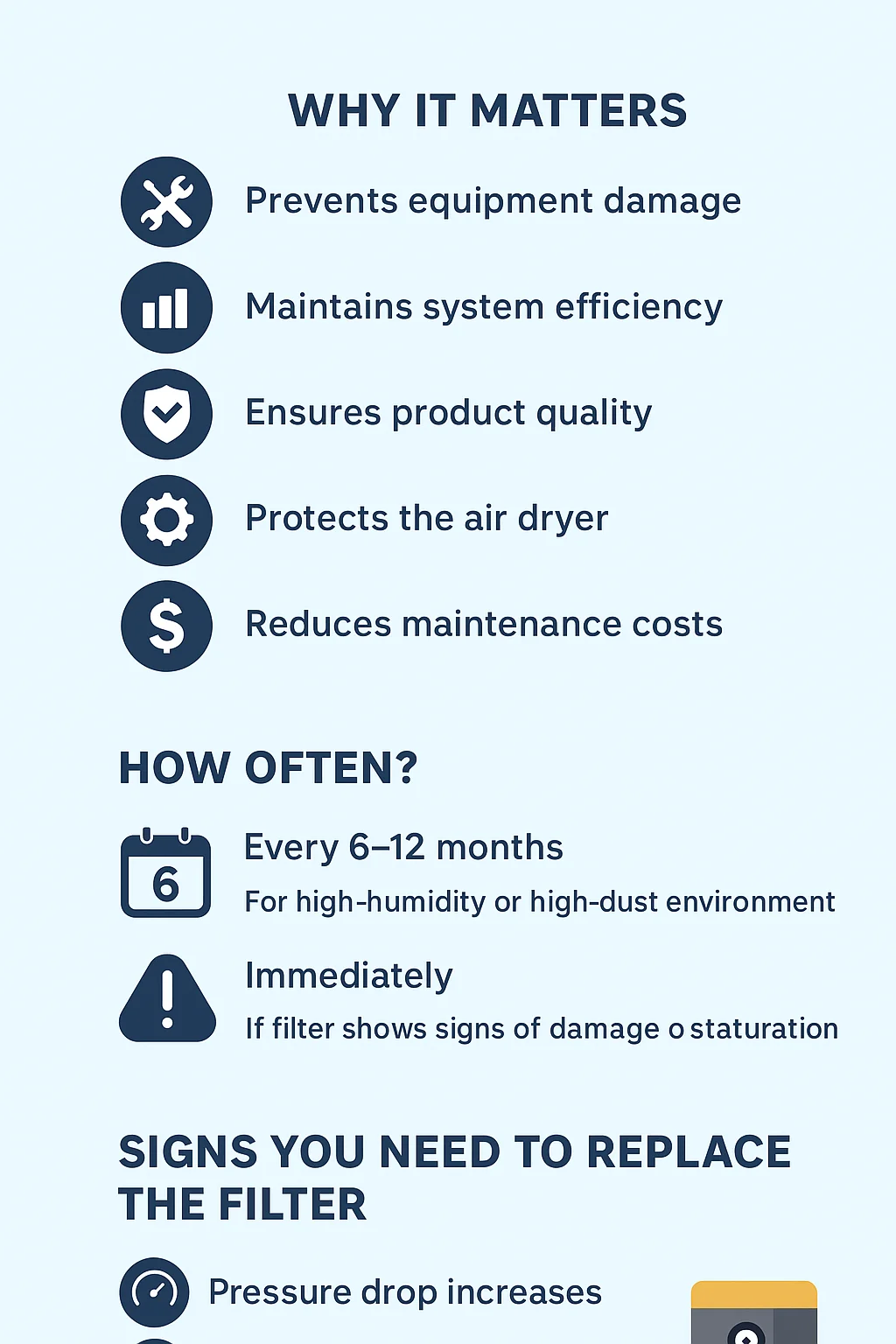
Why Air Dryer Filter Replacement Matters
A filter element collects contamination as compressed air passes through it.
Over time, the element can become loaded with oil, particles, and other contaminants. As this happens, filtration performance and airflow characteristics may change.
Replacing the element when required helps maintain both air quality and system efficiency.
1. It Helps Control Pressure Drop
A loaded filter can create greater resistance to airflow.
Higher pressure drop means less usable pressure downstream of the filter and may increase the amount of compressor energy required to maintain the desired system pressure.
For this reason, differential pressure is an important maintenance indicator. Some Lingyu filters use a differential pressure indicator to provide a visual indication of when the filter element requires replacement, and differential pressure gauges are also available among compressed air system spare parts.
Users who want to understand the wider system impact can also refer to the compressed air pressure drop guide.
2. It Helps Maintain the Intended Filtration Level
Different filters are designed for different contamination-control requirements.
Lingyu’s AO grade serves as a pre-filter, while AA and AX provide progressively finer particulate and oil control. ACS uses activated carbon for very low residual oil levels.
If a filter element is overdue for replacement or damaged, the system may no longer provide the filtration performance expected from that grade.
This can be particularly important for downstream equipment and moisture-sensitive processes.
3. It Helps Protect Adsorption Dryers
Adsorption dryers rely on desiccant beds to remove water vapor.
Oil and particulate contamination entering the adsorption stage can interfere with the overall treatment system, so upstream filtration is important.
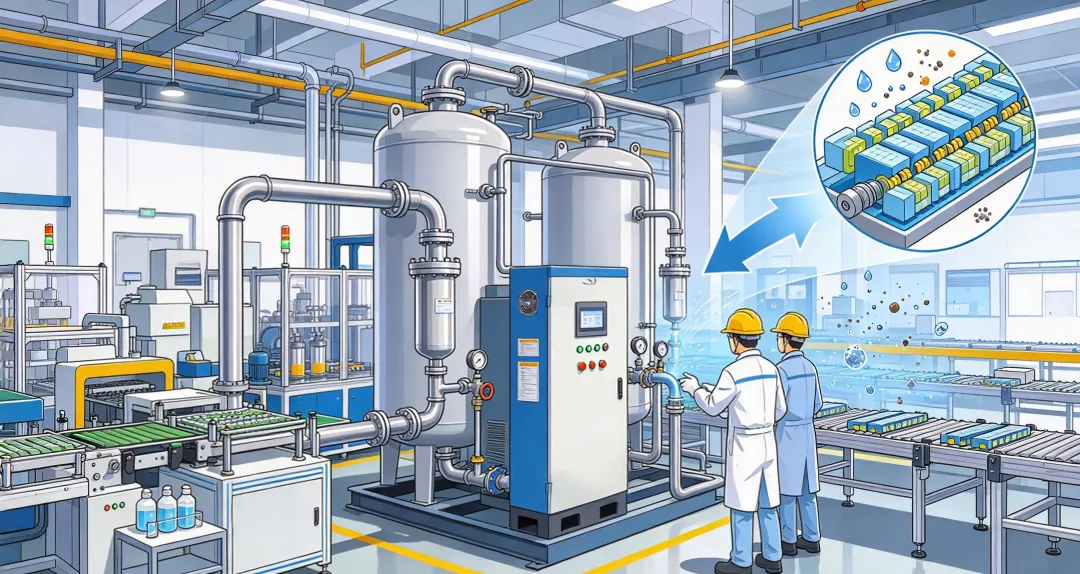
In a combined drying arrangement, oil-removal filtration can be positioned before the adsorption stage, while high-efficiency particulate filtration downstream can remove residual particles or desiccant dust.
This illustrates why filtration should be treated as part of the dryer system rather than as an unrelated accessory.
Facilities using low-dew-point drying can explore the desiccant air dryer product category for the corresponding drying technologies.
4. It Helps Control Desiccant Dust Downstream
Adsorption dryers can generate fine desiccant particles over time.
Desiccant dust can become a source of solid contamination in the compressed air stream, which is one reason downstream particulate filtration may be used after an adsorption dryer.
A properly maintained after-filter helps prevent these particles from reaching downstream equipment and production processes.
5. It Supports Overall System Reliability
A compressed air treatment system may include the compressor, receiver, dryer, filters, drains, controls, and distribution piping.
Poor filter maintenance can affect more than one component.
Increased pressure drop, contamination breakthrough, or element damage can reduce overall treatment performance and increase maintenance demands elsewhere in the system.
How Often Should an Air Dryer Filter Be Replaced?
There is no single replacement interval that applies to every compressed air filter element.
Fixed statements such as “replace every 6–12 months” should therefore not be treated as a universal rule.
A more reliable maintenance approach uses several indicators together.
Manufacturer maintenance requirements should be the primary reference. Different filter grades and element materials can have different service expectations.
Differential pressure can indicate whether the element is becoming restrictive.
Air quality results can reveal whether oil or particulate performance is deteriorating.
Operating environment also matters. Systems with heavier oil carryover, dust, high operating hours, or demanding process conditions may load filter elements more quickly.
Visual condition can be useful during scheduled inspection when the equipment design allows safe access, but appearance alone should not be the only replacement criterion.
Signs That a Filter May Need Attention
A rising differential pressure is one of the most useful practical indicators because it directly reflects increasing restriction across the element.
Other warning signs can include deterioration in downstream air quality, unexpected oil or particle carryover, abnormal system pressure loss, element damage discovered during inspection, or a filter that has reached the manufacturer’s specified service limit.
These symptoms should be investigated rather than automatically assuming the filter is the only cause.
For example, moisture downstream can also indicate a problem with the dryer, condensate drain, operating conditions, or system layout.
Types of Compressed Air Filters Used With Dryers
AO-Grade Pre-Filter
A pre-filter is used as an upstream contamination-control stage.
Lingyu’s D Series AO filter has a particle filtration rating of approximately 1.0 μm and residual oil content of ≤3 ppm for the applicable specification.
It may be used where larger particles and initial contamination need to be reduced before finer filtration stages.
AA-Grade Oil and Particulate Removal Filter
The AA grade provides finer filtration.
Its particle filtration rating is approximately 0.1 μm, with residual oil content of ≤0.1 ppm for the applicable specification.
This filtration stage can help protect downstream drying or process equipment.
AX-Grade High-Efficiency Oil Removal Filter
The AX grade is designed for still finer oil and particulate control.
Its particle filtration rating is approximately 0.01 μm, with residual oil content of ≤0.05 ppm for the applicable specification.
Where tighter oil-control requirements apply, this stage may be selected as part of the treatment train.
ACS Activated-Carbon Filter
The ACS grade is an activated-carbon oil removal filter.
Its residual oil content is ≤0.003 ppm for the applicable specification.
Its stated function in this filtration range is oil removal, so the filter should be selected according to the required residual-oil level rather than assuming a different function.
For more information on these filter grades, users can read the AO/AA/AX/ACS compressed air filter guide.
Pre-Filters and After-Filters Serve Different Roles
Filter position matters.
A pre-filter is installed upstream of the dryer to reduce contaminants entering the drying equipment.
An after-filter is installed downstream when particles generated within the treatment process, such as desiccant dust, need to be controlled before the compressed air reaches the final application.
In an integrated drying system, both functions may be required.
Lingyu’s DH Series combined dryer is equipped with one standard intermediate filter, with additional intermediate filters available according to customer requirements.
For facilities evaluating integrated treatment, the DH Series combined compressed air dryer provides a relevant product example.
How to Replace a Compressed Air Filter Element
Exact replacement procedures depend on the filter model and installation, so the equipment instructions should take priority.
A general maintenance sequence is as follows:
- Isolate the equipment and remove pressure. The relevant section of the compressed air system must be safely isolated and fully depressurized before the housing is opened.
- Open the filter housing according to the manufacturer’s instructions. Different housings use different bowls, seals, threads, or locking arrangements.
- Remove the used element. Inspect the element for unusual contamination, oil loading, damage, or other signs that may indicate an upstream system problem.
- Inspect seals and housing components. O-rings, sealing surfaces, drains, and housing condition should be checked before installing the replacement.
- Install the correct replacement element. The element must match the filter housing, filtration grade, flow capacity, pressure rating, and intended application.
- Reassemble and gradually repressurize. After reassembly, restore pressure according to the approved procedure and check the housing for leakage or abnormal operation.
Because compressed air equipment operates under pressure, maintenance should be carried out by qualified personnel using the applicable equipment instructions and site safety procedures.
Choosing the Right Replacement Filter Element
Replacement selection should not be based on dimensions alone.
The replacement should match the filter series, grade, rated flow, filtration performance, operating pressure, operating temperature, connection configuration, and housing design.
For Lingyu systems, maintaining the correct filtration grade is particularly important because AO, AA, AX, and ACS filters serve different purposes and have different performance specifications.
If the element is being changed because the process air-quality requirement has changed, the complete filtration train should be reviewed rather than simply substituting a different element into an existing housing.
OEM and Compatible Replacement Parts
Lingyu provides various filter elements and other compressed air treatment spare parts, together with after-sales technical consultation, commissioning, repair, maintenance, and on-site service support.
Replacement elements should meet the technical requirements of the filter housing and system, including filtration grade, dimensions, flow capacity, pressure rating, sealing arrangement, and operating conditions.
When specifications are uncertain, users can contact Lingyu to confirm the correct element or filter configuration.
Filter Maintenance in Refrigerated Air Dryer Systems
Refrigerated dryers and filters often work together but perform separate tasks.
The dryer cools compressed air to condense moisture, while filtration manages oil and particulate contamination.
Users should therefore avoid assuming that replacing a filter element will correct every moisture-control problem.
If the system is experiencing a higher-than-expected dew point, the dryer itself, refrigeration circuit, separator, drain, operating load, inlet conditions, and filters may all need to be checked.
For facilities using this dryer technology, the refrigerated air dryer category provides the relevant drying equipment context.
Filter Maintenance in Adsorption Dryer Systems
Adsorption dryers make filtration particularly important because both the desiccant bed and downstream air quality need protection.
Upstream oil-removal filtration helps reduce contamination entering the desiccant bed, while downstream particulate filtration can capture residual desiccant particles.
In combined dryer arrangements, an oil-removal filter can be positioned before the adsorption stage and a high-efficiency particulate filter after deep drying.
Filter condition is therefore an important part of maintaining the overall low-dew-point treatment system.
Conclusion
Air dryer filter replacement is an important part of compressed air system maintenance, but the term should be understood correctly.
The dryer removes moisture, while compressed air filters control oil aerosols and solid particles. Depending on system design, filters may be installed before, after, or between drying stages.
Replacement should be based on filter grade, manufacturer requirements, differential pressure, actual air quality, contamination loading, and element condition, rather than a universal calendar interval.
Proper filter maintenance helps control pressure drop, protect downstream equipment, support dryer performance, and maintain the intended compressed air quality.
For installations where filter grade, system layout, or replacement element selection is uncertain, users should review the complete treatment configuration rather than replacing components according to appearance or elapsed time alone.