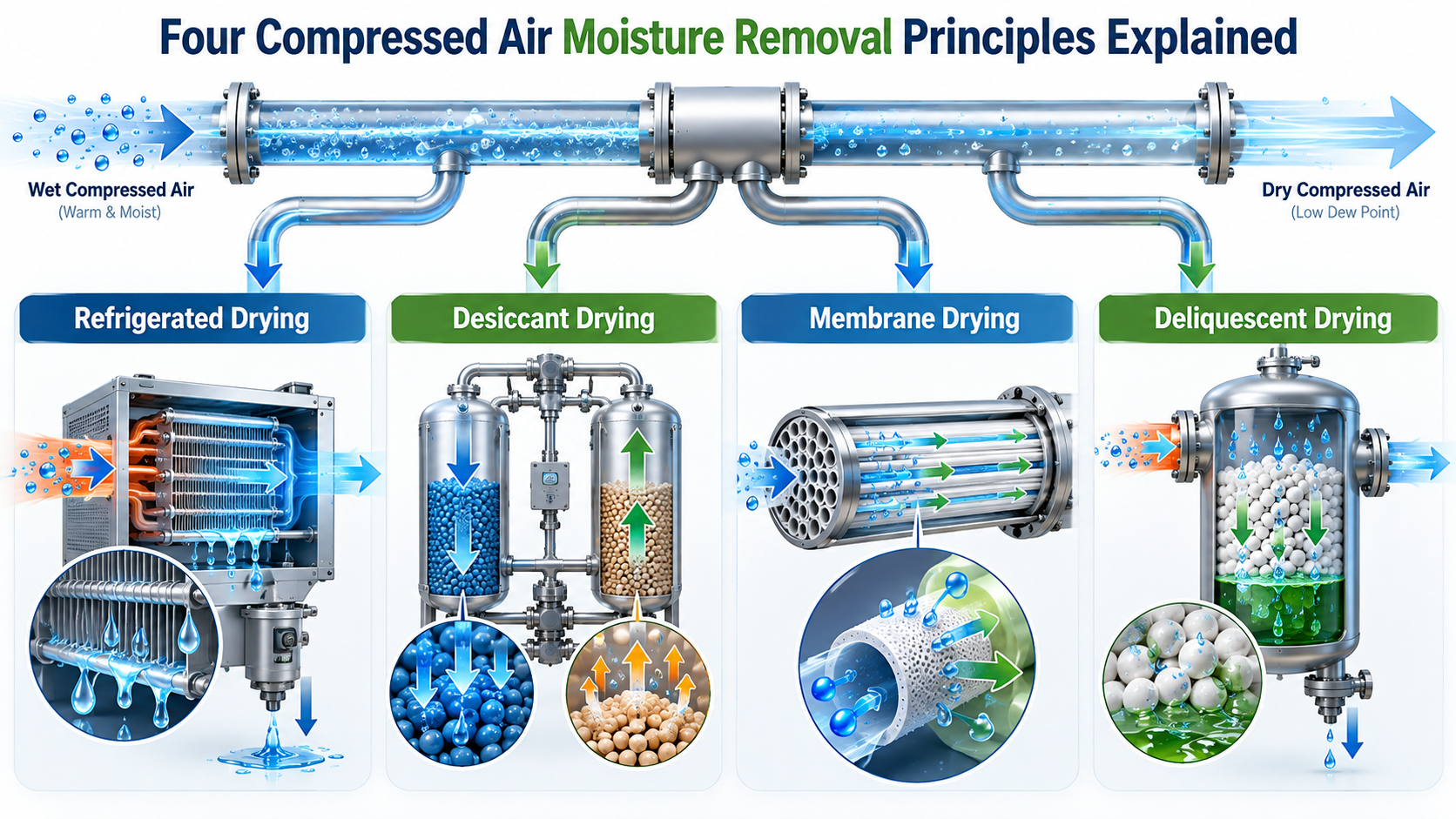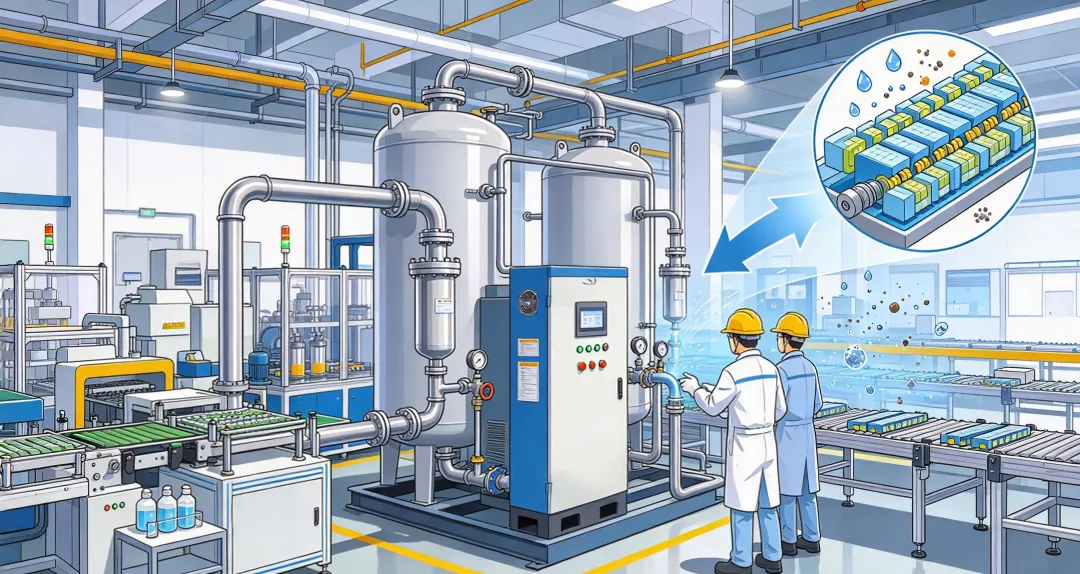
Moisture control is an important part of industrial compressed air treatment. As compressed air cools after compression, water vapor can condense into liquid, contributing to corrosion, pneumatic equipment problems, process contamination, and production interruptions.
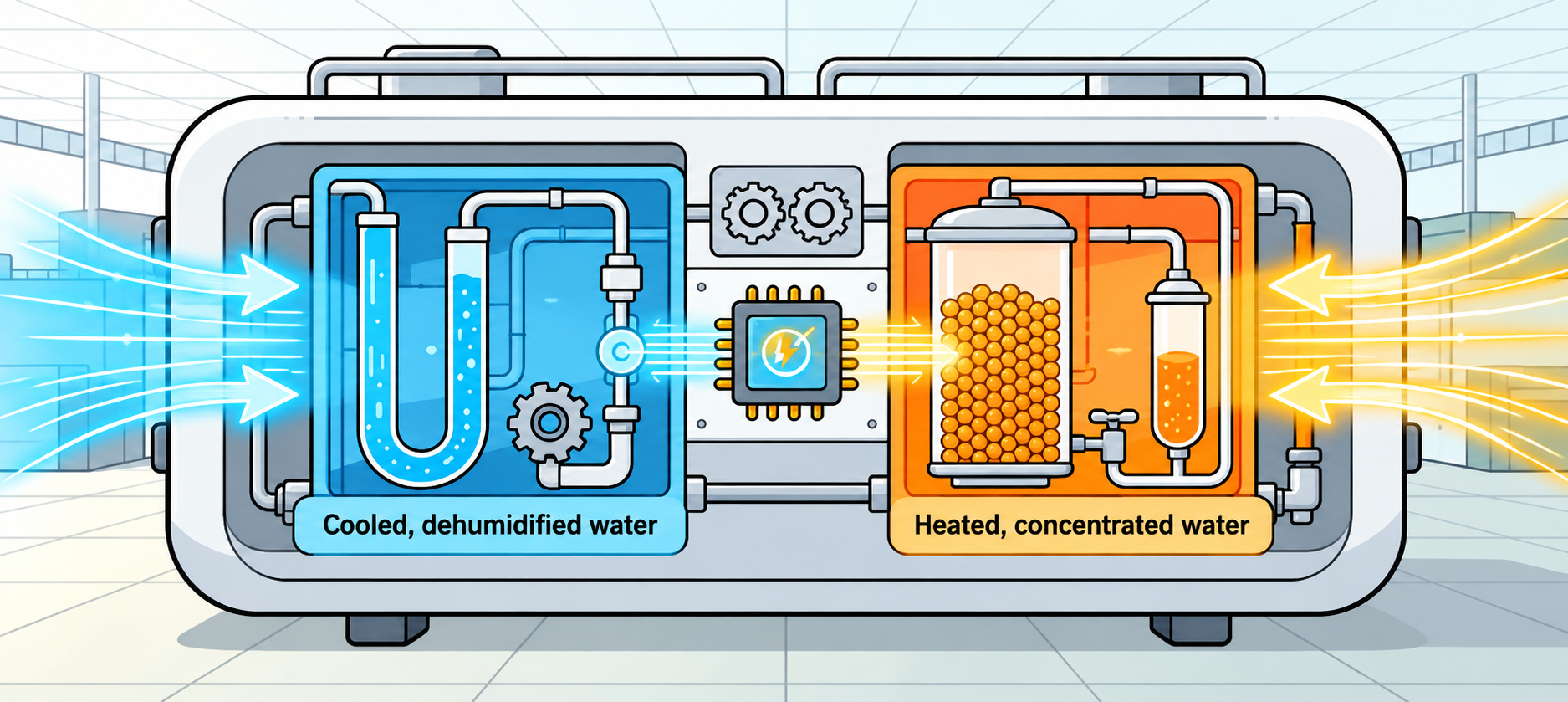
A refrigerated air dryer for compressor systems reduces this moisture by cooling compressed air, condensing water vapor, separating the liquid, and automatically draining it before the air enters the downstream system.
However, refrigerated drying is not automatically suitable for every industry or every process. The correct solution depends on required pressure dew point, airflow, inlet temperature, operating pressure, ambient conditions, and final compressed air quality.
How Does a Refrigerated Air Dryer Work With a Compressor?
A compressor draws in atmospheric air containing water vapor. Compression raises the air temperature and concentrates the moisture.
As the compressed air subsequently cools, part of the water vapor condenses.
A refrigerated dryer provides controlled cooling so that additional moisture can be removed before the compressed air reaches downstream equipment.
For Lingyu’s conventional refrigerated dryer technology, the treatment process can be summarized as:
compressor → aftercooling/separation → compressed air dryer → downstream treatment → distribution system
Inside the dryer:
hot wet air → pre-cooling → evaporator → condensation → gas-liquid separation → automatic drainage → reheating → dry compressed air
The dryer is therefore one component of the complete compressed air treatment system rather than a replacement for aftercoolers, separators, filters, receivers, or other equipment.
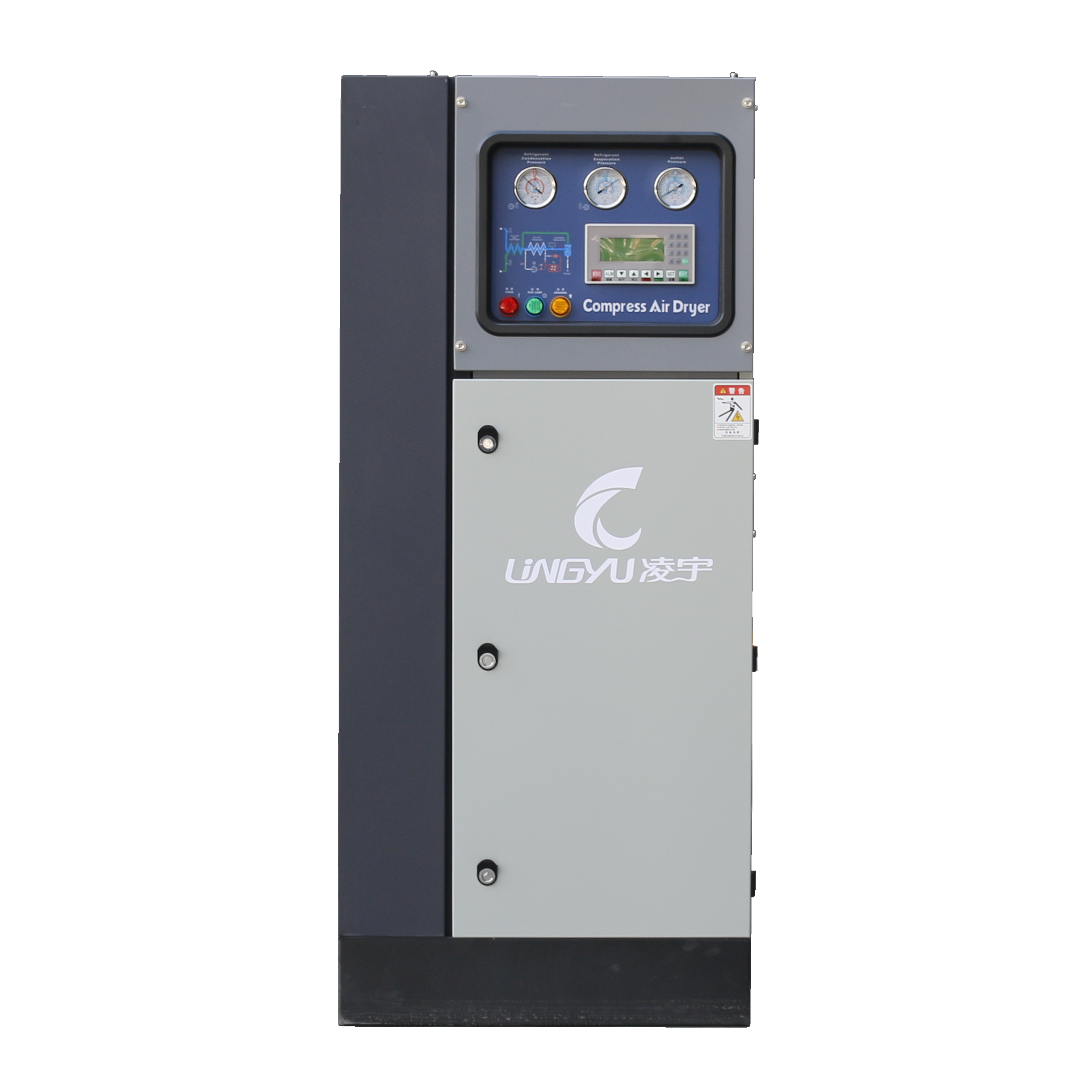
For different airflow and cooling requirements, Lingyu’s refrigerated air dryer range includes air-cooled and water-cooled industrial solutions.
Pressure Dew Point and Industrial Applications
Pressure dew point (PDP) indicates the temperature at which water vapor in compressed air would begin to condense at system pressure.
For Lingyu’s conventional AH air-cooled and WH water-cooled refrigerated dryers, the specified PDP is 2–10°C under rated operating conditions.
This range can be suitable for many general industrial applications where compressed air piping remains above the delivered PDP.
If the process requires substantially drier air, or downstream piping is exposed to temperatures below the refrigerated dryer’s pressure dew point, adsorption drying may be more appropriate.
This distinction is particularly important when comparing dryer requirements across different industries.
1. Food and Beverage Production
Compressed air has many potential uses in food and beverage production, including packaging equipment, conveying systems, pneumatic machinery, and process control.
Moisture in compressed air can contribute to corrosion and interfere with pneumatic equipment. Refrigerated drying can therefore provide effective bulk moisture control where its pressure dew point meets the process requirement.
However, a refrigerated dryer should not be described as automatically producing hygienic or contamination-free compressed air.
Food and beverage applications may also require control of:
- Solid particles
- Oil aerosols
- Oil vapor
- Microbiological contamination
- Other process-specific contaminants
Whether compressed air has direct or indirect contact with food or packaging also influences the required treatment level.
The final compressed air specification should therefore determine the complete purification system.
2. Pharmaceutical and Biopharmaceutical Applications
Compressed air may be used for pneumatic equipment, instrumentation, packaging, conveying, and certain process operations in pharmaceutical and biopharmaceutical manufacturing.
Moisture control can be important, but pharmaceutical compressed air requirements vary substantially according to how and where the air is used.
A refrigerated dryer should not automatically be assumed to provide:
- Sterile air
- Contamination-free air
- Air suitable for every pharmaceutical process
- Compliance with every applicable air-quality requirement
Where a 2–10°C PDP is sufficient, refrigerated drying may form part of the treatment system.
Where substantially lower pressure dew points are required, an adsorption dryer should be considered.
Filtration and any additional purification stages should be selected according to the validated process requirement.
3. Automotive Manufacturing
Compressed air is extensively used in automotive and general manufacturing for pneumatic tools, assembly machinery, automation, actuators, and other equipment.
Controlling moisture can help reduce condensate-related problems in:
- Air distribution piping
- Pneumatic cylinders
- Valves
- Tools
- Automated machinery
Painting and finishing require particular attention.
Moisture can contribute to coating problems, but drying alone does not control every contaminant that can affect finish quality. Oil aerosols and particles must also be considered.
A refrigerated dryer can therefore provide bulk moisture control while suitable filtration addresses other contamination requirements.
4. Electronics and Precision Manufacturing
Compressed air used in electronics and precision manufacturing may serve pneumatic equipment, automation, cleaning-related operations, and production machinery.
Moisture control can help maintain stable operation, but the required air quality depends on the specific process.
A refrigerated dryer should not automatically be described as producing particle-free air because a dryer primarily controls moisture.
For moisture-sensitive electronics processes requiring substantially lower pressure dew points, adsorption drying may be necessary.
The dryer should therefore be selected from the actual process specification rather than solely from the industry name.
5. Metal Fabrication and Laser Cutting
Compressed air supports a wide range of fabrication equipment, pneumatic systems, and manufacturing operations.
In metal fabrication and laser cutting, the required moisture and contamination levels depend strongly on the equipment and how compressed air is being used.
General pneumatic equipment may be adequately served by refrigerated drying, while specialized laser processes can impose different pressure, filtration, and dryness requirements.
Lingyu also provides a special combination refrigerated dryer for laser cutting for this more specialized application.
6. Plastics and Glass Manufacturing
In glass and plastics manufacturing, compressed air can support pneumatic machinery, controls, forming equipment, and other production processes.
Moisture control can reduce condensate-related problems in air lines and pneumatic components.
The correct dryer capacity should account for actual plant airflow, inlet temperature, pressure, and ambient conditions rather than simply matching compressor nameplate capacity.
7. Power and Utility Applications
Compressed air can support pneumatic controls, instrumentation, maintenance equipment, and other operations in power and utility facilities.
Where compressed air lines or instrumentation are exposed to low temperatures, the minimum environmental temperature becomes particularly important.
If piping temperature can fall below the refrigerated dryer’s delivered PDP, condensation and freezing can occur.
A low-dew-point adsorption dryer may therefore be more appropriate for certain instrument-air or outdoor systems.
8. General Industrial Manufacturing
For many general manufacturing facilities, refrigerated drying provides a practical moisture-control solution.
Applications can include:
- Pneumatic tools
- Cylinders
- Valves
- Assembly machinery
- Packaging equipment
- Automated production lines
- General plant air
Where the compressed air remains in an indoor environment above its pressure dew point and the process does not require very dry air, refrigerated drying can offer a comparatively straightforward treatment approach.
Refrigerated Dryer vs. Desiccant Dryer by Application
| Operating Requirement | Refrigerated Dryer | Desiccant Dryer |
|---|---|---|
| General indoor plant air | Often suitable | Usually unnecessary unless lower PDP required |
| Typical Lingyu PDP | 2–10°C | Much lower PDP available depending on series |
| Pneumatic machinery | Often suitable | Application-dependent |
| Below-freezing piping | Often insufficient | Generally more appropriate |
| Moisture-sensitive process | Depends on specification | Often considered for lower PDP |
| Instrument air | Depends on required PDP | Common where low PDP is specified |
| Regeneration | Not required | Required |
| Purge air | No desiccant purge | Depends on regeneration method |
Neither dryer technology is inherently better.
The correct choice is the one that provides the required pressure dew point under actual operating conditions at an acceptable lifecycle cost.
Where deeper drying is required, Lingyu’s desiccant air dryer range provides heatless, heated, blower, modular, and heat-of-compression options.
How to Select a Refrigerated Air Dryer for a Compressor
Determine Actual Peak Airflow
Do not select a dryer solely by matching its nominal CFM rating to the compressor nameplate.
Consider the maximum airflow that will actually pass through the dryer, including simultaneous compressor operation and peak production demand.
Future expansion can also be considered where there is a realistic plan for additional compressed air consumption.
Check Inlet Temperature
Inlet temperature has a significant effect on dryer load.
For Lingyu’s conventional AH and WH high-inlet-temperature refrigerated dryers:
- Rated inlet temperature: 50°C
- Maximum inlet temperature: ≤80°C
Higher inlet temperature increases the thermal and moisture load on the dryer.
Effective aftercooling and upstream condensate separation can therefore reduce the load reaching the refrigeration system.
Check Operating Pressure
For Lingyu’s conventional AH and WH Series:
- Rated inlet pressure: 0.7 MPa
- Operating pressure range: 0.6–1.0 MPa
Other pressure requirements should be confirmed for the selected equipment.
Dryer capacity should be evaluated at actual operating pressure rather than assuming nominal airflow remains unchanged under all conditions.
Evaluate Ambient Conditions
Air-cooled refrigerated dryers depend on ambient air for condenser heat rejection.
Lingyu’s conventional AH Series specifies:
- Rated ambient temperature: 32°C
- Operating ambient range: 2–45°C
Good ventilation and adequate clearance are important.
For indoor installation, Lingyu specifies a level concrete floor and approximately 1.5 m minimum clearance around the equipment.
High ambient temperature, dirty condenser surfaces, or hot-air recirculation can reduce cooling performance.
Consider Water Cooling for Large Systems
Where suitable cooling water is available, a water-cooled dryer may be appropriate.
Lingyu’s conventional WH Series specifies:
- Cooling-water pressure: 0.2–0.4 MPa
- Rated cooling-water temperature: ≤32°C
- Cooling-water operating range: 2–38°C
Actual cooling-water flow and connection requirements should be confirmed for the selected model.
For very high compressed-air flow, Lingyu’s 8830 CFM water-cooled high-temperature refrigerated dryer provides a dedicated large-capacity option.
Humidity Alone Does Not Determine Dryer Size
High ambient humidity can increase the moisture entering the compressor, but it should not be addressed simply by selecting an arbitrarily oversized dryer.
Dryer sizing should consider the complete set of operating conditions:
maximum airflow + inlet pressure + inlet temperature + ambient/cooling-water conditions + required pressure dew point
Manufacturer correction factors should be applied when actual conditions differ from rated conditions.
This provides a more reliable basis for selection than adding a generic percentage to nominal CFM.
Air Drying and Filtration Must Work Together
A refrigerated dryer primarily addresses water vapor.
It does not by itself remove all particles, oil aerosols, or oil vapor.
Appropriate precision compressed air filtration should therefore be selected according to compressor type and required final air quality.
For example, Lingyu’s filter grades include different performance levels for particle and residual oil control.
The correct filter combination depends on the application rather than applying the same filtration train to every compressor system.
Pressure Drop Is an Energy Consideration
Installing a dryer does not automatically reduce compressor energy consumption.
A more accurate energy assessment considers the dryer’s electrical consumption together with pressure drop.
Every restriction in the compressed air system—including filters, separators, dryers, valves, and piping—reduces downstream pressure.
If excessive pressure loss forces the compressor to operate at a higher discharge pressure, total system energy consumption can increase.
Lingyu’s conventional AH and WH refrigerated dryers specify pressure drop of ≤0.025 MPa under rated conditions.
Maintaining clean heat exchangers and replacing filter elements according to their condition can also help prevent unnecessary deterioration in system performance.
What About Cycling and Variable-Frequency Dryers?
A cycling or variable-output dryer can be useful where air demand fluctuates, but this feature should not be treated as universally necessary.
Lingyu’s frequency-conversion refrigerated air dryer uses variable-frequency compressor control to match refrigeration output more closely to load.
The benefit depends on the site’s actual demand profile.
A plant operating continuously near full load may have different optimization priorities from one experiencing substantial periods of partial load.
Maintenance Should Be Condition-Based
A universal six- or twelve-month service interval is not appropriate for every refrigerated dryer.
Inspection frequency depends on operating hours, ambient contamination, thermal load, installation environment, and equipment condition.
Important points to monitor include:
- Condenser cleanliness
- Automatic drain operation
- Heat-exchanger condition
- Refrigeration performance
- Electrical components
- Filter differential pressure
- Actual pressure dew point where monitored
Refrigerant should not normally require routine replacement in a correctly sealed system. If the refrigerant charge is low, the cause of leakage should be identified and repaired before restoring the specified charge.
Frequently Asked Questions
Can a refrigerated air dryer be used in a cleanroom?
It can form part of a compressed air treatment system serving a cleanroom, but the dryer alone does not establish cleanroom air quality.
The required pressure dew point, particles, oil, microbiological control, and other specifications should be evaluated for the actual process.
Can a refrigerated air dryer be installed outdoors?
Not automatically.
Lingyu’s conventional AH and WH refrigerated dryers are specified for indoor installation.
If an application requires outdoor equipment, the dryer and its enclosure must be specifically selected for those environmental conditions.
Does a refrigerated air dryer remove oil?
Its primary purpose is moisture control.
Oil aerosol and particle removal generally require appropriately selected filtration.
Is a refrigerated dryer suitable for food or pharmaceutical compressed air?
It may be suitable for moisture control if its PDP meets the process requirement.
However, the dryer alone does not guarantee food-grade, pharmaceutical-grade, sterile, or contamination-free compressed air.
When should I choose a desiccant dryer instead?
Consider adsorption drying when the process requires a substantially lower PDP than refrigerated drying provides or when downstream piping is exposed to temperatures below the refrigerated dryer’s delivered PDP.
How often should the dryer be serviced?
Follow the model-specific maintenance requirements and adjust inspection frequency according to actual operating conditions.
There is no single maintenance interval suitable for every installation.
Match the Dryer to the Application, Not Just the Industry
A refrigerated air dryer can support applications across manufacturing, automotive, food and beverage, electronics, pharmaceuticals, utilities, and many other industries.
But the industry name alone does not determine the correct dryer.
Two facilities in the same industry may require very different compressed air quality depending on how the air contacts the process, the lowest downstream temperature, contamination limits, airflow, and operating conditions.
The better selection approach is therefore:
define the application → establish required air quality and PDP → determine peak airflow → verify pressure and temperature → apply correction factors → evaluate pressure drop and lifecycle cost
For application-specific equipment selection, contact Lingyu with your maximum airflow, operating pressure, inlet temperature, ambient conditions, compressor configuration, and required pressure dew point.