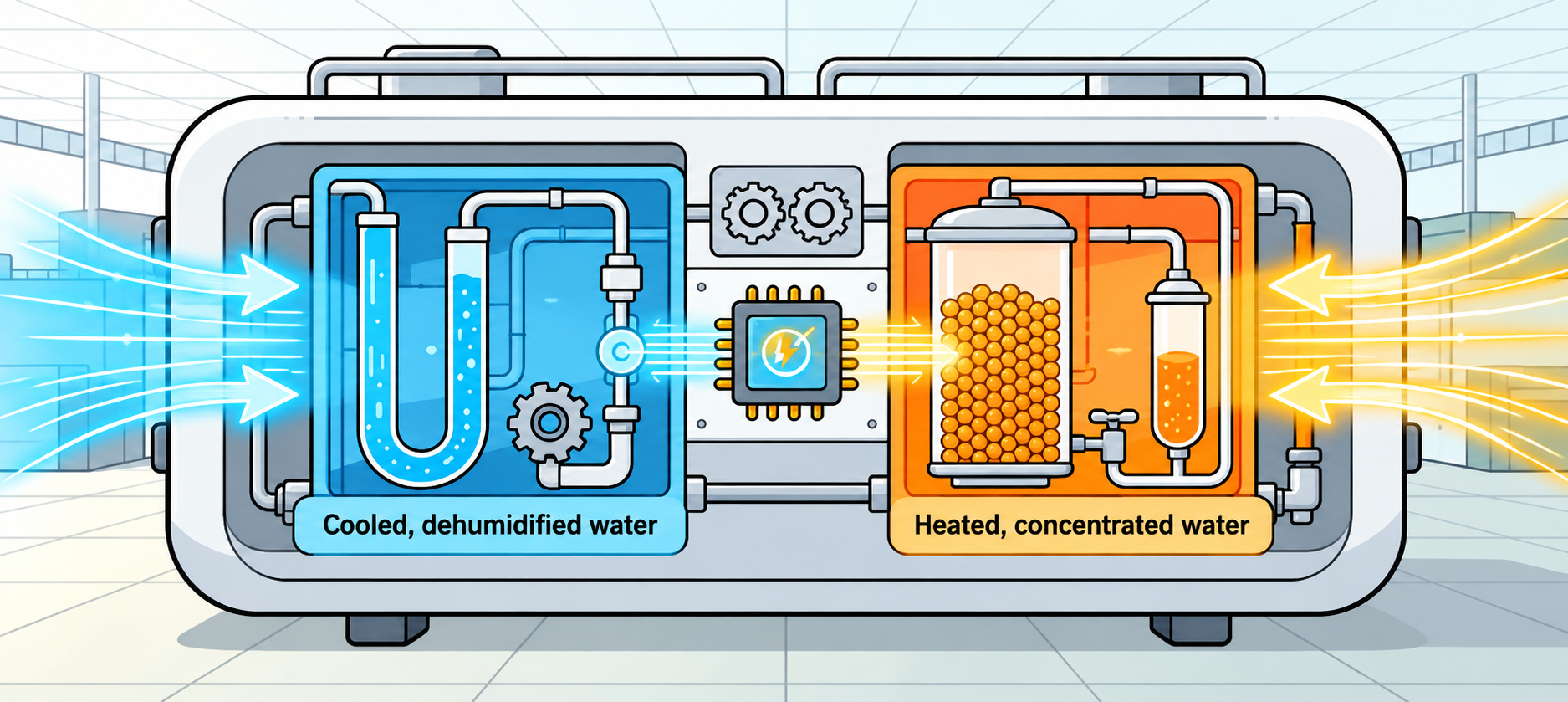
Compressed air is widely used in food and beverage plants for pneumatic equipment, packaging machinery, conveying systems, filling lines, process controls, and other production utilities. However, compressed air can also carry water vapor, liquid condensate, oil, and solid particles.
If these contaminants are not properly controlled, they can contribute to corrosion, unreliable pneumatic equipment, packaging problems, and other process-quality issues.
For this reason, selecting the right air dryer for food-industry compressed-air systems is an important part of designing a reliable air-treatment system. The key question is not simply, “What is the best air dryer?” It is: What pressure dew point and overall compressed-air quality does the specific food-processing application require?
Lingyu provides refrigerated dryers, regenerative adsorption dryers, combined dryers, and precision filtration equipment for compressed-air purification.
For sector-specific information, see Lingyu’s food and beverage compressed-air application.

What Is an Air Dryer for the Food Industry?
In this article, an air dryer for food production means a compressed-air dryer installed in the plant air system.
Its primary job is to reduce moisture in compressed air before the air reaches downstream equipment or processes.
This should be distinguished from equipment designed to dry the surfaces of food products, bottles, cans, or packaging. Air knives, surface-drying blowers, heated food dryers, and product-dehydration equipment perform different functions from compressed-air dryers.
Keeping these equipment categories separate is important when specifying an industrial compressed-air treatment system.
Why Moisture Control Matters in Food-Plant Compressed Air
Ambient air naturally contains water vapor.
During compression, the amount of water contained per cubic meter increases. As compressed air cools, excess moisture can condense into liquid water.
Uncontrolled moisture can contribute to pipeline corrosion, reduced process or product quality, control-system problems, and freezing under suitable low-temperature conditions.
A properly selected dryer reduces this moisture load before compressed air reaches sensitive parts of the plant.
However, moisture is only one part of compressed-air quality.
Oil and solid particles also need to be considered separately. Drying, oil removal, and particle filtration should therefore be treated as coordinated but distinct stages of compressed-air purification.
Does a Food-Industry Air Dryer Produce “Food-Grade Air”?
Not by itself.
A compressed-air dryer primarily controls moisture. It should not automatically be described as producing hygienic, sterile, oil-free, or “food-grade” compressed air simply because it is installed in a food factory.
Depending on the application, the complete treatment system may also require appropriate oil removal, particle filtration, condensate management, and other process-specific controls.
The exact air-quality specification depends on how the compressed air is used and whether it has direct, indirect, or no interaction with the product or packaging process.
The complete compressed-air treatment train should therefore be designed around the actual point-of-use requirement.
Main Types of Compressed-Air Dryers for Food and Beverage Plants
For Lingyu’s product portfolio, the most relevant choices are refrigerated air dryers, desiccant or adsorption air dryers, and combined refrigerated-plus-adsorption dryers.
Membrane compressed-air drying is a separate technology, but it should not be presented as a Lingyu compressed-air dryer product category without a corresponding documented product.
Refrigerated Air Dryers
A refrigerated dryer cools compressed air until water vapor condenses.
The general process is:
Pre-cooling → refrigeration cooling → condensation → gas-liquid separation → drainage → reheating
Lingyu’s AH and WH refrigerated dryer series are specified for a 2–10°C pressure dew point under their operating conditions.
For many general plant-air applications in food and beverage facilities, this level of moisture control may be sufficient.
Typical duties can include pneumatic equipment, packaging machinery, actuators, and other utilities where the process does not require a sub-zero pressure dew point.
Facilities without a cooling-water system may consider Lingyu’s air-cooled refrigerated dryer range, while plants with suitable cooling-water infrastructure can evaluate the water-cooled refrigerated dryer range.
When Is a Refrigerated Dryer a Good Choice?
A refrigerated dryer can be appropriate when the required PDP is approximately 2–10°C, the compressed-air piping and point of use will not be exposed to conditions requiring a substantially lower dew point, and the process does not require deeper moisture removal.
A major practical advantage is that refrigerated drying provides effective bulk moisture removal without the regeneration-air requirements of a conventional desiccant dryer.
Desiccant Air Dryers
A desiccant or adsorption dryer is more appropriate when the process requires significantly drier compressed air.
Instead of condensing moisture through refrigeration, compressed air passes through a bed of adsorbent material that captures residual water vapor.
Lingyu’s conventional HH heatless regenerative dryer, for example, is specified for ≤−40°C pressure dew point, uses activated alumina plus high-performance molecular sieve, and has average purge-air consumption of 8–14%.
For food-processing operations where a low pressure dew point is genuinely required, the heatless desiccant dryer range provides one available technology route.
Does Every Food Plant Need a −40°C Dryer?
No.
Choosing −40°C PDP simply because it sounds cleaner or safer can result in unnecessary equipment and energy costs.
A refrigerated dryer may fully satisfy one application, while another part of the same plant may require adsorption drying.
The correct PDP should come from the actual process specification.
Heated and Low-Purge Adsorption Dryers
Food and beverage plants with larger airflow or long annual operating hours may also need to consider the operating cost of purge air.
Conventional heatless adsorption drying uses part of the already dried compressed air for regeneration.
Lingyu also offers externally heated, blower-heated, and other lower-purge regeneration technologies. These systems can reduce compressed-air regeneration loss, although they may add heaters, blowers, cooling requirements, and more complex controls.
The correct economic comparison should therefore consider both purge-air energy and auxiliary electrical energy.
There is no single adsorption technology that is automatically the most economical for every food facility.
Combined Refrigerated and Adsorption Dryers
Where very dry compressed air is required but the inlet moisture load is high, a combined dryer can be another option.
Lingyu’s combined drying process first uses refrigeration to reduce the compressed air to approximately 2–10°C PDP.
Much of the incoming moisture and part of the oil load condense and are separated. The partially dried air then passes through an oil-removal filter before entering the adsorption stage for deeper drying.
The refrigerated stage reduces the moisture load reaching the adsorption dryer, which can reduce regeneration-air consumption and extend desiccant service life.
For applications requiring both bulk moisture removal and a low final PDP, combined refrigerated and adsorption drying can therefore be worth evaluating.
Refrigerated vs. Desiccant Dryer for Food Processing
The most important difference is the required pressure dew point.
| Factor | Refrigerated Dryer | Desiccant Dryer |
|---|---|---|
| Drying method | Cooling and condensation | Adsorption |
| Lingyu PDP reference | 2–10°C | Depends on series; −20°C and −40°C ranges available |
| Purge air | None for regeneration | Depends on regeneration type |
| System complexity | Generally lower | Generally higher |
| Best suited to | General moisture control | Low-dew-point applications |
| Key selection issue | Temperature and refrigeration load | PDP, purge loss, regeneration energy |
For a more complete technology comparison, see Lingyu’s refrigerated air dryer vs. desiccant air dryer guide.
Why Filtration Matters Alongside Drying
Dry air and clean air are not the same thing.
A dryer primarily addresses moisture. Compressed-air filtration addresses oil aerosols and particles according to the selected filter grade and system configuration.
Lingyu’s D Series precision-filter portfolio includes AO, AA, AX, and activated-carbon configurations for different filtration duties, including pre-filtration, oil-and-particle removal, high-efficiency oil removal, and activated-carbon oil-removal filtration.
Where an application requires additional oil or particulate control, a precision compressed-air filter should be considered as part of the overall treatment system rather than expecting the dryer to perform every purification function.
Typical Compressed-Air Applications in Food and Beverage Plants
Compressed air can support packaging machinery, pneumatic cylinders and actuators, conveying systems, filling equipment, valve actuation, and process-control systems.
The required dryer and filtration level vary by point of use.
Packaging Equipment
Packaging lines frequently use compressed air for actuators, cylinders, valves, and automation.
Moisture in the pneumatic system can contribute to corrosion or unreliable components.
If the packaging equipment only requires conventional plant-air dryness, refrigerated drying may be sufficient. More sensitive processes should be evaluated against their actual PDP specification.
Pneumatic Conveying
Compressed air may also be involved in conveying powders or other ingredients.
Where compressed air interacts more directly with material handling, moisture, oil, and particulate specifications become especially important.
A dryer alone should therefore not automatically be treated as the complete compressed-air quality solution.
Filling and Processing Equipment
Pneumatic valves and actuators used around filling and production equipment can benefit from controlled moisture levels because liquid condensate can interfere with reliable pneumatic operation.
Dryer selection should be based on the required PDP and treatment standard for that specific air use.
Plant Utility Air
A large food facility may have substantial amounts of general utility air that never comes into direct contact with food.
These loads may not require the same air-treatment specification as process-sensitive points.
Segmenting the compressed-air system according to actual quality requirements can therefore avoid unnecessarily treating every cubic meter of air to the most demanding specification.
Compressed-Air Drying vs. Bottle and Can Surface Drying
An industrial compressed-air dryer removes water vapor from compressed air.
An air knife or surface-drying blower removes liquid water from the surface of an object or food product.
They solve different problems.
If a bottling line needs dry compressed air for pneumatic control and also needs an air knife to remove water from bottles before labeling, those are two separate systems.
Bottle drying, can drying, fruit and vegetable drying, and air-knife drying should therefore not be treated as functions of a compressed-air dryer.
Does a Compressed-Air Dryer Increase Food Shelf Life?
A compressed-air dryer should not be treated as a general shelf-life extension system.
The relationship between compressed-air moisture and shelf life depends on whether compressed air interacts with the product, packaging environment, process conditions, and many other variables.
A dryer can help provide the moisture condition required by a specified process. That is different from claiming that installing a compressed-air dryer directly increases shelf life.
The same applies to claims about preventing microbial growth. Those outcomes depend on the broader food-processing and hygiene system.
HACCP, ISO 22000, and FDA Considerations
Compressed-air treatment should be designed according to the food manufacturer’s applicable quality, hygiene, regulatory, and process requirements.
Using a particular dryer does not by itself establish compliance with HACCP, ISO 22000, FDA requirements, or another food-quality framework.
Compliance depends on the complete installation, documentation, operating procedures, and required air-quality specification—not on the dryer alone.
Are Lingyu Dryers “Food-Grade” or Hygienic by Default?
A generic “food-grade dryer” label should not be applied automatically to every compressed-air dryer used in a food facility.
Specific equipment configurations may include anti-corrosion treatment or materials appropriate for particular food or pharmaceutical applications, but those characteristics should not be generalized to every refrigerated, adsorption, blower, or HOC dryer.
Where material construction or certification is important, the required materials, treatment standard, and air-quality conditions should be specified during equipment selection and confirmed for the particular model and project.
Key Factors When Choosing an Air Dryer for a Food Factory
The “best” dryer should be selected from actual operating requirements rather than industry name alone.
Important factors include required pressure dew point, maximum compressed-air flow, inlet pressure, inlet temperature, ambient temperature, oil and particulate limits, direct or indirect process interaction, required filtration stages, allowable pressure drop, purge-air consumption, energy use, annual operating hours, maintenance capability, and applicable site quality and hygiene requirements.
A food factory may therefore use several different air-treatment levels within the same site.
Pressure Dew Point Should Drive the First Decision
A useful first selection question is:
Does the application need approximately 2–10°C PDP, or does it need substantially drier air such as −20°C or −40°C?
If 2–10°C is sufficient, refrigerated drying is often the logical starting point.
If the process genuinely requires a lower PDP, adsorption drying should be considered.
If a low final PDP is required together with high inlet moisture loading, a combined refrigerated-plus-adsorption dryer may be appropriate.
This approach is more useful than simply calling one technology the “best air dryer for food industry.”
Energy and Lifecycle Cost
Dryer purchase price should not be the only economic factor.
For refrigerated dryers, electricity consumption and pressure drop matter.
For adsorption dryers, the calculation may additionally include purge-air loss, heater power, blower power, cooling requirements, and desiccant maintenance.
The most economical dryer is therefore the one that meets the required air-quality specification at an appropriate lifecycle cost—not necessarily the machine with the lowest dew point.
Maintenance Requirements
Food-plant compressed-air dryers require the same basic technical maintenance discipline as dryers in other industrial systems.
For refrigerated units, this includes heat exchangers, condensate separators, automatic drains, refrigeration systems, and controls.
For adsorption dryers, maintenance may include desiccant condition, valves, filters, purge systems, heaters or blowers, silencers, and dew-point monitoring depending on the configuration.
Precision filters should also be maintained according to differential pressure, contamination condition, and relevant service recommendations.
Reliable treatment depends on the complete system remaining in proper operating condition.
Conclusion
The best air dryer for food-industry compressed-air systems is not determined simply by choosing the driest possible technology.
For general plant air and many pneumatic duties, a refrigerated dryer providing approximately 2–10°C PDP may be sufficient.
For moisture-sensitive applications requiring substantially lower dew points, a regenerative desiccant dryer can provide deeper drying. Lingyu’s HH heatless series, for example, is specified at ≤−40°C PDP, with activated alumina plus high-performance molecular sieve and 8–14% average purge-air consumption.
Where a low final dew point and high moisture loading occur together, combined refrigerated and adsorption drying can reduce the moisture burden placed on the adsorption stage.
Most importantly, drying, oil removal, and particle filtration should be treated as separate but coordinated parts of compressed-air purification.
The correct food and beverage compressed-air system should therefore be selected around required PDP, airflow, temperature, contamination limits, point-of-use requirements, pressure drop, energy consumption, filtration, and lifecycle cost rather than relying on a generic “food-grade dryer” label.