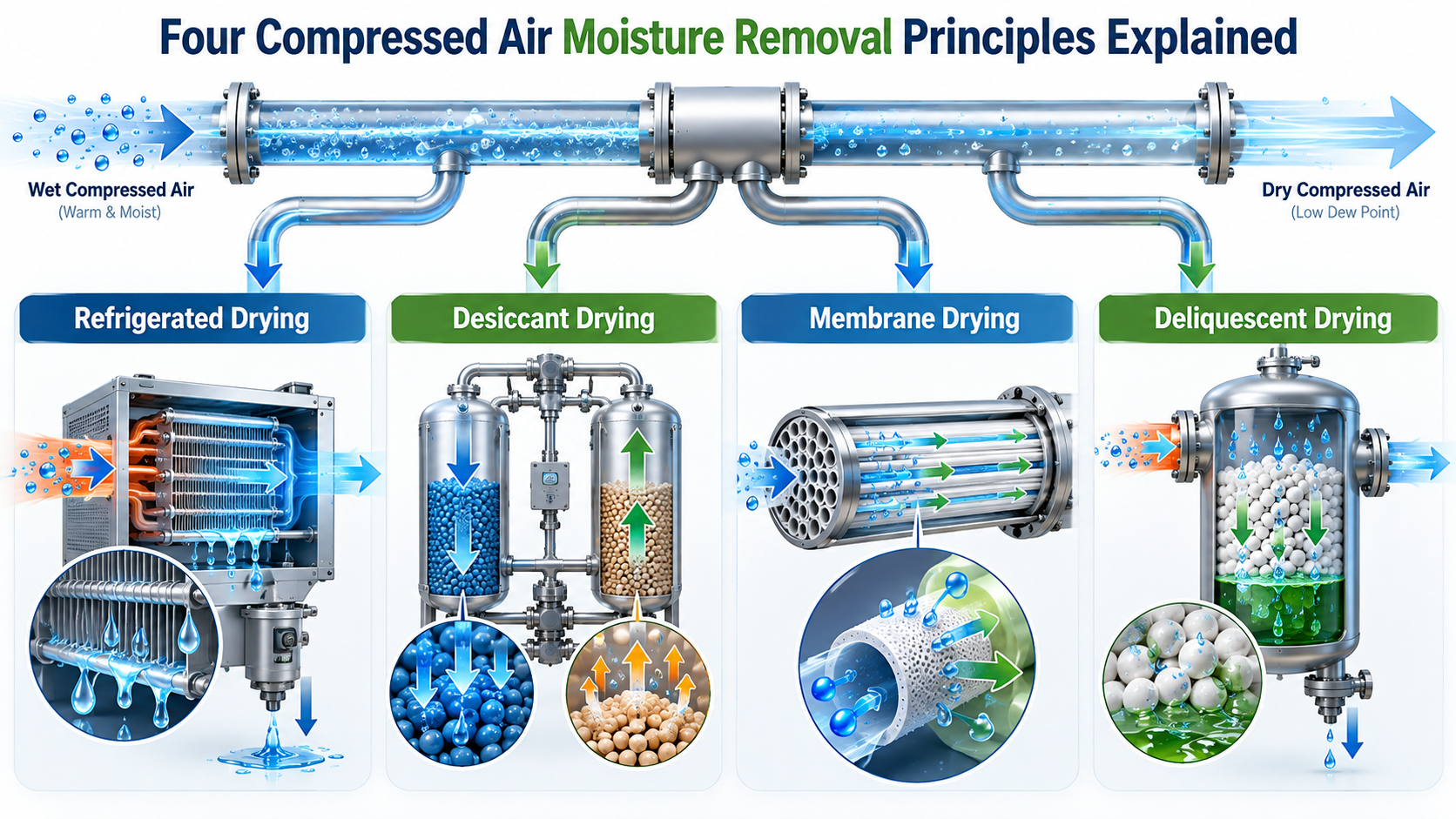
Different compressed air dryer types remove water vapor in different ways, and those differences affect achievable pressure dew point, energy use, regeneration requirements, pressure drop, maintenance, and suitability for specific operating conditions.
For industrial compressed air systems, the most important decision is not simply which dryer type is “best,” but which technology can achieve the required dryness under the actual airflow, pressure, temperature, and environmental conditions of the plant.
The main technologies include refrigerated dryers, heatless and heated adsorption dryers, blower-regenerated dryers, heat-of-compression dryers, combined dryers, and membrane dryers.
Why Different Compressed Air Dryer Types Are Needed
Atmospheric air always contains water vapor. When the air is compressed, the moisture becomes concentrated along with it.
As hot compressed air subsequently cools, some of this water vapor condenses into liquid water. If moisture is not adequately controlled, it can contribute to corrosion, pneumatic equipment problems, product defects, freezing in exposed air lines, and increased maintenance.
However, not every compressed air application requires the same level of dryness.
A general indoor pneumatic system may perform reliably with a pressure dew point of several degrees Celsius, while an instrument-air system exposed to freezing temperatures may require a pressure dew point far below 0°C.
This is why understanding the differences among dryer technologies matters.
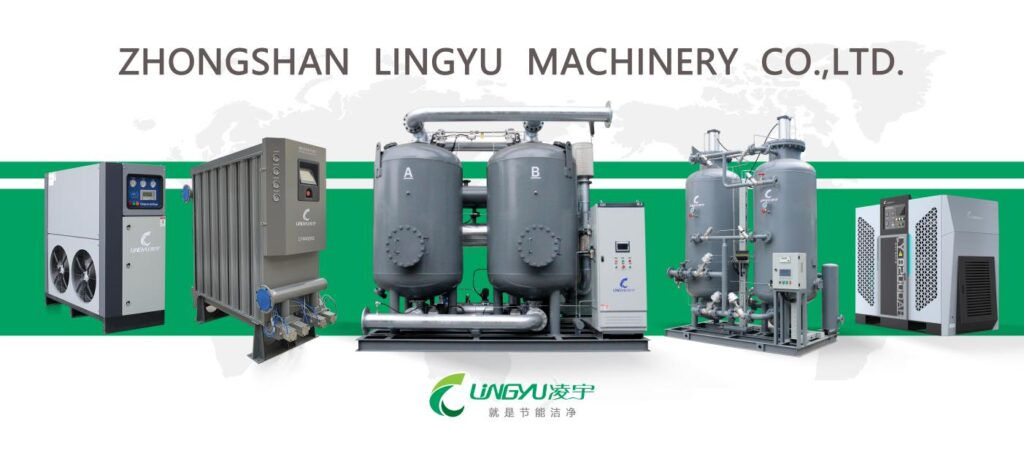
1. Refrigerated Compressed Air Dryers
A refrigerated air dryer removes moisture by cooling compressed air.
As the air temperature falls inside the dryer, water vapor condenses into liquid. The condensate is separated and automatically discharged before the dry air is reheated and sent downstream.
The simplified process is:
hot wet compressed air → pre-cooling → refrigeration cooling → condensation → gas-liquid separation → drainage → reheating
Typical Pressure Dew Point
For Lingyu’s conventional AH air-cooled and WH water-cooled refrigerated dryer technology, the specified pressure dew point is:
2–10°C PDP
under rated operating conditions.
Typical AH and WH operating parameters include:
| Parameter | Typical Specification |
|---|---|
| Rated inlet pressure | 0.7 MPa |
| Operating pressure | 0.6–1.0 MPa |
| Rated inlet temperature | 50°C |
| Maximum inlet temperature | ≤80°C |
| Pressure dew point | 2–10°C |
| Rated ambient temperature | 32°C |
| Ambient range | 2–45°C |
| Pressure drop | ≤0.025 MPa |
Refrigerated drying is therefore suitable for many indoor industrial applications where very low pressure dew points are unnecessary.
Air-Cooled Refrigerated Dryers
An air-cooled refrigerated dryer rejects refrigeration heat to the surrounding air.
This arrangement is convenient where sufficient ventilation is available and ambient temperatures remain within the dryer’s specified range.
Air-cooled installations should avoid restricted ventilation, dirty condenser surfaces, and recirculation of hot discharge air because these conditions can reduce refrigeration performance.
Water-Cooled Refrigerated Dryers
A water-cooled refrigerated dryer rejects heat through a cooling-water circuit instead of directly to ambient air.
For Lingyu’s conventional WH Series, cooling-water operating conditions include:
- Cooling-water pressure: 0.2–0.4 MPa
- Rated cooling-water temperature: ≤32°C
- Cooling-water operating range: 2–38°C
Water-cooled technology can be useful for large compressed air systems or installations where rejecting additional heat into the equipment room is undesirable.
The correct choice between air cooling and water cooling depends on site infrastructure rather than one method being universally superior.
2. Heatless Adsorption Air Dryers
Heatless adsorption is one of the simplest regenerative desiccant drying methods.
The dryer normally contains two adsorption towers. One tower removes water vapor while the second tower regenerates.
A portion of the already dried compressed air is expanded and passed through the regenerating tower to remove the adsorbed moisture.
Lingyu’s CH Series heatless regeneration adsorption dryer operates under typical conditions of:
| Parameter | CH Heatless |
|---|---|
| Rated inlet pressure | 0.7 MPa |
| Operating pressure | 0.6–1.0 MPa |
| Rated inlet temperature | 10–30°C |
| Maximum inlet temperature | ≤40°C |
| Regeneration air consumption | 8–14% |
| Pressure dew point | −50 to −20°C |
| Desiccant | Activated alumina |
The main advantage of heatless drying is its relatively straightforward regeneration principle.
Its main operating consideration is purge-air consumption. Because regeneration air has already been compressed and dried, this represents an indirect energy cost.
3. Heated Regeneration Adsorption Dryers
Heated adsorption dryers also use twin adsorption towers, but external heat is introduced during regeneration.
Heating the desiccant allows more moisture to be removed with less dry compressed-air purge than a conventional heatless system.
Lingyu’s CH Series heated regeneration adsorption dryer specifies:
| Parameter | CH Heated |
|---|---|
| Rated inlet pressure | 0.7 MPa |
| Operating pressure | 0.6–1.0 MPa |
| Rated inlet temperature | 10–30°C |
| Maximum inlet temperature | ≤40°C |
| Regeneration air consumption | 4–8% |
| Pressure dew point | −50 to −20°C |
| Desiccant | Activated alumina |
Compared with heatless regeneration, the purge requirement is lower, but the dryer also requires heater energy and additional components.
The correct comparison should therefore consider total lifecycle energy rather than purge percentage alone.
4. Blower-Regenerated Adsorption Dryers
Blower regeneration reduces dependence on compressed air for desiccant regeneration.
Instead of relying primarily on dry purge air, a blower supplies regeneration air that is heated and passed through the desiccant bed.
This becomes particularly relevant in larger installations where losing a significant percentage of compressed air to regeneration can be expensive.
Lingyu’s blower zero-purge adsorption dryer represents this type of regeneration strategy.
Blower systems should be evaluated according to:
blower power + heater power + cooling requirements + purge consumption + required PDP + operating profile
A system with very low purge consumption is not automatically the lowest-energy solution if blower and heater consumption are ignored.
5. Heat-of-Compression Dryers
Heat-of-compression dryers use thermal energy produced by the compressor system to regenerate the desiccant.
This can reduce the need for separate regeneration heat when the compressor configuration provides suitable discharge temperatures.
The technology is particularly dependent on the compressor station itself.
Important selection factors include:
- Compressor type
- Discharge temperature
- Airflow
- Load profile
- Cooling arrangement
- Required pressure dew point
Lingyu’s heat-of-compression dryer range is intended for systems where compressor heat can be incorporated into the regeneration process.
For example, the HOC-E design includes RS-485 communication and an optional dew-point-based control strategy for adapting adsorption time under fluctuating load conditions.
HOC drying should therefore be evaluated as part of the compressor station rather than as an isolated piece of downstream equipment.
6. Modular Adsorption Dryers
Modular adsorption dryers use multiple compact adsorption modules rather than relying on two large conventional vessels.
Their modular construction can make installation and capacity expansion more flexible for certain compressed air systems.
The modular adsorption air dryer can be considered where compact equipment layout or modular capacity is advantageous.
As with conventional adsorption systems, inlet-air quality, pressure dew point requirements, desiccant protection, purge consumption, and pressure drop remain important selection factors.
7. Combined Refrigerated and Adsorption Dryers
A combined dryer uses both refrigerated and adsorption drying in one treatment system.
The refrigerated stage first removes a substantial portion of the moisture load by cooling and condensation.
The compressed air then enters the adsorption section for deeper drying.
The process can be represented as:
wet compressed air → refrigerated drying → bulk moisture removal → adsorption drying → low-PDP compressed air
This arrangement can reduce the moisture load placed on the adsorption section.
Lingyu’s DC Series combined compressed air dryer is designed around this integrated treatment principle.
Combined dryers can be useful where low PDP is required but the operating strategy benefits from removing a large proportion of moisture before the desiccant stage.
8. Variable-Frequency Refrigerated Dryers
Variable-frequency control is a variation within refrigerated drying rather than a completely different moisture-removal principle.
The dryer still removes moisture through refrigeration and condensation, but compressor speed is adjusted according to refrigeration demand.
Lingyu’s frequency-conversion refrigerated air dryer uses variable-frequency compressor control to better match refrigeration output to changing load.
This can be particularly useful where compressed air demand varies considerably during production.
A facility operating almost continuously near full load may have a different energy profile from one that spends long periods at partial load, so the potential benefit should be evaluated against actual operating data.
9. Plate Heat-Exchange Refrigerated Dryers
Some refrigerated dryers use integrated heat-exchanger designs to reduce pressure drop and improve heat-transfer efficiency.
Lingyu’s 3-in-1 plate heat exchange refrigerated air dryer integrates the evaporator, air-to-air heat exchanger, and water separator into an aluminum plate heat exchanger.
For the PD Series, specified design characteristics include:
- Pressure drop below 0.015 MPa
- Pressure dew point of 2–10°C
- R410A or R407C refrigerant
- Maximum pressure up to 1.6 MPa
- RS-485 communication
This type of design can be relevant where both moisture control and low pressure loss are important system considerations.
10. Membrane Compressed Air Dryers
Membrane dryers use selective permeation through specialized hollow fibers or membrane materials.
Water vapor passes through the membrane at a different rate from the main compressed air stream, reducing moisture in the delivered air.
Membrane dryers can offer compact construction and no refrigeration compressor, making them suitable for certain point-of-use or lower-flow applications.
However, the statement that membrane dryers “use no energy” is incomplete.
Many membrane dryers consume part of the compressed air as sweep or purge air. Producing that compressed air requires compressor energy.
Their true lifecycle efficiency therefore depends on:
required flow + target dew point + purge loss + pressure drop + annual operating hours
Refrigerated vs. Adsorption Dryer Types
The most common industrial selection decision is between refrigerated and adsorption drying.
| Factor | Refrigerated Dryer | Adsorption Dryer |
|---|---|---|
| Moisture-removal principle | Cooling and condensation | Desiccant adsorption |
| Typical Lingyu PDP | 2–10°C | Down to −50 to −20°C for CH; ≤−40°C for HH heatless |
| Desiccant required | No | Yes |
| Regeneration required | No | Yes |
| Purge air | No adsorption purge | Depends on regeneration type |
| Best suited to | General industrial moisture control | Low-PDP applications |
| Below-freezing piping | Usually not appropriate | Often more suitable |
| Energy considerations | Refrigeration + pressure drop | Purge, heaters, blowers and pressure drop |
The required PDP should determine which technology family is evaluated.
How to Compare Compressed Air Dryer Types
Required Pressure Dew Point
This should be the first selection parameter.
If a 2–10°C PDP satisfies the application, refrigerated drying may be sufficient.
If the compressed air must remain dry in below-freezing conditions or the process requires substantially lower moisture content, adsorption technology should be considered.
Peak Airflow
Select according to the maximum airflow expected through the dryer rather than average demand alone.
For multi-compressor stations, consider whether several compressors can feed the same dryer simultaneously.
Inlet Temperature
Higher inlet temperatures increase dryer load.
For conventional Lingyu AH and WH refrigerated dryers, the rated inlet temperature is 50°C and the specified maximum is ≤80°C.
For conventional CH and HH adsorption systems, the rated inlet temperature is 10–30°C and the maximum is ≤40°C.
Operating Pressure
Rated flow cannot be evaluated independently from operating pressure.
Many Lingyu industrial dryer families use 0.7 MPa as the rated inlet pressure with a 0.6–1.0 MPa operating range, although the exact selected model should always be verified.
Pressure Drop
Pressure loss through the dryer affects the entire compressor system.
Excessive pressure drop may force compressors to operate at a higher discharge pressure to maintain adequate pressure at the point of use.
This is why pressure drop should be treated as part of energy efficiency rather than looking only at the dryer’s electrical power.
Regeneration Energy
For adsorption dryers, energy consumption varies by regeneration method.
Heatless systems consume compressed-air purge.
Heated systems reduce purge but require external heater power.
Blower systems use blower and heating energy.
Heat-of-compression systems make use of compressor heat where operating conditions permit.
The correct comparison is therefore total annual energy cost.
Filtration Is Part of Dryer System Design
Compressed air dryers primarily control moisture, but untreated compressed air can also contain particles and oil contamination.
Appropriate compressed air filters and accessories should therefore be selected as part of the complete treatment train.
For adsorption dryers in particular, upstream filtration is important for protecting desiccant from oil and particulate contamination.
Lingyu’s filter range includes AO, AA, AX, and ACS grades for progressively different particle and residual-oil requirements.
The filtration arrangement should be based on the required final air quality rather than automatically installing every available grade.
Dryer Types for Different Industrial Conditions
In petrochemical and chemical processing, dryer selection can depend heavily on instrumentation requirements, environmental conditions, and required PDP.
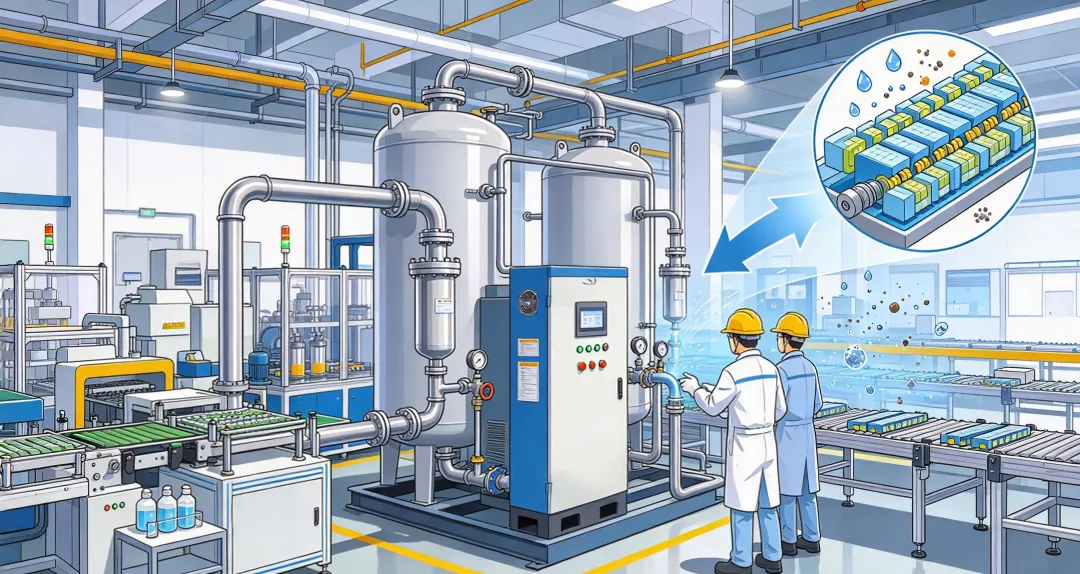
In new-energy and battery manufacturing, moisture-sensitive processes may require substantially deeper drying than general pneumatic equipment.
For metal fabrication and laser cutting, the correct treatment configuration depends on whether compressed air is being used for conventional pneumatic equipment or as part of a specialized cutting process.
The industry therefore helps define operating context, but the process specification should ultimately determine the dryer type.
Which Compressed Air Dryer Type Uses the Least Energy?
There is no single answer.
For a general industrial system that only requires a 2–10°C PDP, a refrigerated dryer may offer a practical lifecycle solution because there is no reason to generate much lower dew points than required.
For a low-PDP application, however, energy comparison should be made among appropriate adsorption technologies.
Annual energy use can include refrigeration power, compressed-air purge, electric heaters, blowers, pressure drop, cooling water, and compressor-system interactions.
A dryer should therefore be evaluated by energy required per year to meet the actual air-quality specification, not by one isolated efficiency feature.
Which Dryer Type Is Best for Cold Weather?
The relevant factor is not simply outdoor ambient temperature but the lowest temperature the compressed air will encounter downstream.
If piping can fall below the pressure dew point delivered by a refrigerated dryer, additional condensation can form and may freeze.
In these situations, an adsorption dryer capable of providing a sufficiently low PDP is generally more appropriate.
An appropriate margin should be maintained between the specified pressure dew point and the minimum expected downstream temperature.
Can Different Dryer Types Be Combined?
Yes.
Refrigerated and adsorption technologies can be combined when deeper drying is required.
However, simply placing two independently selected dryers in series is not necessarily an optimized system.
Flow capacity, pressure drop, intermediate temperature, filtration, drainage, regeneration requirements, and control logic should be considered together.
Purpose-designed combined drying equipment can simplify this integration.
Maintenance Differences Between Dryer Types
Maintenance requirements vary significantly by technology.
Refrigerated dryers require attention to heat exchangers, condensers, automatic drains, refrigeration components, and electrical systems.
Adsorption dryers additionally require inspection of desiccant condition, switching valves, silencers, purge systems, controls, and regeneration components.
Heated and blower dryers introduce heaters and additional regeneration equipment, while HOC systems require coordination with compressor operating conditions.
Maintenance intervals should therefore be based on equipment condition, operating hours, contamination, environment, and manufacturer requirements rather than applying one universal six- or twelve-month schedule.
Choosing Between Compressed Air Dryer Types
Different compressed air dryer types exist because industrial systems do not all have the same moisture-control requirement.
Refrigerated drying is often appropriate when a 2–10°C pressure dew point is sufficient.
Heatless and heated adsorption dryers provide much lower PDP through regenerative desiccant drying.
Blower and heat-of-compression systems offer alternative regeneration strategies for applications where reducing compressed-air purge or utilizing available compressor heat is important.
Combined systems integrate refrigeration and adsorption drying where deeper drying and staged moisture removal are advantageous.
The most reliable comparison can be summarized as:
required PDP → peak airflow → inlet temperature → operating pressure → minimum downstream temperature → regeneration method → pressure drop → annual energy cost → maintenance requirements
For a specific compressed air project, contact Lingyu with the operating pressure, maximum flow, inlet temperature, minimum downstream temperature, required PDP, and compressor configuration so the appropriate dryer technology can be evaluated.