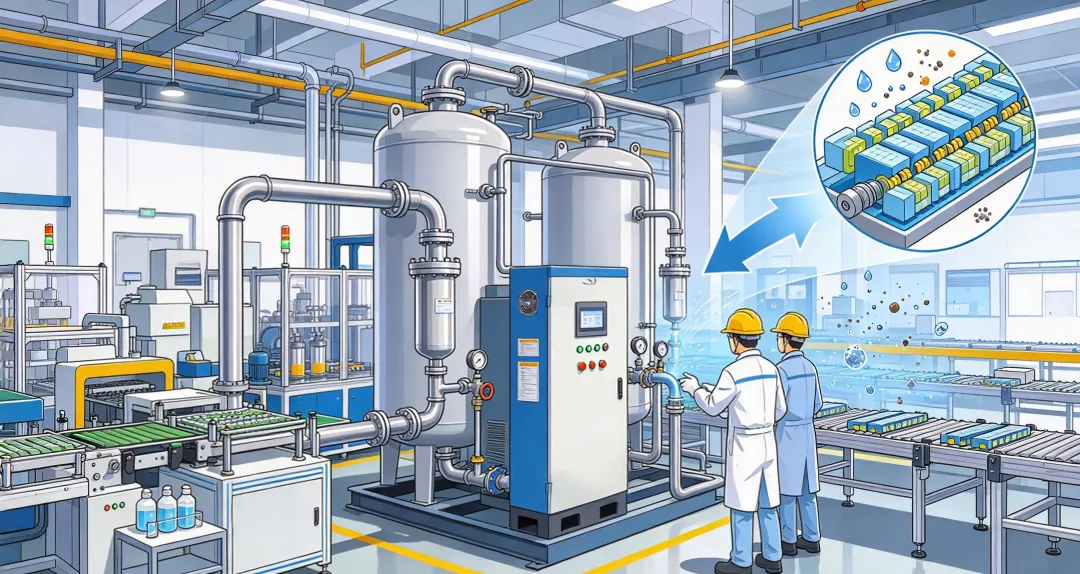
Compressed air is used across manufacturing, automation, packaging, instrumentation, and many other industrial processes. But compressed air quality depends on more than pressure alone.
Untreated compressed air may contain water vapor, liquid condensate, oil aerosols, dust, rust particles, and other contaminants. If these are not controlled, they can contribute to equipment wear, corrosion, unstable pneumatic operation, and process-quality problems.
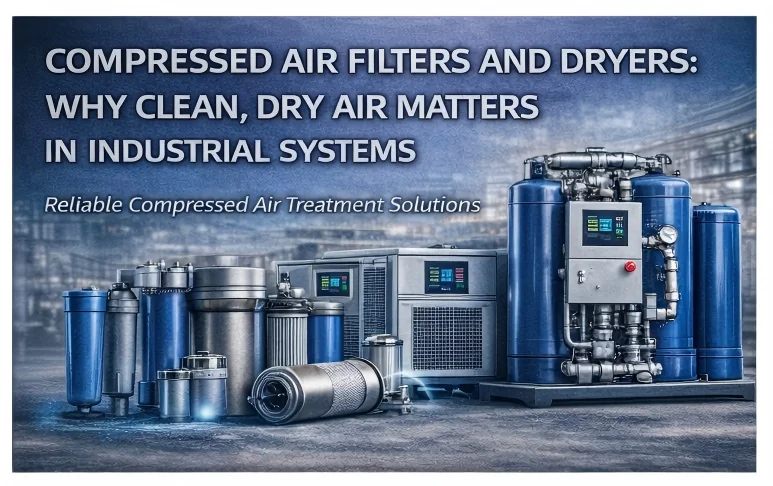
This is why compressed air filters and dryers are often used together. Filters primarily control particles, oil aerosols, and liquid contamination, while dryers reduce water vapor and lower the pressure dew point.
What Are Compressed Air Filters and Dryers?
Compressed air filters and dryers perform different functions within an air-treatment system.
Compressed air filters remove contaminants such as particles and oil aerosols from the air stream. Different filter grades are used depending on the required air quality.
Compressed air dryers reduce water vapor in compressed air. They are selected according to the pressure dew point required by the process.
Together, these components can form part of a complete treatment system designed around the actual air-quality requirement.
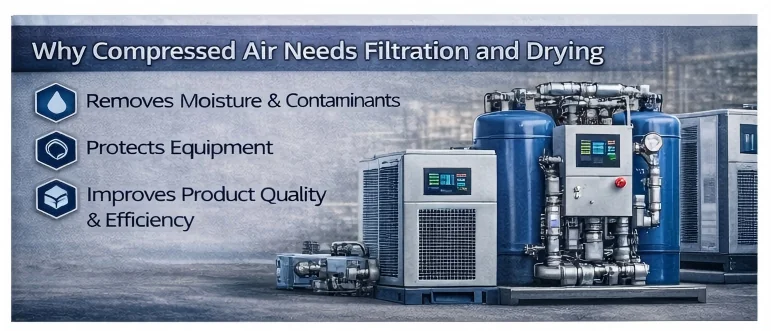
Why Compressed Air Needs Both Filtration and Drying
Atmospheric air contains both water vapor and airborne contaminants. Additional contamination can also enter the compressed-air system through the compressor, piping, and downstream equipment.
These contaminants do not all behave in the same way.
Liquid water can be separated mechanically. Oil aerosols and particles require filtration. Water vapor requires drying if the system must maintain a lower pressure dew point.
Using only a dryer does not automatically remove all particles or oil contamination. Likewise, using filters alone does not sufficiently reduce water vapor when a lower pressure dew point is required.
This division of functions is the key reason filters and dryers are often combined.
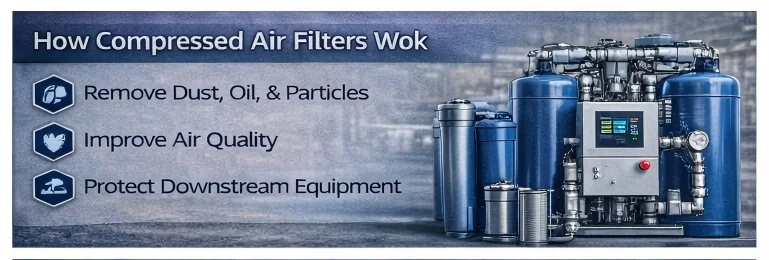
How Compressed Air Filters Work
Compressed air filters pass the air through filter media designed to separate specific contaminants.
The required filter grade depends on what needs to be removed.
Lingyu’s D Series includes several filtration stages, including AO-grade pre-filtration for larger particulate and contamination removal, AA-grade oil and particulate filtration, AX-grade high-efficiency oil removal filtration, and ACS activated-carbon oil removal filtration for applications requiring lower residual oil content.
Filtration becomes progressively finer from AO to AX, while the activated-carbon stage is intended for further oil removal.
Filter selection should therefore be based on the required downstream air quality rather than simply installing the finest filter available at every stage.
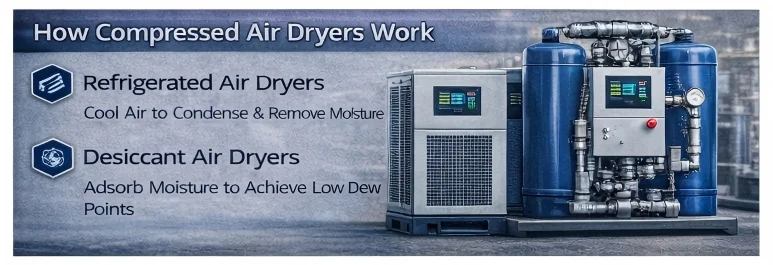
How Compressed Air Dryers Work
Compressed air dryers primarily control moisture.
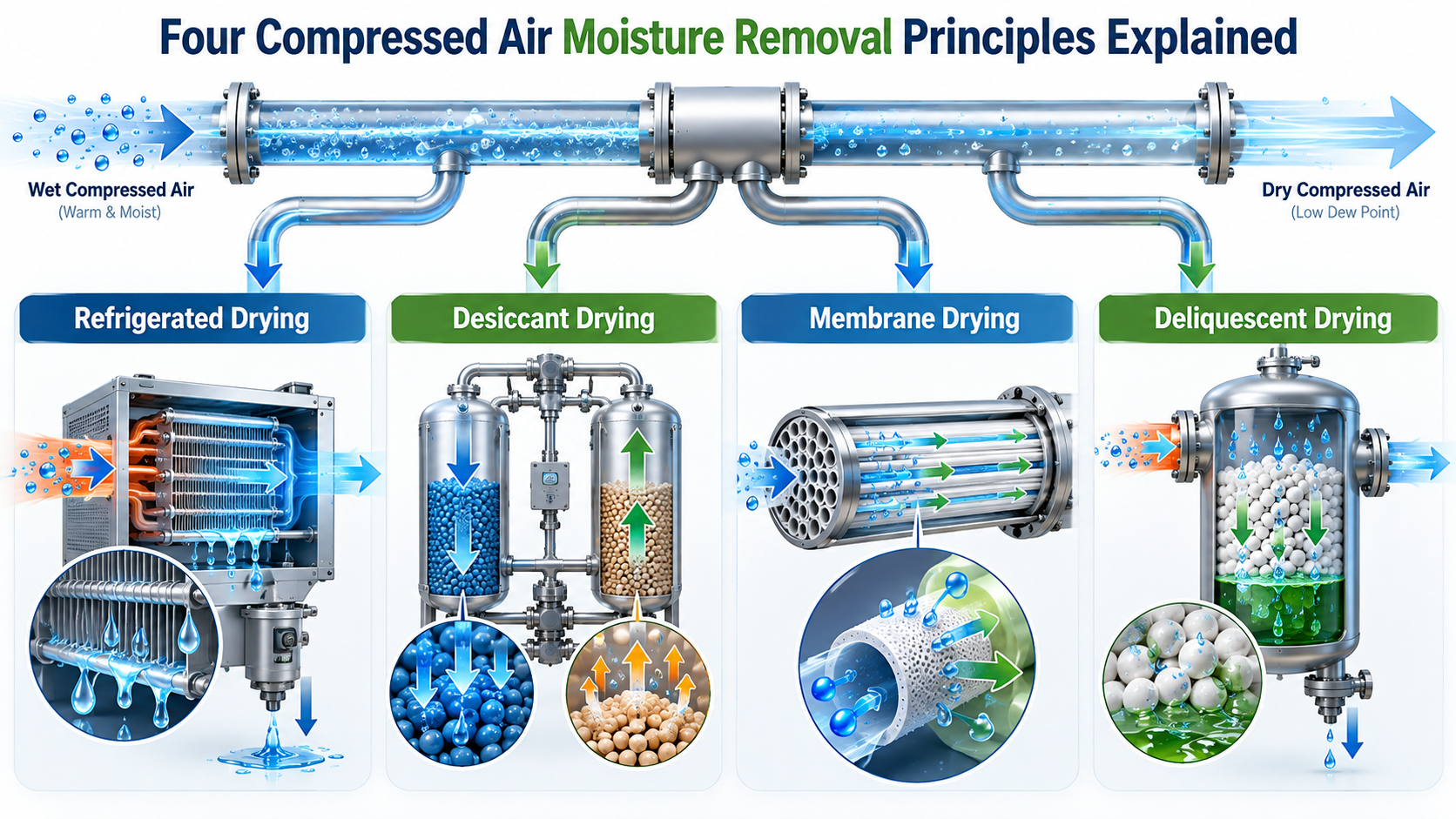
A refrigerated dryer cools compressed air so that water vapor condenses into liquid. The condensate is separated and discharged before the air continues downstream.
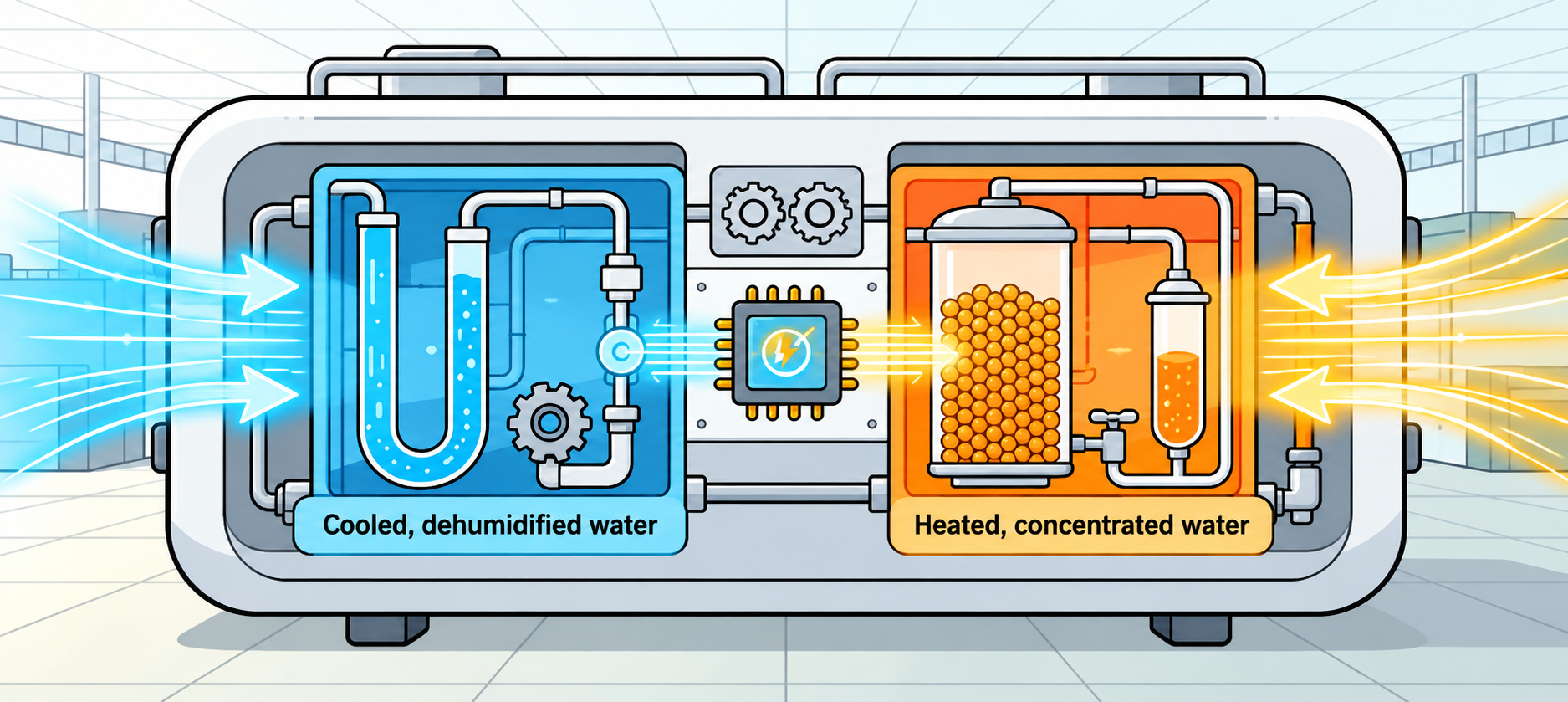
A desiccant or adsorption dryer removes water vapor through adsorption and is used when a substantially lower pressure dew point is required.
Lingyu refrigerated systems can provide approximately 2–10°C pressure dew point under the applicable operating conditions, while selected adsorption systems can provide ≤−40°C pressure dew point.
The correct dryer therefore depends on the actual dew-point requirement rather than on cleanliness alone.
For a more detailed technology comparison, see the refrigerated and desiccant dryer comparison.
Why Filters and Dryers Have Different Jobs
Compressed-air contamination can be divided into three broad groups: solid particles such as dust, rust, and pipe scale; oil contamination including liquid oil, aerosols, and, in some systems, oil vapor; and water contamination in the form of liquid condensate and water vapor.
Filters primarily address particles and oil contamination. Separators and drains remove condensed liquid water. Dryers reduce the remaining water vapor.
A properly designed system therefore combines several treatment stages rather than expecting one component to solve every air-quality problem.
Common Types of Compressed Air Filters
Particulate and Pre-Filters
Pre-filtration removes larger contamination before it reaches more sensitive treatment equipment.
This can help protect downstream filters, dryers, valves, and other equipment from excessive contamination loads.
Coalescing and Oil-Removal Filters
These filters are used when fine oil aerosols and smaller particles need to be reduced.
Lingyu’s AA and AX filter grades provide progressively higher-efficiency oil and particulate filtration within the D Series.
Activated-Carbon Filtration
Activated-carbon filtration is used where further control of oil-related contamination is required.
Lingyu’s ACS filter provides an activated-carbon oil-removal stage.
The need for activated carbon depends on the target air-quality requirement; it is not automatically required in every compressed-air system.
Common Types of Compressed Air Dryers
Refrigerated Air Dryers
Refrigerated dryers are widely used where a moderate pressure dew point is sufficient.
Their main advantages are relatively straightforward operation and suitability for many general industrial compressed-air systems.
Desiccant Air Dryers
Desiccant dryers are selected when the application requires a substantially lower pressure dew point.
Different regeneration methods—including heatless, heated-purge, blower-heated, and heat-of-compression—have different purge-air, electrical-energy, and maintenance requirements.
Combined Drying Systems
Some systems use refrigeration followed by adsorption.
Lingyu’s combined dryer design first removes a large portion of the moisture in the refrigerated stage. The partially dried air then passes through an oil-removal filter before entering the adsorption stage.
This reduces the moisture load on the adsorption system and supports deeper drying.
It is a good example of why filtration and drying should be designed as an integrated treatment process.
How Filters and Dryers Work Together
A common treatment concept can be expressed as:
Cooling and separation → filtration → drying → additional filtration as required
The exact arrangement depends on compressor type, dryer technology, contamination level, pressure dew point, and the final air-quality requirement.
For example, an adsorption dryer generally benefits from suitable upstream oil and liquid-water control because contamination can affect desiccant performance.
Downstream particulate filtration may also be required where desiccant dust or very fine particles need to be controlled.
The correct sequence should therefore be designed around the equipment and process rather than applying one universal layout to every installation.
Benefits of Proper Filtration and Drying
When filters and dryers are correctly selected, they can help reduce moisture-related corrosion, protect pneumatic components, improve process stability, and reduce contamination reaching downstream equipment.
They can also support more predictable maintenance because specific contaminants are controlled before they spread through the compressed-air network.
However, clean compressed air should always be understood relative to the required air-quality specification. A dryer alone does not guarantee oil-free or particle-free compressed air, and a filter alone does not guarantee a sufficiently low pressure dew point.
Applications and Air-Quality Requirements
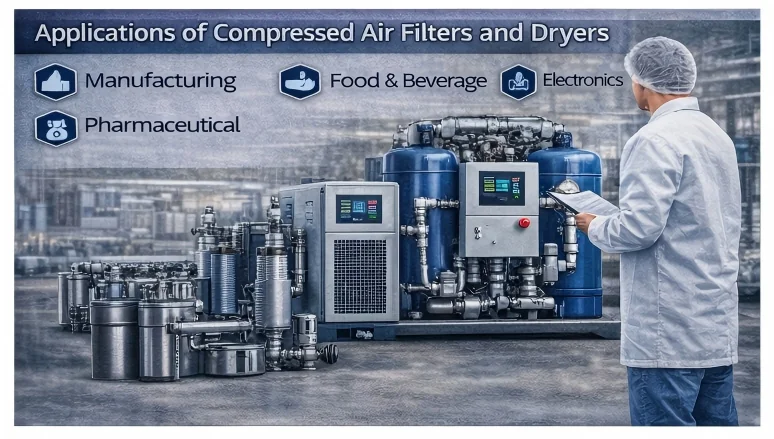
Different industries may require different combinations of filtration and drying.
Food and beverage, pharmaceutical, electronics, automotive, chemical, power, and general manufacturing applications can all use compressed-air treatment, but the correct configuration depends on how the compressed air interacts with the process.
The relevant engineering question is how dry the air must be and how low particle and oil contamination must be for the specific point of use.
How to Choose the Right Filters and Dryers
Selection should begin with the required outlet air quality.
Important factors include required pressure dew point, particle-removal requirements, oil contamination requirements, actual airflow, operating pressure, inlet temperature, ambient conditions, pressure-drop allowance, compressor type, maintenance requirements, and operating and lifecycle cost.
Pressure drop is particularly important because every treatment component introduces some resistance to airflow. Excessive system pressure loss can increase the energy required to deliver usable pressure at the point of use.
For more detail, see the compressed air pressure-drop guide.
Maintenance of Filters and Dryers
Filters and dryers should be maintained as one treatment system, even though their individual service requirements are different.
Filter elements should be inspected and replaced according to condition, differential pressure, operating hours, and applicable maintenance recommendations.
Dryer maintenance depends on the technology. Refrigerated dryers require attention to drains, condensers, evaporators, refrigeration components, and pressure-dew-point performance. Adsorption dryers also require inspection of desiccant, valves, regeneration systems, and controls.
Monitoring the complete treatment system helps identify rising pressure drop, declining drying performance, drainage problems, and filter deterioration before they affect downstream equipment.
Conclusion
Compressed air filters and dryers solve different parts of the same air-quality problem.
Filters control particles, oil aerosols, and other filterable contamination. Dryers reduce water vapor and lower the pressure dew point. Separators and drains remove condensed liquid water.
When these components are correctly combined, the compressed-air treatment system can provide the level of dryness and cleanliness actually required by the process.
The goal is not simply to install more filters or the lowest-dew-point dryer available. It is to design the right combination of filtration, drying, separation, and drainage for the required air quality, system conditions, and operating cost.
Users evaluating complete equipment options can also explore the Lingyu compressed air treatment product range.