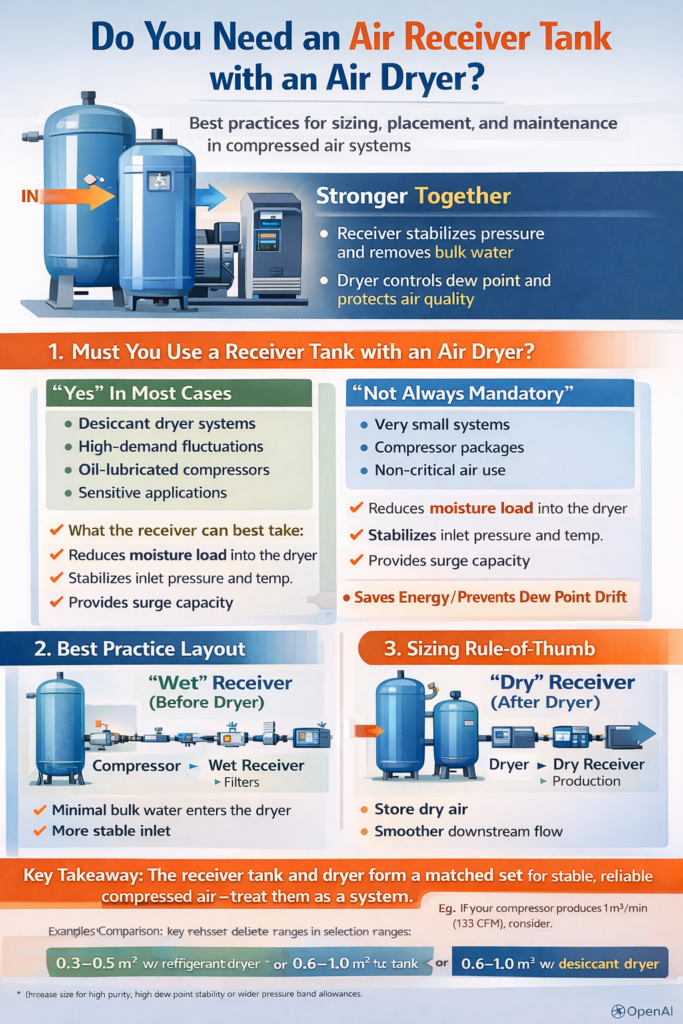
An air receiver tank and an air dryer perform different but complementary functions in a compressed air system.
The receiver stores compressed air and helps stabilize system pressure during changing or short-term demand. The dryer removes water vapor from the compressed-air stream so the system can achieve the pressure dew point required by downstream equipment and processes.
Because these components solve different problems, one cannot replace the other. However, this does not mean that every compressed air system requires exactly the same receiver-and-dryer arrangement.
So, do you need an air receiver tank with an air dryer?
Not necessarily in every installation. Many industrial systems benefit from receiver capacity because it can smooth demand fluctuations, reduce rapid pressure changes, and provide more stable operating conditions for downstream air-treatment equipment.
The correct arrangement depends on compressor control, air demand, dryer type, allowable pressure variation, condensate management, and overall system layout.
What Does an Air Receiver Tank Do?
An air receiver is primarily a compressed-air storage and system-stabilization component.
Its main role is not to dry the air, but to provide stored volume that helps the compressed air system respond more effectively to changes in demand.
Pressure Stabilization
Compressed-air demand rarely remains perfectly constant.
Machines may start and stop, valves may open suddenly, and several production users may consume air at the same time.
A receiver provides temporary stored air between compressor output and plant demand, helping reduce rapid pressure fluctuations during these changes.
This can be particularly useful in systems with frequent or short-duration demand peaks.
Short-Term Air Storage
When plant consumption temporarily exceeds compressor output, a receiver can supply stored compressed air for a limited period.
How long that reserve lasts depends on receiver volume, available pressure range, and actual air demand.
A receiver should not be treated as a substitute for adequate compressor capacity. Instead, it helps the system manage short-term fluctuations without requiring the compressor to respond instantly to every change in demand.
Condensate Management
As compressed air cools, some water vapor can condense into liquid.
If cooling occurs before or inside the receiver, the tank can provide a location where condensate collects before being removed through an appropriate drain.
However, an air receiver is not an air dryer.
It cannot by itself control the final pressure dew point, and it should not replace proper water separation, filtration, or drying equipment.
What Does an Air Dryer Do?
While the receiver manages stored air volume and pressure fluctuations, the air dryer controls moisture in the compressed-air stream.
The appropriate dryer type should therefore be selected according to the pressure dew point required by the application.
Refrigerated Air Dryers
A refrigerated air dryer cools compressed air so that water vapor condenses and can be separated from the air stream.
After cooling, an air-water separator removes liquid moisture before the treated compressed air continues downstream.
Some Lingyu refrigerated-air-dryer systems provide a pressure dew point of 2–10°C, depending on the system configuration and operating conditions.
This type of dryer is generally suitable where moderate moisture control is sufficient.
Desiccant Air Dryers
A desiccant air dryer uses adsorbent material to remove substantially more water vapor from compressed air.
Lingyu’s regenerative adsorption dryer range includes configurations with outlet pressure dew points of −20°C or −40°C, depending on the model and specification.
Desiccant dryers are therefore used where the compressed-air application requires a substantially lower moisture level than a conventional refrigerated dryer can provide.
For more background on adsorption drying, see what a desiccant air dryer is and how it works.
Air Receiver vs. Air Dryer: What Is the Difference?
The simplest way to distinguish the two components is:
Air receiver tank → manages stored compressed-air volume and pressure fluctuations
Air dryer → manages water vapor and pressure dew point
A receiver cannot replace a dryer because storing compressed air does not guarantee that the required pressure dew point will be achieved.
Likewise, a dryer cannot replace receiver capacity because removing moisture does not provide meaningful compressed-air storage for short-term demand peaks.
In many industrial compressed-air systems, both functions are useful. The key question is how they should be arranged and sized for the actual application.
Does the Air Receiver Have to Be Before the Dryer?
Not always.
Receiver location should be selected according to what the system needs the storage volume to accomplish.
Receiver Before the Dryer
A receiver installed upstream of the dryer can provide compressed-air storage between the compressor and downstream air-treatment equipment.
If the compressed air has already been adequately cooled, liquid condensate may also collect in the receiver and be removed through an appropriate drain.
This arrangement can help provide more stable inlet conditions for downstream treatment equipment.
Receiver After the Dryer
A receiver installed downstream of the dryer stores already-treated compressed air.
This can be useful when the plant has short downstream demand peaks because stored dry air can help meet temporary consumption without immediately increasing flow through the dryer.
Receivers on Both Sides
Some installations may use receiver capacity on both sides of the air-treatment system.
There is no universal rule requiring every compressed-air installation to use one specific receiver location.
The correct layout should be designed around the compressor, dryer, demand profile, condensate-management strategy, and plant piping.
For a wider view of how these components work together, see the guide to the compressor and dryer as the foundation of a compressed air system.
Why Dryer Inlet Conditions Matter
Air dryers are designed around defined inlet conditions.
If inlet temperature, pressure, flow, or moisture load moves substantially beyond the intended operating range, dryer performance can be affected.
A combined drying system provides a useful example.
In this type of arrangement, the refrigerated stage first cools the compressed air and removes a significant amount of moisture. The partially dried air then passes through oil-removal filtration before entering the adsorption stage.
Reducing the moisture load before the adsorption dryer can reduce the burden on the adsorption stage, lower regeneration demand, and help extend desiccant service life.
This illustrates an important compressed-air system design principle:
Upstream treatment conditions can directly affect downstream dryer performance.
Do Desiccant Dryers Need More Receiver Capacity?
There is no universal rule requiring every desiccant dryer to use a particular receiver size or a fixed receiver-to-compressor ratio.
Adsorption dryers can be sensitive to operating conditions such as flow, pressure, inlet temperature, and regeneration requirements.
For example, Lingyu’s blower-heated regenerative dryer specifications define inlet pressure, inlet temperature, inlet dew point, regeneration-air consumption, and target outlet dew point as operating parameters.
Receiver capacity can be useful where it helps reduce rapid flow or pressure fluctuations, but the tank should be sized according to the actual compressed-air system rather than using a fixed multiplier based only on dryer type.
How Should an Air Receiver Be Sized?
Air receiver sizing should consider the complete operating profile rather than relying on a single universal formula.
Important inputs include:
- Compressor capacity
- Compressor control method
- Minimum and maximum system pressure
- Allowable pressure drop
- Peak air demand
- Duration of the peak
- Desired compressor cycling behavior
- Downstream storage requirements
- Available installation space
A plant with stable continuous air demand can have very different storage requirements from a facility with large intermittent pneumatic loads.
The receiver should therefore be calculated for actual operating conditions rather than selected only from compressor flow.
Consider Pressure Rating and System Pressure Drop
The receiver’s pressure rating must be compatible with the compressed-air system in which it is installed.
At the same time, the dryer, receiver, filters, valves, piping, and other treatment components should be evaluated together for allowable pressure and pressure drop.
Undersized piping, restrictive valves, contaminated filters, or excessive differential pressure can reduce the usable pressure available at production equipment even when the compressor itself has sufficient capacity.
This is why compressed-air system design should consider the complete treatment and distribution path rather than evaluating only individual equipment nameplate values.
For a broader system overview, see Lingyu’s guide to the core components of a compressed air purification system.
Condensate Drainage Is Essential
A receiver can only help manage condensed liquid if that liquid is actually removed.
Drain performance is therefore an important part of system reliability.
Condensate that accumulates in a receiver, separator, filter, or dryer can create downstream problems instead of solving them.
A complete condensate-management strategy should consider:
- Aftercooler and separator drainage
- Receiver drainage
- Filter drains
- Dryer drains
- Inspection and maintenance access
Automatic drainage may be useful for continuously operating systems, but drain selection and maintenance should match the actual condensate load and operating conditions.
Air Filtration Still Matters
Neither a receiver nor an air dryer should be expected to control every compressed-air contaminant.
Particles and oil require appropriate filtration.
This is particularly important upstream of adsorption dryers and other sensitive compressed-air equipment.
Lingyu’s filtration range includes multiple precision-filter grades for particulate and oil removal, supporting a treatment approach in which filtration and drying perform complementary functions.
For additional detail, see the compressed air filters and dryers guide.
Receiver and Dryer Maintenance
A stable compressed-air system depends on maintaining both storage and air-treatment components.
For the receiver, maintenance should focus on areas such as:
- Condensate drainage
- Visible corrosion or damage
- Gauges and safety devices
- Applicable pressure-vessel inspection requirements
Dryer maintenance depends on the dryer type but may include:
- Drain operation
- Filter condition
- Refrigeration-system condition
- Valve operation
- Adsorbent condition
- Dew-point monitoring
System performance should also be tracked over time.
Pressure trends and dew point are particularly useful indicators because they show whether the compressed-air system is still meeting production requirements.
If air demand rises unexpectedly, leakage should also be investigated. Lingyu’s compressed air leak detection guide provides additional information on identifying and managing system leakage.
Safety and Pressure-Vessel Requirements
An air receiver is pressure equipment.
Its design, installation, safety devices, inspection, and registration requirements depend on the specific vessel and the regulations applicable at the installation location.
The required pressure-vessel code, inspection regime, pressure-relief protection, pressure indication, and other protective measures should therefore be confirmed according to the actual receiver and local requirements.
These requirements should be treated separately from the technical specification of the air dryer.
So, Do You Need an Air Receiver With an Air Dryer?
Not necessarily in every compressed-air system, but receiver capacity and drying requirements should be evaluated together.
A receiver can be particularly valuable when the system experiences:
- Short-term demand peaks
- Rapid pressure fluctuations
- Frequent compressor cycling
- A need for downstream stored air
- Variable demand through the air-treatment system
The dryer, meanwhile, remains responsible for achieving the required moisture level and pressure dew point.
Neither component replaces the other.
When designing or upgrading a compressed-air system, it is more useful to evaluate the complete process:
Compressor → cooling and separation → receiver/storage → filtration → dryer → downstream storage/distribution
The exact position and capacity of the receiver can then be determined according to the compressor controls, demand profile, dryer requirements, pressure stability, and plant layout.
If the dryer itself still needs to be selected, the compressed air dryer selection guide provides the next logical step.
Conclusion
An air receiver tank and an air dryer perform different but complementary functions in a compressed-air system.
The receiver primarily provides compressed-air storage and helps stabilize pressure and short-term demand.
The dryer removes water vapor so the system can achieve the pressure dew point required by downstream equipment and processes.
Many industrial systems benefit from using both, but there is no universal rule requiring one specific receiver size, one specific tank location, or two receiver tanks for every dryer installation.
The most suitable arrangement should be designed around:
Air demand → compressor control → pressure stability → condensate management → required dew point → dryer type → filtration → distribution.
By considering these factors as one integrated system, the receiver and dryer can be selected and positioned to support stable compressed-air supply, effective moisture control, and reliable downstream operation.