A reliable compressed air system depends on more than selecting a compressor with enough flow.
The compressor determines how much compressed air is produced and at what pressure, while the air-treatment system determines whether that air reaches production equipment with the required moisture, oil, particle, pressure, and flow conditions.
For many industrial plants, the compressor and dryer should therefore be engineered as parts of the same compressed-air system.
A correctly sized compressor paired with an unsuitable dryer can still result in high dew point, excessive pressure drop, unstable operation, or unnecessary energy consumption. Likewise, an efficient dryer cannot compensate for an undersized compressor, excessive inlet temperature, or unstable upstream conditions.
The goal is not simply to buy a compressor and an air dryer. It is to deliver:
The required air flow → at the required pressure and dew point → with acceptable contamination levels → at a practical total operating cost.
What Does an Air Compressor Do?
An air compressor draws in ambient air and compresses it to a higher pressure for industrial use.
Compressed air can power pneumatic tools, actuators, valves, instrumentation, automation equipment, production machinery, and many other industrial processes.
However, ambient air naturally contains water vapor and solid contaminants. Depending on the compressor and intake environment, oil contamination may also enter the compressed-air system.
Compression increases the amount of water contained per unit volume. As the compressed air subsequently cools, part of that moisture can condense into liquid water.
That means producing pressure is only the first part of the job.
The compressed air must then be treated according to the requirements of the downstream application.
What Does an Air Dryer Do?
An air dryer removes moisture from compressed air to achieve a defined pressure dew point.
The required dew point depends on the application, installation environment, distribution system, and risk of condensation or freezing.
Two major industrial drying technologies are refrigerated drying and adsorption/desiccant drying.
Refrigerated Air Dryers
A refrigerated air dryer cools compressed air so that water vapor condenses and can be separated from the air stream.
Lingyu refrigerated systems and project configurations can provide pressure dew points around 2–10°C, depending on the equipment and operating conditions.
Refrigerated drying is commonly suitable where moderate moisture control is sufficient and the compressed-air system does not require a very low dew point.
Desiccant Air Dryers
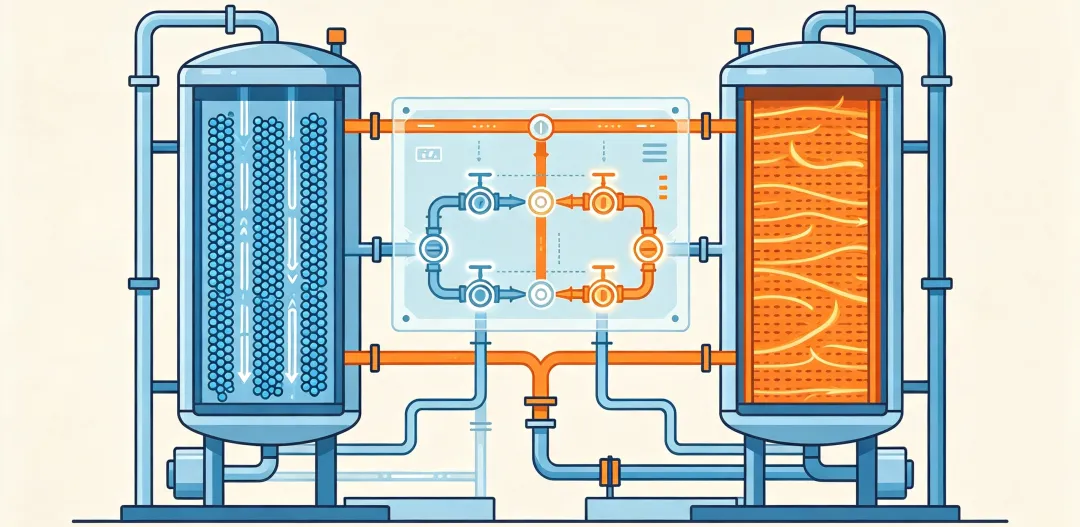
A desiccant air dryer removes water vapor through adsorption.
Depending on the regeneration method and specific model, Lingyu’s adsorption dryer range includes pressure dew-point configurations such as −20°C, −40°C, and lower values in selected series.
For example, the CH heatless series has an outlet pressure dew-point range of −50°C to −20°C.
These dryers are appropriate where the application requires substantially drier compressed air.
The correct dryer should therefore be chosen according to the required pressure dew point rather than from the assumption that one dryer technology is universally better.
Why the Compressor and Dryer Must Be Matched
Dryer performance depends directly on what the compressor and upstream system send into it.
Important variables include:
- Actual air flow
- Inlet pressure
- Inlet temperature
- Moisture load
- Compressor operating profile
- Oil and particle contamination
- Demand fluctuations
If actual operating conditions exceed the dryer’s design basis, it may no longer achieve its rated performance.
For example, increasing inlet temperature can increase the moisture load entering the dryer. Flow significantly above rated capacity can also reduce drying performance or increase pressure loss.
This is why the compressor should not be selected independently from the downstream treatment equipment.
For a deeper system-layout discussion, see the air compressor and dryer setup guide.
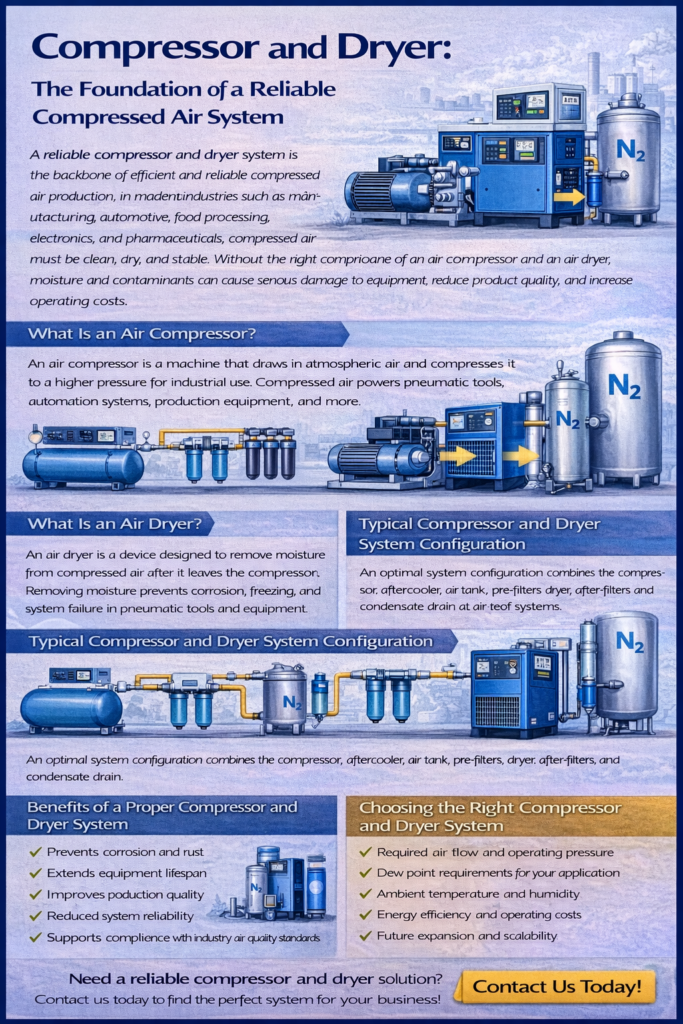
A Typical Compressed Air Treatment System
A practical industrial compressed-air treatment system may include:
Compressor → aftercooling/separation → receiver → filtration → dryer → downstream filtration/storage → distribution
The exact arrangement depends on the required air quality, dryer technology, compressor configuration, demand profile, and plant conditions.
Not every installation needs every component in exactly the same order.
The important point is that each stage should prepare the compressed air appropriately for the next stage while maintaining the required point-of-use pressure and air quality.
The Aftercooler and Water Separator
Compressed air leaving a compressor can be hot.
Cooling the air allows a significant portion of the water vapor to condense into liquid before the air reaches the dryer.
A separator and drain can then remove this bulk liquid.
This is particularly important for adsorption dryers, which are intended primarily to remove water vapor rather than absorb large quantities of incoming liquid water.
Effective cooling and separation can therefore substantially reduce the moisture load placed on downstream treatment equipment.
Why an Air Receiver Can Help
An air receiver provides storage volume and can help stabilize pressure and short-duration demand fluctuations.
Depending on the system layout, it can also provide a location where condensate formed after cooling can collect and be drained.
However, a receiver does not replace a dryer because it cannot establish a controlled pressure dew point.
Likewise, a dryer does not replace receiver capacity because drying the air does not provide meaningful storage for short demand peaks.
For more detail on this relationship, see whether an air receiver tank and air dryer should be used together.
Filtration Is Separate From Drying
Another common system-design mistake is assuming that the dryer removes every compressed-air contaminant.
It does not.
Moisture, oil, and particles require different treatment mechanisms.
Filtration, separation, refrigerated drying, and adsorption drying therefore perform different functions within the complete compressed-air treatment system.
Upstream filtration can help protect dryers from oil and particulate contamination, while downstream filtration may be used to capture particles according to the required air-quality specification.
A precision compressed air filter can therefore be part of the complete treatment train rather than a substitute for the dryer.
Choosing the Correct Dryer Dew Point
The correct pressure dew point should come from the downstream process requirement.
Do not automatically choose the lowest achievable value.
A system designed around a much lower dew point than production actually requires can increase capital cost, regeneration demand, or overall energy consumption.
Conversely, choosing a refrigerated dryer where the distribution system or process genuinely requires very dry air can lead to condensation or process problems.
The first question should therefore be:
What pressure dew point must be maintained at the required operating conditions?
Only after answering that question should the dryer technology be selected.
Compressor Flow and Dryer Capacity Must Match
Dryer capacity should be evaluated against the air it will actually process.
This means looking beyond nominal compressor flow.
The system designer should consider:
- Normal demand
- Peak demand
- Compressor sequencing
- Future expansion
- Operating pressure
- Inlet temperature
- Dryer correction factors
A dryer that is marginally sized under ideal rated conditions may become undersized when the real plant operates hotter, at a different pressure, or at greater flow.
Compressor and dryer ratings should therefore be compared under the same actual operating conditions.
Pressure Drop Is Part of System Selection
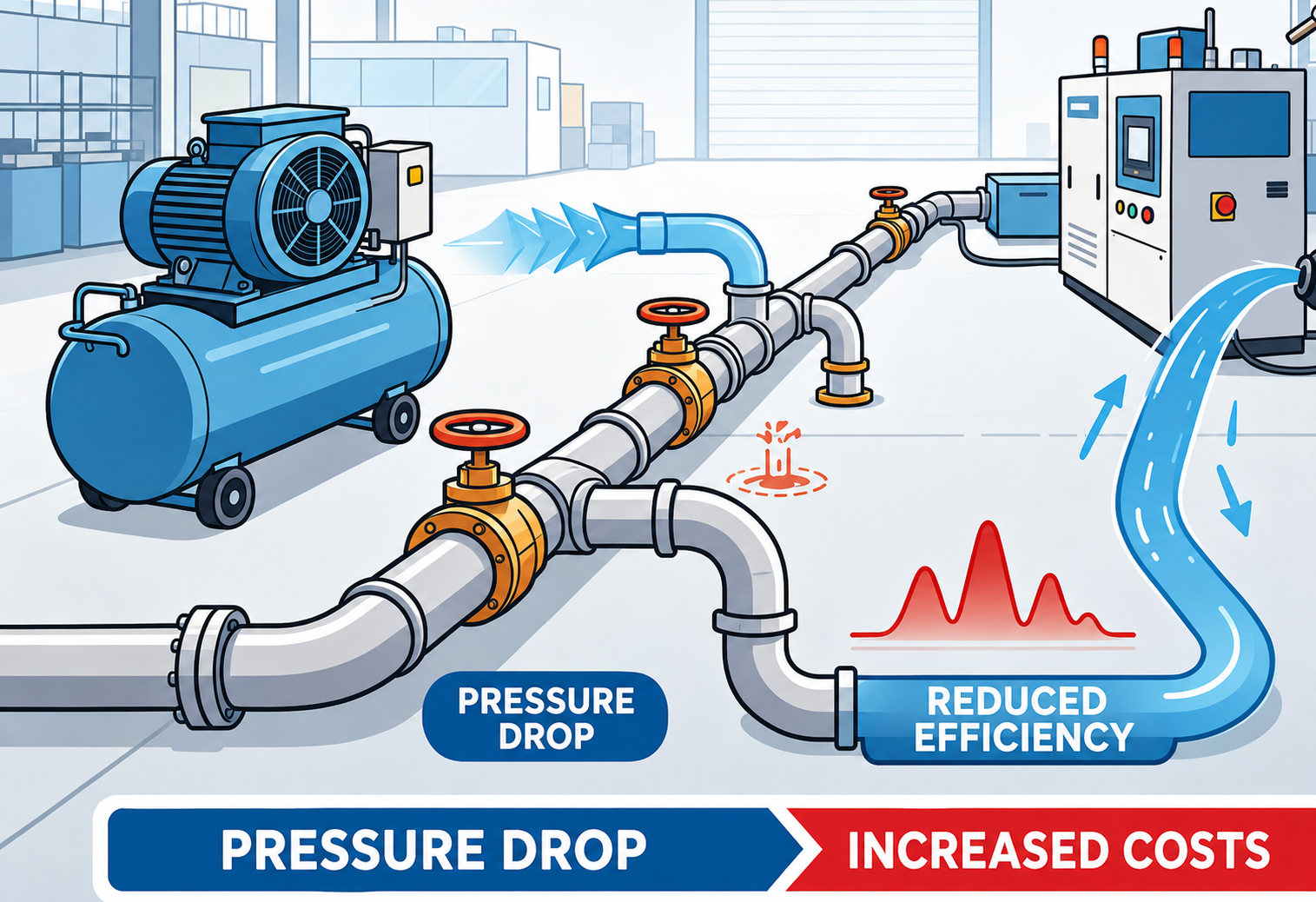
The compressor may produce adequate discharge pressure while the production line still receives too little pressure.
Every component between the compressor and point of use can contribute pressure loss, including filters, dryers, separators, receivers, valves, piping, and fittings.
Excessive pressure drop can encourage operators to raise compressor discharge pressure unnecessarily, which may increase energy consumption without correcting the actual restriction.
The system should therefore be designed around the required point-of-use pressure, not only compressor discharge pressure.
For more detail, see the guide to compressed air pressure drop and system efficiency.
Inlet Temperature Can Change Dryer Performance
Dryers are rated for defined inlet conditions.
For example, Lingyu’s HRB-E low-purge blower-heated regenerative dryer has a rated inlet temperature of 10–30°C, a maximum inlet temperature of ≤40°C, and a rated inlet pressure of 0.7 MPa within an operating range of 0.6–1.0 MPa.
Other dryer technologies have different inlet-temperature requirements.
Heat-of-compression dryers, for example, are intentionally designed around high-temperature compressor discharge air.
This is why generic advice such as “all dryers need cool inlet air” is incorrect.
The dryer must be matched to both the compressor type and the intended system architecture.
Combined Drying Can Be Useful for Lower Dew Points
Where a plant needs a lower dew point while also reducing the moisture load on the adsorption stage, a combined drying configuration may be appropriate.
Lingyu’s combined dryer design first uses refrigerated drying to remove a substantial amount of moisture. The air then passes through oil-removal filtration before entering the adsorption stage for deeper drying.
This arrangement reduces the moisture load on the adsorption system, lowers regeneration-air consumption, and can help extend desiccant service life.
The Lingyu DH combined dryer configuration provides an outlet pressure dew point of ≤−40°C.
This demonstrates why system architecture can matter as much as the individual dryer.
Energy Efficiency Is a System Issue
A “high-efficiency dryer” does not automatically make the entire compressed-air system efficient.
Total energy performance depends on:
- Compressor efficiency
- Discharge pressure
- System pressure drop
- Regeneration-air consumption
- Dryer electrical consumption
- Air leakage
- Demand profile
- Control strategy
Different adsorption regeneration technologies can also have very different compressed-air consumption.
For example, the HRB-E low-purge configuration uses 2–3% regeneration air, while the HOC-Z configuration uses 0% regeneration air under its stated operating configuration.
However, the lowest purge percentage is not automatically the best system choice.
Electrical power, available compressor heat, cooling utilities, operating hours, load profile, maintenance requirements, and capital cost should also be considered.
The most efficient solution is the one that achieves the required air quality and reliability with an appropriate total operating cost.
Reliability Depends on the Whole Treatment Train
When compressed-air quality deteriorates, the dryer is often blamed first.
But high dew point or unstable performance may originate elsewhere in the system.
Possible causes include:
- Poor aftercooling
- Failed separators or drains
- Clogged filters
- Excessive inlet temperature
- Increased plant flow
- Unstable compressor pressure
- Air leaks
- Poor regeneration
- Incorrect dryer sizing
Troubleshooting should therefore follow the entire air path instead of replacing dryer components before the upstream system has been checked.
If high dew point is already becoming a recurring problem, see the desiccant air dryer high-dew-point troubleshooting guide.
How to Select a Compressor and Dryer as One System
Before equipment selection, define:
- Required point-of-use flow
- Normal and peak demand
- Required point-of-use pressure
- Target pressure dew point
- Required oil and particle limits
- Compressor discharge temperature
- Actual ambient conditions
- Operating hours and load profile
- Available cooling utilities
- Receiver and storage requirements
- Pressure-drop allowance
- Redundancy requirement
- Future capacity growth
Then select the compressor, cooling and separation equipment, receiver, filtration, dryer, and distribution system around those requirements.
If the dryer technology itself has not yet been selected, the compressed air dryer selection guide is the more appropriate next step.
Conclusion
A compressor and dryer should not be treated as two unrelated pieces of equipment.
The compressor establishes the available compressed-air capacity and pressure, while the dryer and associated treatment equipment determine whether that air reaches the process at the required moisture and contamination level.
A reliable compressed-air system therefore needs to balance:
Flow → pressure → temperature → moisture load → dew point → filtration → storage → pressure drop → energy consumption → reliability
When these variables are evaluated together, the result is a compressed-air system that is better matched to actual production requirements and easier to operate reliably over the long term.