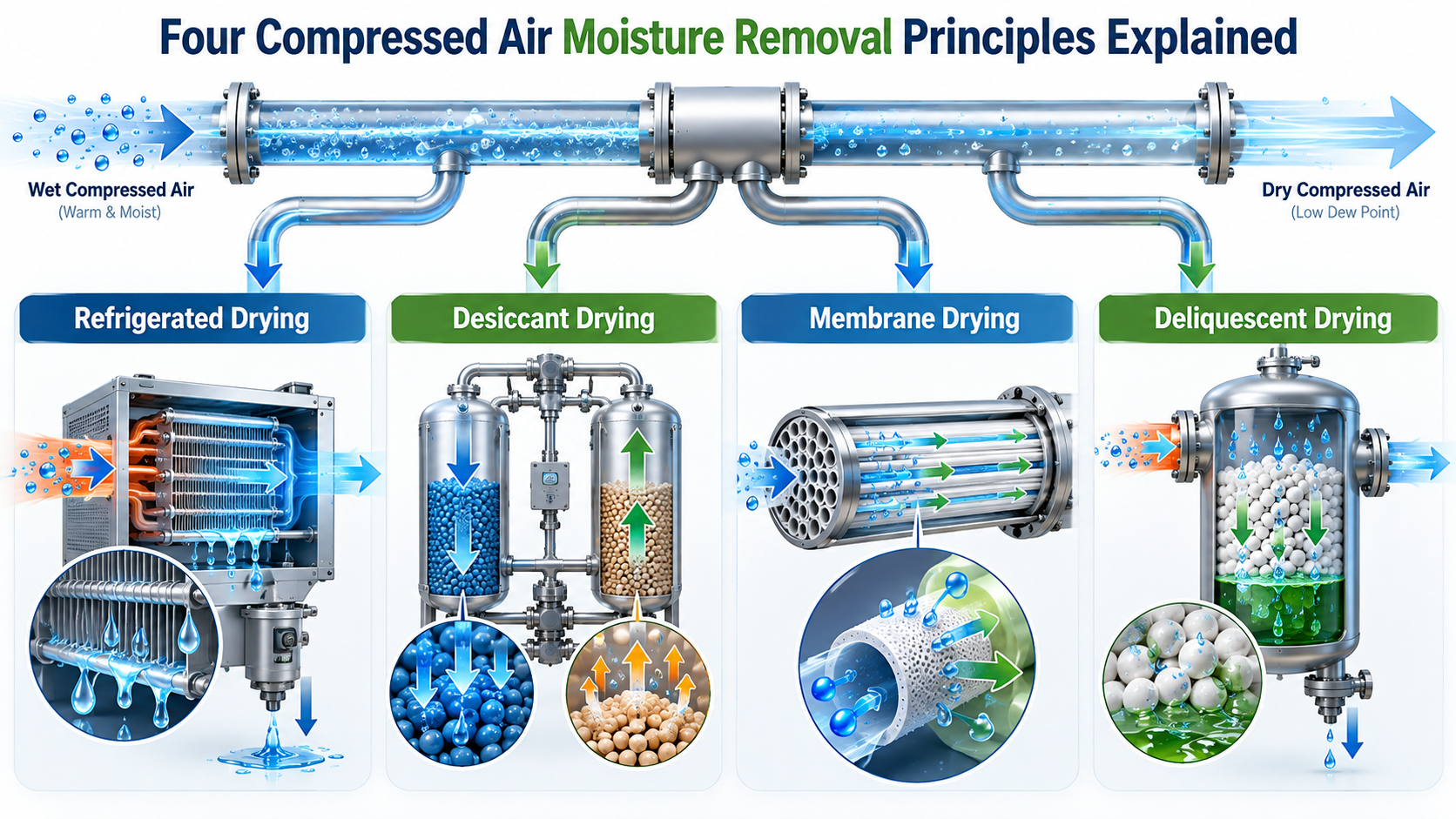
Moisture is one of the main contaminants that must be controlled in an industrial compressed-air system.
Ambient air naturally contains water vapor. When air is compressed and later cools, excess moisture can condense into liquid water. If this moisture is not properly controlled, it can contribute to pipeline corrosion, control-system problems, freezing, equipment damage, and reduced product quality.
Both liquid water and water vapor must therefore be considered when designing a compressed-air purification system.
For processes that require a substantially lower pressure dew point than conventional refrigerated drying can provide, a desiccant air dryer system is an important solution.
Also known as an adsorption dryer, this technology uses desiccant to adsorb water vapor from compressed air and can provide pressure dew points such as −20°C or −40°C, depending on the dryer type and configuration.
For a broader view of available technologies, users can explore Lingyu’s desiccant air dryer product category.
What Is a Desiccant Air Dryer System?
A desiccant air dryer system removes water vapor from compressed air through adsorption.
Compressed air passes through a vessel containing adsorbent material. Water molecules adhere to the surface of the desiccant while the dried compressed air continues downstream.
Once the desiccant has accumulated sufficient moisture, it must be regenerated so that its adsorption capacity can be restored.
Lingyu adsorption dryer systems use materials such as activated alumina and high-performance molecular sieve, depending on the product series. For example, the HH Series heatless regenerative desiccant air dryer uses activated alumina together with high-performance molecular sieve and provides an outlet pressure dew point of ≤−40°C under its specified operating conditions.
This makes adsorption drying particularly relevant when a process needs substantially drier compressed air than a standard refrigerated dryer normally provides.
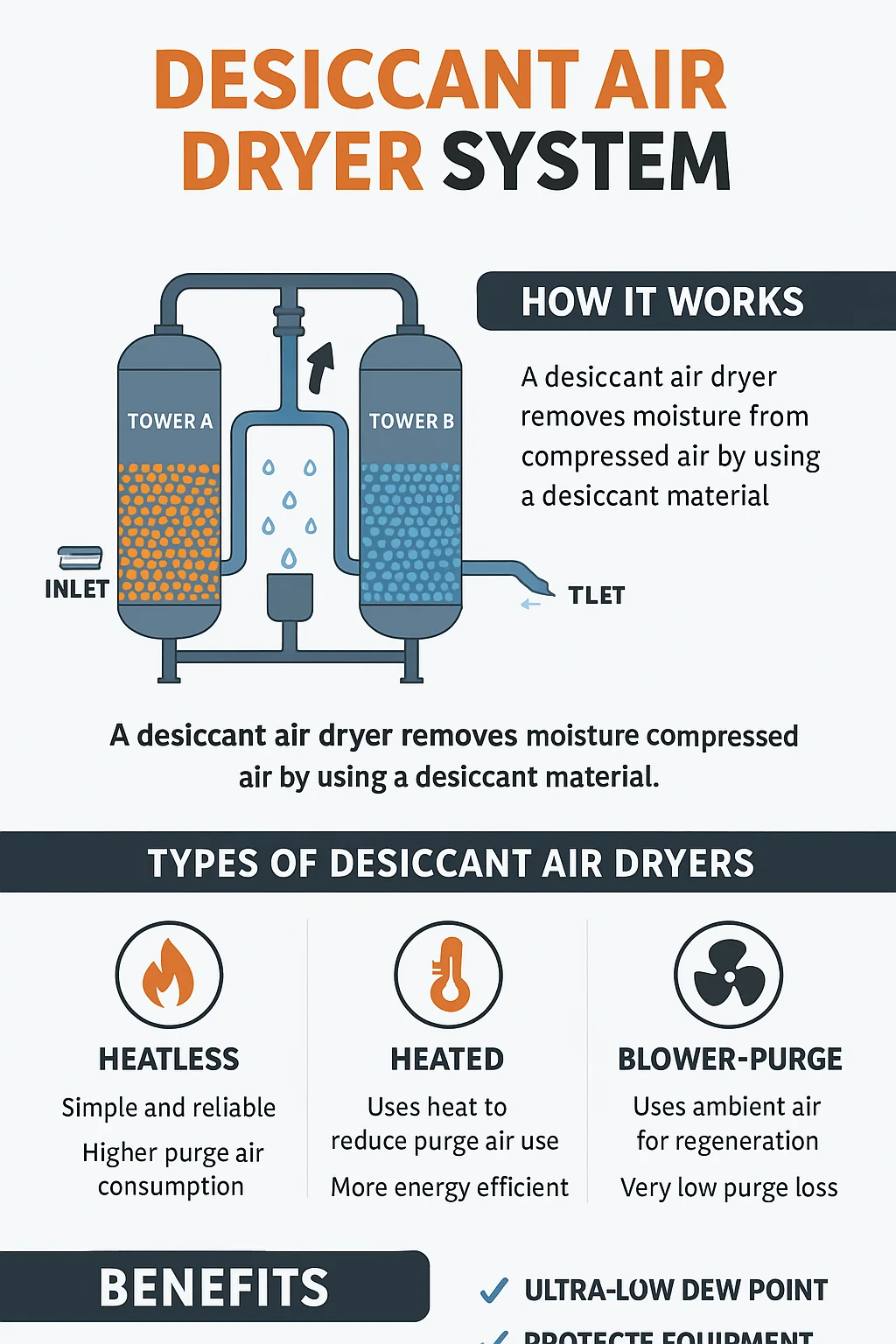
How a Desiccant Air Dryer System Works
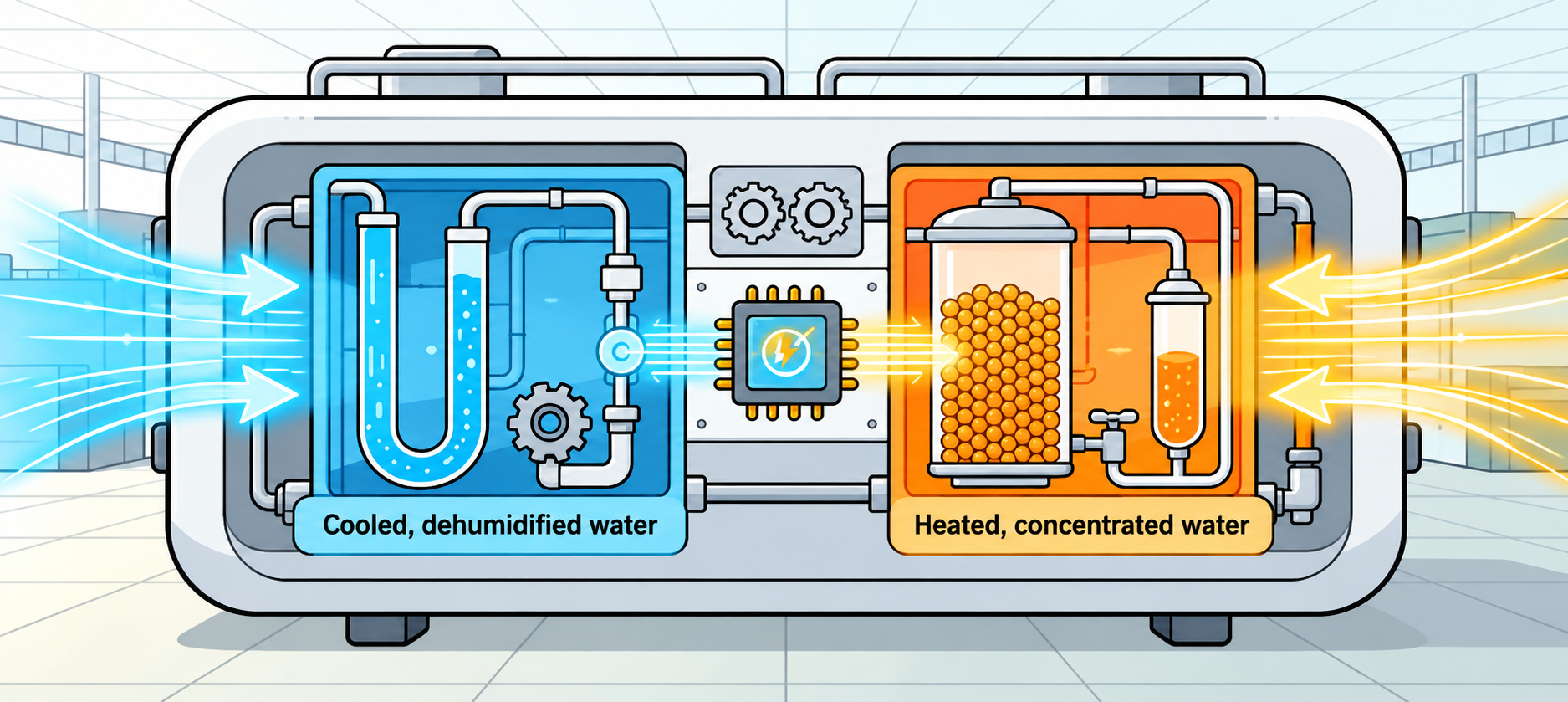
Many industrial adsorption dryers use two vessels so that drying and regeneration can occur alternately.
Tower A: Adsorption
Wet compressed air enters the active adsorption tower.
As air passes through the desiccant bed, water vapor is adsorbed onto the desiccant surface. The treated compressed air then exits the dryer at the specified pressure dew point.
Tower B: Regeneration
While Tower A is adsorbing moisture, Tower B undergoes regeneration.
Moisture previously captured by the desiccant is released and removed from the vessel.
After regeneration is completed and the required operating conditions are restored, the two vessels switch functions.
This alternating arrangement allows the dryer to maintain a continuous supply of dry compressed air.
For a more detailed explanation, users can review the twin-tower desiccant dryer operation guide.
How Is the Desiccant Regenerated?
The major difference between desiccant dryer technologies is how the adsorbent is regenerated.
Some systems use dry compressed air. Others use external heaters, ambient blower air, heat recovered from high-temperature compressor discharge air, or a combination of these methods.
The regeneration method strongly influences purge-air consumption, electrical consumption, equipment complexity, and overall lifecycle cost.
Lingyu’s adsorption dryer range includes heatless regeneration, heated-purge regeneration, modular heatless drying, blower-heated regeneration, zero-purge blower-heated regeneration, and heat-of-compression regeneration.
Types of Desiccant Air Dryer Systems
Heatless Desiccant Air Dryers
A heatless regenerative dryer uses part of the dry product air to regenerate the saturated desiccant.
The process is based on Pressure Swing Adsorption. Reducing the pressure and water-vapor partial pressure in the regeneration tower allows adsorbed moisture to be released, while dry purge air carries the moisture out of the system.
The advantages of heatless regeneration include relatively simple construction and straightforward operation.
However, purge air represents a compressed-air operating cost.
Lingyu’s HH Series heatless regenerative desiccant air dryer is specified with average purge-air consumption of 8–14% and an outlet pressure dew point of ≤−40°C.
Users evaluating this technology can review the heatless regeneration adsorption air dryer.
Heated-Purge Desiccant Air Dryers
A heated regenerative dryer uses an external heat source to provide the energy required to desorb moisture from the desiccant.
A portion of dry product air is still used as the carrier gas during regeneration, but adding heat reduces the purge-air requirement compared with conventional heatless regeneration.
The CH Series Heated Purge Regenerative Desiccant Air Dryer operates on the principle of Temperature Swing Adsorption. Its regeneration sequence includes heated desorption followed by a cooling stage before the desiccant returns to normal adsorption service.
The applicable heated-purge configuration is specified with average purge-air consumption of 4–8% and an outlet pressure dew point of ≤−40°C.
A relevant product option is the heated regeneration adsorption air dryer.
Blower-Heated Desiccant Air Dryers
A blower-heated dryer further reduces dependence on compressed product air.
During regeneration, an independent blower draws ambient air into the system. A heater raises its temperature, and the heated air passes through the regeneration vessel to desorb moisture from the desiccant.
Lingyu’s HRB-E low-purge blower-heated regenerative desiccant air dryer uses only a small amount of dry product air during cooling.
Its technical operating conditions specify:
Regeneration air consumption: 2–3%
Outlet pressure dew point: −20°C / −40°C optional
Rated inlet pressure: 0.7 MPa
Operating pressure range: 0.6–1.0 MPa
Rated inlet temperature: 10–30°C
Maximum inlet temperature: ≤40°C
Facilities with larger or continuous compressed-air demand can therefore evaluate a blower-heated regeneration adsorption air dryer where reducing purge losses is an important operating objective.
Zero-Purge Blower-Heated Dryers
Zero-purge designs take this concept further.
In Lingyu’s HRB-Z zero-purge blower-heated configuration, ambient air is heated during the regeneration stage. During cooling, air circulates through the intercooler and regeneration tower in a closed-loop circuit rather than consuming dry product air.
The HRB-Z operating specification gives approximately 0% regeneration air consumption, with −20°C or −40°C pressure dew point options.
A blower zero-purge adsorption dryer can therefore be relevant for large installations where compressed-air losses represent a significant lifecycle cost.
The actual economic benefit should still be calculated according to airflow, operating hours, electrical energy consumption, load profile, and required pressure dew point.
Modular Desiccant Air Dryers
Modular adsorption dryers provide another configuration for applications where installation footprint and scalability are important.
Lingyu’s M Series modular adsorption dryer covers multiple flow capacities and provides an outlet pressure dew point of ≤−20°C, with −40°C available as an option.
The desiccant configuration uses activated alumina together with high-performance molecular sieve.
For applications where this design is appropriate, users can review the modular adsorption air dryer.
Heat-of-Compression Desiccant Dryers
Large compressed-air systems can also use heat already available in high-temperature compressor discharge air.
A heat-of-compression dryer uses this thermal energy to regenerate the desiccant instead of depending entirely on an external regeneration heater or large quantities of compressed purge air.
Lingyu’s HOC-E configuration is designed for high-temperature compressed air, with a rated inlet temperature of 120°C, an allowable inlet temperature range of 110–180°C, regeneration air consumption of ≤3%, and optional −20°C / −40°C outlet pressure dew points.
The HOC-Z zero-purge configuration uses the same rated and allowable inlet-temperature conditions while specifying 0% regeneration air consumption.
Heat-of-compression technology is particularly relevant when the compressor station and drying system can be evaluated together as one integrated system.
Why Use a Desiccant Air Dryer?
The primary reason to select adsorption drying is the need for a low pressure dew point.
A refrigerated air dryer is suitable for many general industrial applications, but some processes require moisture to remain controlled even when downstream air temperatures become much lower.
In these applications, adsorption drying provides deeper water-vapor removal.
Other potential benefits include reduced risk of condensation in low-temperature sections of the compressed-air network, improved protection of moisture-sensitive equipment, and more consistent air quality for critical industrial processes.
However, a desiccant dryer should not automatically be specified whenever “better air quality” is desired.
Lower pressure dew points generally require additional regeneration energy, purge air, equipment complexity, or a combination of these factors. The target dew point should therefore be based on the actual process requirement.
For users comparing the two main dryer technologies, the refrigerated air dryer vs. desiccant air dryer guide provides a focused comparison.
Pressure Dew Point: −20°C or −40°C?
The required pressure dew point should be defined before selecting the dryer.
Multiple Lingyu adsorption dryer configurations offer −20°C and −40°C pressure dew point options.
For example, the HRB-E blower-heated system provides −20°C / −40°C optional, while the M Series modular dryer provides ≤−20°C with −40°C available as an option.
Other configurations, including the HH heatless dryer and applicable CH heated-purge dryers, can provide ≤−40°C.
A generic −70°C pressure dew point should therefore not be treated as a standard specification for Lingyu desiccant dryers without confirmation for a specific customized system.
Selecting −40°C when −20°C is sufficient can also increase lifecycle cost unnecessarily.
Filtration Is Part of the Drying System
A desiccant dryer should not be considered separately from filtration.
Compressed air can contain moisture, oil, and solid particles. Adsorption dryers can also introduce desiccant dust if particles are generated through adsorbent wear.
Upstream filtration helps protect the adsorption bed against oil and particulate contamination, while downstream filtration can capture desiccant dust and other particles before compressed air reaches the final process.
A precision compressed air filter can therefore form an important part of the overall treatment system.
In a combined refrigerated and adsorption drying arrangement, an oil-removal filter can be installed before the adsorption stage, while a high-efficiency particulate filter downstream can remove residual particles or desiccant dust.
The exact filtration arrangement should be selected according to the required final air quality.
Common Applications
Desiccant dryers are most relevant where the required pressure dew point is lower than conventional refrigerated drying can practically provide.
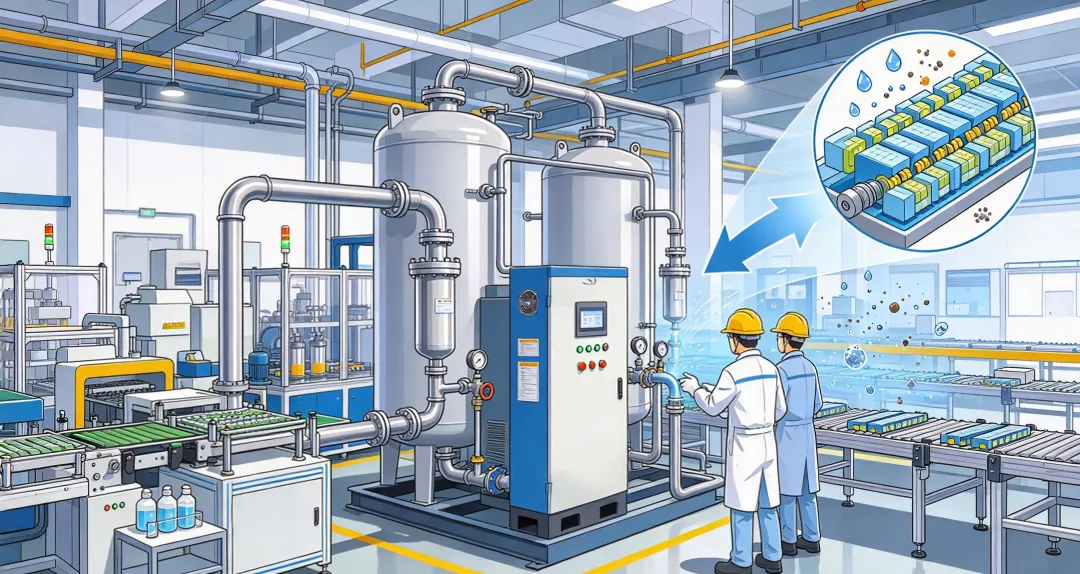
In electronics and precision manufacturing, moisture control can be important for sensitive production equipment and processes.
In pharmaceutical and biopharmaceutical manufacturing, compressed-air treatment should be engineered according to the actual process air-quality requirement.
For petrochemical and chemical processing, dry compressed air can be required for instrumentation, automation, and process-support applications.
Low-dew-point adsorption dryers are also used in semiconductor manufacturing, energy storage, photovoltaic production, metallurgy, food processing, new-energy manufacturing, and other industrial sectors.
The correct pressure dew point and filtration level should always be determined by the specific process rather than by industry name alone.
How to Choose the Right Desiccant Air Dryer System
Selection should begin with the process requirement rather than the dryer model.
Important factors include:
- Required pressure dew point: Determine whether −20°C or −40°C is actually required.
- Maximum airflow: Size the dryer according to realistic peak flow and operating conditions.
- Operating pressure: Actual dryer capacity depends on pressure as well as nominal flow.
- Inlet temperature: Higher inlet temperatures can increase the moisture load entering the adsorption system.
- Regeneration method: Compare heatless, heated-purge, blower-heated, zero-purge, and HOC systems according to lifecycle cost.
- Purge-air consumption: Compressed-air loss can represent a significant energy cost in large systems.
- Pressure drop: Excessive restriction increases the energy required to maintain downstream pressure.
- Filtration: Protect the desiccant upstream and control downstream particulate contamination.
- Controls: Large systems may benefit from time-based, dew-point-based, remote, or intelligent operating modes.
- Maintenance: Evaluate valve reliability, desiccant condition, filters, heaters, blowers, silencers, and other regeneration components.
For further sizing considerations, buyers can review the desiccant air dryer sizing guide.
Energy Consumption and Lifecycle Cost
The lowest purchase price does not necessarily produce the lowest operating cost.
A heatless dryer has a relatively simple regeneration system but consumes more dry compressed air for regeneration. Lingyu’s HH Series specifies 8–14% average purge-air consumption.
A CH heated-purge configuration reduces average purge-air consumption to 4–8%.
The HRB-E low-purge blower-heated system reduces regeneration air consumption further to 2–3%, while the HRB-Z zero-purge blower-heated configuration is specified at approximately 0%.
These figures illustrate why dryer selection should consider annual operating hours, compressed-air energy cost, electrical consumption, maintenance, and actual load profile in addition to purchase price.
In one large installation, eight customized 220 m³/min low-purge blower-heated regenerative adsorption dryers were configured for ≤−40°C pressure dew point and ≤3% regeneration air consumption. The project achieved approximately 8% energy savings compared with conventional heated-purge dryers under its specific operating conditions.
This is a project-specific result and should not be treated as a universal savings guarantee.
Controls and Monitoring
Modern adsorption dryers can use intelligent control to improve efficiency and operating visibility.
Selected Lingyu blower-heated and HOC systems support RS-485 communication, optional IoT connectivity, touchscreen operation, and dew-point-based control.
Under fluctuating loads, optional dew-point-based control can extend the adsorption cycle according to actual demand instead of initiating regeneration solely according to a fixed timer.
This can reduce unnecessary regeneration when moisture loading is below the design maximum.
The value of these controls becomes particularly important in large systems where purge-air consumption, heating energy, blower operation, and regeneration frequency contribute significantly to lifecycle cost.
Conclusion
A desiccant air dryer system is an important compressed-air treatment solution when a facility requires pressure dew points lower than those normally provided by refrigerated drying.
The technology works by adsorbing water vapor onto desiccant and then regenerating that desiccant through dry purge air, external heating, ambient blower air, compressor heat, or a combination of these methods.
Heatless dryers offer relatively simple operation, while heated-purge, blower-heated, zero-purge, modular, and heat-of-compression systems provide different balances of energy consumption, purge-air loss, system complexity, installation requirements, and control capability.
The right choice should be based on required pressure dew point, airflow, inlet temperature, operating pressure, regeneration energy, purge-air consumption, filtration, pressure drop, controls, maintenance, and lifecycle cost.
Rather than specifying the lowest possible dew point by default, industrial users should select the drying technology and regeneration method that meet the actual process requirement with an appropriate balance of performance, reliability, and operating efficiency.
For projects with specific flow, pressure, inlet-temperature, or pressure-dew-point requirements, users can contact Lingyu for dryer selection based on actual operating conditions.