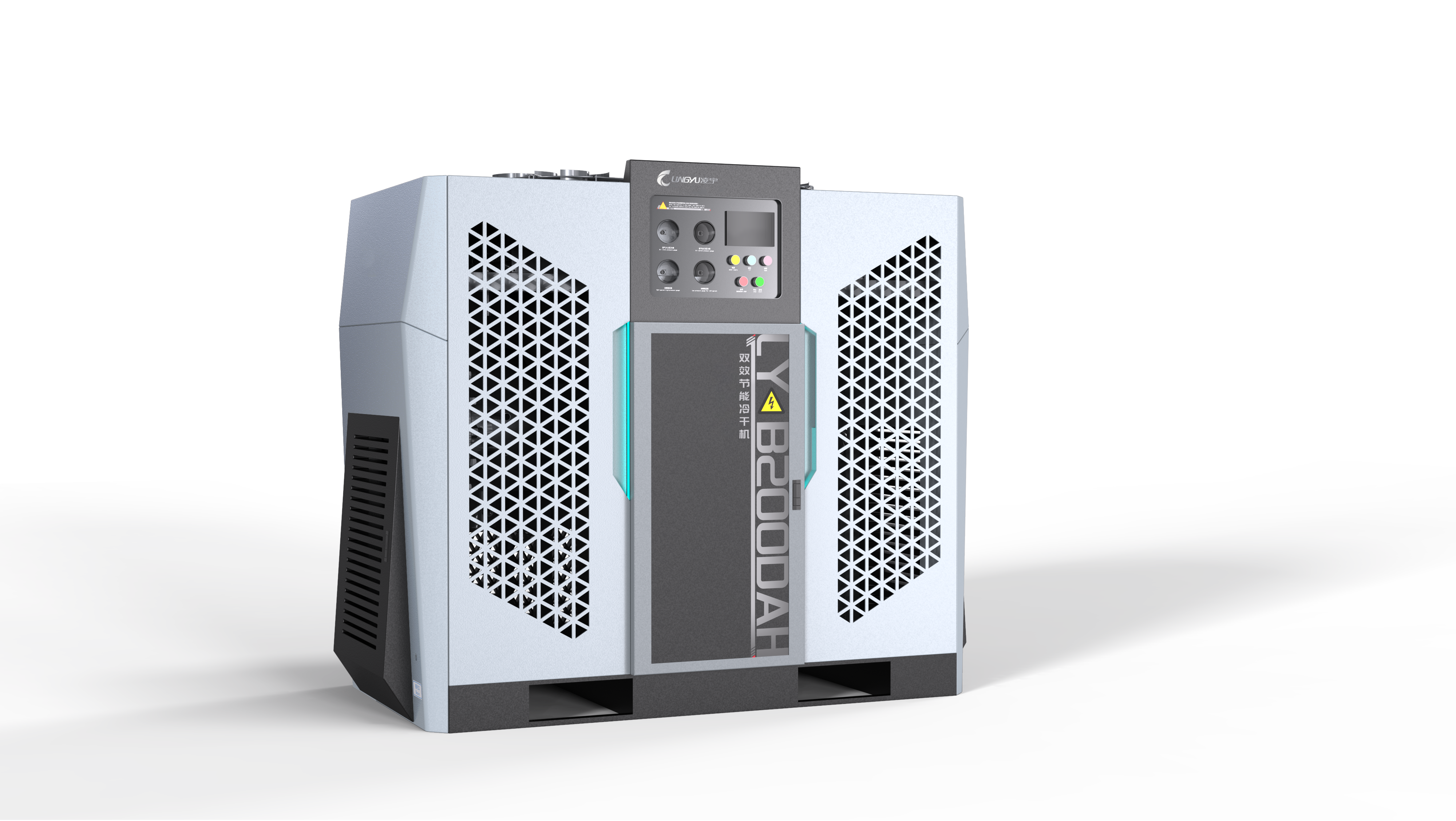
The PB Series Dual-Effect Energy-Saving Variable-Frequency Refrigerated Air Dryer is designed for compressed-air systems where air demand changes during production and refrigeration capacity needs to follow those changes efficiently.
Rather than operating the refrigeration compressor at a fixed output regardless of actual load, the PB Series automatically adjusts compressor speed according to compressed-air treatment demand.
The system combines a pre-cooler, high-performance 3-in-1 plate heat exchanger, variable-frequency refrigeration compressor, intelligent control system, and real-time monitoring to maintain stable drying performance while reducing unnecessary energy consumption.
For users comparing other refrigerated dryer technologies, Lingyu’s refrigerated air dryer range includes additional configurations for different operating priorities.
How the PB Series Variable-Frequency Dryer Works
Compressed air first enters the pre-cooler for initial temperature reduction.
It then passes through the pre-cooling and reheating section of the high-performance 3-in-1 plate heat exchanger, where additional heat is transferred from the incoming compressed air.
The pre-cooled air subsequently enters the evaporator section and is rapidly cooled. As the air temperature falls, moisture condenses and is separated from the compressed-air stream.
The treated low-temperature air then returns through the pre-cooling/reheating heat exchanger and exchanges heat with the hotter incoming air. This reheats the dried compressed air before discharge while simultaneously reducing the cooling load on the incoming air.
The key difference is that the refrigeration system does not simply operate at one fixed output. Compressor speed is continuously adjusted according to system load, allowing refrigeration capacity to follow actual compressed-air demand.
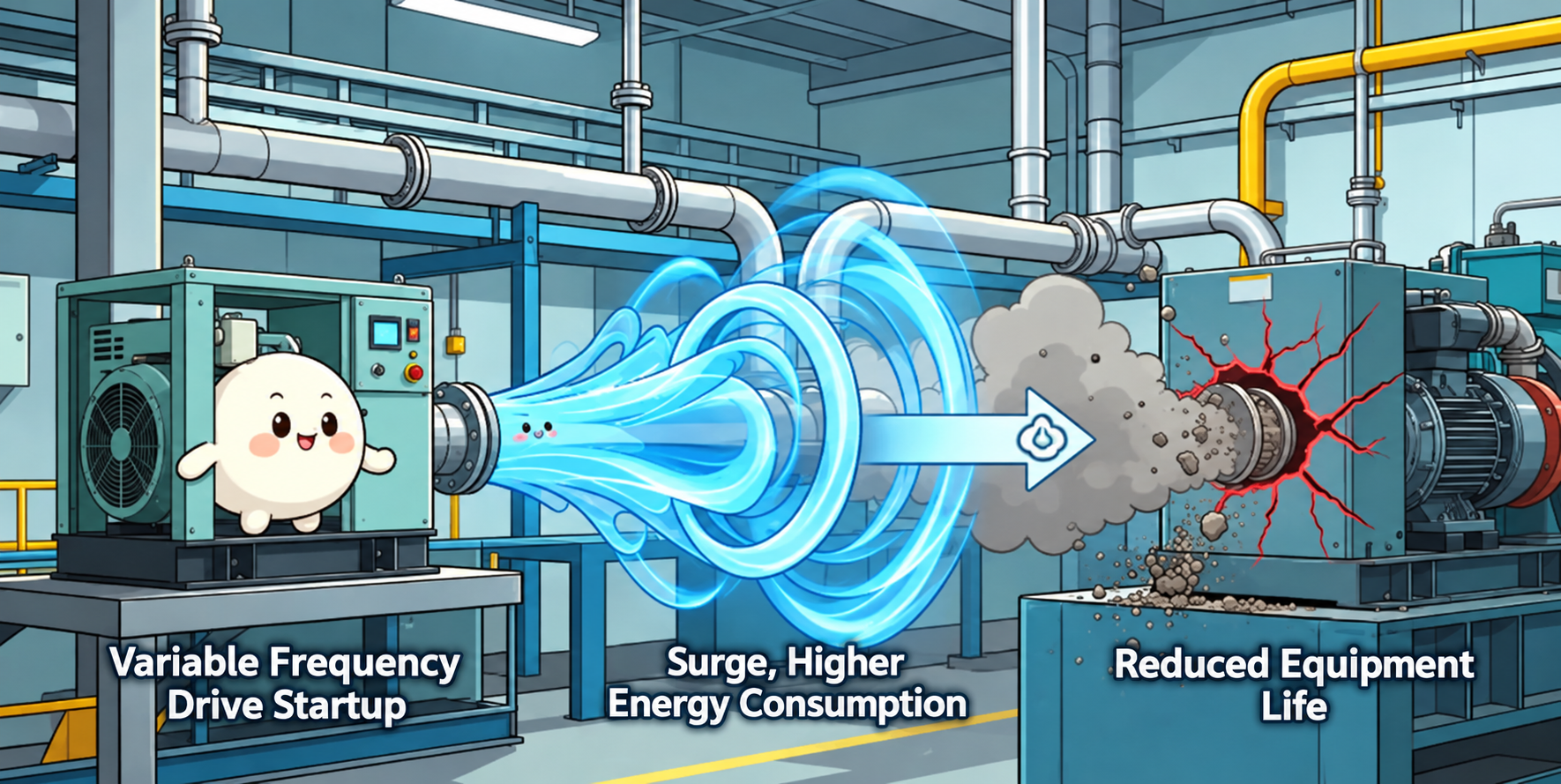
Why Variable-Frequency Control Matters
Compressed-air demand in many industrial facilities is not constant.
Production shifts, equipment sequencing, process cycles, and intermittent pneumatic demand can all cause airflow to change throughout the day.
In a fixed-speed refrigeration system, refrigeration capacity may remain higher than necessary during reduced-load conditions. The PB Series addresses this by automatically regulating operating frequency according to actual air-treatment demand.
When load decreases, refrigeration output can be reduced. When demand increases, compressor frequency can rise accordingly.
This allows the refrigeration system to better match actual operating requirements while maintaining the required dew-point performance.
Pre-Cooler Design
The PB Series uses a dedicated pre-cooler to reduce the temperature of relatively hot compressed air before it reaches the main refrigeration section.
The pre-cooler uses an aluminum-alloy plate-fin heat exchanger, providing high thermal conductivity, efficient heat transfer, and a relatively compact structure.
Pre-cooling is particularly important because reducing inlet-air temperature before the evaporator lowers the refrigeration load that the compressor must handle.
High-Performance 3-in-1 Plate Heat Exchanger
The PB Series also incorporates a specially engineered 3-in-1 plate heat exchanger.
Its heat-transfer area is more than 30% greater than conventional 3-in-1 plate heat exchangers of the same airflow capacity, while maintaining relatively low pressure drop.
The increased effective heat-transfer area supports better pre-cooling of incoming compressed air, efficient evaporation and moisture condensation, reheating of treated compressed air, reduced refrigeration load, and stable operation under changing airflow conditions.
This feature helps distinguish the PB Series from a conventional fixed-speed refrigerated dryer.
Standard Operating Conditions
The PB Series operates under the following conditions:
| Parameter | Specification |
|---|---|
| Applicable medium | Compressed air / non-corrosive air |
| Inlet temperature | ≤60°C |
| Pressure dew point | 2–8°C |
| Operating pressure | 0.6–1.0 MPa |
| Ambient temperature | ≤42°C |
| Temporary higher ambient operation | Above 42°C and below 45°C without shutdown |
| Pressure drop | ≤0.13 bar |
| Energy consumption | 0.08–0.18 kWh/m³ under stated conditions |
The specified 0.08–0.18 kWh/m³ energy-consumption range applies under 35–60°C inlet temperatures and 30–42°C ambient temperatures.
Actual energy performance should therefore be evaluated under the project’s operating conditions rather than treating this range as universal for every load and environment.
Pressure Dew Point: 2–8°C
The PB Series is designed to provide a pressure dew point of 2–8°C under the stated operating conditions.
This is suitable for many industrial compressed-air systems where the main objective is preventing liquid-water condensation and protecting downstream pneumatic equipment.
It should not be confused with adsorption drying systems designed for negative pressure dew points such as −20°C or −40°C.
The required dew point should therefore be established from the actual process requirement before choosing the dryer technology.
Variable-Frequency Control System
The PB control system is designed specifically for variable-frequency refrigeration operation.
It provides high control accuracy, fast response, real-time operating monitoring, and standard RS-485 communication.
Monitored parameters include compressed-air inlet and outlet temperatures, pressure dew point, compressed-air pressure, evaporation temperature, condensing temperature, suction temperature, evaporation pressure, condensing pressure, and refrigerant discharge temperature.
For centralized compressed-air stations, these monitoring capabilities can support integration with compatible plant-level operating and monitoring systems.
Variable-Frequency Compressor
The PB Series uses Mitsubishi permanent-magnet DC inverter compressors across the series.
These compressors are designed for smooth operation across a wide frequency range and relatively low noise. The internal rotor also uses an anti-wear treatment to support stable output during high-speed operation.
The main significance of the inverter compressor is its ability to vary refrigeration output instead of repeatedly operating at one fixed capacity.
That capability is central to the PB Series energy-saving strategy.
PB Series Normal-Temperature Models
Normal-temperature air-cooled and water-cooled PB configurations cover 13.5 to 120 m³/min.
| Model | Airflow | Input Power | Connection | Weight | Dimensions |
|---|---|---|---|---|---|
| LY-PB100AN/WN | 13.5 m³/min | 1.1–3.5 kW | DN65 | 220/230 kg | 1250×800×1400 mm |
| LY-PB120AN/WN | 17.5 m³/min | 1.25–4.2 kW | DN65 | 245/255 kg | 1400×800×1600 mm |
| LY-PB150AN/WN | 22.0 m³/min | 1.4–5.1 kW | DN80 | 255/265 kg | 1400×800×1600 mm |
| LY-PB200AN/WN | 28.5 m³/min | 1.5–5.8 kW | DN80 | 280/280 kg | 1500×950×1600 mm |
| LY-PB400AN/WN | 45.0 m³/min | 2.5–9.2 kW | DN100 | 380/390 kg | 1750×1050×1825 mm |
| LY-PB600AN/WN | 65.0 m³/min | 3.5–11.8 kW | DN125 | 480/490 kg | 2100×1050×2000 mm |
| LY-PB800AN/WN | 85.0 m³/min | 4.2–15.8 kW | DN125 | 610/620 kg | 2200×1200×2180 mm |
| LY-PB1000AN/WN | 100.0 m³/min | 6.2–21.5 kW | DN150 | 750/770 kg | 2400×1400×2410 mm |
| LY-PB1200AN/WN | 120.0 m³/min | 7.0–24.5 kW | DN150 | 810/850 kg | 2400×1400×2410 mm |
For product-level information, users can review Lingyu’s frequency conversion refrigerated air dryer page.
High-Temperature PB Series Models
The PB Series also provides a separate air-cooled configuration for higher inlet-temperature applications.
| Model | Airflow | Input Power | Connection | Weight |
|---|---|---|---|---|
| LY-PB200AH | 28.5 m³/min | 1.5–5.8 kW | DN80 | 310 kg |
| LY-PB300AH | 37.0 m³/min | 2.1–7.8 kW | DN100 | 420 kg |
| LY-PB400AH | 45.0 m³/min | 2.5–9.2 kW | DN100 | 460 kg |
| LY-PB600AH | 65.0 m³/min | 3.5–11.8 kW | DN125 | 585 kg |
| LY-PB800AH | 85.0 m³/min | 4.2–15.8 kW | DN125 | 720 kg |
| LY-PB1000AH | 100.0 m³/min | 6.2–21.5 kW | DN150 | 855 kg |
| LY-PB1200AH | 120.0 m³/min | 7.0–24.5 kW | DN150 | 925 kg |
For capacities above 120 m³/min, or projects with special specifications, materials, or operating temperatures, the configuration should be technically confirmed separately.
Why the Input-Power Range Matters
Unlike a conventional dryer whose specification may show one nominal compressor power, PB Series models provide an input-power range.
For example, the LY-PB400 is specified at approximately 2.5–9.2 kW, while the LY-PB800 is approximately 4.2–15.8 kW, depending on configuration and operating demand.
This illustrates the main logic of variable-frequency operation: the dryer does not necessarily need to run continuously at maximum refrigeration power when compressed-air load is lower.
For facilities with significant load variation, evaluating the operating power range can therefore be more meaningful than looking only at maximum input power.
Where the PB Series Fits Best
The PB Series is particularly relevant to compressed-air systems where air demand changes substantially over time.
Typical operating conditions can include multiple production shifts, intermittent pneumatic equipment, CNC or machining equipment with changing demand, several compressors operating in sequence, production lines with strong peak/off-peak airflow variation, and centralized compressed-air stations.
For metal-processing facilities with variable compressed-air demand, Lingyu’s metal fabrication and laser cutting application page provides industry-specific application information.
Filtration Still Needs to Be Considered
The PB Series removes moisture by refrigeration and condensation, but a complete compressed-air treatment system may also need dedicated filtration for oil aerosols and solid particles.
Appropriate precision compressed-air filters can therefore be installed according to the required air-quality level.
The dryer and filters should be treated as separate but complementary components of the complete purification system.
When Does Variable Frequency Provide the Most Value?
Variable-frequency operation is most relevant when system load changes materially over time.
If a compressed-air system operates continuously near one stable design airflow, the economic benefit of variable-frequency refrigeration may differ from that of a plant whose airflow repeatedly shifts between low and high load.
When evaluating a PB Series dryer, the load profile should therefore include minimum airflow, normal operating airflow, peak airflow, operating hours, frequency of load variation, inlet temperature, ambient temperature, required pressure dew point, and compressor-station control strategy.
This provides a better basis for evaluating energy performance than simply comparing rated power values.
PB Series vs. Other Refrigerated Dryer Designs
The PB Series has a distinct role within the refrigerated dryer range.
The AH Series is primarily positioned around high inlet-temperature capability and conventional industrial refrigeration. The PD Series emphasizes the integrated 3-in-1 plate heat exchanger and reduced energy consumption. The DD Series is specifically optimized around ultra-low system pressure drop.
The PB Series combines heat-exchange optimization with variable-frequency refrigeration capacity control.
Keeping these product roles separate makes it easier to select a dryer according to the actual operating priority rather than treating all refrigerated dryer technologies as interchangeable.
Maintenance and Monitoring
Because the PB Series continuously adjusts refrigeration operation according to load, routine maintenance should focus on both refrigeration components and monitoring accuracy.
Important areas include the pre-cooler, 3-in-1 heat exchanger, condenser, refrigeration compressor, drainage system, temperature and pressure sensors, and controller.
Abnormal temperature or pressure readings should not be ignored because these signals are used by the control system to determine operating conditions.
Maintaining clean heat-transfer surfaces is also important for preserving refrigeration efficiency and stable dew-point performance.
Information to Prepare Before Selection
Before requesting a PB Series configuration, prepare the minimum, normal, and maximum airflow; inlet temperature; operating pressure; ambient temperature; required pressure dew point; preferred cooling configuration; daily operating hours; and expected load variation.
Load profile is especially important for this series because the purpose of frequency conversion is to match refrigeration output to changing treatment demand.
For capacities above the standard 120 m³/min range or non-standard operating conditions, a customized technical configuration should be evaluated.
Conclusion
The PB Series Dual-Effect Energy-Saving Variable-Frequency Refrigerated Air Dryer is designed for industrial compressed-air systems where refrigeration demand changes with airflow.
Its key characteristics include a 2–8°C pressure dew point, ≤60°C inlet-air capability, 0.6–1.0 MPa operating pressure, ≤42°C ambient temperature with temporary operation above 42°C and below 45°C without shutdown, ≤0.13 bar pressure drop, 0.08–0.18 kWh/m³ energy consumption under the stated conditions, variable-frequency refrigeration control, Mitsubishi permanent-magnet DC inverter compressors, a high-performance 3-in-1 heat exchanger with more than 30% greater heat-transfer area, and standard RS-485 communication.
The main selection question is therefore not simply how much air the dryer can process, but also how much the airflow varies and whether refrigeration capacity can be matched effectively to that load profile.