In modern metal fabrication, laser cutting is widely used to produce accurate profiles, narrow kerfs, and high-quality cut edges across a range of metals.
For many applications, nitrogen is used as an assist gas to help remove molten material from the kerf while limiting oxidation at the cut surface.
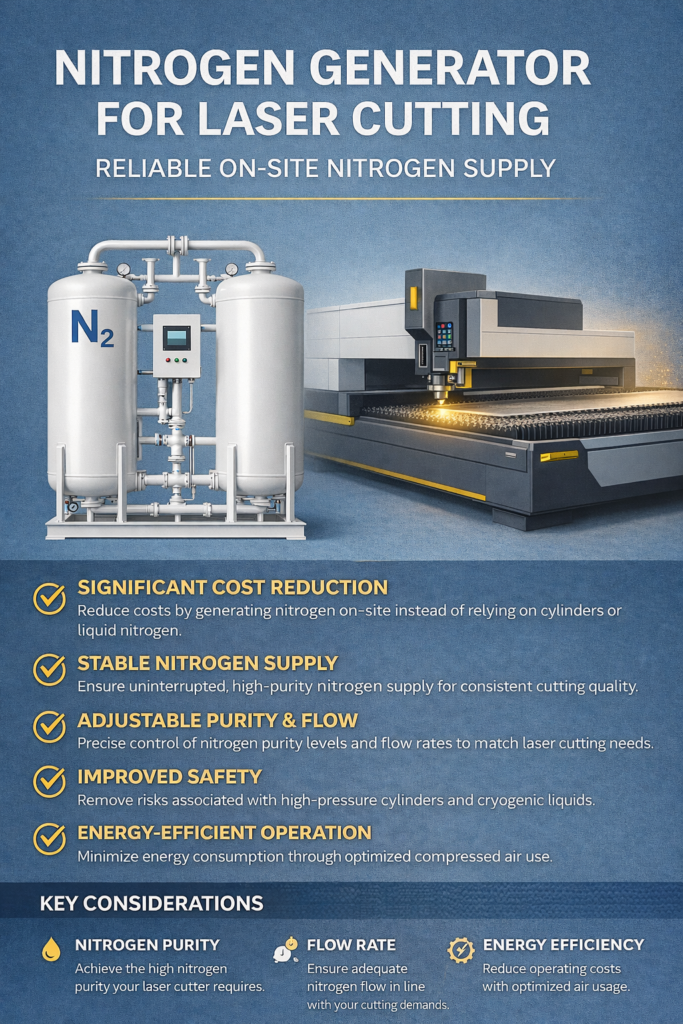
A properly engineered nitrogen generator for laser cutting can provide an on-site source of gaseous nitrogen, reducing dependence on delivered cylinders or bulk liquid nitrogen and giving manufacturers greater control over gas production.
However, an effective laser-cutting nitrogen system involves more than choosing the highest available purity. Nitrogen purity, flow, pressure, storage capacity, compressed-air quality, and the cutting machine’s actual requirements all need to be considered together.
Lingyu provides PSA nitrogen generation systems for different nitrogen purity and capacity requirements, with applications including metal fabrication and laser cutting.
Why Is Nitrogen Used in Laser Cutting?
Nitrogen is commonly used as an assist gas when the cutting process needs to minimize oxidation of the cut surface.
This can be particularly valuable when cutting materials such as stainless steel and certain non-ferrous metals.
Instead of participating in combustion in the way oxygen can, nitrogen primarily provides a relatively non-reactive assist-gas environment while helping eject molten material from the cutting zone.
Depending on the material and cutting parameters, nitrogen can support:
- Cleaner, brighter cut surfaces
- Reduced oxide formation
- Less discoloration
- Lower post-processing requirements
- More consistent downstream welding, coating, or finishing
These results should not be treated as automatic. Edge quality depends on the complete cutting process, including laser power, focal position, nozzle condition, nitrogen purity, gas pressure, flow, material grade, thickness, and machine settings.
How Does a PSA Nitrogen Generator Work?
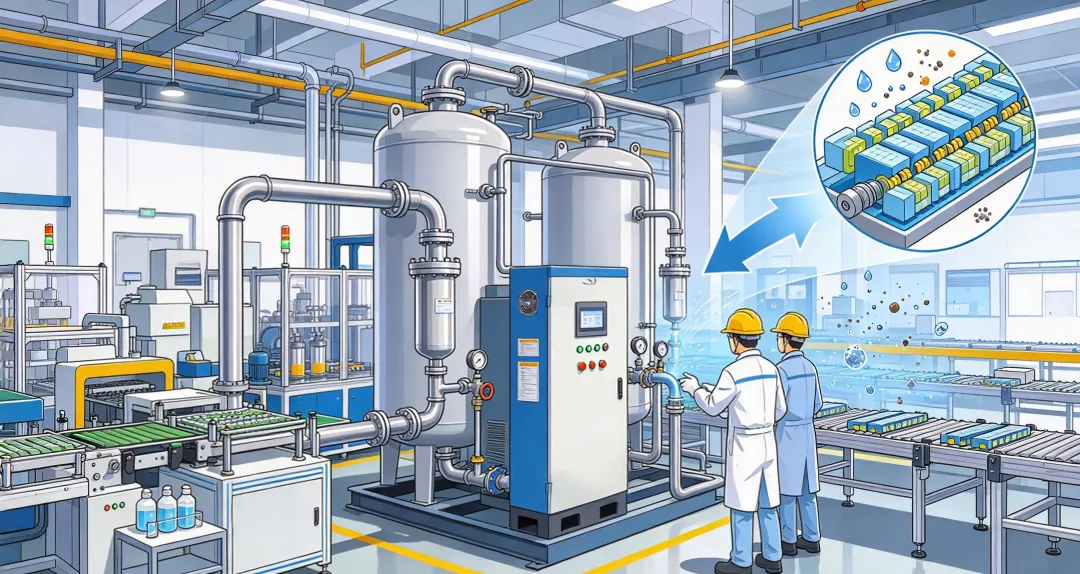
Lingyu’s PSA nitrogen generator uses Pressure Swing Adsorption (PSA) technology to separate nitrogen from compressed air.
The system contains two adsorption towers filled with Carbon Molecular Sieve (CMS).
Compressed air enters one tower, where CMS selectively adsorbs oxygen while nitrogen passes through the adsorption bed and is collected as product gas.
At the same time, the second tower undergoes depressurization and regeneration. The two vessels then switch functions automatically.
A PLC controls this alternating process to maintain continuous nitrogen production.
The operating sequence can be summarized as:
Compressed air treatment → CMS adsorption → nitrogen separation → tower regeneration → pressure equalization/switching → continuous nitrogen supply
For additional technical detail, see how PSA nitrogen generation works with Carbon Molecular Sieve.
What Nitrogen Purity Is Needed for Laser Cutting?
There is no single nitrogen purity that is correct for every laser-cutting application.
The required purity depends on factors such as:
- Material
- Material thickness
- Laser type and power
- Cutting speed
- Nozzle configuration
- Acceptable edge appearance
- Downstream welding, coating, or finishing requirements
Lingyu’s PSA nitrogen generator operates across a 95%–99.999% nitrogen purity range, depending on configuration.
Key operating parameters include:
Nitrogen purity: 95%–99.999%
Inlet compressed-air pressure: 0.5–0.8 MPa
Nitrogen dew point: ≤−40°C
Inlet air temperature: ≤40°C
Ambient temperature: ≤40°C
Switching cycle: 45–60 s
Noise level: ≤75 dB
The system can therefore be configured around different purity requirements rather than treating 99.999% as the only useful target.
Higher nitrogen purity generally requires more demanding separation conditions and can affect nitrogen recovery, feed-air consumption, equipment sizing, and operating cost.
The better approach is to determine the minimum purity that consistently achieves the required cutting result.
Is 99.999% Nitrogen Always Necessary?
No.
Some high-quality cutting processes may require very high-purity nitrogen, but the appropriate purity should come from the laser-machine and process requirements.
Lingyu PSA nitrogen systems support purity grades including:
99.0%
99.5%
99.9%
99.99%
99.999%
Where tighter residual-oxygen requirements are necessary, an additional carbon-based deoxygenation purification stage can further purify approximately 99.9% PSA nitrogen to ≥99.999%.
For this purification system:
Nitrogen capacity: 10–800 m³/h
Nitrogen purity: ≥99.999%
Oxygen content: ≤10 ppm
CO₂ content: ≤5 ppm
Nitrogen atmospheric dew point: ≤−60°C
Pressure drop: ≤0.1 MPa
This additional purification stage should only be considered where the actual cutting specification justifies the higher purity.
Nitrogen Pressure Is Just as Important as Purity
A laser-cutting machine requires nitrogen at a defined pressure and flow at the cutting head.
The PSA generator creates nitrogen, but the pressure associated with nitrogen generation should not automatically be assumed to match the assist-gas pressure required by the laser-cutting machine.
Lingyu’s PSA nitrogen generator uses a feed compressed-air pressure of 0.5–0.8 MPa.
Where the cutting machine requires substantially higher nitrogen delivery pressure, the complete system may require:
PSA nitrogen generator → nitrogen buffer → nitrogen booster/compressor → high-pressure storage → pressure regulation → laser cutting machine
This distinction is essential because PSA nitrogen generation and downstream nitrogen pressurization are separate functions.
The generator produces nitrogen at the required purity and flow. A downstream booster or compressor can then raise the nitrogen pressure where the cutting process requires it.
Nitrogen Flow Must Match Peak Cutting Demand
Nitrogen-generator sizing should be based on actual nitrogen consumption rather than laser power alone.
Gas demand can vary with:
- Nozzle diameter
- Material thickness
- Assist-gas pressure
- Cutting speed
- Machine model
- Cutting recipe
- Number of laser cutters operating simultaneously
The nitrogen generator should therefore be sized around both normal consumption and peak demand.
A buffer tank can help smooth short-term demand fluctuations, but it does not compensate for a nitrogen generator that is chronically undersized.
Where several laser cutters share one nitrogen system, simultaneous peak consumption becomes particularly important.
Feed Compressed-Air Quality Matters
A PSA nitrogen generator depends on compressed air as its feed gas.
This means nitrogen-system performance is directly connected to the quality and stability of the upstream compressed-air system.
A practical system can include:
Air compressor → air receiver → compressed-air dryer → filtration → PSA nitrogen generator → nitrogen buffer/storage
Oil, liquid water, particles, and unstable air pressure can negatively affect CMS performance and overall system reliability.
The nitrogen generator should therefore not be evaluated independently from the compressor and compressed-air purification equipment.
Where additional contaminant control is required, Lingyu’s precision compressed air filter can form part of the feed-air treatment system.
Advantages of On-Site Nitrogen for Laser Cutting
When correctly engineered and sized, an on-site PSA system can provide several operational advantages.
Greater Supply Independence
Producing nitrogen at the facility reduces reliance on scheduled gas deliveries.
This can be valuable for plants with continuous or variable cutting demand, particularly where external supply logistics are inconvenient.
Nitrogen Produced According to Actual Demand
A PSA system can be designed around the plant’s required nitrogen purity and production capacity.
Lingyu PSA systems provide real-time monitoring of nitrogen purity and flow.
If nitrogen purity falls below the setpoint, the system can generate an alarm, while persistent off-spec operation can trigger automatic protection or shutdown.
Reduced Cylinder Handling
Generating nitrogen on-site can reduce the operational burden associated with frequent cylinder deliveries and changeovers.
However, on-site generation does not eliminate gas-related safety requirements.
Nitrogen can create an oxygen-deficiency hazard in inadequately ventilated areas, while boosters, pressure vessels, storage systems, and high-pressure distribution equipment require appropriate engineering and operating procedures.
Potential Lifecycle Cost Benefits
On-site generation can reduce spending on delivered nitrogen where consumption is sufficiently high.
Savings should not be assumed automatically.
The economic result depends on:
Local nitrogen price + electricity cost + compressor efficiency + purity + flow + delivery pressure + operating hours + maintenance + booster energy + capital cost
The appropriate comparison is therefore total lifecycle cost, not simply cylinder price versus nitrogen-generator purchase price.
Purity and Energy Consumption Are Connected
A PSA generator does not produce every purity level at exactly the same efficiency.
Higher purity requires more stringent oxygen separation and can affect nitrogen recovery and feed compressed-air requirements.
For laser cutting, this creates an important optimization opportunity.
If acceptable edge quality can consistently be achieved at a lower nitrogen purity for a particular material and cutting recipe, operating at unnecessarily high purity can increase energy consumption without providing a useful production benefit.
The nitrogen system should therefore be designed around actual cutting recipes rather than automatically applying one maximum-purity setting to every job.
For broader sizing guidance, see Lingyu’s PSA nitrogen generator selection guide.
What Should a Complete Laser-Cutting Nitrogen System Include?
A practical on-site nitrogen system can contain several stages.
1. Compressed-Air Generation and Treatment
The compressor, receiver, dryer, drains, and filtration prepare suitable feed air for the PSA generator.
2. PSA Nitrogen Generation
Carbon Molecular Sieve separates nitrogen from oxygen through alternating adsorption and regeneration cycles.
3. Nitrogen Quality Monitoring
An analyzer monitors product-gas purity so that off-spec nitrogen can be identified.
4. Nitrogen Buffer Storage
Buffer storage helps stabilize PSA operation and accommodate production-demand fluctuations.
5. Pressure Boosting Where Required
A downstream nitrogen booster raises the gas to the delivery pressure required by the laser-cutting equipment.
6. High-Pressure Storage Where Required
Properly engineered high-pressure storage can help accommodate short periods of high gas demand.
7. Pressure and Flow Control
Appropriate regulation supplies the cutting machine within its required operating pressure and flow range.
This complete-system perspective is more useful than asking only, “What size nitrogen generator do I need?”
Choosing the Right Nitrogen Generator for Laser Cutting
Before selecting a system, obtain actual operating data from the laser-cutting machine and production schedule.
The most important values include:
- Required nitrogen purity
- Nitrogen consumption for different cutting recipes
- Required delivery pressure
- Normal gas consumption
- Peak simultaneous demand
- Daily and annual operating hours
- Material mix
- Material thickness range
- Existing compressor capacity
- Available compressed-air quality
- Required buffer capacity
- Booster requirements
The generator should then be evaluated together with the required dryer, filtration, buffer tank, booster, storage, and pressure-control system.
For broader equipment sizing, Lingyu’s nitrogen generator specification guide provides additional selection guidance.
Stainless Steel Laser Cutting
Nitrogen is frequently considered for stainless-steel laser cutting where minimizing oxidation and maintaining a clean cut surface are important.
However, required nitrogen purity, pressure, and flow vary with material thickness, laser parameters, and machine configuration.
Nitrogen should therefore be described as supporting oxidation-controlled cutting, rather than assuming that one fixed purity automatically produces the same bright-edge result on every stainless-steel job.
Production trials and laser-machine specifications remain important when optimizing assist-gas settings.
Aluminum and Other Non-Ferrous Metals
Nitrogen can also be used with aluminum and other compatible non-ferrous materials where oxidation control is important.
Again, gas parameters should be selected according to the actual laser process.
Copper and other highly reflective materials introduce additional laser-processing considerations, so assist gas alone does not determine whether a material can be cut successfully.
One generic purity, pressure, or flow recommendation should therefore not be applied indiscriminately to stainless steel, aluminum, copper, and other materials.
Automatic Monitoring Improves Reliability
Stable nitrogen quality is important because a reduction in purity can affect cutting results before the problem is immediately obvious to operators.
Lingyu PSA nitrogen systems provide:
- Real-time nitrogen purity monitoring
- Real-time flow monitoring
- Digital touchscreen display
- Pressure and system-status display
- Low-purity alarm
- Automatic protection for persistent off-spec operation
These functions are particularly useful where laser cutting operates continuously or several machines depend on the same nitrogen supply.
On-Site PSA Nitrogen vs. Liquid Nitrogen
PSA technology produces gaseous nitrogen on-site.
It does not produce liquid nitrogen.
A plant currently using bulk liquid nitrogen can consider replacing some or all of that supply with an on-site gaseous nitrogen system only after comparing:
- Required purity
- Normal and peak flow
- Required assist-gas pressure
- Storage requirements
- Compressor energy
- Nitrogen booster energy
- Available installation space
- Maintenance
- Production reliability
- Delivered nitrogen cost
For high-pressure laser cutting in particular, the energy required for downstream nitrogen compression should be included in the comparison.
The economics are therefore more nuanced than simply assuming that PSA nitrogen will always cost less than delivered liquid nitrogen.
Conclusion
A nitrogen generator for laser cutting can provide a reliable on-site gaseous nitrogen source for metal-fabrication operations seeking greater control over gas supply and reduced dependence on delivered nitrogen.
Lingyu PSA technology uses Carbon Molecular Sieve and alternating adsorption towers to continuously produce nitrogen, with available purity grades from 95% to 99.999% and real-time monitoring of nitrogen purity and flow.
For laser cutting, however, the best system is not automatically the generator with the highest purity.
Nitrogen purity, flow, delivery pressure, buffer capacity, booster requirements, compressed-air quality, material type, thickness, laser parameters, and operating cost must be evaluated together.
Where higher assist-gas pressure is required, the PSA generator forms the nitrogen-production stage of a larger system that may also require downstream compression and storage.
By engineering the complete nitrogen supply around actual cutting demand, manufacturers can achieve a more stable gas supply while balancing cut quality, energy consumption, operating cost, and production reliability.