A Pressure Swing Adsorption nitrogen generator, commonly called a PSA nitrogen generator, produces nitrogen on-site from compressed air by separating oxygen through a controlled adsorption and regeneration cycle.
For industrial users, the main advantage is the ability to generate nitrogen according to the required flow and purity without relying entirely on an externally supplied nitrogen source.
Lingyu’s PSA nitrogen generator range uses twin adsorption towers filled with Carbon Molecular Sieve (CMS), automatic PLC control, online nitrogen monitoring, and selectable purity levels for different industrial requirements.
Users evaluating an on-site system can start with Lingyu’s nitrogen generator product page.
What Is a Pressure Swing Adsorption Nitrogen Generator?
A PSA nitrogen generator is an on-site gas-separation system that uses compressed air as its feed source.
The system contains two pressure vessels filled with Carbon Molecular Sieve (CMS).
During operation, CMS preferentially adsorbs oxygen from the compressed air while nitrogen passes through the adsorption bed and is collected as product gas.
The two vessels alternate between adsorption and regeneration so that nitrogen production can continue without interrupting the operating cycle.
Lingyu PSA systems support nitrogen purity from 95% to 99.999%, depending on system configuration and operating requirements.
This makes PSA suitable for applications where nitrogen purity and flow need to be engineered around the actual process.
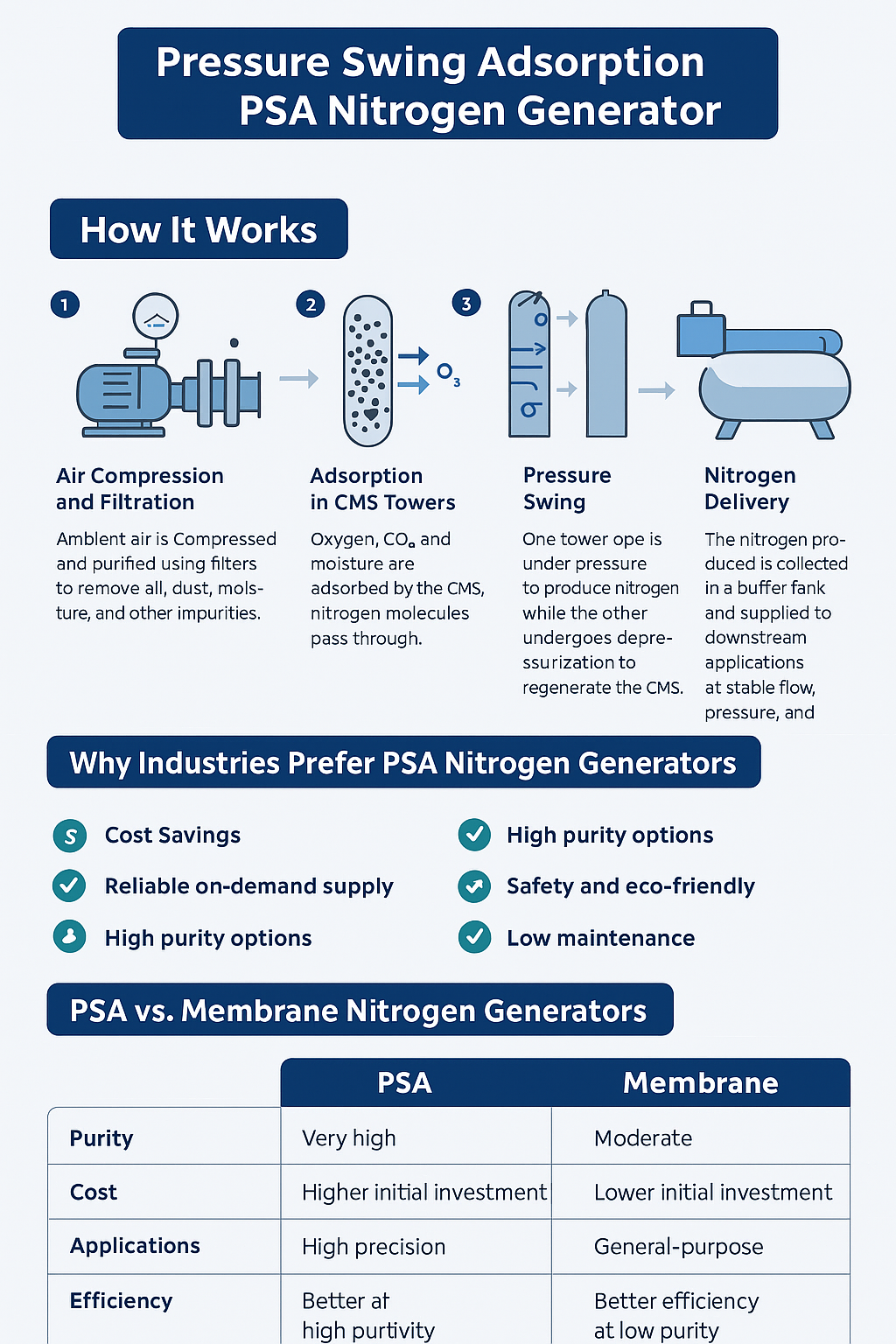
How Does PSA Nitrogen Generation Work?
The PSA process can be divided into several main stages.
1. Compressed Air Preparation
The generator does not operate directly from untreated ambient air.
Ambient air must first be compressed and conditioned before reaching the adsorption towers.
A complete nitrogen-generation system can include an energy-efficient air compressor, air receiver tank, refrigerated air dryer, buffer tank, nitrogen generator, nitrogen buffer tank, pressure-reducing equipment, nitrogen/oxygen analyzer, and outlet controls.
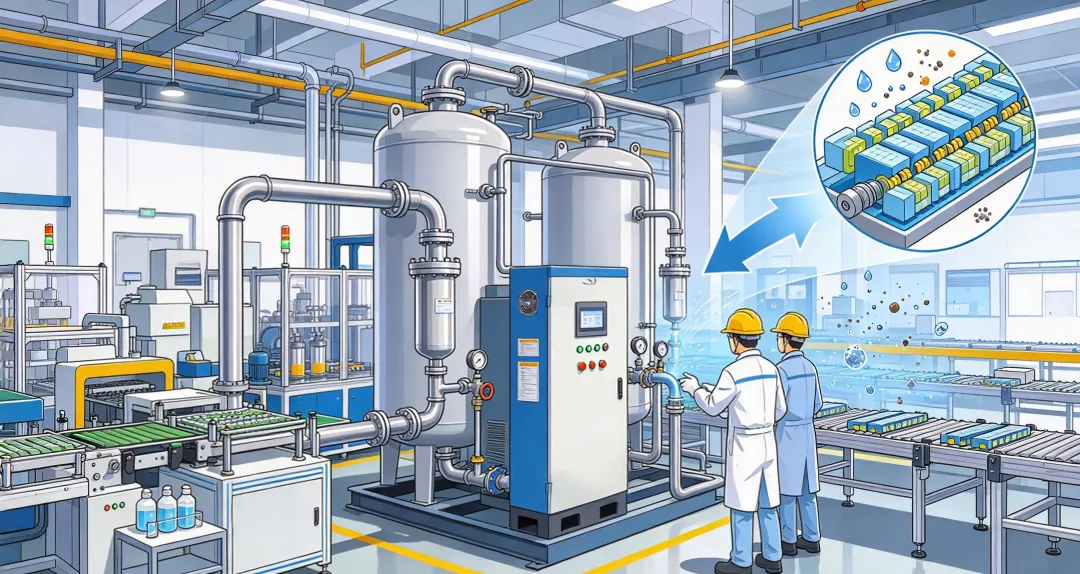
This pretreatment stage matters because compressed air can contain moisture, oil, and particles that should be controlled before the air reaches the CMS bed.
A precision compressed air filter may therefore form part of the upstream treatment system where the required air-quality specification calls for additional oil or particulate control.
2. Adsorption in the CMS Tower
Conditioned compressed air enters one adsorption tower.
The tower is filled with Carbon Molecular Sieve.
Under pressure, oxygen molecules are preferentially adsorbed by the CMS, while nitrogen passes through the bed and becomes the product gas.
The separation principle is therefore based on the selective adsorption characteristics of CMS rather than a simple explanation based only on molecular size.
3. Regeneration by Depressurization
While one tower is producing nitrogen, the other tower regenerates.
The regeneration tower is depressurized, allowing the oxygen previously adsorbed by the CMS to be released.
A small amount of nitrogen purge gas also assists the regeneration process.
Once the producing tower reaches its predetermined adsorption capacity and the second tower has completed regeneration, the system changes operating modes.
4. Automatic Tower Switching
Tower A and Tower B continuously alternate between adsorption and regeneration.
The process is automatically controlled through PLC-operated pneumatic valves.
This allows the system to maintain continuous nitrogen production at the specified purity.
5. Nitrogen Monitoring and Delivery
The generated nitrogen is monitored before it is supplied downstream.
Lingyu’s PSA system provides real-time monitoring of nitrogen purity and flow rate.
If purity falls below the specified value, an alarm is activated. If the off-specification condition continues for a preset period, the system can automatically shut down for protection.
The touchscreen displays operating parameters including pressure, nitrogen purity, flow rate, and system status.
What Nitrogen Purity Can a PSA Generator Produce?
Nitrogen purity should be selected according to the actual application rather than automatically specifying the highest available purity.
Lingyu PSA systems cover a nitrogen purity range of 95%–99.999%.
Standard LYZD-A configurations include:
- 99.0%
- 99.5%
- 99.9%
- 99.99%
Systems for 99.999% nitrogen purity can also be configured according to the required application.
Users requiring a defined high-purity configuration can review the 99.99% nitrogen generator.
The correct purity should balance process requirements, nitrogen recovery, compressed-air demand, and total operating cost.
PSA Operating Conditions
PSA generator performance depends on inlet conditions.
For the applicable Lingyu PSA system:
| Parameter | Specification |
|---|---|
| Inlet air temperature | ≤40°C |
| Inlet air pressure | 0.5–0.8 MPa |
| Nitrogen purity | 95%–99.999% |
| Nitrogen dew point | ≤−40°C |
| Ambient temperature | ≤40°C |
| Switching cycle | 45–60 seconds |
| Noise level | ≤75 dB |
These are product-series operating specifications rather than universal PSA standards.
Actual sizing should therefore consider more than required nitrogen flow alone.
Why Compressed Air Quality Matters
The PSA generator relies on a stable compressed-air supply.
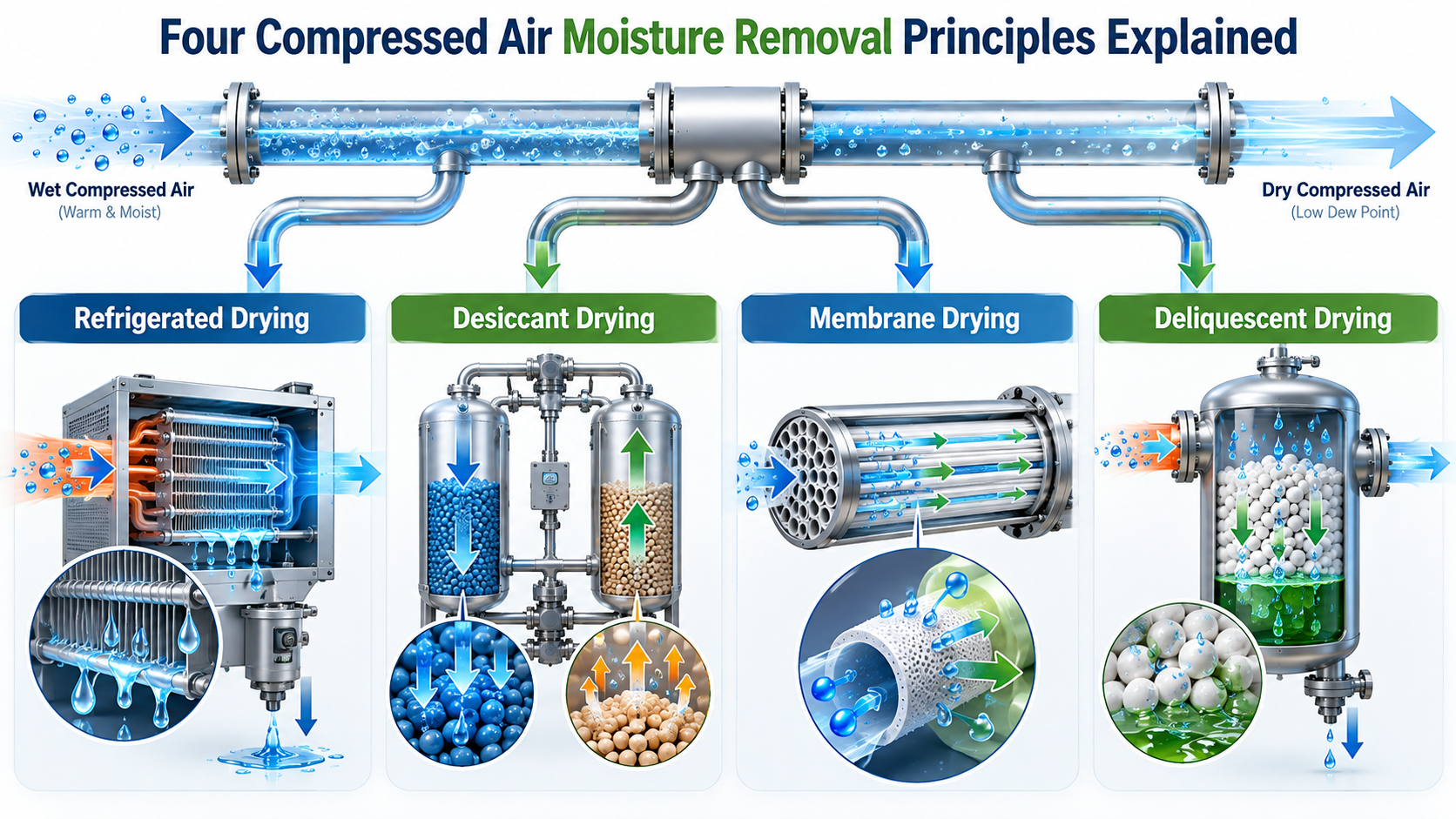
A refrigerated air dryer can be installed upstream of the nitrogen generator to control moisture before the compressed air reaches the adsorption system.
Moisture, oil, and particulate contamination should be considered because feed-air quality can affect overall system performance and CMS condition.
A properly designed nitrogen station should therefore consider the compressor, receiver, dryer, filtration, buffer tanks, PSA generator, analyzers, and downstream control system together.
The refrigerated air dryer category provides relevant upstream compressed-air drying options within the same treatment chain.
Why Industries Use PSA Nitrogen Generators
A key benefit of PSA technology is controlled on-site nitrogen production.
A PSA system automatically cycles between its two towers, monitors nitrogen purity and flow, and supplies nitrogen at the selected specification.
This can reduce dependence on external nitrogen logistics where an on-site generation strategy is technically and economically appropriate.
However, PSA should not automatically be assumed to provide the lowest cost in every installation.
The actual economics depend on compressed-air energy, required purity, nitrogen flow, operating hours, maintenance, equipment investment, and the cost of the alternative nitrogen supply.
For users evaluating these factors, the nitrogen generator cost guide provides additional context.
Automatic Control and Product Protection
Modern PSA generators are more than two adsorption vessels and a set of switching valves.
Lingyu’s PSA system includes automatic start/stop and cycle switching, PLC-controlled pneumatic valves, real-time purity and flow monitoring, off-spec nitrogen alarms, protective shutdown, automatic CMS compaction, touchscreen monitoring, and optimized pressure equalization.
The CMS compaction system is designed to maintain packing density and help reduce pulverization caused by bed movement.
The optimized unequal-pressure equalization process can indirectly reduce overall energy consumption by approximately 5% for the applicable PSA design.
This is a series-specific feature rather than a universal PSA efficiency value.
Industrial Applications of PSA Nitrogen
PSA nitrogen can be configured for a wide range of industrial uses, but purity and flow should be selected for the specific process.
Food and Beverage
Nitrogen may be selected for processes where oxygen displacement or a controlled nitrogen atmosphere is required.
For related applications, users can explore Lingyu’s food and beverage section.
The exact purity needed should be based on the actual packaging, processing, or storage requirement rather than assuming every food application needs 99.999% nitrogen.
Electronics and Semiconductor Manufacturing
Electronics production may require nitrogen for selected controlled-atmosphere or oxygen-sensitive processes.
For this sector, users can review the electronics and precision manufacturing application page.
The appropriate purity depends on the individual process.
Chemical and Petrochemical Processing
Nitrogen may be used where inerting, purging, or oxygen displacement forms part of the process design.
For this sector, the petrochemical and chemical processing application page provides relevant context.
System selection should take into account flow, purity, operating pressure, and any process-specific safety requirements.
Pharmaceutical Production
Nitrogen can support selected pharmaceutical processes that require controlled or low-oxygen atmospheres.
The pharmaceutical and biopharmaceutical application page is relevant for this sector.
A PSA nitrogen generator should not automatically be described as “pharmaceutical compliant” or as producing a sterile environment. Actual system requirements depend on the process, applicable standards, and validation requirements.
Metal Fabrication and Laser Cutting
Nitrogen can also be used in selected metal-processing applications.
Users can review the metal fabrication and laser cutting application page.
The required nitrogen pressure, flow, and purity should be specified according to the cutting process and equipment rather than assumed from industry name alone.
Should You Always Choose 99.999% Nitrogen?
No.
Higher nitrogen purity is not automatically better for every application.
The correct target is the lowest purity that safely and reliably satisfies the actual process specification.
Producing higher purity generally affects nitrogen recovery and the amount of compressed air required, so specifying unnecessarily high purity can increase operating cost.
Lingyu’s 95%–99.999% range gives users flexibility to match the generator to the process rather than applying one purity to every installation.
For selection guidance, users can refer to the PSA nitrogen generator selection guide.
When Is Additional Nitrogen Purification Required?
A standard PSA generator is not the only configuration available for high-purity nitrogen production.
For applications requiring further oxygen reduction, Lingyu offers a Carbon-Based Deoxygenation Purification System.
This system takes nitrogen produced by a PSA generator at approximately 99.9% purity and further purifies it to ≥99.999%. Residual oxygen reacts with a carbon-based catalyst to form CO₂; downstream adsorption purification then removes CO₂ and moisture, followed by precision filtration.
The system supports nitrogen capacity of 10–800 m³/h and final nitrogen purity of ≥99.999%.
This distinction is important because very high-purity nitrogen can involve an additional purification stage rather than treating every application as the same PSA operating point.
How to Select a PSA Nitrogen Generator
A PSA generator should be specified around the application rather than simply choosing the highest-purity machine.
Key selection parameters include required nitrogen purity, required nitrogen flow, delivery pressure, operating hours, inlet compressed-air pressure, inlet temperature, feed-air quality, nitrogen dew point, load variation, monitoring requirements, and future capacity requirements.
Some LYZD-A sizing data use design conditions of 0.8 MPa(g) adsorption pressure, 20°C ambient temperature, and 80% relative humidity of the feed air.
Actual operating conditions should therefore be provided before final model selection rather than relying on nominal flow data alone.
Conclusion
A Pressure Swing Adsorption nitrogen generator produces nitrogen from conditioned compressed air by using Carbon Molecular Sieve to preferentially adsorb oxygen.
Twin adsorption towers alternate between adsorption and depressurization-based regeneration under automatic PLC control, allowing continuous nitrogen production.
Lingyu’s PSA systems support nitrogen purity from 95% to 99.999%, nitrogen dew point of ≤−40°C for the applicable system, real-time purity and flow monitoring, off-spec alarms, touchscreen controls, and automatic operating-cycle management.
For applications requiring further purification, a carbon-based deoxygenation system can upgrade approximately 99.9% PSA nitrogen to ≥99.999%.
The correct PSA system should therefore be selected according to nitrogen purity, flow, pressure, dew point, compressed-air quality, operating conditions, control requirements, and lifecycle economics rather than selecting the highest available purity by default.
For a project-specific configuration, users can contact Lingyu with their required nitrogen purity, flow, pressure, operating schedule, and inlet compressed-air conditions.