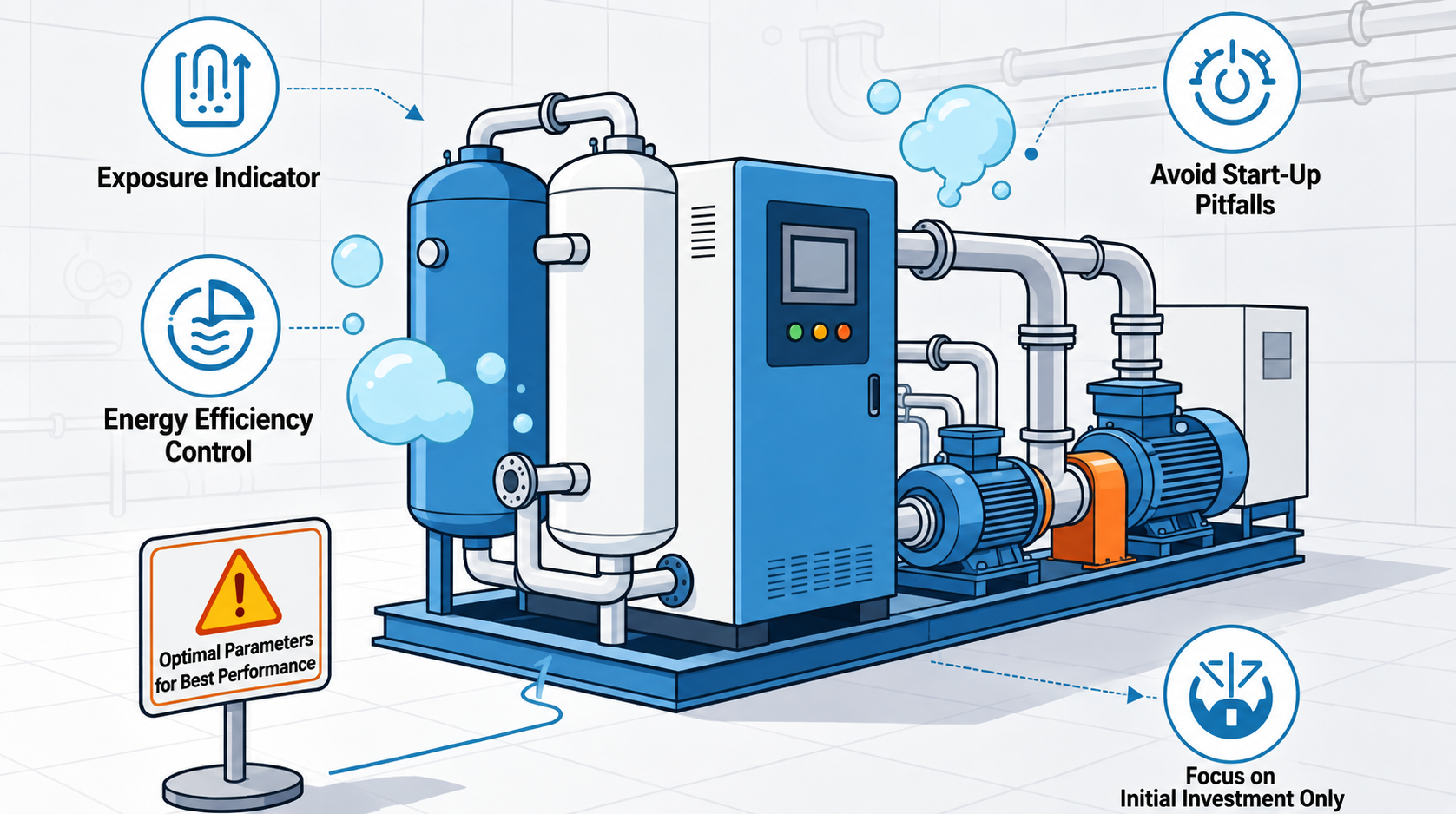
A PSA nitrogen generator with low pressure can cause unstable nitrogen supply, insufficient flow, and interruptions to downstream production. In many cases, however, the nitrogen generator itself is not the first component that should be inspected.
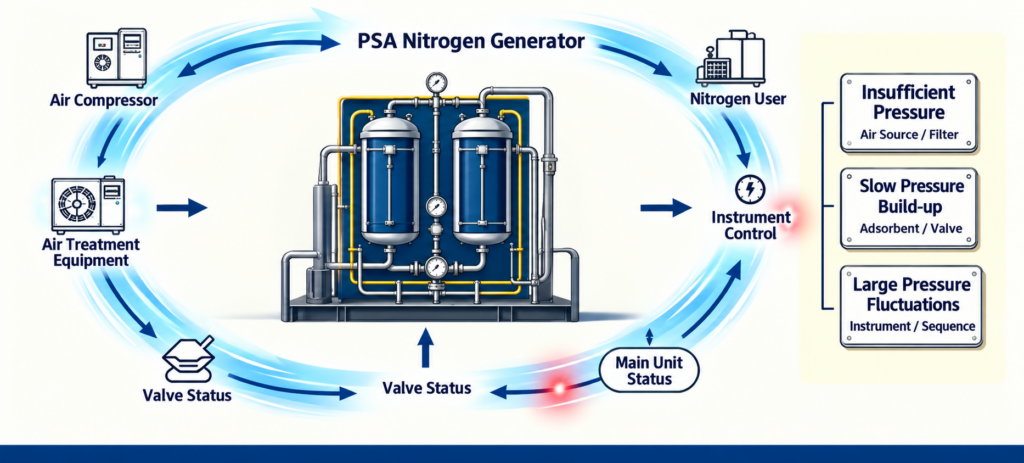
Low nitrogen pressure may originate anywhere from the air compressor and compressed air treatment system to filters, piping, pneumatic valves, adsorption towers, or downstream nitrogen demand.
This guide provides a practical, step-by-step approach to PSA nitrogen generator low-pressure troubleshooting, helping maintenance teams identify the source of insufficient pressure without unnecessarily dismantling the generator.
What Does Low Pressure in a PSA Nitrogen Generator Look Like?
Typical symptoms include:
- Feed-air pressure appears normal, but the adsorption towers pressurize slowly.
- Nitrogen outlet pressure cannot reach the required operating value.
- Nitrogen purity meets the specification, but delivery pressure remains low.
- Pressure repeatedly rises and falls during operation.
- Nitrogen pressure drops significantly when downstream consumption increases.
- The pressure difference between the compressor and nitrogen generator is unusually high.
The most effective troubleshooting sequence is:
Compressed air supply → piping and filters → valves → adsorption towers and CMS → controls and downstream demand
Following this sequence helps technicians eliminate external causes before opening the PSA generator.
Important: Operating pressure is model-specific. Lingyu PSA nitrogen generators typically specify an inlet compressed-air pressure range of 0.5–0.8 MPa. Always confirm the operating requirements of the specific nitrogen generator before changing pressure settings.
Step 1: Check the Compressed Air Supply
A PSA nitrogen generator depends entirely on a stable supply of clean, dry compressed air. If the upstream compressed air system cannot maintain sufficient pressure and flow, the PSA unit cannot build pressure correctly.
Check Air Compressor Discharge Pressure
Measure the pressure directly at the compressor outlet and compare it with the pressure at the PSA generator inlet.
If compressor discharge pressure itself is below the required range, inspect:
- Compressor loading and unloading behavior
- Intake valve operation
- Compressor capacity
- Screw or piston condition
- Pressure-control settings
- Actual plant compressed-air demand
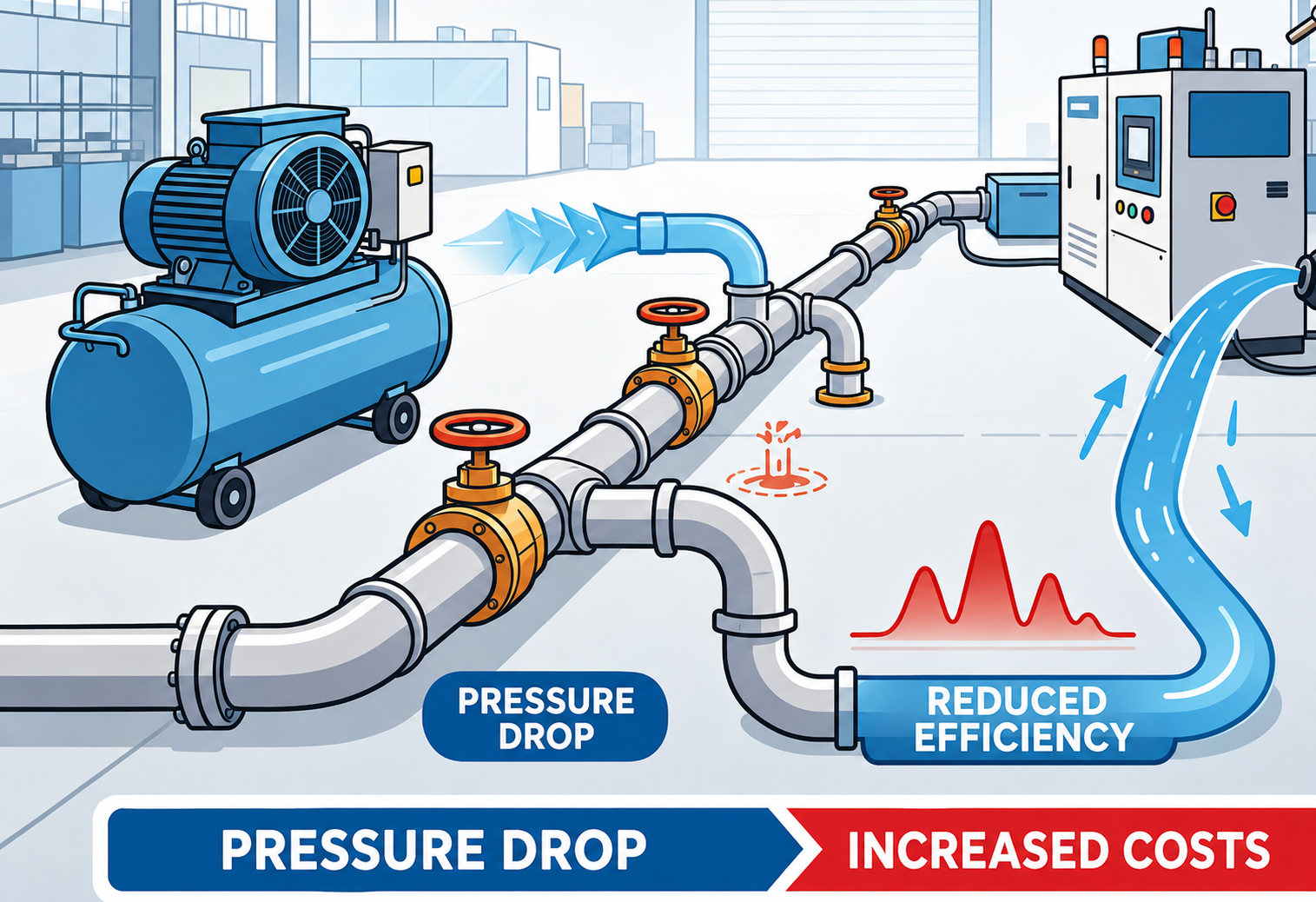
Do not simply increase compressor discharge pressure to compensate for an unidentified pressure loss. Excessive pressure drop between the compressor and point of use can indicate restrictions, undersized piping, dirty filters, dryer problems, or leakage.
For a detailed explanation, see our guide to compressed air pressure drop.
Inspect the Air Receiver and Drains
Check the air receiver, automatic drains, manual drain valves, connections, and fittings for leakage.
A drain valve that fails to close completely can continuously release compressed air and prevent the system from maintaining stable pressure.
After draining condensate, confirm that:
- Drain valves close completely.
- Automatic drains are functioning correctly.
- Receiver connections are leak-free.
- Flanges, welds, and fittings show no signs of leakage.
Verify Air Dryer Operation
Wet compressed air can affect filters, valves, piping, and the long-term performance of the PSA system.
Check the upstream refrigerated or desiccant dryer for abnormal pressure drop, bypass operation, drainage problems, or operating faults.
If you need a broader overview of compressed-air drying technologies, see our compressed air dryer system guide.
Step 2: Inspect Piping and Compressed Air Filters
If compressor pressure is normal, measure pressure at different points between the compressor and PSA nitrogen generator.
A significant pressure difference between two measurement points can help locate the restriction.
Check the System for Air Leaks
Inspect:
- Pipe joints
- Flanges
- Flexible connections
- Valve connections
- Pressure gauge fittings
- PSA inlet and outlet connections
- Air and nitrogen receiver connections
Where permitted by site procedures, an appropriate leak-detection solution can be applied to accessible joints. Continuous bubbling indicates a potential leakage point.
Repair loose fittings and replace damaged or aged seals as required.
For more information on systematic leak inspection, refer to our compressed air leak detection guide.
Measure Filter Differential Pressure
Blocked compressed-air filters can restrict airflow even when compressor discharge pressure appears normal.
Measure pressure immediately upstream and downstream of each filter instead of judging filter condition only by service hours.
Inspect the:
- Pre-filter
- Coalescing filter
- Fine filter
- Activated-carbon filter, where installed
If differential pressure exceeds the filter manufacturer’s specified replacement limit, replace the element.
Lingyu also provides precision compressed air filters for compressed-air pretreatment applications.
Check Pipe Diameter and Valve Position
Restrictions can also result from:
- Undersized piping
- Excessively long pipe runs
- Too many elbows or fittings
- Partially closed ball valves
- Sticking check valves
- Blocked valve internals
Verify that isolation valves are fully open during normal operation and inspect check valves for contamination or mechanical sticking.
Step 3: Inspect the PSA Nitrogen Generator Valve System
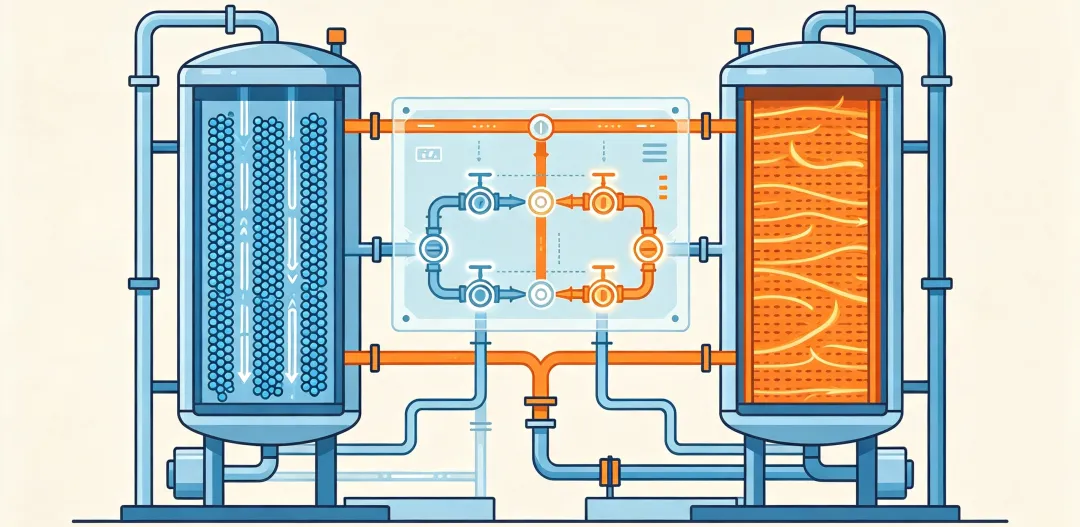
PSA nitrogen generators depend on accurately timed valve operation to alternate between adsorption, regeneration, depressurization, and pressure equalization.
A leaking, sticking, or incorrectly actuated valve can prevent an adsorption tower from reaching the expected pressure.
Check Switching Valve Operation
Observe the generator through several complete PSA cycles.
Look and listen for:
- Uneven switching
- Delayed valve movement
- Continuous exhaust
- Abnormal air leakage
- Valve sticking
- Significant differences between Tower A and Tower B pressure behavior
If a valve fails to seal correctly, inspect the valve seat, actuator, seals, and internal components according to the manufacturer’s maintenance procedure.
Check Solenoid Valves and Pilot Air
Pneumatic valves require reliable pilot-air pressure and correctly functioning solenoid valves.
Inspect:
- Solenoid electrical operation
- Coil condition
- Pilot-air tubing
- Pilot pressure
- Pneumatic actuator response
Do not apply a universal pilot-pressure setting without checking the machine specification. The correct value depends on the installed valve and actuator configuration.
Inspect Pressure-Regulating and Exhaust Components
A regulator that cannot maintain its setting or an exhaust valve that remains partially open can continuously bleed pressure from the system.
Check whether the pressure loss occurs during a particular part of the PSA cycle. This can help distinguish an upstream supply problem from a switching or exhaust-valve problem.
Step 4: Check the Adsorption Towers and Carbon Molecular Sieve
If the compressed-air supply, piping, filters, and valves are operating correctly, the next step is to investigate the adsorption section.
Inspect the Adsorption Towers for Leakage
Check:
- Tower flanges
- Pressure gauge connections
- Instrument fittings
- Valve-to-vessel connections
- Accessible seals and gaskets
Even relatively small leaks can affect pressure recovery when they occur repeatedly during every PSA cycle.
Check the Condition of the Carbon Molecular Sieve
Carbon Molecular Sieve (CMS) is the core separation medium inside a PSA nitrogen generator.
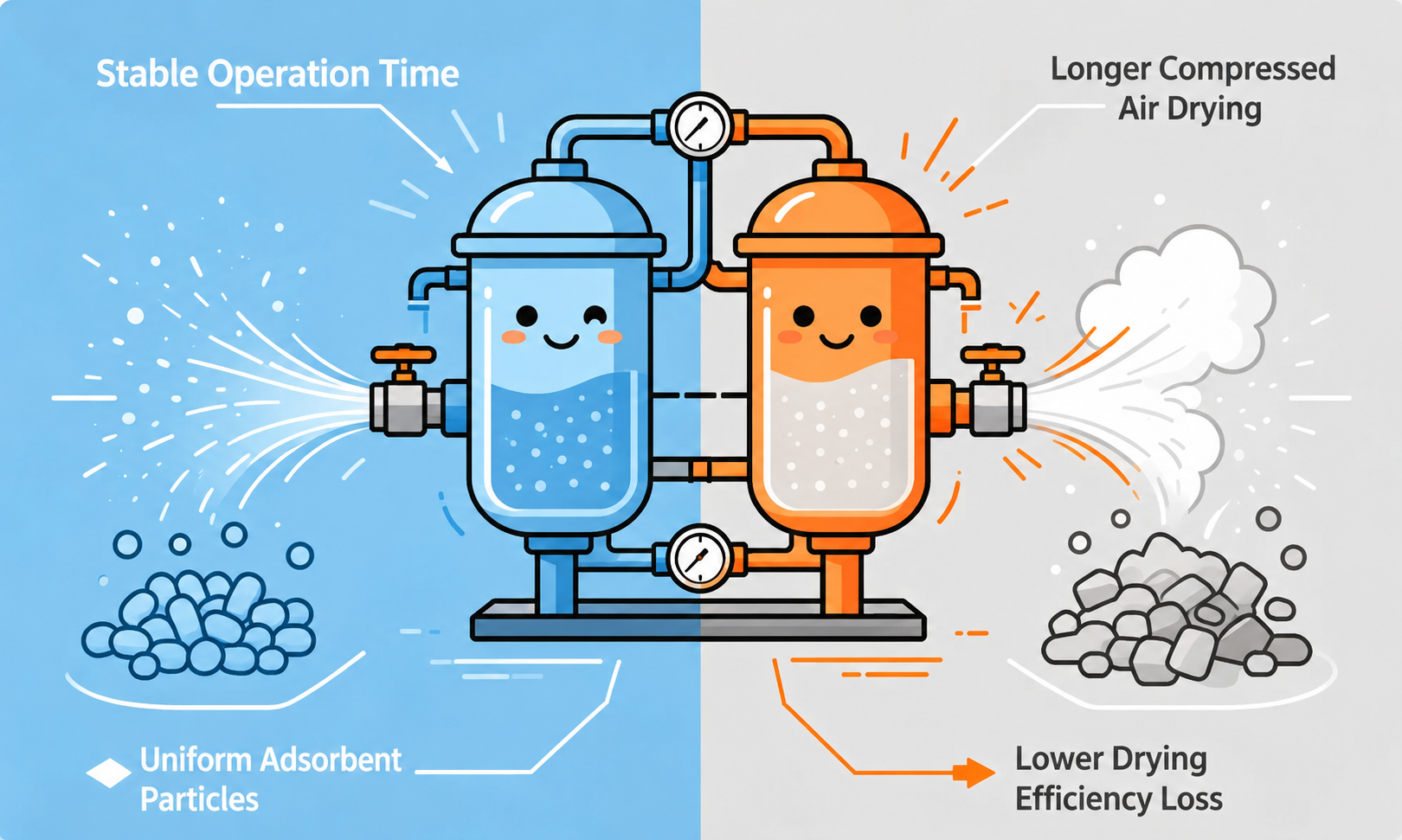
Mechanical degradation, contamination, abnormal bed movement, damaged retaining components, or CMS powdering can affect gas distribution and overall generator performance.
Possible warning signs include:
- CMS dust in downstream or exhaust areas
- Unusual pressure behavior
- Increasing pressure loss
- Unstable nitrogen performance
- Evidence of adsorbent settlement
If CMS powdering is suspected, do not simply add new molecular sieve. The underlying cause should be identified first.
See our dedicated guide to PSA nitrogen generator adsorbent powdering for a more detailed inspection procedure.
Check Pressure Equalization and Regeneration
Pressure equalization is an important part of the PSA cycle.
Abnormal equalization, excessive regeneration loss, incorrect switching, or valve leakage can prevent the next adsorption cycle from starting under the intended conditions.
Compare:
- Tower A pressure profile
- Tower B pressure profile
- Equalization behavior
- Regeneration exhaust
- Switching sequence
against the manufacturer’s specified operating sequence.
Avoid changing adsorption time, regeneration time, or equalization parameters simply to increase pressure. Incorrect PSA timing can affect nitrogen recovery, purity, and CMS service life.
For more background on the adsorption/regeneration process, read how a PSA nitrogen generator works.
Step 5: Check Instrumentation, Controls, and Downstream Nitrogen Demand
If the mechanical system appears normal, determine whether the apparent pressure problem originates from instrumentation, control logic, or excessive nitrogen consumption.
Verify the Pressure Sensor
Compare the electronic pressure reading with a calibrated mechanical pressure gauge or reference instrument.
If the readings differ significantly, inspect or calibrate the pressure transmitter before assuming that the PSA generator has a mechanical pressure problem.
Check Actual Nitrogen Consumption
A PSA nitrogen generator has a defined relationship between:
- Nitrogen purity
- Nitrogen flow
- Feed-air conditions
- Delivery pressure
If downstream nitrogen consumption exceeds the generator’s rated capacity, the nitrogen receiver may be depleted faster than the generator can replenish it.
The result can look exactly like a generator pressure fault.
Measure actual nitrogen demand, especially during peak production.
If peak consumption is significantly higher than average consumption, evaluate:
- Generator capacity
- Simultaneous nitrogen users
- Nitrogen receiver volume
- Peak-demand duration
- Distribution pressure losses
A properly sized nitrogen buffer tank can help stabilize short-duration demand fluctuations, but it should not be used to compensate for a permanently undersized generator.
If system capacity is the underlying problem, our PSA nitrogen generator selection guide explains how purity, flow, pressure, peak demand, and storage capacity should be evaluated together.
Verify PLC Switching Logic
PLC or control-setting problems may cause:
- Incorrect valve sequencing
- Unequal adsorption times
- Incomplete regeneration
- Abnormal equalization
- Premature tower switching
Compare the actual operating sequence with the manufacturer’s approved settings.
Do not modify PSA cycle parameters without understanding how the changes affect purity, nitrogen recovery, CMS loading, and valve operation.
Quick PSA Nitrogen Generator Low-Pressure Troubleshooting Table
| Symptom | Possible Cause | What to Check |
|---|---|---|
| Low pressure at PSA inlet | Compressor or upstream system problem | Compressor output, receiver, dryer, filters |
| Compressor pressure normal but PSA inlet pressure low | Excessive system pressure drop | Piping, filters, valves, leaks |
| Tower pressurizes slowly | Restricted airflow or valve leakage | Filters, switching valves, check valves |
| One tower behaves differently from the other | Valve or tower-specific fault | Valve sequence, seals, tower leakage |
| Pressure fluctuates with PSA switching | Switching/equalization problem | Pneumatic valves, equalization, PLC sequence |
| Pressure falls during peak production | Nitrogen demand exceeds available supply | Flow demand, receiver capacity, generator sizing |
| Display shows low pressure but mechanical gauge is normal | Instrument fault | Pressure transmitter and calibration |
| Abnormal pressure behavior with CMS dust | Adsorbent or internal retaining problem | CMS bed, screens, compaction system |
A Faster Troubleshooting Sequence
When a PSA nitrogen generator cannot maintain pressure, use this order:
1. Measure compressor discharge pressure.
2. Measure pressure at the PSA inlet.
3. Compare pressure before and after dryers and filters.
4. Check the compressed-air system for leaks.
5. Observe both adsorption towers through several switching cycles.
6. Inspect pneumatic and solenoid valve operation.
7. Compare actual nitrogen consumption with rated generator capacity.
8. Investigate CMS and internal tower components only after external causes have been eliminated.
This approach reduces unnecessary disassembly and helps technicians isolate the fault using actual pressure measurements rather than assumptions.
How to Prevent Low-Pressure Problems
Preventive maintenance is usually more effective than troubleshooting after production has already been interrupted.
Recommended practices include:
- Drain air receivers and separators correctly.
- Maintain compressed-air dryers according to their service requirements.
- Monitor filter differential pressure.
- Replace filter elements according to condition and manufacturer recommendations.
- Perform routine compressed-air and nitrogen leak inspections.
- Check pneumatic valves and seals periodically.
- Monitor tower pressure trends instead of relying only on alarms.
- Keep compressed air free from excessive moisture, oil, and particulates.
- Avoid continuously operating the generator above its rated nitrogen flow.
- Investigate unusual CMS dust before adsorbent damage becomes severe.
Feed-air treatment is especially important because moisture, oil, and particulate contamination can affect filters, valves, instrumentation, and the CMS bed.
Frequently Asked Questions
Why is my PSA nitrogen generator pressure too low even though the air compressor pressure is normal?
The pressure may be lost between the compressor and generator because of dirty filters, dryer pressure drop, undersized piping, partially closed valves, check-valve restrictions, or compressed-air leakage. Measure pressure at several points in the system to locate where the drop occurs.
Can a dirty filter cause low nitrogen generator pressure?
Yes. A heavily loaded filter element can restrict compressed-air flow and create a significant pressure drop. Measure differential pressure across the filter and follow the filter manufacturer’s replacement criteria.
Can damaged Carbon Molecular Sieve cause a pressure problem?
CMS deterioration can contribute to abnormal flow and pressure behavior, particularly when powdering, settlement, contamination, or damaged retaining components affect the adsorption bed. However, upstream air supply, filters, piping, and valves should normally be checked first.
Why does nitrogen pressure drop when production demand increases?
The downstream nitrogen demand may exceed the generator’s instantaneous production capacity. Check actual peak flow, nitrogen receiver capacity, distribution pressure loss, and generator sizing.
Should I increase compressor pressure when nitrogen pressure is too low?
Not until the cause has been identified. Raising compressor discharge pressure may increase energy consumption without correcting a dirty filter, restricted pipe, leaking valve, or undersized system.
What inlet pressure does a Lingyu PSA nitrogen generator require?
For Lingyu’s referenced PSA nitrogen generator range, the specified compressed-air inlet pressure is 0.5–0.8 MPa. The exact requirement should always be confirmed for the specific model and operating configuration.
Conclusion
Low pressure in a PSA nitrogen generator does not automatically mean that the adsorption towers or Carbon Molecular Sieve have failed.
A more effective diagnostic approach is to work systematically from the upstream compressed-air supply toward the PSA unit:
Air compressor → receiver and dryer → filters and piping → PSA valves → adsorption towers → controls → downstream nitrogen demand
In many cases, pressure problems can be traced to air-supply limitations, excessive pressure drop, filter restrictions, leakage, valve malfunction, or demand exceeding available capacity.
By monitoring pressure at multiple points, maintaining clean and dry feed air, servicing filters and valves, and matching nitrogen production capacity to actual peak demand, operators can significantly improve the stability and reliability of an on-site nitrogen generation system.
For system specifications and available configurations, explore our PSA nitrogen generators or contact Lingyu for assistance with nitrogen flow, purity, pressure, and compressed-air pretreatment requirements.