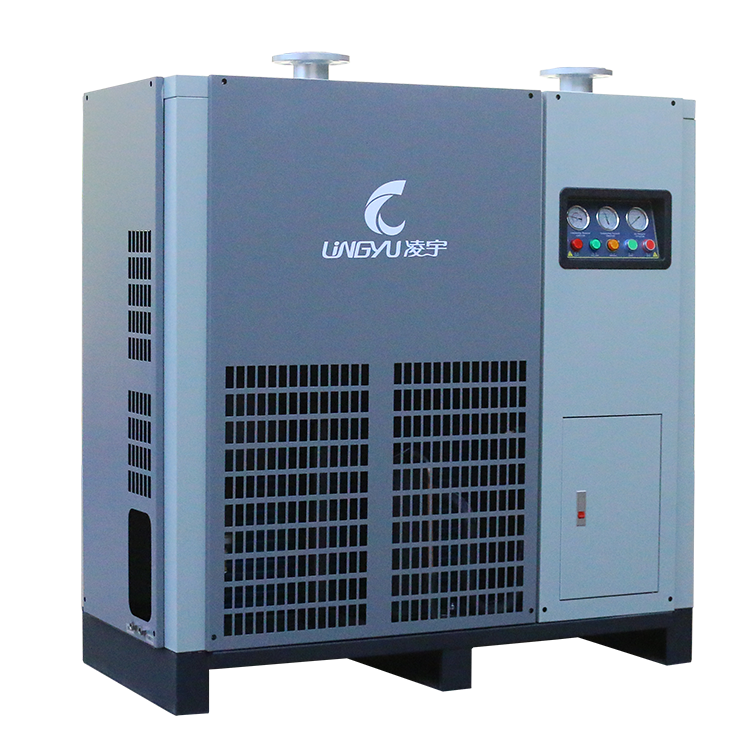
The AH Series air-cooled refrigerated air dryer is designed for industrial compressed-air systems that require reliable moisture removal under relatively high inlet-temperature conditions.
This article focuses specifically on the AH Series operating principle, pressure dew point, pressure drop, moisture-separation design, operating range, and model-selection considerations.
Under standard conditions, the AH Series provides a pressure dew point of 2–10°C, supports a rated inlet temperature of 50°C, and can handle inlet temperatures up to 80°C.
For users comparing a wider range of refrigeration drying solutions, Lingyu’s air-cooled refrigerated air dryer range provides additional configurations for different operating conditions.
How the AH Series Refrigerated Air Dryer Works
High-temperature compressed air containing moisture and oil first enters the air-cooled pre-cooler and the air-to-air heat exchanger.
During this stage, the incoming compressed air is pre-cooled before entering the refrigeration evaporator.
The compressed air then passes through the air-to-refrigerant evaporator, where its temperature is reduced until moisture condenses. Under standard operating conditions, the dryer is designed to achieve a pressure dew point of 2–10°C.
The condensed moisture, oil, and part of the entrained impurities are separated from the air by the gas-liquid separation system and discharged through an automatic drain.
Finally, the dried low-temperature compressed air returns through the air-to-air heat exchanger, where it is reheated toward ambient temperature before leaving the dryer.
This process reduces downstream condensation risk while recovering cooling capacity through heat exchange.
Main Operating Conditions
The AH Series standard operating conditions are:
| Parameter | Specification |
|---|---|
| Rated inlet pressure | 0.7 MPa |
| Operating pressure range | 0.6–1.0 MPa |
| Rated inlet temperature | 50°C |
| Maximum inlet temperature | ≤80°C |
| Pressure dew point | 2–10°C |
| Rated ambient temperature | 32°C |
| Ambient operating range | 2–45°C |
| Pressure drop | ≤0.025 MPa |
| Cooling method | Air-cooled |
| Standard refrigerant | R22 |
| Optional refrigerants | R407C / R410A upon request |
The AH Series is intended for indoor installation on a level concrete floor with approximately 1.5 m minimum clearance around the unit.
These limits are important during selection because dryer performance is affected not only by airflow but also by inlet temperature, system pressure, and ambient conditions.
Why High Inlet Temperature Capability Matters
A refrigerated dryer must remove both sensible heat and moisture from incoming compressed air.
When compressor discharge air enters the dryer at a higher temperature, the refrigeration system must handle a greater thermal load. This can also increase the amount of water vapor entering the treatment system.
The AH Series is rated at 50°C inlet temperature and supports a maximum inlet temperature of 80°C, making it suitable for compressed-air systems where inlet temperature may be higher than in conventional lower-temperature applications.
However, the maximum inlet-temperature rating should not be treated as the normal design target.
For long-term system stability, actual compressor discharge temperature, aftercooler performance, ventilation conditions, and ambient temperature should all be evaluated together.
High-Stability Refrigeration Design
The AH Series uses in-house-manufactured key heat exchangers together with refrigeration compressors and components from established suppliers, including compressor sources such as Panasonic, Copeland, Danfoss, and Hanbell.
The main consideration is not simply component branding. Stable refrigeration performance matters because fluctuations in evaporating temperature or cooling capacity can directly affect outlet dew point.
A refrigerated dryer therefore needs consistent refrigeration performance across its intended operating conditions rather than only meeting nominal capacity at a single design point.
Moisture Separation After Cooling
Cooling compressed air does not complete the drying process by itself. Once moisture condenses, the liquid must be effectively separated and discharged before the air leaves the dryer.
The AH Series uses an independently designed water-separation system intended to provide reliable gas-liquid separation.
Its refrigeration and condensate-removal system incorporates the air-cooled pre-cooler, air-to-air heat exchanger, refrigeration evaporator, air-water separator, automatic drain, refrigeration compressor, condenser, expansion valve, and pressure switches.
These components work together as one refrigeration and condensate-removal system rather than as isolated parts.
Pressure Drop and System Efficiency
The AH Series specifies a pressure drop of ≤0.025 MPa.
Pressure drop matters because the compressor must ultimately maintain the required pressure at the downstream point of use. If excessive pressure is lost across dryers, filters, valves, or piping, the compressor station may need to operate at a higher discharge pressure.
Dryer efficiency should therefore not be evaluated only by electrical power consumption.
The total system assessment should also account for pressure losses across the refrigerated dryer, filters, air receiver and valves, distribution piping, and point-of-use treatment equipment.
A relatively low dryer pressure drop helps reduce unnecessary losses within the compressed-air treatment train.
Intelligent Dual-Compressor Operation on Larger Models
One important feature of applicable larger AH Series models is a 1+1 dual-refrigeration-compressor arrangement.
The second refrigeration compressor can automatically start or stop according to system load. Instead of operating both compressors continuously under reduced load, the system can adapt refrigeration capacity to actual treatment demand.
This load-adaptive arrangement is particularly useful where compressed-air demand fluctuates.
AH Series Technical Specifications
Representative AH Series models are shown below.
| Model | Airflow | Power Supply | Total Power | Connection | Weight | Dimensions |
|---|---|---|---|---|---|---|
| LY-D10AC | 1.5 m³/min | 220 V / 50 Hz | 0.68 kW | G1″ | 49 kg | 680×440×710 mm |
| LY-D20AC | 2.5 m³/min | 220 V / 50 Hz | 0.83 kW | G1″ | 58 kg | 800×440×800 mm |
| LY-D30AH | 3.8 m³/min | 220 V / 50 Hz | 1.10 kW | G1.5″ | 104 kg | 980×500×930 mm |
| LY-D50AH | 6.5 m³/min | 220 V / 50 Hz | 1.50 kW | G1.5″ | 129 kg | 1030×550×1000 mm |
| LY-D75AH | 10.5 m³/min | 220 V / 50 Hz | 2.20 kW | G2″ | 177 kg | 1240×650×1150 mm |
| LY-D100AH | 13.5 m³/min | 380 V / 50 Hz | 3.10 kW | G2.5″ | 215 kg | 1350×670×1300 mm |
| LY-D120AH | 17.0 m³/min | 380 V / 50 Hz | 3.10 kW | G2.5″ | 222 kg | 1350×670×1300 mm |
| LY-D150AH | 21.5 m³/min | 380 V / 50 Hz | 5.20 kW | DN80 | 283 kg | 1450×700×1510 mm |
| LY-D200AH | 28.5 m³/min | 380 V / 50 Hz | 5.50 kW | DN80 | 334 kg | 1550×850×1595 mm |
| LY-D400AH | 45.0 m³/min | 380 V / 50 Hz | 10.0 kW | DN100 | 630 kg | 1830×950×1840 mm |
| LY-D600AH | 65.0 m³/min | 380 V / 50 Hz | 11.9 kW | DN125 | 950 kg | 2300×1300×1930 mm |
| LY-D800AH | 85.0 m³/min | 380 V / 50 Hz | 16.2 kW | DN125 | 1200 kg | 2400×1420×1860 mm |
| LY-D1100AH | 110.0 m³/min | 380 V / 50 Hz | 19.7 kW | DN150 | 1450 kg | 3100×1600×2180 mm |
The standard AH Series range extends to 110 m³/min. For larger airflow requirements or special requirements involving materials, temperature, or operating pressure, the configuration should be confirmed separately.
For equipment-specific information, users can review Lingyu’s shell-tube refrigerated air dryer product page.
How to Select the Correct AH Series Model
Selecting an AH Series dryer should begin with actual operating conditions rather than simply matching the compressor’s nominal airflow.
Airflow
Determine the actual maximum compressed-air demand that will pass through the dryer.
A dryer selected too close to its nominal capacity may have limited margin when inlet temperature or ambient conditions rise.
Inlet Temperature
The rated inlet temperature is 50°C, with a maximum of 80°C.
If the site regularly approaches the upper temperature limit, this should be considered during equipment selection.
Operating Pressure
The standard rated pressure is 0.7 MPa, with a normal operating range of 0.6–1.0 MPa.
If actual pressure differs significantly, effective treatment capacity may need to be recalculated.
Required Dew Point
The AH Series is designed around a 2–10°C pressure dew point.
If the process requires substantially lower dew points, an adsorption or combined drying system may be more appropriate rather than overspecifying a refrigerated dryer.
Ambient Conditions
Because the AH Series is air-cooled, heat rejection depends on the installation environment.
Adequate ventilation and sufficient surrounding clearance are therefore part of correct dryer sizing and installation.
Air-Cooled Design and Installation Considerations
The AH Series uses air cooling, eliminating the need for an external cooling-water supply.
This can simplify installation in facilities where cooling water is unavailable or undesirable. However, air-cooled refrigeration equipment depends on ambient airflow for condenser heat rejection.
The installation area should provide adequate ventilation, sufficient service clearance, clean condenser airflow, protection from excessive dust accumulation, and an ambient temperature within the specified 2–45°C operating range.
Indoor installation on a level concrete floor with approximately 1.5 m of surrounding clearance is recommended for the standard installation arrangement.
Filtration Should Be Considered Separately
A refrigerated dryer primarily addresses moisture by cooling compressed air and separating condensate. It does not replace all filtration requirements.
Oil aerosols and solid particles may still require dedicated treatment before or after the dryer, depending on the air-quality target.
Lingyu’s precision compressed-air filter range can therefore be integrated with the dryer where additional particulate or oil-removal performance is required.
This keeps the role of each component clear: the dryer controls moisture, while filtration addresses contaminants that refrigeration alone does not fully remove.
Suitable Industrial Use
The AH Series is intended for industrial compressed-air treatment rather than being tied to a long list of unrelated end devices.
Its industrial coverage can include sectors such as electronics, power, home appliances, aerospace, steel, machinery, automotive, and lithium-battery manufacturing, with the final dryer configuration determined by the actual compressed-air conditions and air-quality requirements.
Industry-specific system requirements should be evaluated separately so that AH Series selection remains focused on dryer performance rather than a generic application list.
When Another Refrigerated Dryer May Be More Suitable
The AH Series is primarily positioned around air cooling, high inlet-temperature capability, and stable industrial operation.
However, another refrigerated dryer may be more suitable when a project prioritizes a different requirement. Water-cooled systems can be considered where suitable plant cooling water is available; DD Series models focus more strongly on low pressure drop; PD Series models use an integrated plate heat exchanger; and PB Series models emphasize variable-frequency operation.
These technologies should not be treated as interchangeable. The appropriate configuration depends on the actual operating objective.
Maintenance Points for Stable Performance
Routine maintenance should focus on refrigeration and condensate-removal components that directly influence dryer performance.
Typical inspection points include the condenser, refrigeration compressor, automatic drain, air-water separator, refrigerant pressures, expansion valve, filter drier, and airflow around the condenser.
Maintenance is not only intended to prevent breakdowns. It also helps maintain stable heat transfer, effective condensate removal, and consistent outlet dew point.
Information to Prepare Before Requesting a Dryer
Before selecting an AH Series model, prepare the required airflow, operating pressure, normal and maximum inlet temperature, ambient temperature, required pressure dew point, available installation space, operating hours, and any control or communication requirements.
The AH Series can also support optional PLC control, dry contacts, Modbus communication, and IoT-related customization according to project requirements.
For non-standard requirements, a customized technical configuration can then be evaluated.
Conclusion
The AH Series shell-tube refrigerated air dryer is designed for industrial compressed-air systems that require stable moisture removal under relatively high inlet-temperature conditions.
Its key characteristics include a 2–10°C pressure dew point, 50°C rated inlet temperature, ≤80°C maximum inlet temperature, ≤0.025 MPa pressure drop, 0.7 MPa rated inlet pressure, 0.6–1.0 MPa operating pressure, 2–45°C ambient operating range, air-cooled operation, R22 standard refrigerant, R407C/R410A optional refrigerants, high-efficiency moisture separation, and load-adaptive dual-compressor operation on applicable larger models.
Correct selection should consider airflow, inlet temperature, operating pressure, ambient conditions, pressure drop, required dew point, and installation environment together rather than relying on nominal capacity alone.