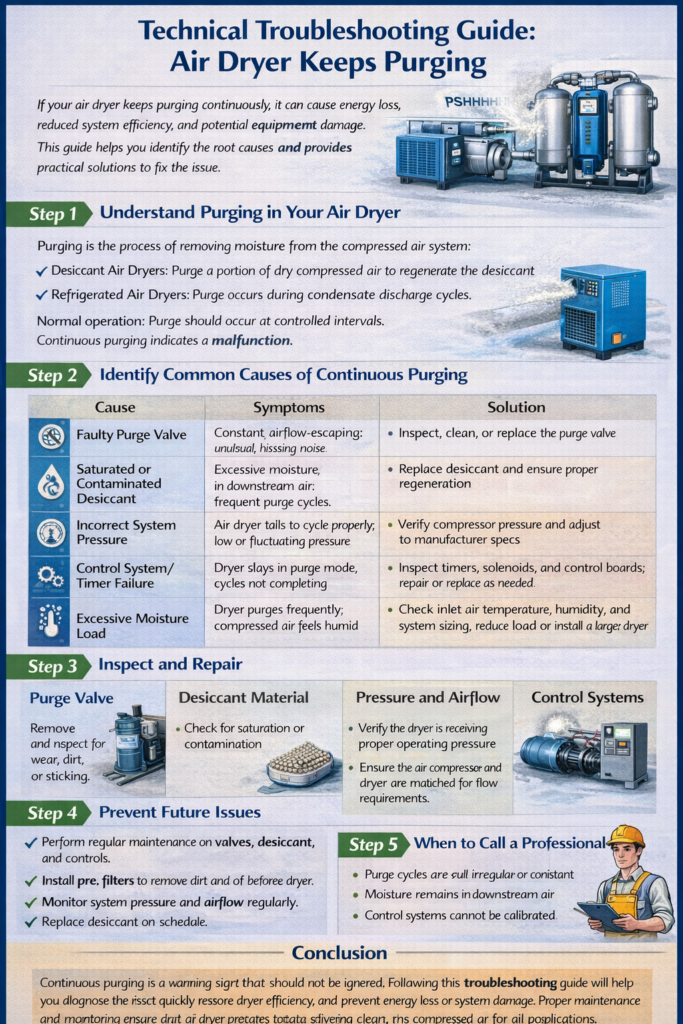
If your air dryer keeps purging or appears to discharge compressed air continuously, the first step is to determine whether the exhaust is part of a normal regeneration cycle or a genuine fault.
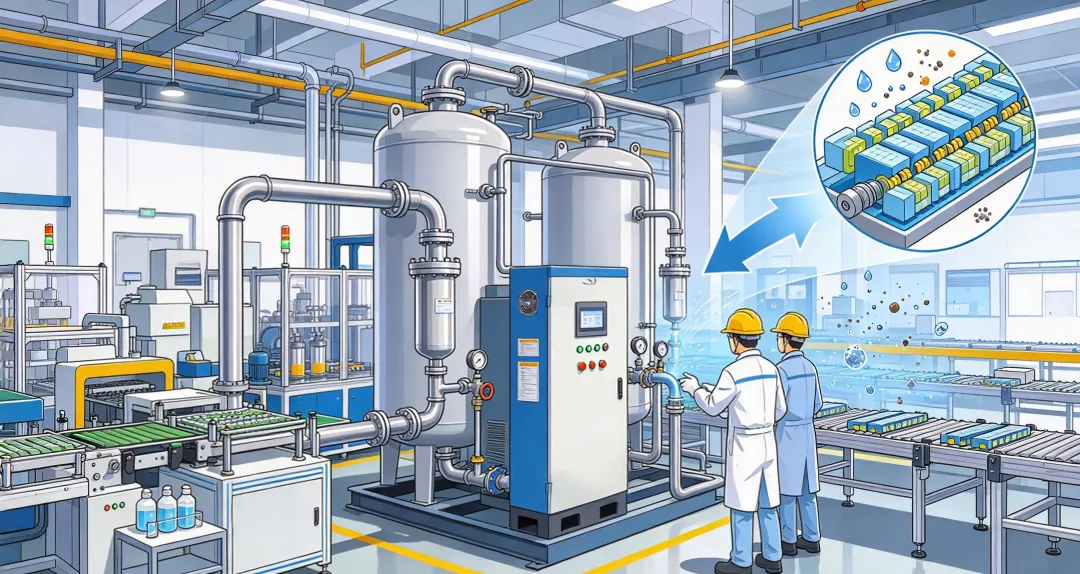
This distinction is especially important for regenerative desiccant air dryers. During normal operation, one adsorption tower dries the compressed air while the other tower regenerates. Depending on the dryer design, regeneration may intentionally consume and exhaust a portion of dry compressed air.
However, if air continues escaping when the regeneration stage should have ended, one tower fails to repressurize, the dryer cannot switch correctly, or system pressure and dew point deteriorate, troubleshooting is required.
This guide focuses primarily on regenerative desiccant air dryers because continuous purge air is fundamentally different from condensate drainage on a refrigerated dryer.
First: Is the Air Dryer Actually Purging Abnormally?
Before replacing valves or desiccant, verify how the dryer is designed to operate.
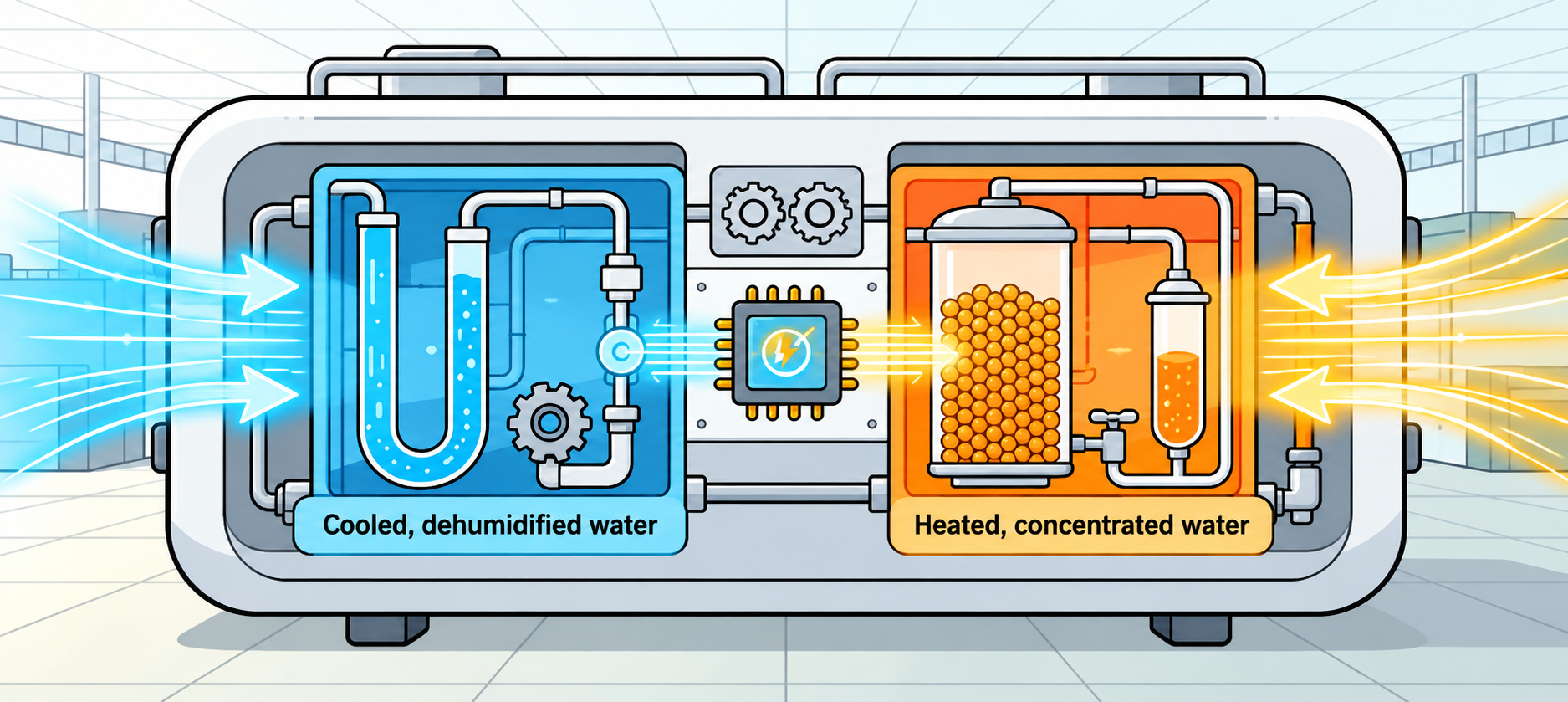
A desiccant air dryer removes water vapor through adsorption. During regeneration, moisture captured by the desiccant must be released and discharged before that tower returns to drying service.
Lingyu’s heatless regenerative dryer uses Pressure Swing Adsorption. A portion of the dry compressed air produced by the operating tower is used as purge air for the regenerating tower. The purge stream helps desorb moisture and carries it out through the exhaust system.
For example, Lingyu’s HH Series heatless regenerative dryer specifies average purge-air consumption of 8–14% under its stated operating conditions.
Therefore, hearing air exhausting during regeneration does not automatically mean the dryer is malfunctioning.
The purge is more likely abnormal when:
- Exhaust continues beyond the expected regeneration period.
- One tower cannot repressurize.
- Both towers appear to exhaust incorrectly.
- System pressure cannot recover.
- Tower switching stops or becomes unstable.
- Outlet pressure dew point deteriorates.
The first troubleshooting step is therefore to distinguish normal regeneration exhaust from continuous uncontrolled air loss.
Do Refrigerated Air Dryers “Purge”?
Not in the same sense.
A refrigerated air dryer cools compressed air so that water vapor condenses. The condensate is then separated and discharged through a drain.
That condensate discharge should not be confused with the regeneration purge used by a desiccant dryer.
After moisture separation, the dry compressed air is reheated toward ambient temperature before returning to the compressed-air system.
If a refrigerated dryer continuously loses compressed air through its condensate drain, the troubleshooting target is therefore more likely the drain system rather than a desiccant-regeneration purge circuit.
For this reason, the phrase “air dryer keeps purging” usually applies more directly to regenerative adsorption dryers.
Common Cause 1: Exhaust or Purge Valve Fails to Close
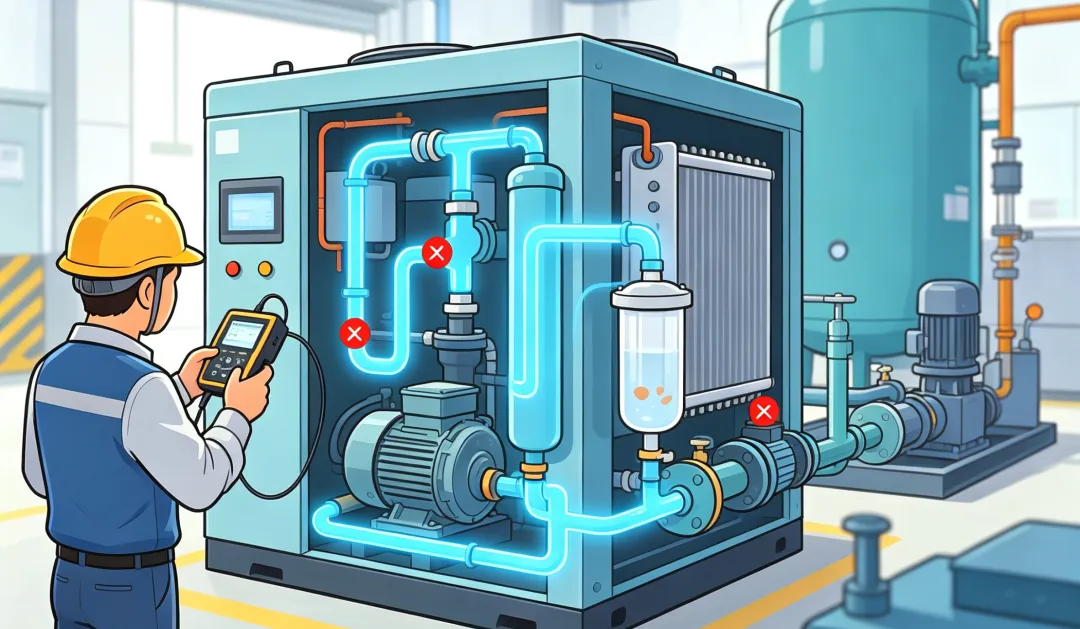
One of the first areas to inspect when a desiccant dryer continuously exhausts compressed air is the valve system.
Regenerative dryers depend on coordinated inlet, outlet, exhaust, and regeneration valves.
If an exhaust valve remains mechanically open when the tower should be repressurizing or returning to adsorption, compressed air can continue escaping.
Possible indicators include:
- Continuous hissing well beyond the expected regeneration period
- Inability of one tower to build pressure
- Excessive system pressure loss
- Failure to complete the switching sequence
Lingyu heatless regenerative dryers use pneumatic valves and actuators for tower switching.
Inspection should therefore focus not only on the exhaust valve itself but also on the actuator, pilot-air supply, solenoid control, wiring, and command signal.
Common Cause 2: Solenoid or Control Signal Problem
A mechanically healthy valve can still remain in the wrong position if its control signal is incorrect.
Regenerative dryers depend on a programmed operating sequence. If a solenoid valve, electrical connection, programmable controller, or related control component fails to change state at the correct time, a tower may remain in regeneration longer than intended.
Lingyu heatless regenerative dryers use electronic programmable control, while blower-heated and HOC systems incorporate additional monitoring and control functions.
During troubleshooting, compare the controller’s indicated operating state with the physical state of the valves.
For example, if the controller indicates that Tower A should be adsorbing while its exhaust valve remains open, the likely diagnostic areas include the:
Valve → actuator → pilot-air circuit → solenoid → wiring → control sequence
rather than immediately assuming that the desiccant has failed.
Common Cause 3: Repressurization Is Not Completing
A regenerative dryer normally has to bring the regenerated tower back toward operating pressure before switching it into adsorption service.
Lingyu’s heatless design includes automatic repressurization and pressure equalization before valve switching.
This process helps stabilize vessel pressure, reduce pressure fluctuations, and reduce mechanical impact on the desiccant.
If repressurization does not complete correctly, the dryer may appear to remain in purge mode or repeatedly attempt to switch.
Possible areas to inspect include:
- Repressurization valves
- Restricted control-air passages
- Check valves
- Insufficient inlet pressure
- Pilot-air supply
- Abnormal valve sequencing
The exact switching and repressurization sequence varies by dryer model, so individual valve states should be verified against the operating sequence for the specific equipment.
Common Cause 4: Operating Pressure Is Too Low or Unstable
Regenerative dryer performance depends on appropriate operating pressure.
If inlet pressure falls significantly below the design range, tower repressurization and switching can become unstable.
Excessive compressed-air demand elsewhere in the plant can also cause pressure fluctuations that make the dryer appear to operate incorrectly.
For Lingyu’s HH Series heatless regenerative dryer:
Rated inlet pressure: 0.7 MPa
Operating pressure range: 0.6–1.0 MPa
Other pressure ratings: Available on request
Before assuming that the dryer itself has failed, verify the actual pressure directly at the dryer inlet during adsorption, regeneration, repressurization, and switching.
A system-level pressure problem can sometimes be mistaken for a dryer-control problem.
Common Cause 5: Excessive Inlet Flow or Moisture Load
A dryer operating outside its intended capacity can suffer poor dew-point performance and unstable operating conditions.
Rated dryer capacity should therefore be evaluated against actual airflow, inlet pressure, inlet temperature, and moisture load, not just nominal compressor capacity.
If compressed-air consumption has increased because of production expansion, additional equipment, leakage, or changes to compressor operation, the dryer may now be operating above its original design point.
High inlet temperature can also increase the moisture load entering the adsorption system.
Lingyu’s HH Series specifies:
Rated inlet temperature: 10–30°C
Maximum inlet temperature: ≤40°C
Where dryer sizing is uncertain, the compressed air dryer selection guide provides additional selection guidance.
Common Cause 6: Desiccant Performance Has Deteriorated
Poor desiccant condition usually does not by itself explain a purge valve that is physically stuck open, but it can contribute to poor drying and regeneration performance.
Desiccant performance can deteriorate because of contamination, mechanical attrition, unsuitable operating conditions, or extended service.
If the dryer cycles normally but the outlet pressure dew point remains too high, desiccant condition becomes a more important diagnostic direction.
For this type of problem, see the desiccant air dryer troubleshooting guide.
Replacing desiccant should not be the first response to every continuous-purge complaint. When continuous exhaust is the primary symptom, the valve and control sequence should generally be checked first.
Common Cause 7: Oil or Particulate Contamination
Contamination upstream of the adsorption dryer can affect both valves and desiccant.
Oil aerosols, solid particles, corrosion debris, and other contaminants can interfere with valve movement or degrade the adsorption system over time.
Proper upstream filtration is therefore important for protecting a regenerative dryer.
Where filtration is part of the troubleshooting review, Lingyu’s precision compressed air filter can form part of the air-treatment system.
Filter condition should also be checked because excessive differential pressure or damaged filter elements can affect the overall compressed-air system.
A Practical Troubleshooting Sequence
When an air dryer keeps purging, start by observing the dryer through a complete operating cycle rather than immediately replacing components.
1. Identify the Tower States
Determine which tower is adsorbing and which tower is regenerating.
Observe whether the exhaust changes state when the controller commands a tower switch.
2. Compare Tower Pressures
The regenerating tower should follow the expected depressurization and regeneration sequence and subsequently repressurize before returning to adsorption duty.
If the tower cannot build pressure, inspect the exhaust valve and associated control circuit.
3. Verify Inlet Pressure and Airflow
Check actual pressure at the dryer during normal operation and peak plant demand.
If inlet pressure drops below the required operating range during peak demand, investigate the compressed-air supply before changing the dryer sequence.
4. Check Solenoids and Pilot Air
Verify that each electrical or pneumatic control signal produces the corresponding physical valve movement.
A control command without the expected valve movement points toward the solenoid, actuator, valve, or pilot-air path.
5. Evaluate Dew Point and Desiccant Condition
After the switching system has been verified, evaluate outlet pressure dew point and desiccant condition.
If the operating cycles are normal but the dryer still produces wet air, contamination, desiccant degradation, or excessive moisture load becomes more likely.
Following this sequence helps distinguish a purge-control fault from a drying-performance fault.
Do Not Change the Purge Setting Arbitrarily
A common response to excessive purge-air consumption is to manually reduce regeneration airflow.
This can create another problem.
Heatless regeneration depends on sufficient purge air to create suitable regeneration conditions and carry moisture out of the regenerating tower.
Reducing purge flow below the dryer’s design requirement may lower visible air consumption while leaving the desiccant incompletely regenerated.
The result can be a rising outlet pressure dew point and reduced dryer performance.
If purge consumption appears excessive, determine why it is excessive rather than simply restricting the purge line.
Different Dryer Technologies Have Different Normal Purge Rates
The amount of regeneration air considered normal depends heavily on dryer technology.
For Lingyu regenerative dryer configurations:
| Dryer Configuration | Regeneration Air Consumption |
|---|---|
| HH Series heatless | 8–14% average |
| Heated-purge configuration | 4–8% |
| HRB-E low-purge blower-heated | 2–3% |
| HOC-E heat-of-compression | ≤3% |
| HOC-Z zero-purge heat-of-compression | 0% |
This is why a complaint such as “my dryer is purging too much” cannot be diagnosed without first identifying the dryer type and its intended regeneration method.
Where purge loss is a major operating-cost concern, Lingyu’s blower zero-purge adsorption dryer provides an alternative regeneration architecture rather than simply reducing the purge setting on a heatless dryer.
Continuous Purging vs. High Dew Point
These two symptoms can occur together, but they should not be treated as the same fault.
Continuous purge or exhaust directs troubleshooting toward valves, solenoids, control sequencing, repressurization, and operating pressure.
High outlet pressure dew point directs more attention toward desiccant condition, contamination, inlet moisture load, regeneration effectiveness, airflow, and operating temperature.
A dryer can have one problem without the other.
Separating these symptoms early can help avoid unnecessary desiccant or valve replacement.
Preventing Future Purge Problems
Preventive maintenance should focus on the complete switching and air-treatment system rather than replacing desiccant based only on a fixed assumption.
Useful practices include:
- Observe tower switching and pressure behavior periodically.
- Check valves and silencers for abnormal leakage or restriction.
- Maintain upstream filtration.
- Verify inlet pressure and temperature.
- Monitor outlet pressure dew point where instrumentation is available.
- Compare actual airflow with dryer design capacity.
- Inspect pilot-air and solenoid systems.
- Check automatic drains and upstream separators.
- Investigate changes in plant compressed-air demand.
Where dew-point-based control is installed, sensor operation should also be verified.
Lingyu blower-heated systems offer optional dew-point-based control that can extend the adsorption cycle according to actual operating demand instead of relying only on a fixed cycle.
When Should You Stop Troubleshooting and Call for Service?
If the dryer involves pressurized towers, electrical controls, pneumatic valves, heaters, or blower systems and the fault cannot be isolated through routine operational checks, qualified service personnel should inspect the equipment.
Professional diagnosis is particularly appropriate when:
- Tower pressure does not follow the specified switching sequence.
- Pneumatic valves cannot be confirmed to operate correctly.
- Repeated alarms occur.
- Outlet dew point remains outside the required range.
- Significant uncontrolled compressed-air loss continues.
- Pressure-containing equipment needs to be opened or disassembled.
The dryer should be properly isolated and depressurized according to the equipment’s maintenance procedure before work involving pressure-containing components.
Conclusion
If an air dryer keeps purging, do not immediately assume that every exhaust sound indicates a failure.
For a regenerative desiccant dryer, purge air can be an intentional part of the regeneration process. Lingyu’s HH Series heatless dryer, for example, uses part of the dry product air for regeneration, with 8–14% average purge-air consumption under its specified operating conditions.
Troubleshooting should begin when exhaust continues outside the normal regeneration sequence, the offline tower fails to repressurize, valves do not follow controller commands, system pressure drops excessively, or outlet pressure dew point deteriorates.
The most useful diagnostic order is:
Operating cycle → valves → control signals → repressurization → inlet pressure and flow → dew point → desiccant and moisture load
By distinguishing normal regeneration exhaust from a genuine continuous-purge fault, maintenance teams can avoid unnecessary component replacement while identifying the actual cause of compressed-air loss and unstable dryer performance.