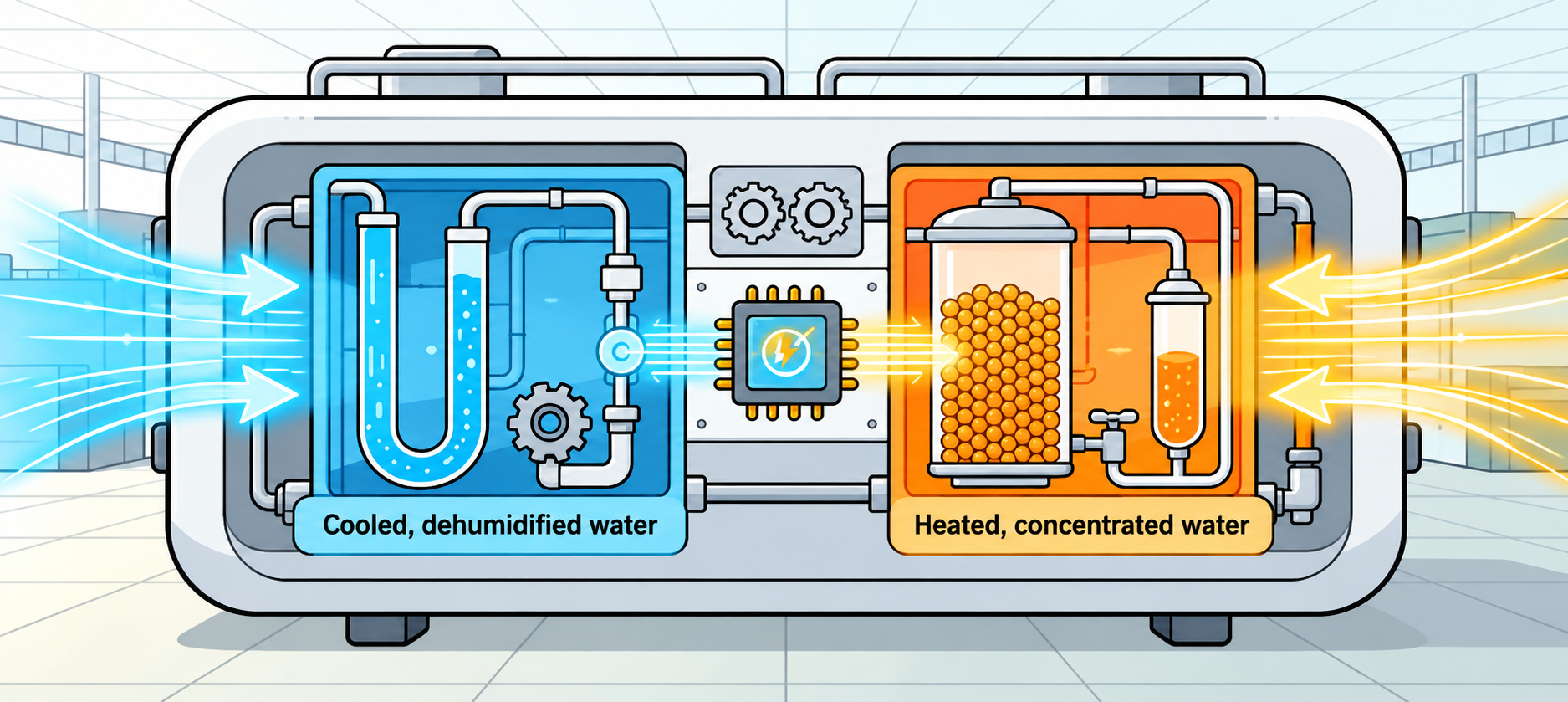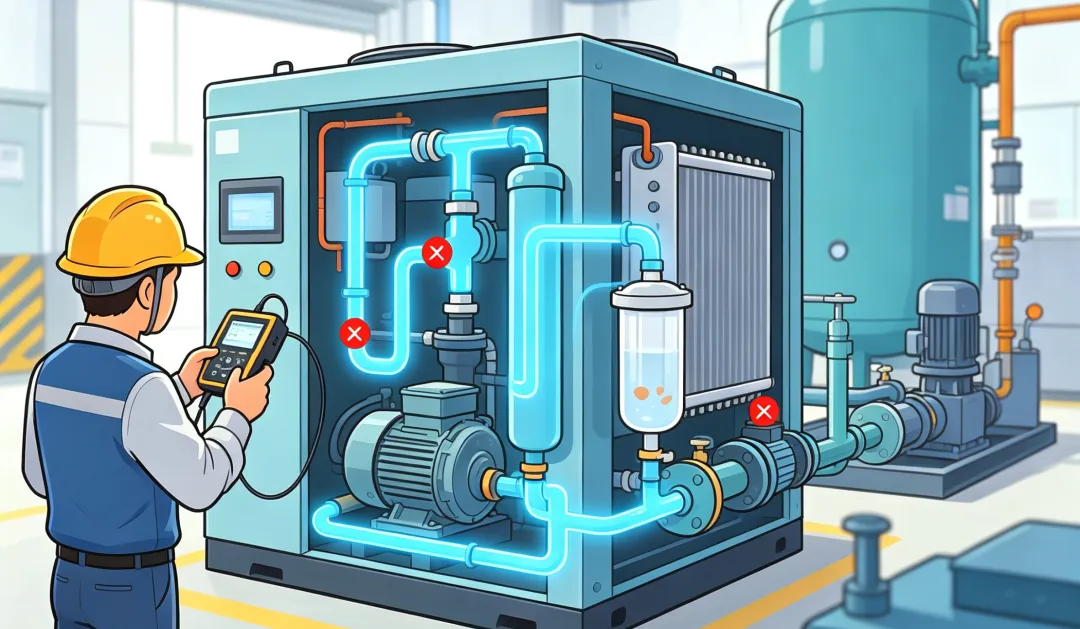
A desiccant air dryer is designed to remove water vapor from compressed air and maintain a specified pressure dew point.
When performance deteriorates, the symptoms may include high outlet dew point, unstable tower pressure, excessive purge consumption, abnormal switching, alarms, or repeated shutdowns.
However, the dryer itself is not always the root cause.
Many recurring problems originate from the conditions around the dryer, including excessive inlet temperature, unstable pressure, overloaded flow, liquid-water carryover, poor filtration, incorrect regeneration, or changes in plant demand.
The most effective troubleshooting approach is therefore:
Verify operating conditions first → check regeneration → inspect valves and controls → evaluate the desiccant bed.
For background on the technology and available configurations, see Lingyu’s desiccant air dryer range.
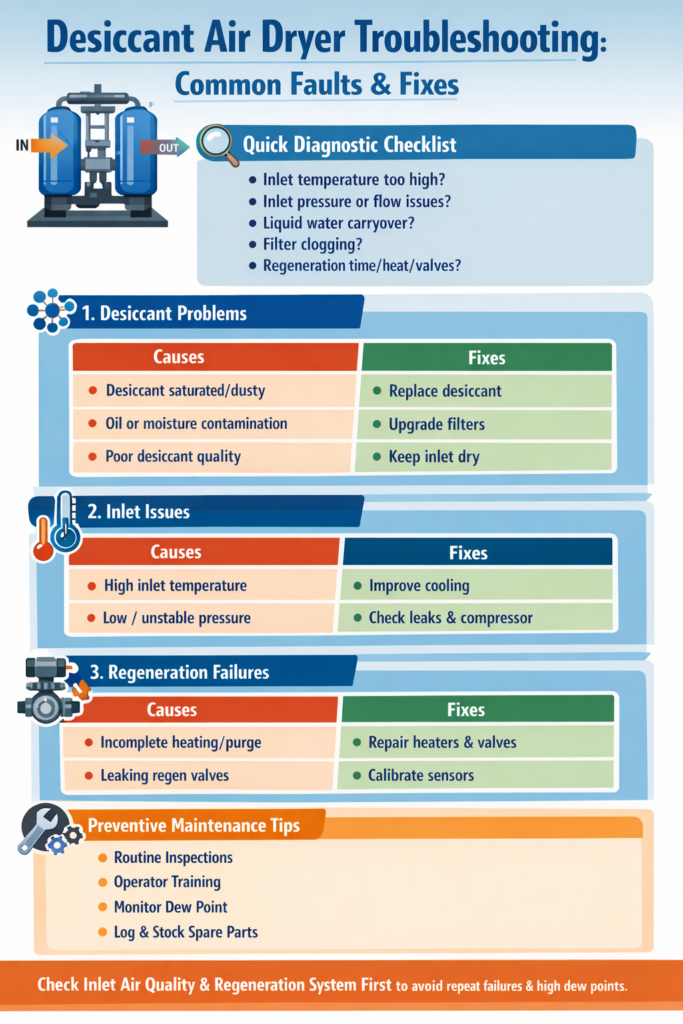
Start With the Operating Conditions
Before replacing desiccant, valves, or sensors, compare the actual operating data with the dryer’s specified operating conditions.
Check:
- Inlet temperature
- Inlet pressure
- Actual air flow
- Upstream drainage
- Filter condition
- Tower pressures
- Regeneration sequence
- Outlet dew point
This matters because adsorption dryers are designed around defined operating conditions.
For example, several Lingyu regenerative dryer series use a rated inlet pressure of 0.7 MPa, with an operating range of 0.6–1.0 MPa. Many conventional regenerative models have rated inlet temperatures of 10–30°C and maximum inlet temperatures of ≤40°C.
These values should not be applied universally to every dryer. The correct operating limits should always be confirmed for the actual model.
1. High Inlet Temperature
High inlet temperature can increase the moisture load entering an adsorption dryer.
A system that performs correctly under cooler operating conditions may therefore struggle if compressor discharge cooling deteriorates or ambient conditions change.
Check the aftercooler, cooling-air or cooling-water conditions, ventilation, separator performance, and actual temperature measured at the dryer inlet.
If the inlet temperature exceeds the selected dryer’s design condition, correct that upstream problem before assuming the desiccant has failed.
For some Lingyu regenerative series, the normal rated inlet temperature is 10–30°C, with a maximum inlet temperature of ≤40°C, although other dryer technologies and models may have different limits.
2. Excessive Flow or Unstable Inlet Pressure
A dryer selected for one flow rate cannot necessarily maintain the same dew point when actual flow rises significantly above its design capacity.
Higher flow reduces effective contact time through the adsorption bed and also increases the moisture load that must be handled during each cycle.
Low or unstable pressure can create additional problems with adsorption, purge flow, repressurization, and tower switching.
Check actual plant flow rather than relying only on compressor nameplate capacity. Also review newly added pneumatic users, simultaneous demand, piping losses, and filter pressure drop.
If pressure loss itself is the primary symptom, see what to do when adsorption dryer pressure drop is too high.
3. Liquid Water Entering the Dryer
A desiccant dryer is intended primarily to remove water vapor.
Large amounts of liquid condensate entering the adsorption bed create a much more severe moisture load and can adversely affect both the desiccant and the regeneration process.
Inspect:
- Aftercooler performance
- Air-water separator
- Automatic drains
- Receiver drainage
- Prefilters
- Any refrigerated pretreatment stage
Lingyu’s combined drying system illustrates the value of pretreatment clearly: the refrigerated stage removes a significant portion of moisture before the adsorption stage, reducing the moisture load on the desiccant and lowering regeneration demand.
If liquid water repeatedly reaches the dryer, correcting the drainage or upstream separation problem is more important than simply replacing the desiccant.
4. Oil and Particulate Contamination
Compressed-air contamination can affect filters, valves, piping, desiccant, and downstream air quality.
Oil contamination is particularly important because adsorption media that has been contaminated may not recover simply through a normal regeneration cycle.
If oil is present, investigate the compressor, separator, drains, and filtration system rather than treating the dryer as an isolated component.
In combined drying systems, an oil-removal filter can be installed before the adsorption drying stage to help protect the desiccant and downstream equipment.
For a system-level diagnosis, see how to solve excessive oil content in a compressed air system.
5. Incomplete Regeneration
A desiccant bed can only return to effective adsorption service if the previous regeneration stage is completed correctly.
This is one of the most important areas to investigate when dew point becomes progressively worse over repeated cycles.
The required regeneration mechanism depends on the dryer type.
A heatless dryer uses dry product air for regeneration. A heated-purge dryer uses heat plus purge air. A blower-heated dryer can use ambient blower air during regeneration, while some zero-purge designs use different heating and cooling arrangements.
For example, Lingyu’s heated-purge HH design uses external heat together with a portion of dry product air. Desorption alone does not complete the regeneration process; the desiccant must also cool sufficiently before returning to full adsorption service.
High dew point may therefore be related to:
- Incomplete heating
- Insufficient purge
- Incomplete cooling
- Incorrect sequence timing
- A failed regeneration component
Before replacing the desiccant, confirm that the complete regeneration sequence is actually being completed.
6. Incorrect Regeneration Air Flow
Too little regeneration air can leave excessive moisture in the adsorption bed.
Too much purge air, on the other hand, can waste compressed air and reduce the net usable flow available to the plant.
There is no single correct purge percentage for all adsorption dryers because regeneration-air requirements vary by design.
For example:
- HH heated-purge series: 4–8% average purge-air consumption
- HRB-E low-purge blower-heated series: approximately 2–3%
If purge flow appears abnormal, use the specification for the exact dryer model rather than adjusting the valve according to a generic percentage.
For more detail, see how regeneration air flow should be adjusted on an adsorption air dryer.
7. Heater, Blower, or Cooling Problems
For heated and blower-regenerated dryers, dew-point troubleshooting must include the equipment responsible for regeneration.
Possible areas to inspect include:
- Heater operation
- Regeneration temperature
- Blower operation
- Cooling performance
- Regeneration airflow
- Heating-to-cooling sequence
Some Lingyu blower-heated designs monitor parameters including air outlet temperature, heating temperature, regeneration exhaust temperature, Tower A/B pressure, blower pressure, and optional pressure dew point.
These operating trends can help distinguish a genuine adsorption problem from a regeneration-system problem.
Do not replace the desiccant solely because the outlet dew point is high if the heater, blower, cooling stage, or regeneration airflow is not operating correctly.
8. Switching-Valve Leakage or Incorrect Valve Sequence
Twin-tower dryers rely on reliable switching between adsorption and regeneration.
If an inlet, outlet, purge, exhaust, equalization, or check valve does not reach the correct position, the dryer may experience pressure loss, poor regeneration, cross-flow between towers, or abnormal dew point.
Possible causes include:
- Actuator problems
- Solenoid faults
- Contamination
- Worn sealing surfaces
- Incorrect control signals
- Mechanical sticking
Lingyu’s regenerative dryers use pneumatic valves and automatic repressurization/equalization to stabilize tower pressure before switching.
If tower switching itself appears abnormal, see how to troubleshoot abnormal switching in a desiccant air dryer.
9. Continuous or Abnormal Regeneration Exhaust
Audible exhaust does not automatically indicate dryer failure.
Heatless and heated-purge dryers intentionally discharge regeneration air during certain operating stages.
The problem is when exhaust does not match the expected regeneration sequence, remains open when the tower should be repressurizing, or causes unexplained system-pressure loss.
A useful diagnostic sequence is:
Controller status → tower pressure → valve command → exhaust behavior
This helps determine whether the exhaust is part of normal regeneration or whether a valve, actuator, control, or pressure-sequence problem is present.
For a dedicated fault sequence, see normal vs abnormal regeneration exhaust on a desiccant air dryer.
10. Desiccant Dusting and Mechanical Degradation
Desiccant does not simply become “full of moisture forever” under normal regenerative operation.
More persistent deterioration can result from physical attrition, contamination, repeated pressure shock, movement within the adsorption bed, or other long-term operating conditions.
Symptoms may include:
- Increasing dust downstream
- Contaminated mufflers or filters
- Higher pressure drop
- Reduced adsorption performance
Lingyu regenerative dryer designs use desiccants selected for mechanical strength and abrasion resistance, while repressurization and pressure equalization help reduce pressure impact on the adsorption material.
If dust carryover is the main symptom, see how to prevent desiccant dust carryover in an adsorption air dryer.
11. Channeling or Uneven Air Distribution
A desiccant bed should distribute compressed air effectively through the adsorption media.
If airflow develops preferential paths through the bed, part of the desiccant may be underutilized while moisture breaks through earlier than expected.
Possible contributing factors can include:
- Bed settling
- Poor packing
- Damaged support components
- Abnormal airflow conditions
Do not assume channeling simply because the dew point is high.
First eliminate inlet-condition problems, incomplete regeneration, valve faults, contamination, and measurement errors.
If pressure behavior and desiccant condition suggest a bed-distribution problem, see how to prevent the channeling effect in a desiccant air dryer.
12. Filters and Mufflers Can Create Secondary Problems
A heavily loaded prefilter can reduce dryer inlet pressure.
A blocked afterfilter can increase downstream pressure drop.
A contaminated exhaust silencer or regeneration-flow component can interfere with normal depressurization or purge flow.
Filter service should therefore be based on the manufacturer’s allowable pressure drop, contamination condition, and operating history rather than on one universal replacement threshold.
Likewise, filter elements should not automatically be replaced according to a generic calendar interval.
Differential pressure, operating hours, contamination load, and the specific manufacturer’s maintenance requirements should all be considered.
13. Controller and Sensor Problems
Modern regenerative dryers depend on control logic to coordinate adsorption, depressurization, regeneration, cooling, repressurization, and tower switching.
A faulty pressure, temperature, or dew-point signal can therefore make a mechanically healthy dryer appear to malfunction.
Check whether the displayed values are physically reasonable and whether valve actions match the commanded operating stage.
Also review recent parameter changes before assuming that the PLC program itself has failed.
Control programs should not be modified casually during troubleshooting. If the configuration appears corrupted or the operating sequence no longer matches the intended design, restore verified parameters or involve qualified service personnel.
14. Dew-Point Measurement Can Also Be the Problem
Before undertaking major mechanical repairs, verify that the dew-point reading itself is trustworthy.
A sensor exposed to contamination, installed incorrectly, or operating outside its measurement conditions can produce misleading data.
Compare the analyzer reading with the dryer’s other operating indicators and, where appropriate, verify it using a known-good instrument or manufacturer-approved calibration method.
This is especially important when the dryer appears mechanically normal but the reported dew point changes suddenly without corresponding changes in pressure, flow, regeneration, or temperature.
15. Avoid Replacing Desiccant Too Early
High dew point does not automatically mean the desiccant needs replacement.
Before replacing an entire adsorption charge, verify:
Inlet temperature → flow → pressure → liquid-water control → filtration → regeneration flow → heater/blower performance → valve sequence → dew-point measurement
If all of these conditions are correct and the dryer still cannot achieve its specified performance, then desiccant condition becomes a stronger suspect.
This troubleshooting order can prevent replacing expensive adsorption media while leaving the actual root cause unresolved.
16. Preventive Maintenance Should Be Condition-Based
Maintenance intervals vary according to dryer type, cycle frequency, inlet-air quality, contamination, operating environment, and operating hours.
For this reason, preventive maintenance should combine the actual model’s service requirements with condition monitoring rather than relying on one generic daily, monthly, or replacement schedule for every dryer.
Useful operating trends to track include:
- Inlet and outlet pressure
- Inlet temperature
- Filter differential pressure
- Tower-pressure sequence
- Outlet dew point
- Regeneration temperature, where applicable
- Purge behavior
- Drainage condition
- Alarm history
- Operating hours
Also record what changed before each failure.
Recurring dew-point problems often become much easier to diagnose when operators can determine whether temperature, flow, pressure, regeneration, or filtration changed first.
A Practical Troubleshooting Sequence
When outlet dew point rises or the dryer repeatedly alarms, use this sequence:
Verify the dew-point reading → check inlet temperature → confirm actual flow and inlet pressure → inspect liquid-water separation and drains → check filtration and oil contamination → confirm regeneration sequence and regeneration flow → inspect heater/blower functions where applicable → compare tower pressure with switching commands → investigate valve leakage → inspect desiccant condition and bed distribution
This keeps the investigation focused on the most accessible system conditions before moving toward invasive internal inspection.
Safety During Troubleshooting
Regenerative dryers contain pressurized vessels, automatically operated valves, electrical equipment, and—in heated designs—high-temperature components.
Before mechanical inspection:
- Isolate the dryer from pressure and energy sources
- Depressurize it according to the approved procedure
- Prevent automatic restart
- Follow the site’s lockout/tagout requirements
Internal tower work, heater testing, valve disassembly, electrical diagnosis, and changes to controller parameters should be performed by qualified personnel using the correct model documentation.
Conclusion
Repeated desiccant air dryer failure is rarely explained by one symptom alone.
High dew point can result from excessive inlet moisture load, high temperature, overload, unstable pressure, poor pretreatment, incorrect regeneration, valve problems, contamination, sensor error, or genuine desiccant deterioration.
The most reliable troubleshooting approach is not:
“High dew point = replace the desiccant.”
Instead, diagnose the dryer as part of the complete compressed-air system:
Measurement → inlet conditions → pretreatment → regeneration → valves and controls → desiccant bed
When the root cause is corrected rather than only the visible symptom, dew-point stability and dryer reliability are much easier to maintain.