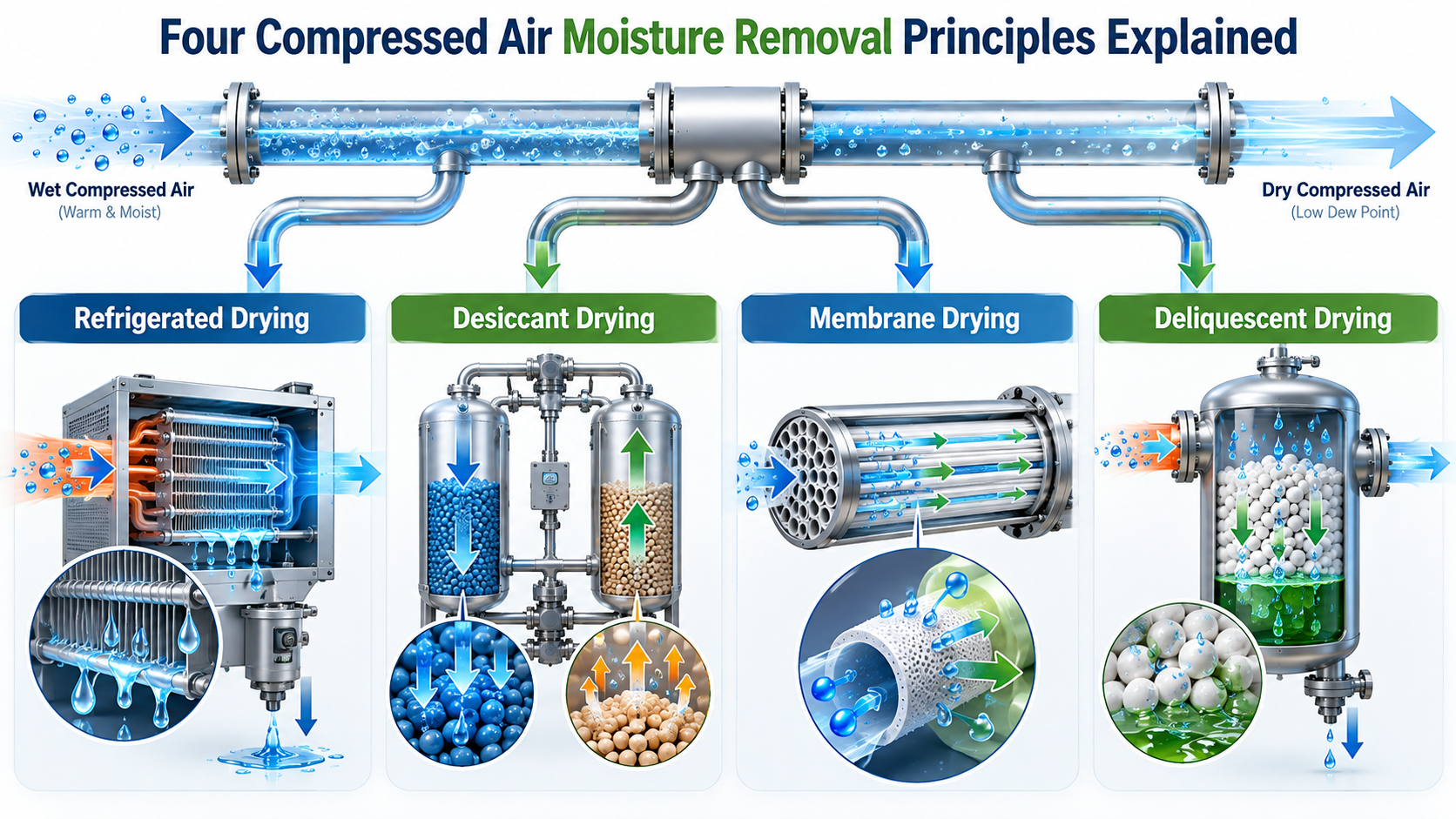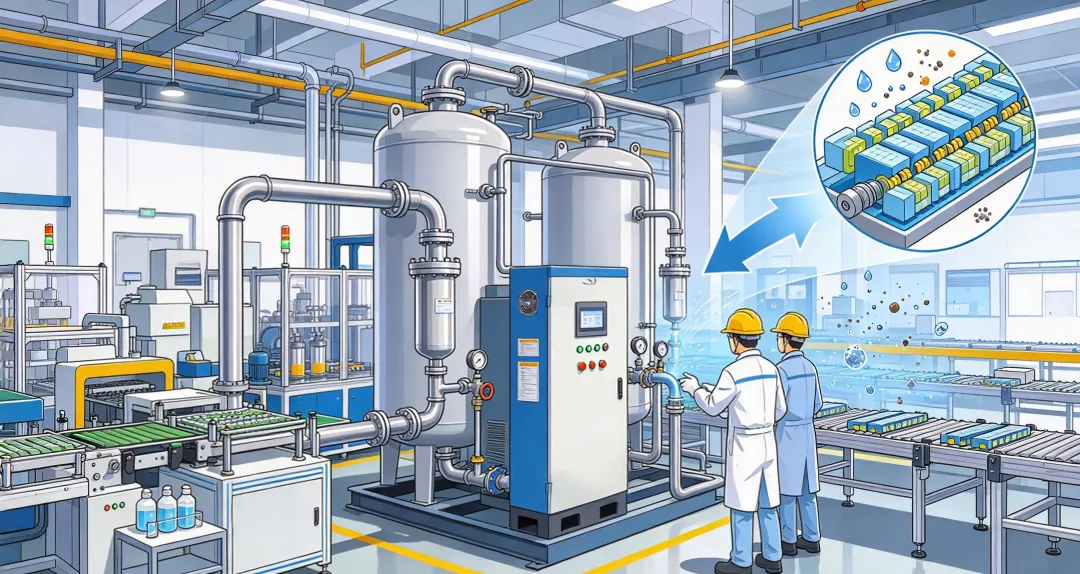
Compressed air is a critical utility in modern manufacturing, but the air leaving a compressor can contain water vapor, liquid condensate, oil contamination, and particles. If these contaminants are not properly treated, they can contribute to pipeline corrosion, pneumatic equipment problems, unstable processes, and product-quality issues.
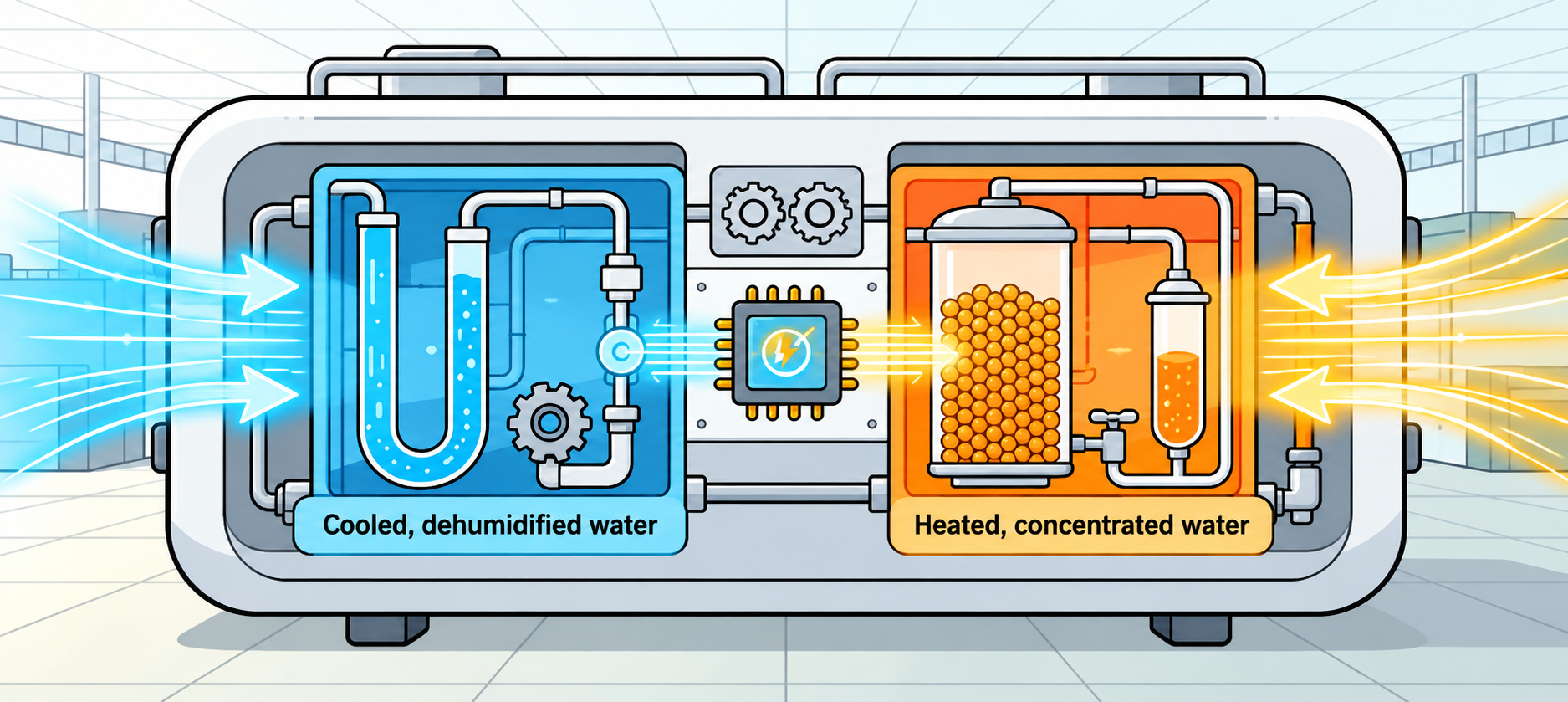
An air-cooled refrigerated air dryer removes a large portion of the moisture by cooling compressed air until water vapor condenses, separating the resulting liquid, and reheating the dry air before it enters the distribution system.
For industrial applications that do not require extremely low pressure dew points, refrigerated drying can provide an effective balance of moisture removal, system simplicity, and operating cost.
Lingyu’s AH Series is specifically designed as an air-cooled refrigerated dryer and forms part of the company’s broader air-cooled refrigerated dryer range.
How Does an Air-Cooled Refrigerated Air Dryer Work?
The basic drying process has four main stages.
1. Pre-Cooling
High-temperature compressed air containing moisture first enters the air-cooled pre-cooler and air-to-air heat exchanger.
The incoming air is partially cooled before reaching the evaporator, reducing the refrigeration load.
2. Refrigeration Cooling
The compressed air then passes through the air-to-refrigerant evaporator.
Here, the refrigeration circuit lowers the air temperature until water vapor begins to condense.
Lingyu’s AH Series is specified for a pressure dew point of 2–10°C under its stated operating conditions.
3. Condensate Separation and Drainage
During cooling, moisture, oil, and some impurities condense.
A gas-liquid separator removes the condensate from the compressed-air stream, after which it is discharged through an automatic drain valve.
This stage is critical because cooling the air alone is not enough; the condensed liquid must also be removed reliably.
4. Reheating
The cold, dried compressed air passes back through the air-to-air heat exchanger.
It is reheated toward ambient temperature before leaving the dryer while simultaneously helping pre-cool the incoming compressed air.
For a more detailed explanation of the refrigeration cycle, see the working principle of air-cooled refrigerated air dryers.
Key AH Series Operating Conditions
The principal AH Series operating specifications are:
| Parameter | AH Series Specification |
|---|---|
| Rated inlet pressure | 0.7 MPa |
| Operating pressure | 0.6–1.0 MPa |
| Rated inlet temperature | 50°C |
| Maximum inlet temperature | ≤80°C |
| Pressure dew point | 2–10°C |
| Rated ambient temperature | 32°C |
| Ambient operating range | 2–45°C |
| Pressure drop | ≤0.025 MPa |
| Cooling method | Air-cooled |
| Standard refrigerant | R22 |
| Optional refrigerants | R407C / R410A on request |
These operating conditions are important for actual dryer selection because airflow alone does not determine refrigeration-dryer capacity.
Why Air-Cooled Refrigerated Dryers Are Common in Industry
One of the most practical advantages of an air-cooled dryer is that it does not require a cooling-water circuit.
Heat from the refrigeration system is rejected through ambient air, which can simplify installation where cooling water is unavailable, undesirable, or expensive to provide.
This does not mean an air-cooled design is automatically better than a water-cooled dryer. An air-cooled installation depends more heavily on ambient temperature, airflow, ventilation, and condenser cleanliness, while a water-cooled system depends on cooling-water temperature, pressure, flow, and water quality.
The correct choice is therefore site-specific.
Applications of Air-Cooled Refrigerated Air Dryers
Air-cooled refrigerated dryers can be used across a wide range of industrial processes when their 2–10°C pressure dew point and overall air-treatment configuration satisfy the actual process requirement.
Automotive and General Manufacturing
Automotive and general manufacturing facilities use compressed air for pneumatic tools, actuators, automation equipment, assembly systems, robotics, and many other production functions.
Excess moisture can contribute to corrosion, sticking valves, unstable pneumatic operation, and maintenance problems.
Where the process requirement can be satisfied by a 2–10°C pressure dew point, an air-cooled refrigerated dryer can provide an appropriate moisture-control solution.
See Lingyu’s automotive and general manufacturing application.
Machining and Pneumatic Equipment
Machining centers and other industrial equipment frequently rely on pneumatic cylinders, valves, air tools, clamping systems, and controls.
Condensed water in the distribution system can contribute to corrosion and affect lubrication or component reliability.
A refrigerated dryer can substantially reduce this moisture load before the air reaches downstream equipment.
The dryer should be sized for actual operating airflow, pressure, and inlet temperature rather than simply matching the compressor’s nameplate capacity.
Lingyu’s AH Series has a 50°C rated inlet temperature and permits a maximum inlet temperature of ≤80°C, which is especially relevant when the air entering the dryer remains relatively hot.
Painting and Coating Processes
Moisture contamination can create problems in compressed-air-assisted painting and coating processes.
Depending on the process, water reaching the air supply may contribute to surface defects, inconsistent atomization, or coating-quality problems.
Where the required air quality is compatible with refrigerated drying, an air-cooled refrigerated dryer can help stabilize the moisture level of the compressed-air supply.
However, moisture is not the only contaminant that matters. Oil and particles may also need to be controlled through appropriate upstream or downstream filtration.
A dryer should therefore be considered part of a compressed-air treatment train rather than a complete contaminant-removal solution by itself.
Electronics and Precision Manufacturing
Electronics and precision manufacturing often use compressed air in automation, component handling, pneumatic controls, cleaning, and production equipment.
Moisture-related corrosion or condensation may be unacceptable around sensitive equipment and processes.
If a 2–10°C PDP is adequate, a refrigerated dryer may be appropriate. If the process requires substantially drier compressed air, an adsorption dryer may be necessary instead.
See Lingyu’s electronics and precision manufacturing application.
Food and Beverage Processing
Compressed air can be used in food and beverage facilities for packaging, conveying, pneumatic equipment, process control, and other utilities.
Moisture control can be important, but the required compressed-air quality depends heavily on how and where the air contacts the process or product.
A refrigerated dryer primarily removes moisture by cooling and condensation. It should not be treated as a complete oil-removal solution by itself. Where oil, particles, or other contaminants must be controlled, appropriate filtration and the complete compressed-air treatment configuration must also be considered.
For sector-specific information, see Lingyu’s food and beverage application.
Metal Fabrication and Laser Cutting
Compressed air is increasingly used in metal fabrication and some laser-cutting systems, but the required air quality can vary considerably between equipment and process configurations.
An air-cooled refrigerated dryer can be suitable where the equipment specification allows a refrigerated-dryer dew point.
Some laser or precision processes may require lower dew points or additional filtration, so dryer selection should follow the equipment manufacturer’s compressed-air specification rather than the industry label alone.
See Lingyu’s metal fabrication and laser cutting application.
Chemical and Pharmaceutical Facilities
Chemical, petrochemical, pharmaceutical, and related process industries may use compressed air for instrumentation, pneumatic control, packaging, utility systems, and manufacturing processes.
A refrigerated dryer can be appropriate for some of these duties where the required dew point falls within the refrigeration range.
However, these industries also contain applications that require much lower pressure dew points than 2–10°C. Where a very low dew point is required, desiccant drying should be evaluated instead.
The process specification—not merely the industry—is the correct basis for dryer selection.
General Plant and Workshop Air
Air-cooled refrigerated dryers are particularly practical for general plant-air systems when the required pressure dew point is approximately 2–10°C, a cooling-water system is not available or desired, ambient ventilation is adequate, inlet temperature and pressure remain within the dryer’s design range, and compressed-air demand is compatible with rated capacity.
This combination makes refrigerated drying useful across factories, workshops, warehouses, assembly operations, and other industrial environments.
No Cooling-Water Supply Required
One of the clearest differences between air-cooled and water-cooled refrigerated dryers is infrastructure.
The AH Series uses air cooling, so a cooling-water inlet, outlet, pump circuit, and associated water-management equipment are not required for the dryer itself.
This can simplify installation in facilities without central cooling water.
However, the condenser still needs sufficient ambient airflow. Poor ventilation, blocked heat-exchanger surfaces, or excessive ambient temperature can reduce refrigeration performance.
Stable 2–10°C Pressure Dew Point
The AH Series is specified for a 2–10°C pressure dew point.
This range is suitable for many general industrial compressed-air applications, but it should not be described as an ultra-dry air specification.
If a process requires −20°C, −40°C, or a similarly low pressure dew point, an adsorption dryer is normally the more relevant technology.
The required pressure dew point should therefore be established before choosing between refrigeration and adsorption drying.
Pressure Drop and System Efficiency
The AH Series specifies a pressure drop of ≤0.025 MPa under its stated conditions.
Pressure drop matters because additional pressure loss in the treatment system can increase the compressor discharge pressure required to maintain the desired pressure at the point of use.
Dryer efficiency should therefore not be evaluated only from refrigeration-compressor power. The total system assessment should consider both electrical consumption and pressure loss.
Load-Responsive Refrigeration Control
For AH Series models from 5 to 180 m³/min, a 1+1 dual-compressor arrangement is used in which the second refrigeration compressor can start or stop according to load.
This allows refrigeration capacity to respond to changes in compressed-air demand and provides a product-specific method of adapting refrigeration operation to system load.
Refrigerant Options
The AH Series specifies R22 as the standard refrigerant, with R407C and R410A available upon request.
Because refrigerant requirements and regulations vary by market, the actual refrigerant configuration should be confirmed for the installation location, particularly for export projects.
Installation and Ventilation
The AH Series is designed for indoor installation on a level concrete floor without a foundation, with a minimum clearance of 1.5 m around the unit.
This clearance is particularly relevant for an air-cooled dryer because condenser airflow and service access must remain unobstructed.
Installing an air-cooled dryer in a poorly ventilated enclosure can raise condenser temperature and reduce refrigeration performance.
Air-Cooled vs. Water-Cooled Refrigerated Dryer
The two technologies perform the same fundamental drying function but use different condenser cooling methods.
| Factor | Air-Cooled Dryer | Water-Cooled Dryer |
|---|---|---|
| Condenser cooling | Ambient air | Cooling water |
| Cooling-water supply | Not required | Required |
| Dependence on room ventilation | Higher | Lower |
| Water-system maintenance | Not required for condenser | Required |
| Key site condition | Ambient temperature and airflow | Water temperature, pressure, and quality |
| Lingyu AH/WH PDP | 2–10°C | 2–10°C |
For facilities with a reliable cooling-water system or specific thermal constraints, Lingyu’s water-cooled refrigerated dryer range is worth comparing.
Neither configuration is universally superior.
Example Air-Cooled Product Capacities
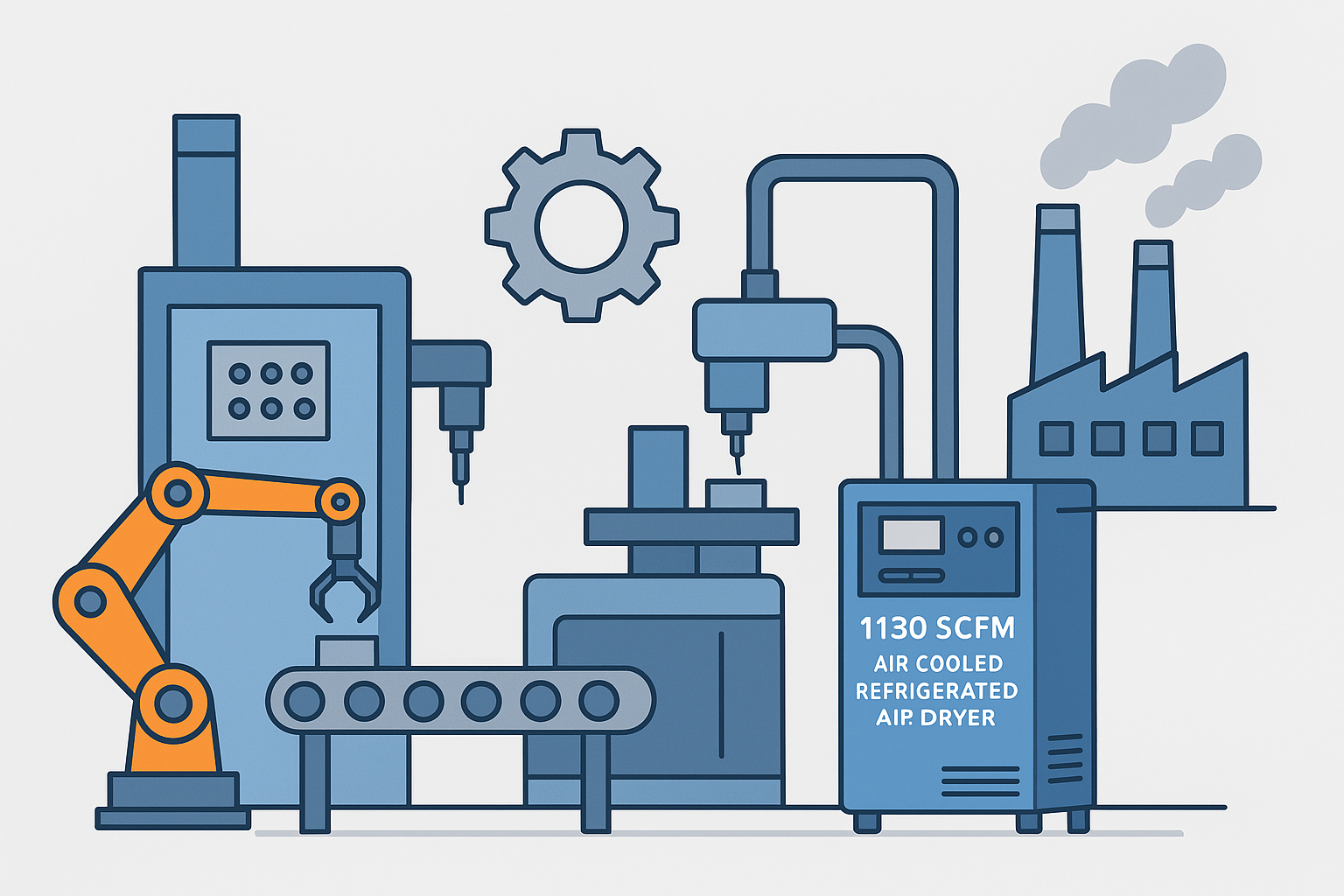
Lingyu offers dedicated air-cooled refrigerated dryer models at different capacities, including 100 CFM and 1,130 SCFM configurations.
For users researching a smaller product-level configuration, see the 100 CFM air-cooled refrigerated air dryer.
Specific model selection should still be corrected for actual inlet temperature, pressure, airflow, and operating conditions rather than choosing solely from nominal CFM.
How to Select an Air-Cooled Refrigerated Air Dryer
The key selection factors are maximum actual airflow, inlet pressure, inlet temperature, ambient temperature, required pressure dew point, allowable pressure drop, available ventilation, electrical supply, load profile, contamination level, and service access.
For the Lingyu AH Series, the reference conditions include 0.7 MPa rated inlet pressure, a 0.6–1.0 MPa standard operating range, 50°C rated inlet temperature, ≤80°C maximum inlet temperature, 2–10°C PDP, and a 2–45°C ambient operating range.
The dryer should be sized for actual worst-case operating conditions rather than only the compressor’s nominal flow.
Maintenance Considerations
Air-cooled refrigerated dryers do not have a condenser cooling-water circuit, but they still require routine maintenance.
Key areas include the air-cooled condenser and pre-cooler, air-to-air heat exchanger, evaporator, gas-liquid separator, automatic drain, refrigeration compressor, controls, and refrigerant circuit.
Condenser cleanliness is particularly important because blocked fins or restricted airflow reduce heat rejection.
Drain operation should also be checked routinely. If condensate is not discharged properly, downstream moisture can increase even when the refrigeration circuit itself is functioning normally.
A rising outlet dew point should prompt checks of airflow, inlet temperature, ambient temperature, condenser condition, separator and drain performance, and refrigeration-system operation.
When an Air-Cooled Refrigerated Dryer Is Not Enough
A refrigerated dryer should not be selected simply because it is common or economical.
If the process requires a pressure dew point substantially below 2°C, the application may need adsorption drying or a combined treatment system instead.
Similarly, if the process requires strict oil, particle, or microbiological limits, a refrigerated dryer alone does not define the complete air-quality solution.
The treatment system should be configured around the required downstream air specification.
Conclusion
Air-cooled refrigerated air dryers are widely applicable where industrial compressed air needs reliable moisture removal without requiring an external cooling-water circuit.
Lingyu’s AH Series uses an air-cooled pre-cooler, air-to-air heat exchanger, refrigeration evaporator, gas-liquid separator, automatic drain, and reheating stage to produce compressed air with a specified 2–10°C pressure dew point.
Its principal operating conditions include a 0.7 MPa rated inlet pressure, 0.6–1.0 MPa operating pressure, 50°C rated inlet temperature, ≤80°C maximum inlet temperature, 2–45°C ambient operating range, and ≤0.025 MPa pressure drop. The AH Series also specifies R22 as standard refrigerant, with R407C or R410A available upon request.
These dryers can be suitable across general manufacturing, automotive production, machining, pneumatic systems, coating operations, food and beverage facilities, electronics, metal fabrication, and other industrial plants, provided that the required pressure dew point and overall air-quality specification fall within the capability of refrigerated drying.
The correct choice should therefore be based on required pressure dew point, airflow, inlet temperature, ambient conditions, pressure drop, ventilation, contamination control, and total operating cost rather than industry name alone.