Moisture is one of the most common problems in industrial compressed-air systems. As compressed air cools after compression, water vapor can condense inside pipelines, receivers, valves, pneumatic equipment, and downstream processes.
An air-cooled refrigerated air dryer controls this moisture by lowering the temperature of compressed air, condensing part of the water vapor into liquid, separating the condensate, and then reheating the dried air before it leaves the dryer.
An air-cooled refrigerated dryer contains two interacting flow circuits: the compressed-air circuit, where moisture is removed, and the refrigeration circuit, where heat is absorbed from the compressed air and rejected to ambient air.
Lingyu’s AH Series represents the company’s standard air-cooled refrigerated dryer family.
The Core Principle: Cool, Condense, Separate, and Reheat
The drying process can be summarized as:
Hot wet compressed air → pre-cooling → refrigeration cooling → condensation → gas-liquid separation → drainage → reheating → dry compressed air
The AH Series is specified for a 2–10°C pressure dew point (PDP) under its stated operating conditions.
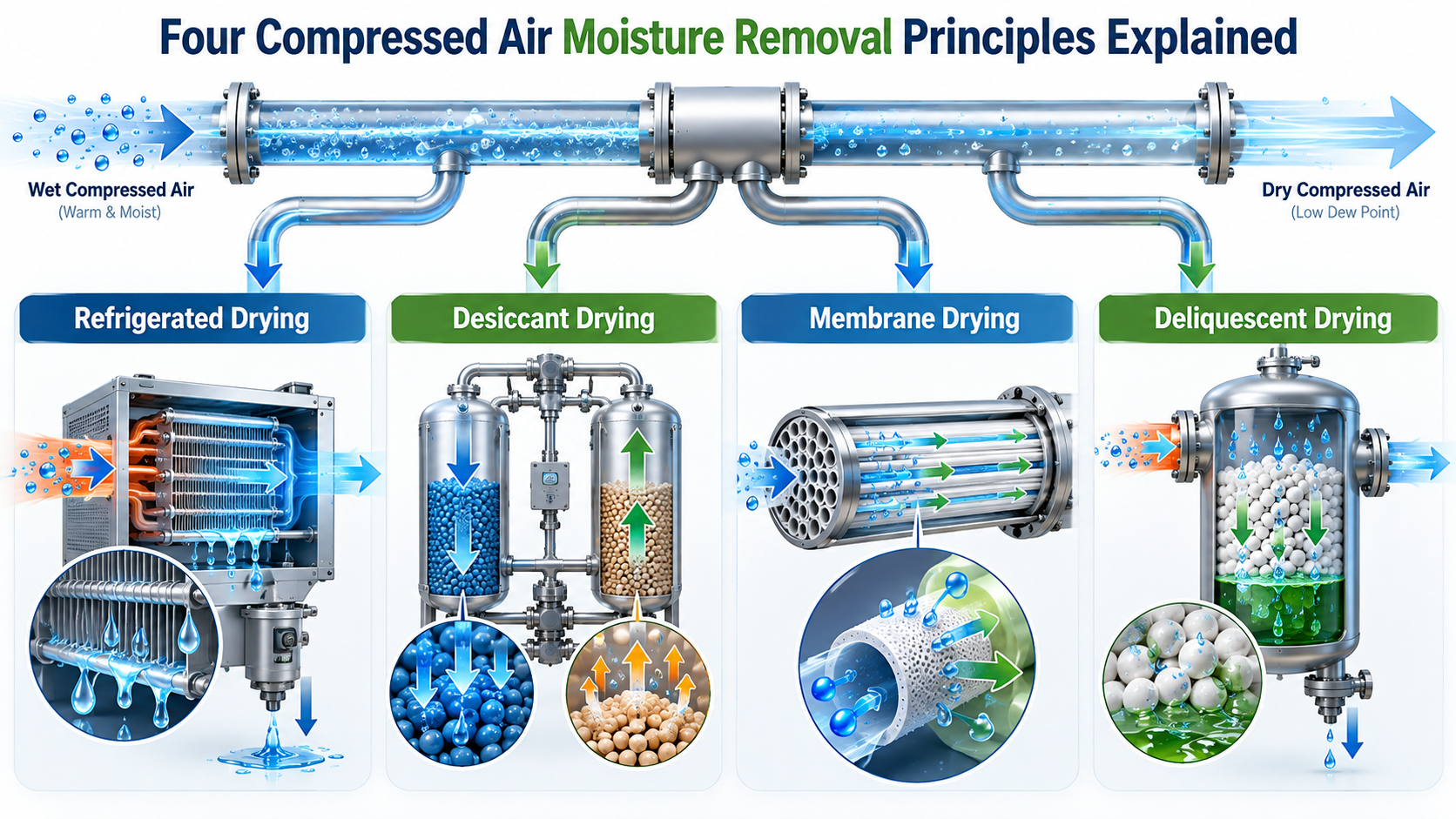
Unlike a desiccant dryer, a refrigerated dryer does not remove water vapor by adsorption. Instead, refrigeration lowers the compressed-air temperature until a substantial portion of the water vapor condenses into liquid water. That liquid is then physically separated and discharged.
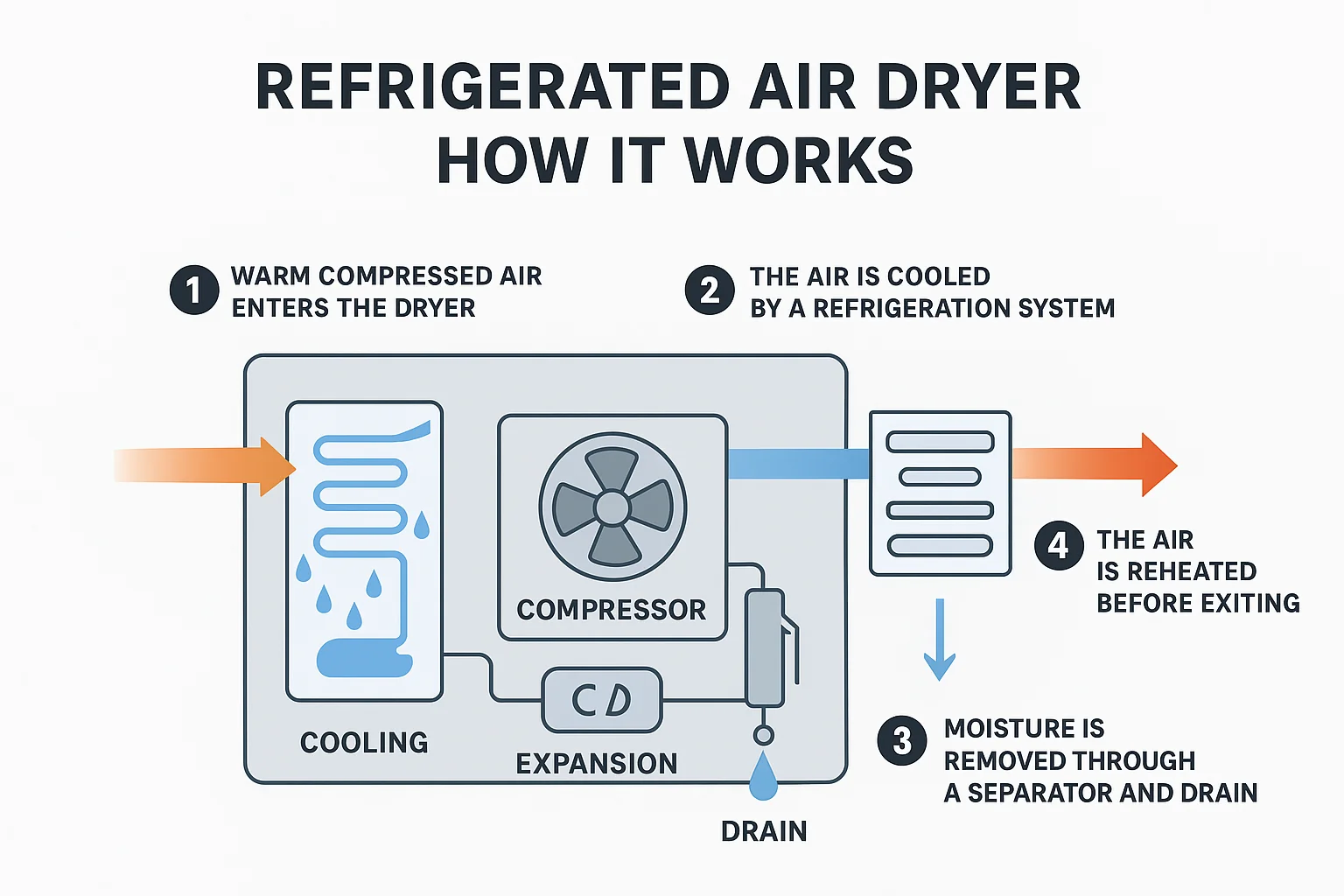
Step 1: High-Temperature Compressed Air Enters the Dryer
Compressed air entering the dryer contains water vapor and may also carry oil and other contaminants depending on the upstream compressor and treatment system.
Lingyu’s AH Series is designed around a rated inlet temperature of 50°C, with a maximum inlet temperature of ≤80°C.
Actual compressor discharge and dryer inlet temperatures vary according to compressor type, aftercooling, ambient conditions, piping, and system configuration.
Dryer selection should therefore use the actual maximum inlet temperature at the dryer rather than relying on a generic compressor-discharge temperature.
Step 2: The Air Is Pre-Cooled
The incoming compressed air first enters the air-cooled pre-cooler and air-to-air heat exchanger.
Here, part of the sensible heat is removed before the air reaches the refrigeration evaporator. This pre-cooling stage reduces the thermal load on the evaporator and refrigeration system.
The air-to-air heat exchanger also performs another important function later in the process: outgoing cold, dry air absorbs heat from the incoming warmer compressed air.
In simplified terms:
Incoming hot air gives up heat → outgoing cold dry air absorbs that heat
This internal heat recovery reduces the amount of refrigeration work required.
Step 3: The Compressed Air Enters the Evaporator
After pre-cooling, the compressed air flows into the air-to-refrigerant evaporator.
This is the main refrigeration cooling stage.
Cold refrigerant flowing through the evaporator absorbs heat from the compressed air. As the compressed-air temperature falls, its capacity to retain water vapor decreases and moisture begins to condense.
For the AH Series, the specified pressure dew point is 2–10°C.
It is important to distinguish the evaporator from the condenser:
The evaporator cools the compressed air.
The condenser rejects heat from the refrigerant to ambient air.
These components perform different functions on different sides of the refrigeration system.
Step 4: Water Vapor Condenses Into Liquid
As compressed air cools in the evaporator, moisture reaches saturation conditions and condenses.
Moisture, oil, and some impurities can condense from the compressed-air stream during this cooling process.
Condensation alone does not complete the drying process. The resulting liquid must also be separated from the airflow before the compressed air leaves the dryer.
Step 5: The Gas-Liquid Separator Removes Condensate
After cooling, the compressed air enters the gas-liquid separation stage.
Lingyu’s AH Series uses an independently designed water-separation system intended to provide reliable condensate separation.
The separator removes condensed liquid droplets from the compressed-air stream. Effective separation is important because poor separation can result in liquid carryover even when the refrigeration circuit is operating normally.
A stable outlet moisture condition therefore depends not only on refrigeration capacity but also on effective condensate separation.
Step 6: The Automatic Drain Discharges the Condensate
Once separated, the collected liquid is discharged through the automatic drain valve.
A malfunctioning or blocked drain can cause moisture problems downstream, so drain inspection should be part of routine refrigerated-air-dryer maintenance.
For broader service considerations, see Lingyu’s refrigerated compressed air dryer maintenance guide.
Step 7: The Dry Air Is Reheated
After moisture separation, the dry compressed air is still relatively cold.
It therefore returns through the air-to-air heat exchanger, where it absorbs heat from the incoming compressed air. This reheats the dried air toward ambient temperature before it leaves the dryer.
Reheating and pre-cooling are therefore two functions of the same heat-recovery process.
The outgoing dry air is warmed, while the incoming air is pre-cooled to reduce the evaporator refrigeration load.
Complete Compressed-Air Flow
For the AH Series, the practical compressed-air path is:
Compressed Air Inlet → Air-Cooled Pre-Cooler → Air-to-Air Heat Exchanger → Air-to-Refrigerant Evaporator → Condensation → Gas-Liquid Separator → Automatic Drain → Air-to-Air Heat Exchanger for Reheating → Dry Air Outlet
An inlet filter may be part of the broader compressed-air purification system, but it should not automatically be treated as an integral AH dryer component unless the specific system configuration includes it.
How the Refrigeration Circuit Works
The compressed-air path is only half of the system.
The dryer also contains a closed refrigeration circuit whose purpose is to transfer heat continuously from the compressed air to the surrounding environment.
The principal refrigeration process is:
Refrigeration compressor → condenser → expansion/control device → evaporator → compressor
Refrigeration Compressor
The refrigeration compressor raises the pressure and temperature of the refrigerant.
It provides the circulation and pressure difference required for the refrigeration cycle.
Air-Cooled Condenser
The condenser is where the term air-cooled becomes important.
Ambient air removes heat from the high-temperature refrigerant.
The condenser therefore cools the refrigerant rather than directly cooling the compressed-air stream.
Because ambient air is the heat-rejection medium, condenser performance depends on adequate ventilation and airflow around the dryer.
Expansion Device
After condensation, the refrigerant passes through the refrigerant-control or expansion section.
Its pressure is reduced before the refrigerant reaches the evaporator, creating the low-temperature conditions required for heat absorption.
Evaporator
Inside the evaporator, the refrigerant absorbs heat from the compressed air.
The compressed air becomes colder while the refrigerant absorbs energy and continues through the refrigeration cycle. The compressor then circulates it back through the system.
Why Is It Called “Air-Cooled”?
The term can easily cause confusion.
An air-cooled refrigerated dryer does not mean that ambient air directly dries the compressed air throughout the process.
Instead, air-cooled primarily describes the condenser heat-rejection method.
Ambient air removes heat from the refrigeration circuit. By comparison, a water-cooled dryer uses cooling water for condenser heat rejection.
For a detailed comparison of the alternative configuration, see the guide to water-cooled refrigerant air dryers.
Pressure Dew Point: 2–10°C
Pressure dew point is one of the most important performance specifications for a refrigerated air dryer.
For Lingyu’s AH Series, the specified PDP is 2–10°C.
Pressure dew point should not be confused with the actual dryer outlet-air temperature.
PDP describes the moisture condition of compressed air. It should not simply be treated as the physical temperature of the air leaving the dryer.
Why Refrigerated Dryers Do Not Normally Target Sub-Zero PDP
Refrigerated drying relies on cooling and condensation.
Attempting to drive the refrigeration stage substantially below freezing creates different technical challenges because condensed water can freeze.
For industrial processes requiring pressure dew points such as −20°C or −40°C, adsorption technology is generally more appropriate.
A 2–10°C PDP should therefore not be viewed as a weakness of refrigerated drying. It defines the operating range for which the technology is intended.
Users deciding between these technologies can refer to the refrigerated vs. desiccant air dryer comparison.
AH Series Operating Parameters
The AH Series technical conditions provide the following reference values:
| Parameter | AH Series |
|---|---|
| Rated inlet pressure | 0.7 MPa |
| Operating range | 0.6–1.0 MPa |
| Rated inlet temperature | 50°C |
| Maximum inlet temperature | ≤80°C |
| Pressure dew point | 2–10°C |
| Rated ambient temperature | 32°C |
| Ambient operating range | 2–45°C |
| Pressure drop | ≤0.025 MPa |
| Cooling method | Air-cooled |
| Standard refrigerant | R22 |
| Optional refrigerants | R407C / R410A on request |
The correct approach is to select the dryer according to its actual operating envelope rather than describing the equipment only in broad pressure or application categories.
Refrigerants Used in the AH Series
The AH Series specifies R22 as the standard refrigerant, while R407C and R410A are available upon request.
Because refrigerant rules vary between markets, the final refrigerant should also be confirmed according to the destination country’s regulatory requirements and the actual product configuration.
Pressure Drop Is Part of Dryer Efficiency
Removing moisture is not the only performance objective.
Compressed air must also pass through the dryer without excessive pressure loss.
Lingyu specifies AH Series pressure drop at ≤0.025 MPa under the stated operating conditions.
Higher pressure drop can require higher compressor discharge pressure to maintain the desired downstream pressure. Dryer energy performance should therefore consider system pressure loss as well as refrigeration-compressor power.
How Load Variation Is Managed
Lingyu’s AH Series includes a load-response feature on applicable capacities.
For models from 5 to 180 m³/min, a 1+1 dual refrigeration compressor configuration is used. The second compressor starts or stops automatically according to system load.
This allows the refrigeration system to respond to changing compressed-air demand rather than operating the same compressor configuration under every load condition.
Why Ambient Temperature Matters
An air-cooled condenser rejects refrigeration heat into the surrounding air.
If ambient temperature becomes excessive or airflow around the condenser is restricted, heat rejection becomes more difficult.
For the AH Series, the rated ambient temperature is 32°C, while the ambient operating range is 2–45°C.
The dryer should be installed and sized so that actual ambient conditions remain within the specified operating envelope.
Ventilation and Installation Clearance
Because the condenser depends on ambient airflow, installation space matters.
The AH Series is designed for indoor installation on a level concrete floor and has a recommended minimum clearance of 1.5 m around the unit.
Adequate clearance supports condenser airflow, heat rejection, inspection, cleaning, and service access.
An air-cooled dryer should therefore not be installed in a small enclosure without considering ventilation.
Is an Inlet Filter Part of the Dryer?
Filtration is important in a complete compressed-air purification system, especially when oil and particulate contamination need to be controlled.
However, an inlet filter should be distinguished from the AH dryer’s core air-flow components unless it is included in the specific system configuration.
This distinction separates the dryer itself from upstream and downstream compressed-air treatment equipment and avoids implying that refrigerated drying provides every required filtration function.
Why Is the Dry Air Reheated?
The AH Series air-flow arrangement reheats dry compressed air through the air-to-air heat exchanger toward ambient temperature.
This heat recovery reduces unnecessary cold-air delivery downstream, supports more stable distribution conditions, and simultaneously pre-cools the incoming compressed air.
No fixed 10–15°C outlet temperature is required to explain this process.
The key function is heat recovery between the outgoing cold dry air and incoming warmer compressed air.
How to Size an Air-Cooled Refrigerated Dryer
Rated airflow alone is not enough for correct selection.
Sizing should consider maximum actual airflow, inlet pressure, inlet temperature, ambient temperature, required pressure dew point, pressure drop, load variation, and ventilation conditions.
High inlet temperature, high ambient temperature, or lower operating pressure can increase the effective load on a refrigerated dryer.
For a more detailed methodology, see Lingyu’s refrigerated air dryer sizing guide.
For buyers already evaluating a specific capacity, the 100 CFM air-cooled refrigerated air dryer provides a product-level reference.
Typical Maintenance Points
Although refrigerated dryers do not use desiccant regeneration, they still require regular inspection.
Important maintenance points include the air-cooled condenser, pre-cooler, heat exchanger, evaporator, gas-liquid separator, automatic drain, refrigeration compressor, refrigerant circuit, and controls.
For an air-cooled unit in particular, condenser cleanliness and unobstructed airflow are important because the refrigeration circuit must continuously reject heat to ambient air.
A rising dew point should not automatically be interpreted as insufficient refrigerant. Possible causes can include excessive airflow, high inlet temperature, high ambient temperature, blocked condenser airflow, poor condensate drainage, separator problems, or refrigeration-system faults.
Complete Working-Principle Summary
The AH Series process can be understood through two coordinated circuits.
Compressed-Air Circuit
Hot wet compressed air → pre-cooling → air-to-air heat exchange → evaporator cooling → water condensation → gas-liquid separation → automatic drainage → reheating → dry compressed air
Refrigeration Circuit
Refrigeration compressor → air-cooled condenser → refrigerant control/expansion stage → evaporator → refrigeration compressor
The two circuits meet thermally at the evaporator.
The refrigerant absorbs heat while the compressed air loses heat. Water vapor condenses, the separator removes the resulting liquid, and the air-to-air heat exchanger then reheats the dry compressed air while simultaneously pre-cooling the next incoming air stream.
That is the fundamental operating mechanism of an air-cooled refrigerated air dryer.
Conclusion
An air-cooled refrigerated air dryer removes moisture through refrigeration, condensation, mechanical separation, and drainage.
In the Lingyu AH Series, high-temperature compressed air first passes through the pre-cooling and air-to-air heat-exchange section. It then enters the air-to-refrigerant evaporator, where it is cooled to the conditions required for a 2–10°C pressure dew point. Condensed moisture is separated and automatically drained, after which the dry compressed air is reheated toward ambient temperature before leaving the dryer.
The refrigeration circuit operates separately: the evaporator absorbs heat from the compressed air, while the air-cooled condenser rejects that heat to ambient air.
Important AH Series reference conditions include 0.7 MPa rated inlet pressure, 0.6–1.0 MPa operating pressure, 50°C rated inlet temperature, ≤80°C maximum inlet temperature, 2–10°C PDP, ≤0.025 MPa pressure drop, 32°C rated ambient temperature, 2–45°C ambient operating range, R22 standard refrigerant, R407C/R410A optional refrigerants, 5–180 m³/min for the stated 1+1 dual-compressor configuration, and 1.5 m recommended installation clearance.
Understanding the relationship between the compressed-air and refrigeration circuits—and the roles of the pre-cooler, heat exchanger, evaporator, separator, drain, refrigeration compressor, and condenser—is the key to properly selecting, operating, and troubleshooting an air-cooled refrigerated air dryer.