Compressed air naturally contains water vapor. After compression, the air temperature rises; as the air subsequently cools, part of that water vapor can condense inside receivers, piping, and downstream equipment. If moisture is not adequately controlled, it can contribute to corrosion, pneumatic equipment problems, process contamination, and production interruptions.
Different types of compressed air dryers solve this problem in different ways. The best choice depends primarily on the required pressure dew point, actual airflow, inlet temperature, operating pressure, environmental conditions, pressure drop, and lifecycle operating cost.
For industrial systems, Lingyu’s compressed air treatment products include refrigerated, adsorption, and combined drying technologies for different moisture-control requirements.
Main Types of Compressed Air Dryers
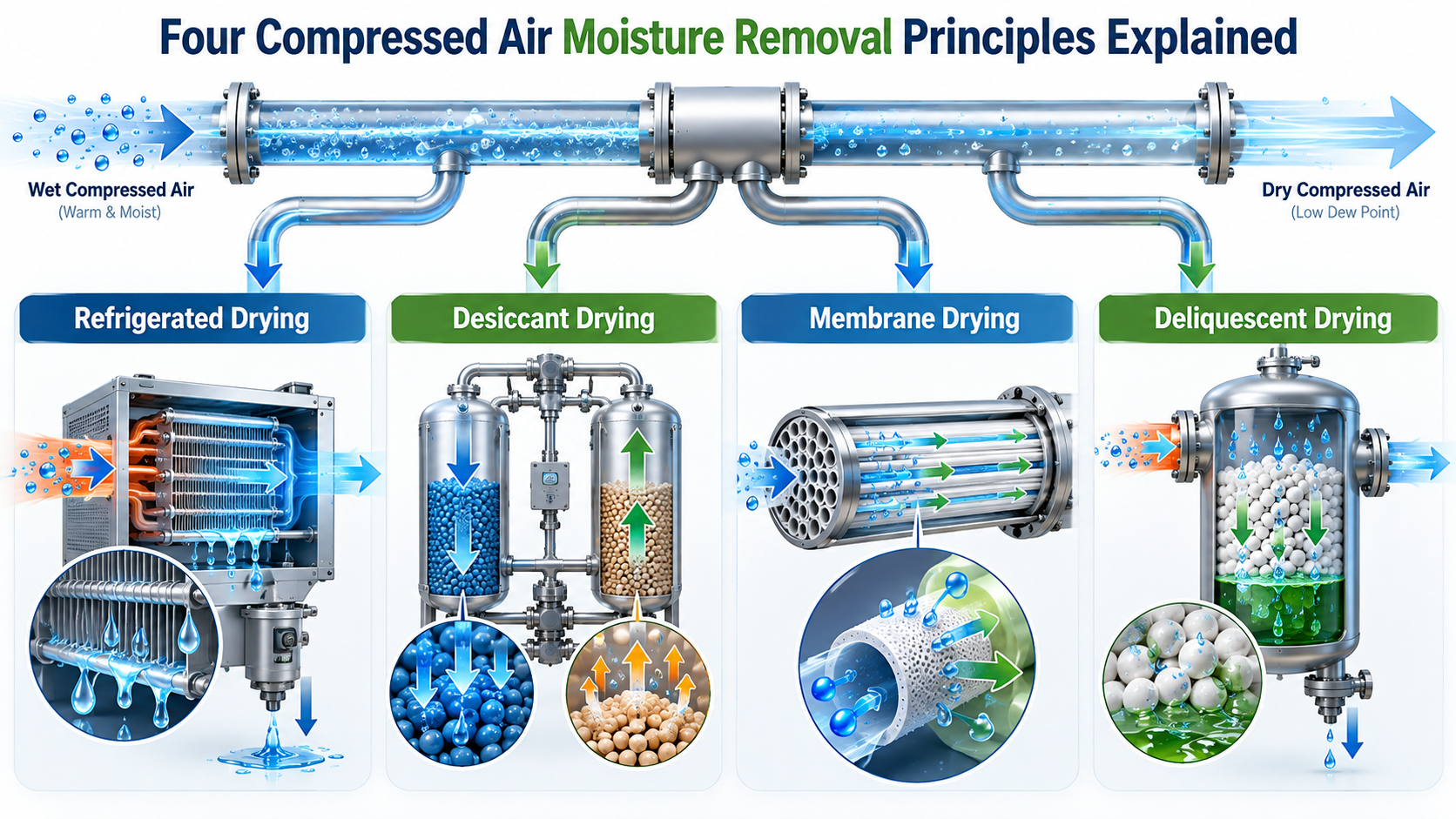
The main industrial dryer technologies include refrigerated dryers, desiccant or adsorption dryers, combined dryers, membrane dryers, and deliquescent dryers.
These technologies should not be compared solely by purchase price or nominal CFM. Their achievable pressure dew points, regeneration requirements, energy consumption, installation requirements, and maintenance needs differ substantially.
To understand the physical mechanisms behind these technologies—including condensation, desiccant adsorption, membrane permeation, and chemical moisture absorption—read our guide to compressed air moisture removal principles.
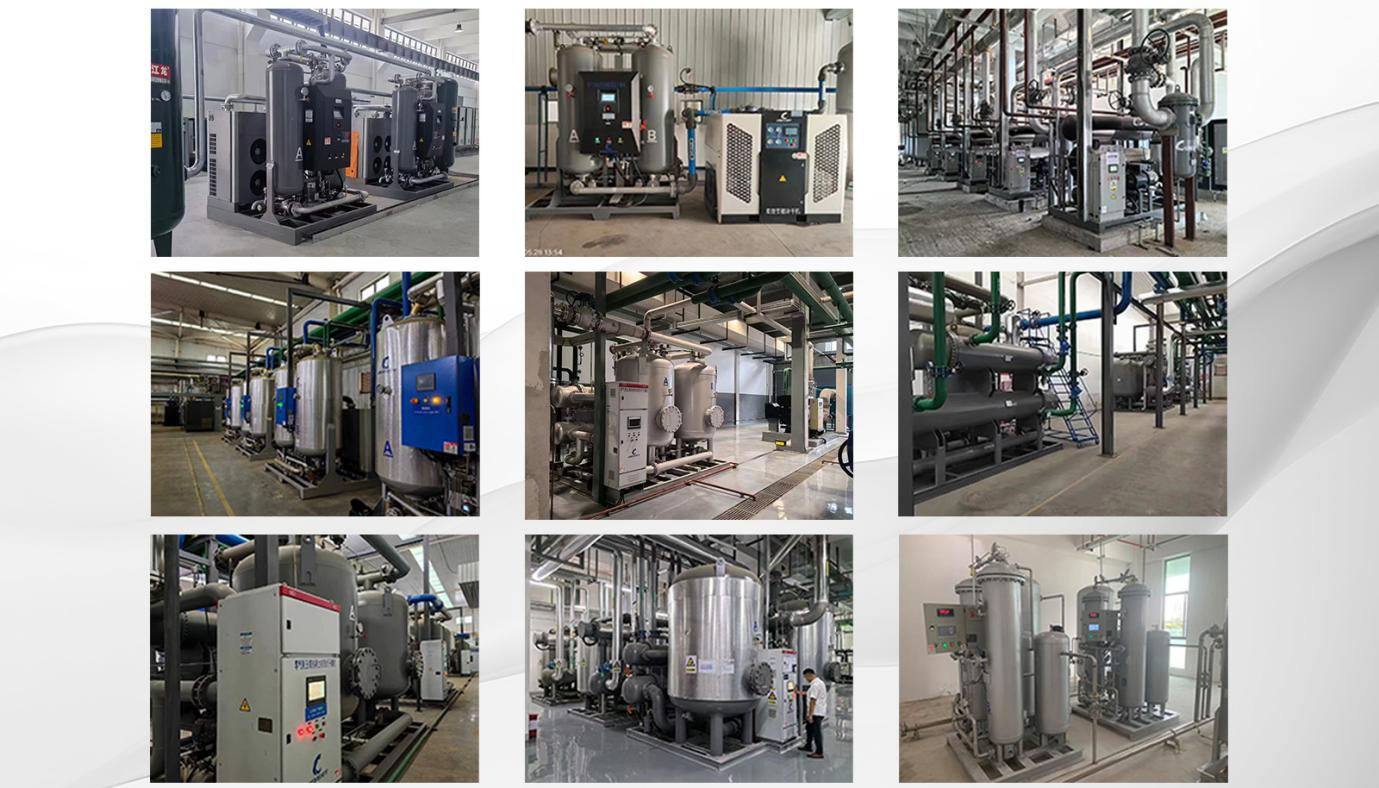
1. Refrigerated Air Dryers
A refrigerated air dryer removes moisture through cooling and condensation.
Hot, moisture-laden compressed air enters the dryer and is cooled. As its temperature falls, water vapor condenses into liquid. The condensed moisture is then separated and discharged through a drain.
For Lingyu’s conventional AH air-cooled and WH water-cooled technology, the process can be summarized as:
hot wet compressed air → pre-cooling → refrigeration cooling → condensation → gas-liquid separation → automatic drainage → reheating → dry compressed air
Refrigerated Dryer Pressure Dew Point
Lingyu’s conventional AH and WH refrigerated dryers specify a 2–10°C pressure dew point under rated conditions.
This makes refrigerated drying suitable for many indoor industrial systems where extremely low PDP is unnecessary.
It is more accurate to use the specified 2–10°C range than to assume every refrigerated dryer will continuously deliver a fixed 2–4°C PDP.
Typical Operating Conditions
| Parameter | Specification |
|---|---|
| Rated inlet pressure | 0.7 MPa |
| Operating pressure range | 0.6–1.0 MPa |
| Rated inlet temperature | 50°C |
| Maximum inlet temperature | ≤80°C |
| Pressure dew point | 2–10°C |
| Rated ambient temperature | 32°C |
| Ambient operating range | 2–45°C |
| Pressure drop | ≤0.025 MPa |
Advantages of Refrigerated Dryers
Refrigerated drying offers a practical combination of moisture control, relatively straightforward operation, and no requirement for desiccant regeneration purge air.
It is particularly suitable when the required pressure dew point falls within the capability of refrigeration technology.
For smaller compressed air systems, Lingyu’s 75 CFM air-cooled refrigerated air dryer provides a purpose-built refrigerated solution.
Limitations
A refrigerated dryer is generally not appropriate when downstream piping will experience temperatures below the delivered pressure dew point.
It may also be insufficient for highly moisture-sensitive processes requiring substantially drier compressed air.
In these situations, adsorption drying should be evaluated.
2. Desiccant or Adsorption Air Dryers
A desiccant air dryer removes water vapor through adsorption rather than refrigeration.
Most industrial adsorption dryers use two desiccant towers. During operation, one tower dries the compressed air while the other regenerates. The towers periodically switch functions to maintain continuous operation.
The basic process is:
wet compressed air → adsorption tower → moisture retained by desiccant → dry compressed air
Industrial desiccant dryers generally operate by adsorption, where water molecules adhere to the desiccant surface.
Heatless Desiccant Dryers
Heatless regeneration uses a portion of already dried compressed air to regenerate the offline tower.
Lingyu’s CH Series heatless technology operates with the following standard conditions:
| Parameter | CH Heatless Specification |
|---|---|
| Rated inlet pressure | 0.7 MPa |
| Operating pressure | 0.6–1.0 MPa |
| Rated inlet temperature | 10–30°C |
| Maximum inlet temperature | ≤40°C |
| Regeneration air consumption | 8–14% |
| Pressure dew point | −50°C to −20°C |
| Desiccant | Activated alumina |
Heatless technology has a relatively straightforward regeneration principle, but the purge air has already been compressed and dried, so its consumption represents an operating-energy cost.
Lingyu’s CH Series heatless regeneration adsorption dryer is designed around this regeneration method.
Heated Regeneration Desiccant Dryers
A heated regeneration dryer introduces external heat during desorption.
Heating reduces the amount of dry compressed air required for regeneration compared with a conventional heatless configuration.
For Lingyu’s CH Series heated regeneration technology:
| Parameter | CH Heated Specification |
|---|---|
| Rated inlet pressure | 0.7 MPa |
| Operating pressure | 0.6–1.0 MPa |
| Rated inlet temperature | 10–30°C |
| Maximum inlet temperature | ≤40°C |
| Regeneration air consumption | 4–8% |
| Pressure dew point | −50°C to −20°C |
| Desiccant | Activated alumina |
The lower purge requirement comes with additional heater energy consumption and system complexity.
The CH Series heated regeneration adsorption air dryer is one option for applications where this balance is appropriate.
Blower Regeneration Dryers
Blower-heated adsorption dryers use a blower and heater during regeneration, reducing dependence on dry compressed air as the regeneration medium.
This can become particularly relevant for larger compressed air systems because compressed-air purge represents a significant operating cost at high flow rates.
However, blower systems introduce their own electricity consumption, components, and control requirements.
They should therefore be evaluated according to total lifecycle energy consumption, not purge percentage alone.
Lingyu’s blower zero-purge adsorption dryer provides another regeneration approach for applications where reducing compressed-air consumption during regeneration is a priority.
Heat-of-Compression Dryers
Heat-of-compression, or HOC, dryers utilize thermal energy available from the compressor system for desiccant regeneration.
This can reduce reliance on separate regeneration energy sources when the compressor configuration and operating conditions are suitable.
HOC dryer selection is closely connected to:
compressor type + discharge temperature + airflow + load profile + cooling arrangement + required pressure dew point
For this reason, an HOC dryer should normally be evaluated as part of the complete compressor station.
Lingyu’s heat-of-compression dryer category includes solutions based on this regeneration principle.
3. Combined Compressed Air Dryers
Combined dryers integrate refrigerated and adsorption drying stages.
The refrigerated section first removes a substantial portion of the moisture load through cooling, condensation, and separation. The compressed air then passes to an adsorption stage for deeper drying.
The simplified process is:
wet compressed air → refrigerated drying → bulk moisture removal → adsorption drying → low-PDP compressed air
This arrangement reduces the moisture load imposed on the desiccant stage and can be useful for installations requiring low pressure dew points while also seeking to optimize the overall treatment process.
Lingyu’s DC Series combined compressed air dryer integrates these two drying principles into one treatment solution.
4. Membrane Air Dryers
Membrane dryers use selective permeation through specialized membrane fibers.
Water vapor passes through the membrane at a different rate from the main compressed air stream, allowing moisture to be reduced.
Membrane dryers can be attractive for certain point-of-use and lower-flow applications because they are compact and do not require a refrigeration compressor.
However, describing them simply as “energy-free” can be misleading.
Many membrane systems use part of the compressed air as sweep or purge air. Because producing compressed air requires electricity, this lost compressed air represents an indirect energy cost.
Their suitability should therefore be evaluated according to required flow, dew point, purge loss, installation space, and lifecycle cost.
5. Deliquescent Air Dryers
Deliquescent dryers use a consumable chemical drying medium.
The material absorbs moisture and gradually dissolves, producing a liquid that must be drained from the system.
Their relatively simple operating principle can be useful in certain remote or specialized installations.
However, deliquescent drying differs substantially from both refrigerated and regenerative adsorption technologies.
Important considerations include consumable chemical replacement, disposal requirements, limited dew-point suppression, downstream carryover control, and performance changes as operating conditions vary.
For industrial applications requiring a precisely defined low pressure dew point, refrigerated or regenerative adsorption technologies are generally evaluated according to their specified performance.
Compressed Air Dryer Comparison
| Dryer Technology | Moisture-Removal Method | Dew-Point Capability | Regeneration | Main Consideration |
|---|---|---|---|---|
| Refrigerated | Cooling and condensation | Lingyu conventional: 2–10°C PDP | None | Practical for general industrial air |
| Heatless adsorption | Desiccant adsorption | CH: −50 to −20°C PDP | Dry compressed-air purge | Purge-air consumption |
| Heated adsorption | Desiccant adsorption | CH: −50 to −20°C PDP | Heat + reduced purge | Heater energy and purge |
| Blower adsorption | Desiccant adsorption | Configuration-dependent | Blower/heating system | Lifecycle energy |
| Heat of compression | Desiccant adsorption | Configuration-dependent | Compressor heat | Compressor-system compatibility |
| Combined | Refrigeration + adsorption | Low PDP according to configuration | Adsorption stage regenerates | Integrated system design |
| Membrane | Selective permeation | Design-dependent | Typically sweep/purge air | Flow and compressed-air loss |
| Deliquescent | Chemical moisture removal | Limited suppression | Consumable medium | Chemical replacement |
There is no universally “best” compressed air dryer. The correct technology depends on the actual process requirement.
How to Choose the Right Type of Compressed Air Dryer
Start With the Required Pressure Dew Point
The first question should be:
How dry does the compressed air actually need to be?
If a 2–10°C PDP is adequate, refrigerated drying may be the most practical solution.
If piping is exposed to freezing temperatures or the process requires substantially drier compressed air, adsorption technology becomes more appropriate.
Selecting an adsorption dryer when refrigerated drying already meets the process requirement can add unnecessary capital and operating cost. Conversely, selecting refrigerated drying for a low-PDP application can leave the system inadequately protected.
Determine Actual Peak Airflow
Do not choose a dryer solely by matching its CFM rating to the compressor nameplate.
The relevant value is the maximum airflow that will actually pass through the dryer.
Consider peak production demand, simultaneous compressor operation, compressor sequencing, and realistic future expansion.
Check Inlet Temperature
Temperature significantly influences dryer performance.
For Lingyu’s conventional refrigerated AH and WH dryers, the rated inlet temperature is 50°C, with a maximum of ≤80°C.
For conventional CH and HH adsorption dryers, the rated inlet temperature is 10–30°C, with a maximum of ≤40°C.
The compressor aftercooler and upstream condensate separation system can therefore have a major influence on dryer loading.
Check Operating Pressure
Operating pressure affects dryer capacity and overall system performance.
Many Lingyu refrigerated and adsorption series use 0.7 MPa rated inlet pressure, but exact operating conditions should always be checked for the selected product.
Do not assume that every dryer has identical pressure limits.
Consider Pressure Drop
Dryer energy consumption is not limited to electricity, heaters, blowers, or purge air.
Pressure drop also matters.
The complete compressed air treatment train can include separators, filters, dryers, valves, fittings, and piping.
If excessive pressure loss requires the compressor to operate at a higher discharge pressure, system energy consumption can increase.
Consider Regeneration Cost
For adsorption dryers, compare regeneration methods using actual operating costs.
Heatless systems consume dry compressed air.
Heated systems reduce purge demand but require heater energy.
Blower systems add blower and heating requirements while reducing reliance on compressed-air purge.
HOC systems can utilize compressor heat but depend strongly on the compressor station configuration.
The lowest purge percentage does not automatically mean the lowest lifecycle cost.
Don’t Choose a Dryer by Industry Name Alone
A common mistake is to assume that every application in a particular industry needs the same dryer.
For example, pharmaceutical and biopharmaceutical manufacturing can contain applications with very different compressed air requirements.
Likewise, electronics and precision manufacturing can include general pneumatic equipment as well as highly moisture-sensitive production processes.
One may be adequately served by refrigerated drying while another requires a substantially lower pressure dew point.
The process specification—not the industry label—should determine the dryer technology.
Drying and Filtration Are Different
A dryer primarily addresses moisture.
Compressed air may also contain solid particles, rust, oil aerosols, oil vapor, and other contaminants.
Appropriate precision compressed air filters should therefore be selected according to compressor type, dryer technology, and final air-quality requirements.
Drying and filtration should be designed as complementary treatment stages.
Which Dryer Is Best for Below-Freezing Conditions?
If downstream piping is exposed to temperatures below the delivered pressure dew point, water can condense again.
For this reason, a conventional refrigerated dryer with a 2–10°C PDP is generally unsuitable where compressed air lines will regularly encounter freezing temperatures.
A properly selected adsorption dryer with a sufficiently low PDP is more appropriate.
The required pressure dew point should include an appropriate margin relative to the minimum expected downstream temperature.
Which Dryer Uses the Least Energy?
There is no universal answer.
Energy consumption depends on airflow, load profile, required PDP, pressure drop, purge-air consumption, heater power, blower power, refrigeration load, compressor configuration, and annual operating hours.
A refrigerated dryer may provide an economical solution when its PDP is sufficient.
For a low-PDP application, however, the comparison should be made among suitable adsorption regeneration technologies rather than against a dryer that cannot meet the specification.
Maintenance Requirements by Dryer Type
Maintenance should be based on equipment design, operating hours, environment, contamination, and actual condition rather than applying the same six- or twelve-month interval to every dryer.
Refrigerated dryers require attention to components such as condensers, automatic drains, heat exchangers, refrigeration systems, electrical components, and filters.
Adsorption dryers additionally require monitoring of desiccant condition, switching valves, purge systems, silencers, heaters or blowers where applicable, controls, and pressure dew-point performance.
Combined systems require attention to both refrigeration and adsorption stages.
Frequently Asked Questions
What is the most common type of compressed air dryer?
Refrigerated drying is widely used for general industrial compressed air because many applications do not require the very low pressure dew point produced by adsorption technology.
The correct technology should still be selected from the actual process requirements.
Which type of air dryer produces the driest compressed air?
Adsorption dryers are used when substantially lower pressure dew points are required.
For example, Lingyu’s CH heatless and heated regeneration technologies specify a −50°C to −20°C PDP range under specified conditions, while HH heatless technology can provide ≤−40°C PDP.
Does every desiccant dryer consume purge air?
No.
Regeneration methods differ. Heatless and heated-purge systems use compressed air to different degrees, while blower and heat-of-compression technologies use different regeneration strategies.
Does a membrane dryer use no energy?
It may not require an electrical refrigeration compressor, but many membrane dryers consume compressed air as sweep or purge air.
The energy required to produce that compressed air should be included in lifecycle analysis.
How often should a compressed air dryer be maintained?
There is no universal interval.
Follow the requirements for the specific equipment and adjust inspection frequency according to operating hours, environmental conditions, contamination, pressure drop, drain performance, desiccant condition, and pressure dew-point performance.
Do I need filters if I already have an air dryer?
Usually, the complete compressed air treatment system must address contaminants other than moisture.
The exact filtration arrangement depends on compressor type, dryer technology, and required final air quality.
Select the Dryer Technology From the Process Requirement
Choosing among the different types of compressed air dryers begins with defining what the compressed air system actually needs.
For general industrial moisture control, refrigerated drying can provide a practical solution when a 2–10°C PDP is sufficient.
For significantly lower pressure dew points, heatless, heated, blower, or heat-of-compression adsorption technologies can be evaluated according to airflow, regeneration air consumption, energy use, and operating profile.
Combined dryers provide another option when refrigerated pre-drying and deeper adsorption drying are beneficial within the same treatment system.
The final decision should therefore be based on:
required PDP + peak airflow + inlet temperature + operating pressure + environmental conditions + pressure drop + regeneration requirements + lifecycle cost
For application-specific dryer selection, contact Lingyu with your airflow, pressure, inlet temperature, ambient conditions, compressor configuration, and required pressure dew point.