A 75 CFM refrigerated air dryer is commonly used in small to medium industrial compressed air systems where reliable moisture control is required without the very low pressure dew points associated with adsorption drying.
For long-term value, however, selecting the correct capacity is only the beginning. Installation quality, condenser ventilation, filtration, condensate drainage, pressure drop, operating temperature, and preventive maintenance all affect energy consumption and service reliability.
The 75 CFM Refrigerated Air Dryer should therefore be evaluated as part of the complete compressed air system rather than as an isolated piece of equipment.
Typical Operating Conditions
For Lingyu’s AH Series air-cooled refrigerated drying technology, typical operating conditions include:
- Rated inlet pressure: 0.7 MPa
- Operating pressure range: 0.6–1.0 MPa
- Rated inlet temperature: 50°C
- Maximum inlet temperature: ≤80°C
- Pressure dew point: 2–10°C
- Rated ambient temperature: 32°C
- Ambient operating range: 2–45°C
- Pressure drop: ≤0.025 MPa
- Cooling method: Air-cooled
- Installation: Indoor installation on a level concrete floor
- Recommended clearance: At least 1.5 m around the unit
Actual performance should always be evaluated against the site’s airflow, inlet temperature, ambient temperature, and operating pressure.
Why Proper Installation Matters
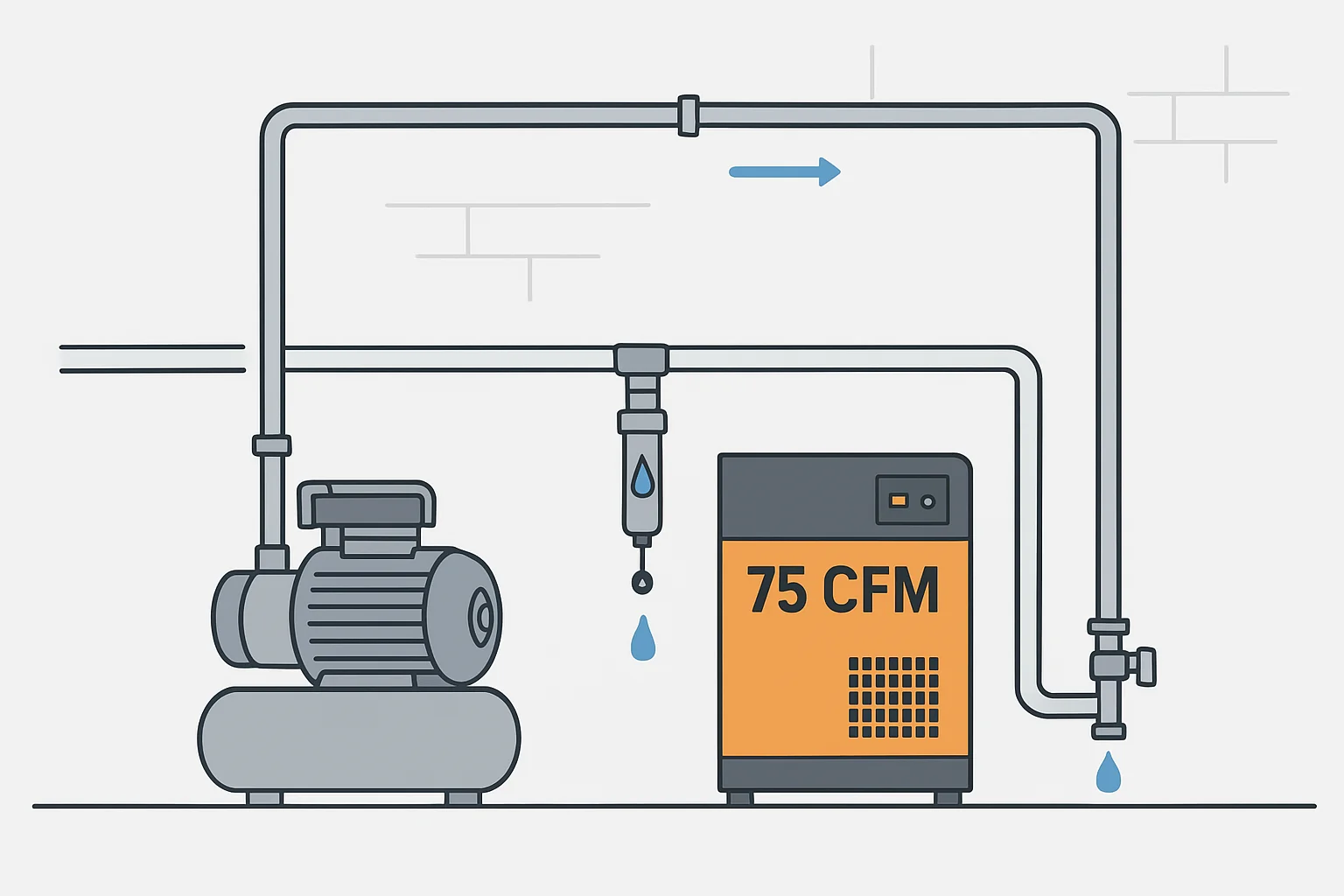
Incorrect installation can reduce dryer performance even when the unit itself is correctly sized.
Provide Adequate Ventilation
An air-cooled refrigerated dryer rejects heat through its condenser.
If the dryer is installed in a confined compressor room where hot air accumulates, condenser temperature rises and the refrigeration system must work under more demanding conditions.
Install the dryer in a well-ventilated indoor area and avoid allowing hot condenser exhaust to recirculate back into the air inlet.
Maintain Sufficient Service Clearance
The standard AH Series installation recommendation is approximately 1.5 m of clearance around the unit.
Adequate clearance helps with:
- Condenser airflow
- Heat dissipation
- Condenser cleaning
- Electrical inspection
- Refrigeration servicing
- Drain maintenance
Restricted space may also make routine maintenance more difficult, increasing the likelihood that cleaning or inspection is delayed.
Keep the Dryer Level
Install the dryer on a level concrete floor.
A stable installation helps maintain proper condensate drainage and reduces unnecessary vibration or mechanical stress.
The main concern is not maintaining an “even refrigerant level,” but ensuring correct equipment orientation, drainage, and mechanical stability.
Piping Design and Pressure Drop
Piping can have a significant effect on compressed air system efficiency.
Avoid:
- Undersized pipe
- Excessively long pipe runs
- Unnecessary elbows
- Sharp directional changes
- Restrictive valves
- Poorly selected fittings
The AH Series dryer itself is designed for a pressure drop of ≤0.025 MPa under specified conditions, but total system pressure loss also includes filters, piping, valves, separators, and other treatment equipment.
Reducing unnecessary pressure loss can lower the compressor discharge pressure required to deliver adequate pressure at the point of use.
How to Confirm That 75 CFM Is the Right Capacity
A dryer should not be selected solely because the compressor nameplate is close to 75 CFM.
Actual capacity depends on operating conditions.
Evaluate:
- Peak compressed air demand
- Inlet air temperature
- Operating pressure
- Ambient temperature
- Compressor duty cycle
- Future production demand
If actual conditions differ significantly from the rated conditions, appropriate correction factors should be applied.
A 75 CFM dryer operating near its limit under high inlet and ambient temperatures may provide less effective capacity than the same dryer under moderate conditions.
Filtration Protects the Dryer and Downstream Equipment
Compressed air can contain oil aerosols, solid particles, rust, and other contaminants in addition to moisture.
Suitable precision compressed air filtration can help protect both the dryer and downstream equipment.
Upstream filtration may reduce contamination entering the heat exchanger and drain system, while downstream filtration can provide additional particle or oil control where required.
Not every installation requires the same filtration sequence. Filter grades should be selected according to compressor type and the final compressed air specification.
Automatic Drain Maintenance
The refrigerated dryer separates condensed liquid from the compressed air, but that condensate must be discharged effectively.
A blocked or malfunctioning automatic drain can allow liquid water to accumulate and eventually carry downstream.
Regularly check:
- Whether condensate is being discharged
- Whether the drain valve is blocked
- Whether the drain line is restricted
- Whether the drain leaks compressed air continuously
- Whether contamination has accumulated inside the drain assembly
Inspection frequency should reflect actual humidity, contamination, and operating hours rather than one fixed quarterly schedule for every system.
Condenser Cleaning
The air-cooled condenser is one of the most important maintenance points.
Dust, oil mist, fibers, and other debris can reduce airflow and heat-transfer efficiency.
A contaminated condenser may contribute to:
- Higher refrigeration pressure
- Reduced cooling performance
- Higher operating temperature
- Protection trips
- Shorter component life
Inspect the condenser regularly and clean it according to actual environmental conditions.
A dusty workshop may require much more frequent cleaning than a clean equipment room.
Filter Inspection and Replacement
Filters should be maintained according to actual contamination load and differential pressure rather than replaced automatically on a fixed three-month or six-month schedule.
An increasingly restricted filter can:
- Increase pressure drop
- Reduce downstream pressure
- Raise compressor energy demand
- Affect system airflow
Inspect filter condition and replace elements according to the manufacturer’s service criteria.
Long-Term Shutdown Procedures
If the dryer or compressed air system will remain out of service for an extended period, prepare it properly before shutdown.
Useful steps can include:
- Isolating and depressurizing equipment safely
- Draining accumulated condensate
- Checking drain lines
- Cleaning contaminated condenser surfaces
- Protecting exposed equipment from dust and moisture
- Following model-specific electrical shutdown procedures
Do not leave standing condensate in piping or treatment equipment for long periods where corrosion may occur.
Energy-Saving Strategies
Energy optimization should focus on the complete compressed air system rather than simply trying to keep the dryer away from full load.
Do Not Intentionally Avoid Full Load
A correctly selected dryer should be capable of operating at its rated capacity under the specified conditions.
There is no general reason to avoid full-load operation solely to save energy.
The real concern is continuous overload, where airflow or thermal load exceeds the dryer’s effective capacity.
Keep Ambient Temperature Under Control
The rated ambient temperature for the AH Series is 32°C, with an operating range of 2–45°C.
Higher ambient temperatures make condenser heat rejection more difficult.
Good compressor-room ventilation can therefore improve operating stability.
Control Inlet Temperature
The rated inlet temperature is 50°C, with a maximum allowable value of 80°C.
A properly functioning compressor aftercooler and upstream condensate separator reduce both thermal and moisture load before the air reaches the dryer.
Repair Compressed Air Leaks
Leaks increase compressor output and dryer loading without contributing to production.
A significant leak can make a properly sized dryer appear undersized.
Leak detection and repair therefore benefit both compressor and dryer efficiency.
Avoid Excessive System Pressure
Operating the compressed air system at a higher pressure than necessary increases compressor energy demand.
Maintain sufficient downstream pressure for production while avoiding unnecessary pressure margin.
Should the Dryer Be Switched Off During Low Demand?
Intermittent shutdown can reduce unnecessary operating time in some systems, but repeated short cycling is not always desirable.
Before adding automatic start/stop control, consider:
- Compressor operating pattern
- Air receiver capacity
- Production schedule
- Dryer restart behavior
- Refrigeration compressor protection requirements
- Risk of supplying untreated air during startup
For predictable periods when no compressed air is required, coordinated shutdown may be practical. Frequent uncontrolled cycling should be avoided.
Smart Monitoring for Critical Systems
Monitoring can help identify performance deterioration before it creates downstream moisture problems.
Useful parameters include:
- Operating pressure
- Inlet temperature
- Ambient temperature
- Airflow
- Outlet pressure dew point
- Pressure drop
- Condensate discharge
- Refrigeration operating condition
For critical facilities, these measurements can be integrated into plant monitoring or maintenance systems where appropriate.
Troubleshooting: Dew Point Is Too High
If the dryer no longer achieves its expected dew point, possible causes include:
- Airflow above effective dryer capacity
- Excessive inlet temperature
- High ambient temperature
- Dirty condenser
- Poor ventilation
- Filter restriction
- Drain malfunction
- Refrigeration-system fault
Start by checking airflow and temperature conditions rather than immediately assuming that refrigerant is low.
Troubleshooting: Unusual Noise
Abnormal noise can originate from several areas:
- Condenser fan
- Refrigeration compressor
- Loose enclosure panels
- Mounting fasteners
- Bearings
- Vibration from piping
Identify the source before replacing components.
Cleaning the condenser may help where airflow is restricted, but persistent mechanical noise should be inspected by qualified service personnel.
Troubleshooting: Poor Condensate Drainage
If the drain does not discharge correctly, check:
- Drain valve contamination
- Blocked drain line
- Incorrect piping arrangement
- Electrical or control problems
- Excessive discharge backpressure
A malfunctioning drain should be corrected promptly because accumulated water can eventually enter the downstream air system.
Protecting Equipment and Reducing Downtime
One of the main economic benefits of refrigerated drying comes from preventing moisture-related problems downstream.
Condensed water can contribute to:
- Pipe corrosion
- Pneumatic valve problems
- Cylinder wear
- Tool deterioration
- Product contamination
- Production interruptions
A correctly maintained dryer therefore supports the reliability of the complete compressed air network rather than simply improving the dryer itself.
Applications for a 75 CFM Refrigerated Dryer
Automotive and General Manufacturing
In automotive and general manufacturing, refrigerated drying can support pneumatic tools, assembly machinery, actuators, and control systems.
Moisture control can also be important where compressed air is used around coating or finishing processes, although final air quality should be selected according to the specific application.
Food and Beverage Operations
In food and beverage production, compressed air may support packaging equipment, pneumatic machinery, and conveying systems.
A refrigerated dryer can control moisture, but the complete filtration and air-quality requirements should be determined according to how the compressed air interacts with the production process.
Laboratory and Analytical Equipment
For laboratory and analytical applications, stable compressed air quality may be important for instruments and pneumatic systems.
Some instruments may require a lower dew point or more stringent filtration than a refrigerated dryer alone can provide, so equipment requirements should be checked individually.
Is a Refrigerated Dryer Enough for Every Application?
No.
A refrigerated dryer providing approximately 2–10°C pressure dew point is suitable for many general industrial systems, but certain applications require substantially drier compressed air.
Examples can include:
- Outdoor piping exposed to freezing temperatures
- Highly moisture-sensitive processes
- Certain instrument-air systems
- Processes requiring a pressure dew point below 0°C
In those situations, a desiccant air dryer may be more appropriate.
The drying technology should always be selected according to the required pressure dew point.
Planning for Future Capacity Growth
If compressed air demand is expected to increase, expansion should be considered during system design.
Possible approaches include:
- Selecting a larger dryer when future demand is reasonably certain
- Adding another appropriately controlled dryer
- Creating separate treatment systems for different production areas
- Upgrading the complete air-treatment train
Parallel dryers require proper piping and control to distribute airflow correctly. Simply connecting two dryers in parallel does not guarantee balanced loading.
Evaluate Total Cost, Not Only Purchase Price
The long-term economic value of a 75 CFM dryer depends on more than its initial purchase price.
Important operating factors include:
- Pressure drop
- Electricity consumption
- Filter replacement
- Maintenance labor
- Condenser cleanliness
- Drain reliability
- Compressor-room temperature
- Production downtime
Correct sizing and preventive maintenance can often provide more value than choosing equipment based only on the lowest acquisition cost.
Building a Reliable 75 CFM Compressed Air System
A refrigerated air dryer performs best when it is integrated into a properly designed compressed air treatment system.
A typical arrangement may include:
compressor → aftercooler/separator → filtration → refrigerated dryer → downstream filtration → air receiver/distribution system → point of use
The exact configuration should depend on compressor type, contamination level, pressure requirements, and required final air quality.
Users considering other capacities or configurations can review Lingyu’s broader refrigerated air dryer range.
Maximizing Long-Term Value
The 75 CFM Refrigerated Air Dryer can provide reliable moisture control for many small and medium industrial compressed air systems when a 2–10°C pressure dew point meets the application requirement.
Its long-term value depends on correct sizing, adequate ventilation, clean condenser surfaces, proper filtration, reliable condensate drainage, low system pressure drop, and condition-based maintenance.
For help evaluating a 75 CFM dryer for a specific installation, contact Lingyu with your compressor airflow, operating pressure, inlet temperature, ambient conditions, and required pressure dew point.