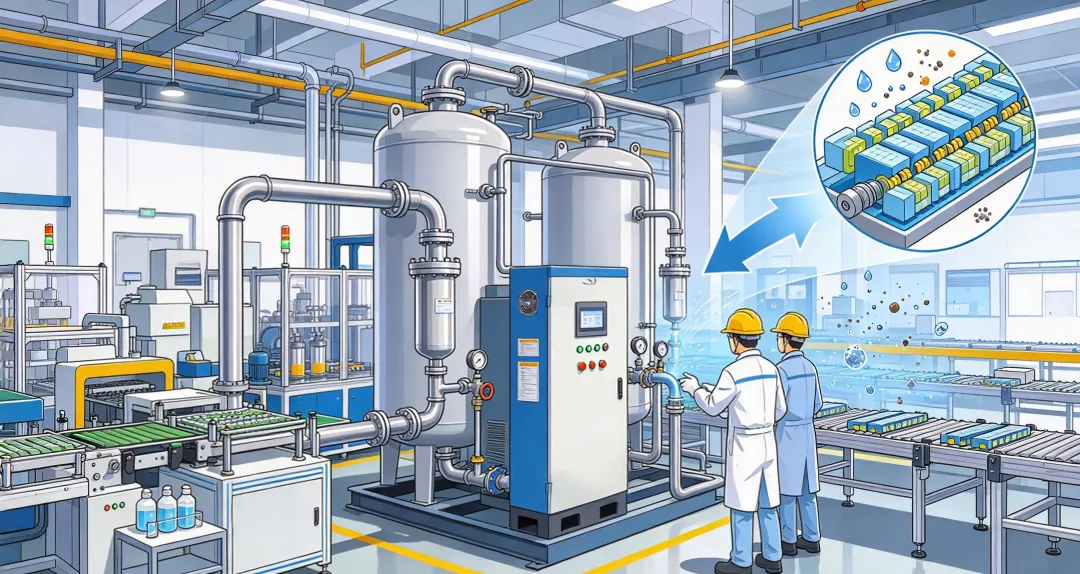
Industrial compressed air demand rarely remains constant throughout an entire production day. Machines cycle on and off, production shifts change, and seasonal conditions affect both airflow and refrigeration load. A refrigerated dryer designed to operate at essentially fixed refrigeration output may therefore spend significant periods working under partial-load conditions.
A variable frequency refrigerated air dryer addresses this challenge by adjusting refrigeration compressor operation according to actual drying demand. Instead of treating every operating condition as full load, the control system changes compressor frequency to match the required refrigeration capacity.
The original article correctly identifies demand-responsive compressor speed as the central advantage of this technology. For industrial users, however, the real benefit depends on the plant’s load profile, dryer design, pressure drop, heat exchanger performance, and control strategy rather than VFD technology alone.
What Is a Variable Frequency Refrigerated Air Dryer?
A variable frequency refrigerated air dryer is a refrigeration-based compressed air dryer equipped with an inverter-controlled refrigeration compressor.
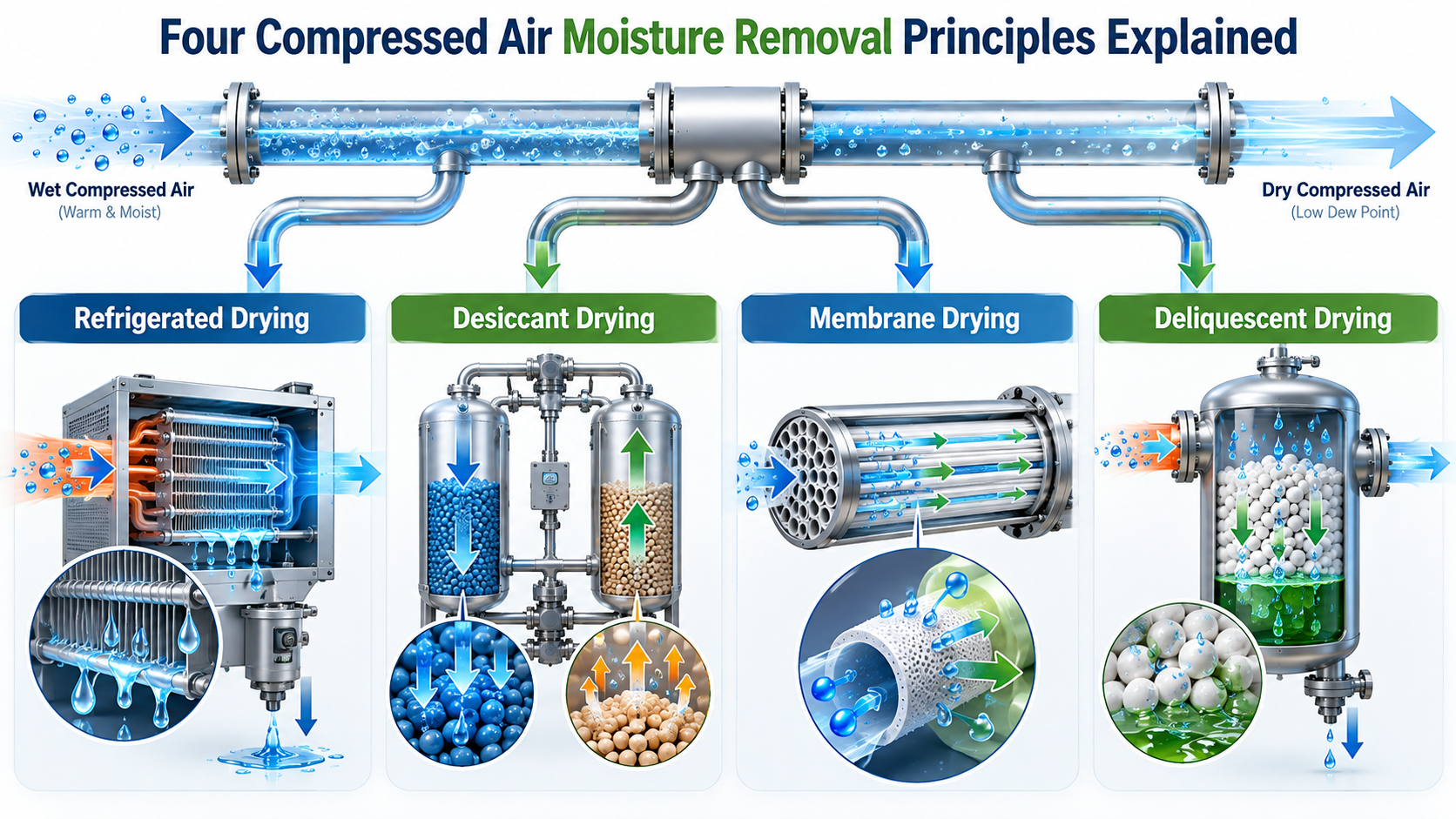
Like a conventional refrigerated air dryer, it removes moisture by lowering compressed-air temperature so that water vapor condenses into liquid water. The condensate is then separated and discharged before the treated air enters the downstream system.
The key difference is how refrigeration capacity is controlled.
In a variable-frequency system, compressor speed can change as drying demand changes. When the compressed air load decreases, the refrigeration system can reduce output. When load increases, compressor frequency can rise to provide additional cooling capacity.
Lingyu’s PB Series uses this operating principle: the refrigeration system adjusts compressor speed according to system load, with operating frequency automatically regulated to match actual air-treatment demand.
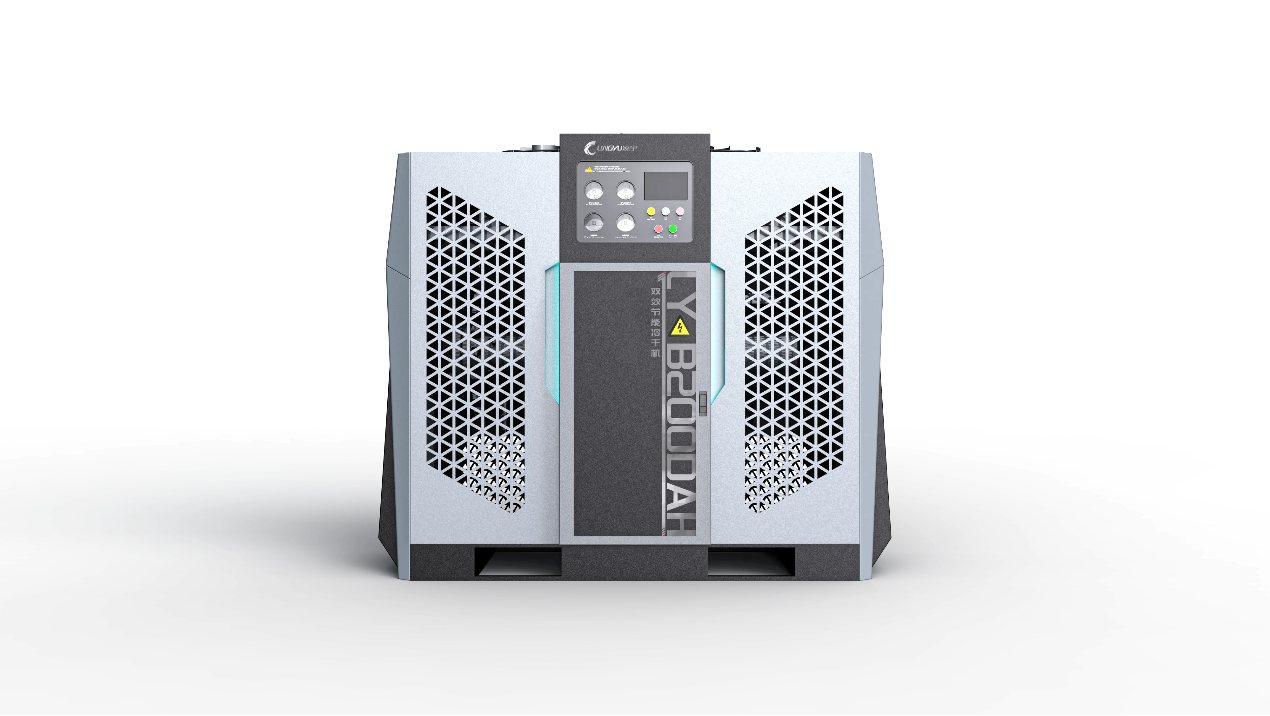
How Does a Variable Frequency Refrigerated Air Dryer Work?
The drying process can be divided into several stages.
1. Pre-Cooling
Warm, moisture-laden compressed air enters the dryer and is initially cooled.
Pre-cooling reduces the thermal load that the refrigeration circuit must subsequently handle.
In the PB Series, a plate-fin pre-cooler is used to reduce the temperature of high-temperature compressed air before it enters the main heat-exchange section.
2. Further Heat Exchange
The compressed air passes through the pre-cooling/reheating section of the main heat exchanger.
Cold treated air leaving the refrigeration stage exchanges heat with the warmer incoming compressed air. This improves thermal utilization by simultaneously pre-cooling incoming air and reheating outgoing dry air.
3. Refrigeration Cooling
The compressed air enters the evaporator section and is cooled further.
As its temperature falls, water vapor condenses into liquid droplets. These droplets must then be efficiently separated from the airflow.
4. Moisture Separation
Condensed moisture is removed before the compressed air leaves the cooling section.
This stage is essential because cooling by itself does not produce a useful drying result if the condensate remains entrained in the airflow.
5. Reheating
The cold dry compressed air returns through the heat exchanger and absorbs heat from incoming compressed air.
This increases outlet temperature without requiring a separate reheating energy source and helps reduce downstream pipe sweating.
6. Variable-Frequency Refrigeration Control
This is where the PB Series differs from a conventional fixed-output refrigerated dryer.
The control system monitors operating conditions and changes refrigeration compressor speed according to actual treatment demand.
Instead of repeatedly assuming maximum refrigeration load, compressor output can follow the compressed air system more closely.
Why Does Variable-Frequency Control Save Energy?
The main energy-saving opportunity occurs when actual demand is below the dryer’s maximum design load.
Consider a dryer sized for peak production. That maximum capacity may be necessary during the busiest period of the day, but the plant may spend many hours operating at 50%, 70%, or 80% of peak airflow.
If refrigeration output can be reduced during those periods, unnecessary compressor power can also be reduced.
This is why VFD technology tends to provide the greatest benefit in variable-load compressed air systems rather than systems operating continuously near full capacity.
The original article correctly associates lower-load operation with reduced refrigeration power consumption. However, a universal statement such as “VFD saves 30%” should be avoided because actual savings depend heavily on operating conditions.
Variable Frequency vs. Fixed-Speed Refrigerated Air Dryer
The fundamental moisture-removal principle is the same in both systems. The difference is primarily refrigeration capacity control.
| Factor | Variable Frequency Dryer | Conventional Fixed-Speed Dryer |
|---|---|---|
| Refrigeration compressor speed | Adjustable | Essentially fixed |
| Partial-load response | Strong | Depends on control design |
| Energy-saving potential | High where load varies | Depends on operating strategy |
| Control complexity | Higher | Generally simpler |
| Monitoring capability | Often more extensive | Model-dependent |
| Initial investment | Usually higher | Often lower |
| Best application | Variable compressed-air demand | Stable or predictable demand |
A VFD dryer should therefore not automatically replace every fixed-speed dryer.
Where airflow remains consistently close to rated capacity, the energy-saving advantage may be smaller. Where demand fluctuates substantially, variable-frequency control can become much more valuable.
Key Benefit 1: Load-Matched Refrigeration
The most important advantage is the ability to match cooling capacity to real compressed-air demand.
Compressed air consumption can change because of:
- Production shifts
- Machine cycling
- Weekend operation
- Seasonal production
- Multiple compressor sequencing
- Changes in production-line utilization
A variable-frequency refrigeration compressor can respond to these conditions rather than operating at the same speed continuously.
This makes VFD drying especially relevant for centralized compressed air stations serving several production areas with different demand patterns.
Key Benefit 2: Stable Pressure Dew Point
Energy savings are useful only if the dryer continues to meet the required air-quality specification.
Variable-frequency control therefore needs to balance power reduction with refrigeration stability.
The PB Series monitors pressure dew point along with other refrigeration and compressed-air parameters, allowing the control system to respond to actual operating conditions.
This is important because simply slowing the refrigeration compressor as much as possible would not be an effective energy-saving strategy. Cooling capacity must remain sufficient to condense and separate the required amount of moisture.
Key Benefit 3: High-Performance Heat Exchange
Variable-frequency control is only one part of dryer efficiency.
Heat exchanger design determines how effectively energy is transferred between incoming air, outgoing air, and the refrigeration system.
Lingyu’s PB Series incorporates a high-performance three-in-one plate heat exchanger with a larger heat-transfer area and low-pressure-drop design. According to its technical specifications, the heat-transfer area is more than 30% greater than conventional three-in-one plate heat exchangers of the same airflow capacity.
For users interested specifically in this heat exchanger architecture, a 3-in-1 plate heat exchange refrigerated air dryer provides another relevant system configuration.
Key Benefit 4: Lower Pressure Drop
A dryer consumes energy in more ways than the electrical power measured at its refrigeration compressor.
Pressure drop is an indirect but important energy cost.
If compressed air loses excessive pressure as it passes through the dryer, filters, piping, and other treatment equipment, the compressor may need to operate at a higher discharge pressure to maintain the required pressure at production equipment.
For this reason, an energy-efficient dryer should combine refrigeration efficiency with low airflow resistance.
A detailed explanation of this relationship is available in compressed air pressure drop and system efficiency.
Key Benefit 5: Intelligent Operating Monitoring
Modern VFD dryers can monitor considerably more than compressor frequency.
Lingyu’s variable-frequency control platform monitors parameters including:
- Compressed air inlet temperature
- Compressed air outlet temperature
- Pressure dew point
- Compressed air pressure
- Evaporation temperature
- Condensing temperature
- Suction temperature
- Evaporation pressure
- Condensing pressure
- Refrigerant discharge temperature
The PB Series also includes an RS-485 communication interface as standard.
This operating visibility can help plant personnel identify abnormal conditions and integrate the dryer with a wider compressed air monitoring system.
Key Benefit 6: Smooth Compressor Operation
Variable-frequency refrigeration can reduce dependence on abrupt full-output operation when load is lower.
The PB Series uses permanent-magnet DC inverter compressors designed for a wide frequency range and smooth operation.
Smooth speed modulation can also reduce some of the operating noise associated with continuously running refrigeration equipment at maximum speed.
However, noise performance should be verified from the actual model specification rather than assuming that every VFD dryer will meet requirements for hospitals, laboratories, or other noise-sensitive environments.
A Real Industrial Energy-Saving Application
Actual energy savings should be evaluated at the compressed air system level rather than assigned as a universal percentage to the dryer.
One Lingyu project used four 85 m³/min dual-efficiency refrigerated dryers combining variable-frequency refrigeration with low-pressure-drop technology.
The project reported that terminal pressure increased from 6.45 bar to 6.8 bar and overall system energy savings were approximately 39%. The configuration also incorporated Mitsubishi variable-frequency compressors, electronic expansion valves, intelligent touchscreen controls, and RS-485 communication.
Importantly, this 39% figure is a project result, not a guaranteed energy-saving percentage for every variable-frequency dryer.
Actual savings depend on the original system, load profile, pressure conditions, equipment efficiency, and operating strategy.
Where Are Variable Frequency Refrigerated Air Dryers Most Useful?
Manufacturing Plants with Fluctuating Demand
This is one of the strongest applications.
Factories with multiple pneumatic production lines rarely maintain identical compressed air consumption throughout every shift. A VFD dryer can respond more effectively when system load changes repeatedly.
Electronics and Semiconductor Manufacturing
Large electronics facilities can have substantial compressed air demand together with strict expectations for system stability and energy efficiency.
Variable-frequency refrigeration, low pressure drop, and centralized monitoring can be useful in these large compressor stations.
Lingyu’s documented energy-efficient refrigerated dryer project was implemented for a semiconductor compressed air station.
Automotive and General Manufacturing
Automotive plants use compressed air across assembly lines, pneumatic tooling, automation, and supporting production equipment.
Because production demand can change between lines and shifts, load-responsive refrigeration can help avoid unnecessary full-output operation.
More information on this industrial environment is available through automotive and general manufacturing applications.
Food and Beverage Processing
Compressed air may support packaging, conveying, filling equipment, and plant automation.
Where a refrigerated pressure dew point meets the process requirement, variable-frequency control can provide an energy-saving option for plants with changing production loads.
New-Energy Manufacturing
Photovoltaic, battery, and energy-storage manufacturing facilities can operate large centralized compressed air stations.
In these applications, dryer energy use, pressure drop, communication capability, and response to variable demand can all influence total station efficiency.
Where a Variable Frequency Refrigerated Dryer May Not Be the Best Choice
VFD technology is not automatically necessary for every application.
A conventional refrigerated dryer may remain appropriate when compressed air demand is highly stable, the plant operates continuously near design capacity, or the additional investment in variable-frequency equipment cannot be justified by expected part-load savings.
More importantly, a variable-frequency refrigerated dryer is still a refrigerated dryer.
It should not be selected simply because the plant needs very dry air. If the process requires a pressure dew point around −20°C or −40°C, an adsorption air dryer should generally be evaluated instead.
VFD control improves how refrigeration capacity is managed; it does not turn refrigeration drying into adsorption drying.
How to Select a Variable Frequency Refrigerated Air Dryer
Determine Peak Airflow
Select capacity according to maximum expected compressed air demand rather than average consumption alone.
Analyze the Load Profile
This is particularly important for VFD equipment.
Determine how many hours the plant operates near full load, medium load, and low load. The greater the amount of part-load operation, the greater the potential value of load-responsive refrigeration.
Check Inlet Temperature
Higher inlet temperatures increase the refrigeration load.
The selected dryer must be rated for the actual compressed air temperature reaching the unit.
Confirm Operating Pressure
Rated capacity depends on system pressure. Actual operating pressure should therefore be included in dryer selection rather than relying solely on nominal airflow.
Define the Required Pressure Dew Point
Do not purchase a refrigerated dryer until the required air dryness is clear.
If refrigerated drying can meet the process specification, VFD technology can then be evaluated for energy optimization.
Evaluate Pressure Drop
Compare pressure drop across the dryer at realistic airflow conditions.
A small reduction in dryer electrical consumption can be undermined if excessive pressure loss forces the air compressor to operate at a higher discharge pressure.
Evaluate Control and Communication
For large compressor stations, consider whether RS-485, centralized monitoring, alarms, and operating-data access are required.
Compare Lifecycle Cost
The relevant comparison is not simply:
VFD dryer purchase price vs. fixed-speed dryer purchase price.
It should include:
Initial cost + annual electricity + pressure-drop cost + maintenance + operating hours + expected load profile.
Users considering this technology can review the frequency conversion refrigerated air dryer when matching these factors to an actual equipment configuration.
FAQ: Variable Frequency Refrigerated Air Dryer
How does a variable frequency refrigerated air dryer save energy?
It adjusts refrigeration compressor speed according to actual treatment demand. When the compressed air load decreases, refrigeration output can be reduced instead of continuously operating at maximum capacity.
Does a VFD dryer always save 30% electricity?
No. There is no universal energy-saving percentage. Savings depend on load variation, operating hours, inlet conditions, refrigeration design, pressure drop, and the equipment being compared.
Is variable-frequency technology useful at full load?
The dryer still operates effectively at high load, but its greatest energy-saving advantage generally appears during part-load operation. A plant operating continuously near full capacity may have less saving potential than one with strongly fluctuating demand.
What pressure dew point can a variable frequency refrigerated dryer provide?
The achievable pressure dew point depends on the specific model and rated operating conditions. It should be verified from the equipment specification rather than assumed from the presence of a VFD.
Is a variable frequency refrigerated dryer suitable for −40°C pressure dew point?
A conventional refrigerated dryer is generally not the correct technology for a −40°C pressure dew point. Adsorption drying should normally be considered for that requirement.
Is a VFD refrigerated dryer suitable for hospitals and medical gases?
It should not automatically be selected for medical-gas applications solely because it has variable-frequency control. Medical compressed-air and gas systems have application-specific air-quality, regulatory, redundancy, and equipment requirements that must be evaluated separately.
Does variable-frequency operation reduce maintenance?
Smooth load-responsive operation may reduce some mechanical and electrical stresses, but it does not eliminate maintenance. Condensers, drains, refrigeration components, sensors, heat exchangers, and controls still require regular inspection.
Can a variable frequency dryer operate continuously?
Industrial VFD refrigerated dryers can be designed for continuous service, provided the selected model operates within its specified airflow, pressure, temperature, ambient, and maintenance requirements.
Conclusion
A variable frequency refrigerated air dryer offers a more responsive approach to compressed air drying by adjusting refrigeration compressor output according to actual system demand.
Its main advantage is not simply the presence of a VFD. Effective energy-saving performance comes from the combination of load-responsive refrigeration, efficient heat exchange, low pressure drop, stable dew-point control, and intelligent monitoring.
For plants with substantial variations in compressed air consumption, this approach can reduce unnecessary refrigeration power during part-load operation while maintaining the required moisture-control performance.
However, the economics should be evaluated using the plant’s real load profile. A fixed-speed dryer may remain practical for stable full-load applications, while processes requiring substantially lower pressure dew points may need adsorption technology instead.
When correctly matched to airflow, inlet temperature, operating pressure, pressure dew point, pressure drop, and production demand, a variable frequency refrigerated air dryer can contribute to a more efficient and controllable compressed air system.