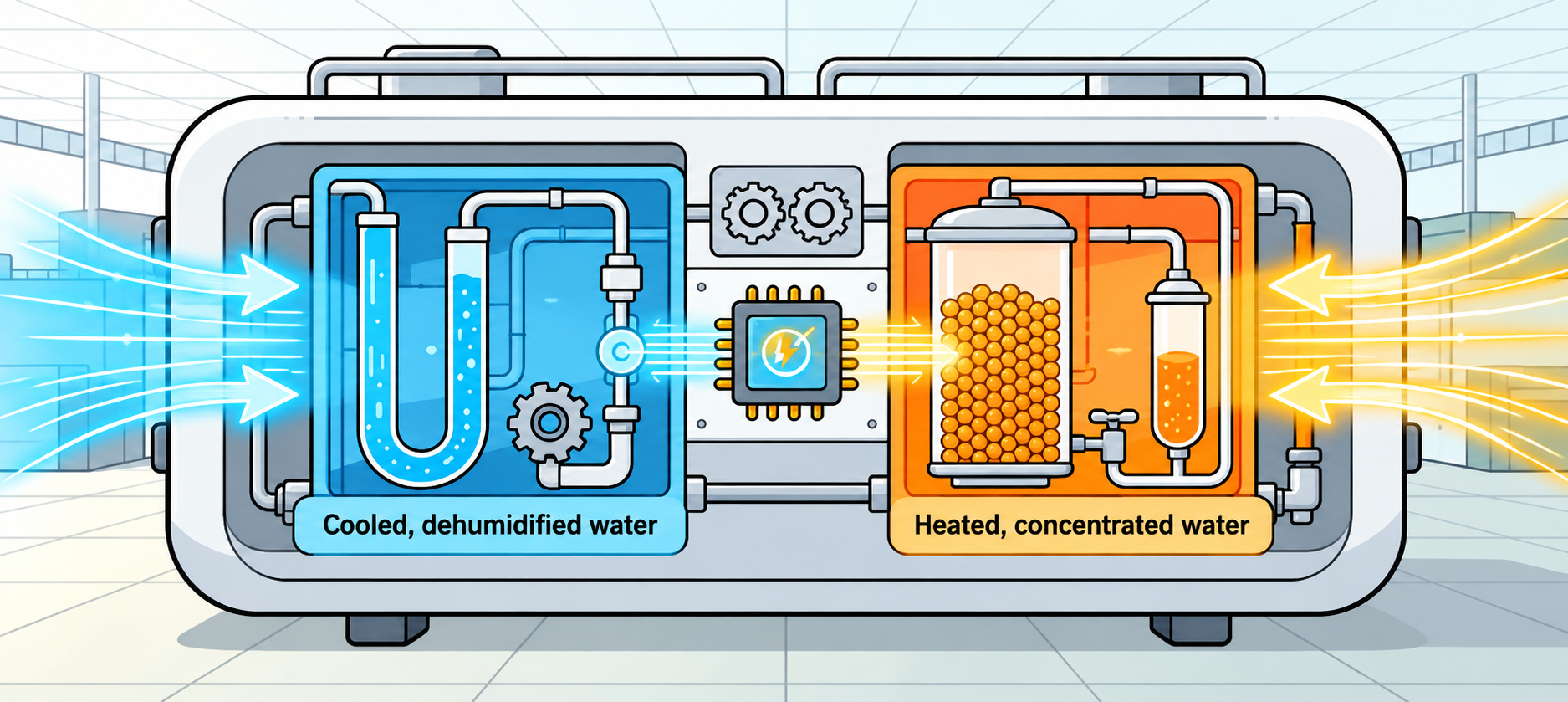
In industrial compressed air systems, moisture removal is essential for protecting downstream equipment and maintaining stable air quality. Heat exchangers are especially important in refrigerated air dryers because they cool compressed air, promote moisture condensation, recover heat, and reduce the refrigeration load.
Different refrigerated dryer designs use different heat-exchanger structures. Depending on the dryer configuration, these can include air-to-air heat exchangers, air-to-refrigerant evaporators, plate-fin heat exchangers, integrated 3-in-1 plate heat exchangers, and shell-and-tube designs.
Role of Heat Exchangers in Compressed Air Dryers
In a refrigerated air dryer, heat exchangers transfer heat between compressed air, refrigerant, or another air stream without allowing the media to mix.
In Lingyu’s AH and WH refrigerated dryers, high-temperature compressed air is first pre-cooled before entering the air-to-air heat exchanger. The air then passes through the air-to-refrigerant evaporator, where further cooling reduces the pressure dew point to approximately 2–10°C.
As the compressed air cools, water vapor condenses. After condensate separation, the dry compressed air returns through the air-to-air heat exchanger, where it is reheated before leaving the dryer.
This heat-recovery process serves two important purposes: it reduces the refrigeration load by pre-cooling the incoming compressed air and raises the outlet-air temperature before the treated air enters the downstream system.
For a more detailed explanation of the complete process, see how a refrigerated air dryer works.
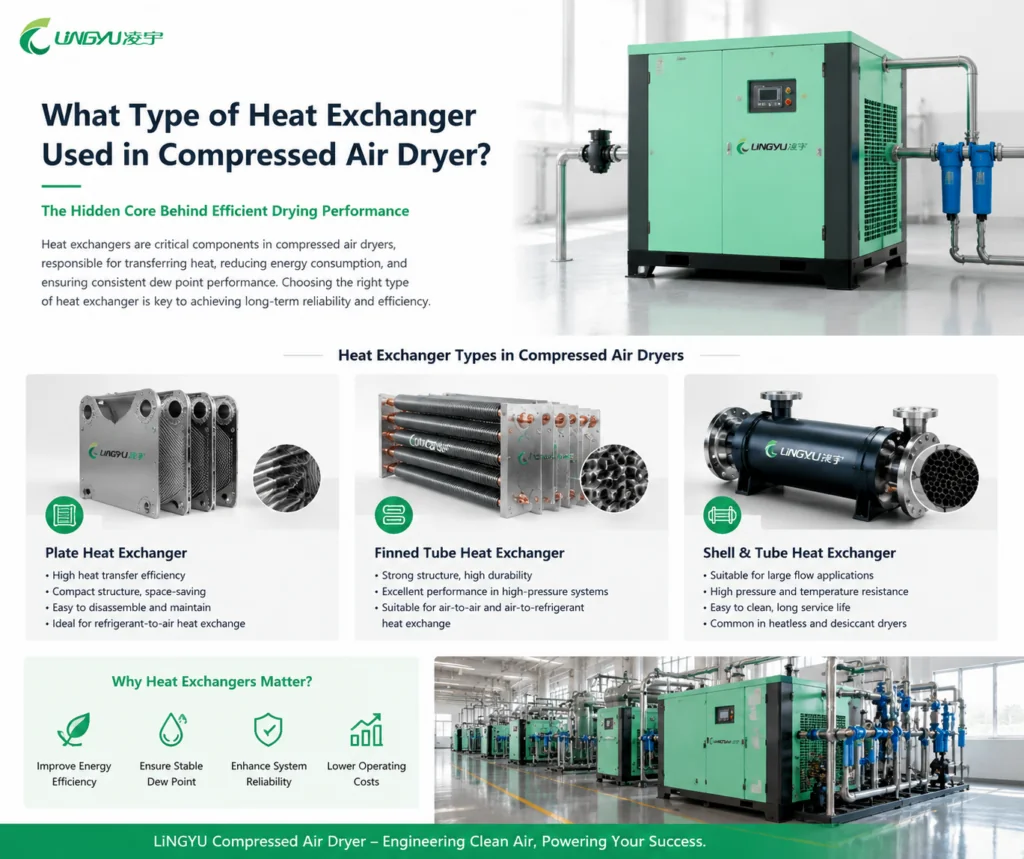
Types of Heat Exchangers Used in Compressed Air Dryers
The appropriate heat exchanger depends on dryer structure, capacity, cooling method, installation requirements, and operating conditions.
1. Air-to-Air Heat Exchanger
An air-to-air heat exchanger transfers heat between the incoming hot compressed air and the outgoing cold, dry compressed air.
The incoming air is pre-cooled before reaching the evaporator, reducing the cooling load on the refrigeration system. At the same time, the cold treated air absorbs heat and is reheated before discharge.
Lingyu’s AH and WH Series both use this heat-recovery arrangement.
The main benefits include:
- Reduced refrigeration load
- Recovery of thermal energy within the dryer
- Reheating of outlet compressed air
- Improved overall thermal efficiency
Because the two compressed-air streams exchange heat without mixing, moisture removal and outlet-air quality can be maintained while reducing unnecessary cooling demand.
2. Air-to-Refrigerant Evaporator
The air-to-refrigerant evaporator is the primary cooling heat exchanger in a refrigerated air dryer.
Inside the evaporator, heat is transferred from the compressed air to the refrigeration system. As the compressed air temperature decreases, water vapor reaches saturation and condenses into liquid water.
In Lingyu’s AH and WH refrigerated dryers, this cooling stage helps achieve a pressure dew point of approximately 2–10°C.
The evaporator must provide sufficient heat-transfer capacity while maintaining acceptable compressed-air pressure drop. Its performance directly affects cooling efficiency, moisture condensation, and pressure dew point stability.
3. Plate-Fin Heat Exchanger
Plate-fin heat exchangers use plates and fins to create a relatively large heat-transfer area within a compact structure.
This configuration can be useful where efficient heat transfer and compact installation are both important.
Lingyu’s PB Series uses an aluminum-alloy plate-fin heat exchanger in the pre-cooling stage to reduce the temperature of high-temperature compressed air before it reaches the main drying section.
Advantages of plate-fin construction can include:
- Large heat-transfer area
- Compact structure
- Efficient pre-cooling
- Reduced installation footprint
The actual suitability of a plate-fin exchanger depends on airflow, pressure, inlet temperature, contamination level, and maintenance requirements.
4. 3-in-1 Plate Heat Exchanger
Some refrigerated air dryers integrate several treatment functions into a compact heat-exchanger assembly.
Lingyu’s PB Series uses a 3-in-1 plate heat exchanger that incorporates pre-cooling/reheating and evaporator functions.
The PD Series uses another integrated configuration that combines the:
- Evaporator
- Air-to-air heat exchanger
- Water separator
Integrating these functions can reduce the number of separate components and create a more compact internal arrangement.
For more information on this configuration, see the 3-in-1 plate heat exchanger refrigerated dryer.
5. Shell-and-Tube Heat Exchanger
Shell-and-tube construction is another heat-exchanger design used in industrial refrigerated air dryers.
In a shell-and-tube exchanger, one fluid passes through tubes while another fluid or air stream flows around the tubes within the surrounding shell. Heat transfers through the tube walls while the two media remain separated.
Compared with compact plate-type configurations, shell-and-tube designs are commonly associated with robust industrial construction and can be suitable for larger equipment configurations.
The correct choice depends on system capacity, pressure, temperature, cooling requirements, allowable pressure drop, installation conditions, and maintenance needs.
For a closer look at this configuration, see the shell-and-tube refrigerated air dryer guide.
How Do These Heat Exchangers Work Together?
A refrigerated dryer may use more than one heat exchanger because each stage performs a different function.
A typical process can be summarized as follows:
- Pre-cooling: High-temperature compressed air is cooled before entering the main refrigeration stage.
- Air-to-air heat recovery: Incoming air transfers heat to the cold, dry outlet air.
- Evaporator cooling: Refrigeration removes additional heat until water vapor condenses.
- Moisture separation: Condensed liquid is separated from the compressed air.
- Reheating: Cold, dry compressed air absorbs heat from the incoming air before leaving the dryer.
The exact arrangement varies by dryer design. Some systems use separate heat exchangers and separators, while integrated plate-type designs can combine multiple functions into a single assembly.
Factors to Consider When Choosing a Heat Exchanger
The appropriate heat-exchanger design depends on the dryer and the actual operating conditions.
Airflow Capacity
The heat exchanger must handle the required compressed-air volume while providing sufficient heat-transfer capacity.
An undersized exchanger can limit cooling performance and affect pressure dew point.
Operating Pressure
The exchanger must be suitable for the compressed-air system’s operating pressure.
Pressure requirements should be considered together with materials, construction, connections, and the complete dryer design.
Heat-Transfer Efficiency
Effective heat transfer helps reduce the cooling load on the refrigeration system.
In an air-to-air exchanger, efficient heat recovery also allows the cold outlet air to pre-cool the incoming compressed air.
Pressure Drop
Pressure drop is an important consideration in compressed-air equipment.
Excessive pressure loss through a heat exchanger can increase the compressor discharge pressure required to maintain adequate downstream pressure, increasing system energy demand.
Inlet Temperature
High inlet temperatures increase the heat load placed on the dryer.
The heat exchanger and refrigeration system must therefore be selected according to actual inlet-air conditions rather than nominal airflow alone.
Installation Space
Plate, plate-fin, and integrated heat-exchanger designs can provide compact equipment arrangements where installation space is limited.
However, compactness should be evaluated together with heat-transfer performance, pressure drop, and maintenance accessibility.
Maintenance and Service Access
Heat-transfer surfaces can lose performance if contamination accumulates.
The appropriate exchanger design should therefore account for the operating environment, compressed-air cleanliness, cooling conditions, inspection requirements, and service accessibility.
Benefits of the Right Heat Exchanger
A properly selected and designed heat exchanger can contribute to:
- Stable pressure dew point
- Effective moisture condensation
- Lower refrigeration load
- Heat recovery
- Controlled pressure drop
- Reduced unnecessary energy consumption
- Compact dryer construction
- Stable long-term dryer operation
Heat-exchanger performance should therefore be evaluated as part of the complete refrigerated dryer rather than as an isolated component.
Which Heat Exchanger Is Best for a Compressed Air Dryer?
There is no single heat-exchanger type that is best for every compressed air dryer.
Air-to-air heat exchangers are useful for heat recovery between incoming and outgoing compressed air.
Air-to-refrigerant evaporators provide the main refrigeration cooling required for moisture condensation.
Plate-fin heat exchangers provide a compact heat-transfer structure and can be used for pre-cooling high-temperature compressed air.
3-in-1 plate heat exchangers integrate multiple treatment functions into a compact assembly.
Shell-and-tube heat exchangers provide another industrial construction option where system design, capacity, and operating conditions favor this configuration.
The correct choice depends on airflow, pressure, inlet temperature, heat-transfer requirements, allowable pressure drop, installation space, maintenance needs, and overall dryer configuration.
Conclusion
Heat exchangers are central to the operation of refrigerated compressed air dryers.
They pre-cool incoming compressed air, provide refrigeration cooling, promote moisture condensation, recover heat, and reheat dry outlet air. Their design directly affects pressure dew point stability, refrigeration load, pressure drop, equipment size, and overall dryer performance.
Lingyu refrigerated dryer configurations use several heat-exchanger arrangements, including air-to-air heat exchangers, air-to-refrigerant evaporators, aluminum-alloy plate-fin exchangers, integrated 3-in-1 plate heat exchangers, and shell-and-tube structures.
For Lingyu’s AH and WH refrigerated dryers, the cooling process provides a pressure dew point of approximately 2–10°C. Other heat-exchanger configurations can be selected according to inlet temperature, capacity, equipment structure, and application requirements.
The most appropriate heat exchanger is therefore not determined by exchanger type alone. It should be selected as part of the complete compressed-air drying system according to actual operating conditions and required air quality.