Compressor liquid slugging in a refrigerated air dryer is a serious refrigeration-system fault that can damage valves, pistons, connecting rods, bearings, and other internal compressor components.
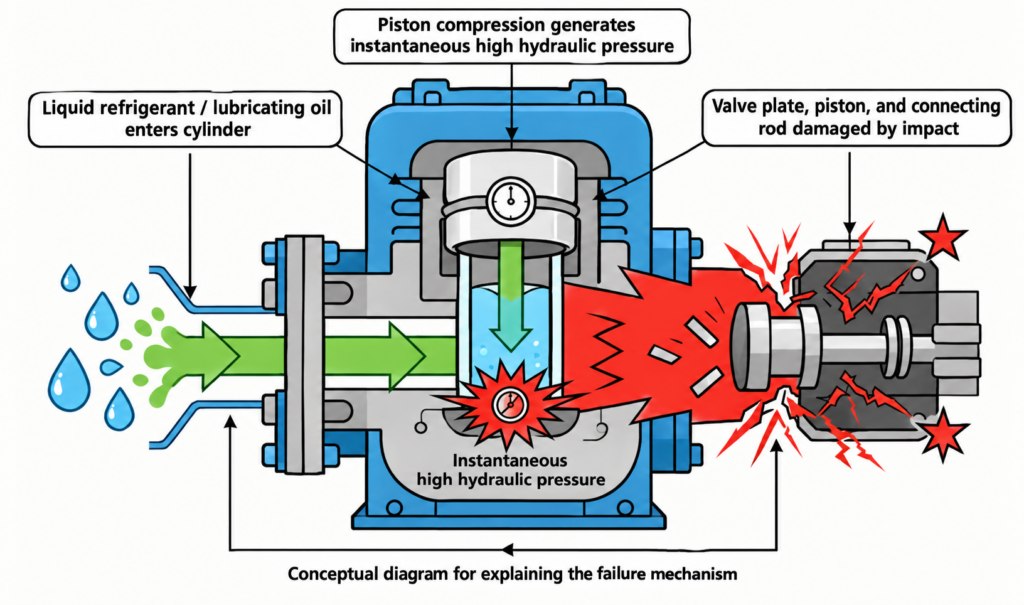
In normal operation, refrigerant returning to the compressor should be adequately vaporized before entering the compression mechanism. When excessive liquid refrigerant—or, under some abnormal conditions, a large amount of oil/refrigerant mixture—enters the compressor, the incompressible liquid can create severe mechanical and hydraulic forces during compression.
This condition is commonly associated with refrigerant floodback, flooded starts, improper refrigerant charging, poor evaporator heat transfer, incorrect expansion-device operation, and refrigerant migration during shutdown.
Understanding the difference between these causes is important because simply replacing a damaged compressor without correcting the underlying refrigeration problem can result in another failure.
What Is Compressor Liquid Slugging in a Refrigerated Air Dryer?
A refrigerated compressed air dryer removes moisture by cooling compressed air so that water vapor condenses and can be separated from the air stream. The refrigeration circuit typically includes a compressor, condenser, expansion or metering device, evaporator, and associated controls.
During normal operation, refrigerant entering the compressor through the suction line should be in a condition suitable for the compressor design.
Liquid slugging occurs when a significant quantity of liquid reaches the compression mechanism. Because liquids are essentially incompressible compared with refrigerant vapor, the compressor may experience a sudden mechanical shock.
Depending on compressor design and the severity of the event, possible consequences include:
- Damaged suction or discharge valves
- Bent or broken connecting rods
- Piston damage
- Bearing damage
- Abnormal vibration and noise
- Lubrication problems
- Compressor seizure or premature failure
Liquid slugging should also be distinguished from refrigerant floodback. Floodback describes liquid refrigerant continuously or intermittently returning through the suction line during operation. Severe floodback can eventually lead to liquid slugging.
1. Refrigerant Overcharge and Improper Charging Procedures
Incorrect refrigerant charging is one of the first areas to investigate when a refrigerated air dryer shows signs of liquid return.
Refrigerant Overcharge
Excessive refrigerant charge can disrupt normal refrigerant circulation and increase the possibility of liquid refrigerant returning to the compressor under certain operating conditions.
Possible symptoms can include:
- Unusual suction conditions
- Reduced or unstable superheat
- Frosting on the suction line or compressor
- Abnormal refrigerant pressures
- Unstable refrigeration performance
An overcharged system can also affect oil return and overall refrigeration-circuit stability.
Refrigerant charge should therefore be based on the dryer manufacturer’s specified charging procedure and system requirements rather than adjusted solely from a single pressure reading.
For technicians investigating other refrigeration-circuit abnormalities, Lingyu’s guide to the refrigerated air dryer refrigeration system provides additional background on the components involved.
Improper Liquid Refrigerant Charging
Liquid refrigerant must be charged using the correct service procedure for the specific system.
Introducing liquid refrigerant improperly into a compressor suction connection, followed by immediate startup, can expose the compressor to a large quantity of liquid before the refrigerant has had time to distribute safely through the system.
Charging procedures should always follow the equipment manufacturer’s service instructions and be performed by qualified refrigeration personnel.
Starting the Dryer Immediately After It Has Been Tilted or Inverted
A refrigerated air dryer that has been severely tilted or inverted during transportation can experience redistribution of compressor oil and refrigerant.
If this has occurred, do not assume that the unit can be powered on immediately after it is returned upright.
Follow the manufacturer’s specified settling period before startup. Where the applicable equipment instructions require an extended settling period, such as 24 hours, that requirement should be observed.
This helps allow oil and refrigerant to return toward their intended operating locations before the compressor starts.
2. Poor Evaporator Heat Transfer and Refrigerant Floodback
The evaporator must absorb enough heat for the refrigerant to vaporize appropriately before returning toward the compressor.
When evaporator heat transfer deteriorates or the actual thermal load becomes unusually low, refrigerant may leave the evaporator insufficiently vaporized.
This creates conditions for refrigerant floodback.
Restricted Heat Transfer
Depending on the refrigerated dryer design, heat-transfer performance may deteriorate because of conditions such as:
- Dirty or blocked heat-exchange surfaces
- Restricted airflow in air-cooled sections
- Fan malfunction
- Reduced fan speed
- Dirty filters or obstructed ventilation
- Abnormal icing or frosting
- Insufficient compressed-air load
- Other conditions that reduce the heat available to the evaporator
If the evaporator cannot absorb the expected heat load, refrigerant evaporation may become incomplete.
Liquid refrigerant can then continue into the suction line and potentially reach the compressor.
If evaporator performance is suspected, it is useful to evaluate the refrigeration circuit rather than treating compressor frosting as an isolated fault. For related troubleshooting, see how to check a refrigerated air dryer evaporator for internal and external leaks.
Prolonged Operation at Very Low Load
A refrigerated air dryer is designed around an expected range of compressed-air flow, inlet temperature, ambient conditions, and refrigeration load.
When a dryer operates for an extended period at very low or no compressed-air load, the heat available at the evaporator can fall substantially.
If the refrigeration controls cannot adequately adapt to this condition, refrigerant may not completely vaporize before returning toward the compressor.
This can produce repeated low-level floodback and, over time, contribute to compressor damage.
For facilities with highly variable compressed-air demand, dryer control strategy and sizing should be considered during equipment selection. The site’s guide on how to size a refrigerated air dryer provides more detail on matching dryer capacity to actual operating conditions.
3. Expansion Valve and Hot-Gas Bypass Control Problems
Refrigerant flow and evaporator pressure must be controlled correctly across changing dryer loads.
Problems with the expansion device or hot-gas bypass control can upset this balance and increase the risk of liquid refrigerant returning to the compressor.
Expansion Valve Oversizing or Incorrect Adjustment
If an expansion valve is oversized, malfunctioning, or adjusted to feed too much refrigerant, the evaporator may receive more liquid refrigerant than it can vaporize under the current load.
The result may be:
Excessive Refrigerant Feed → Low Superheat → Refrigerant Floodback → Potential Liquid Slugging
When diagnosing this condition, technicians should evaluate the relevant operating parameters rather than adjusting the valve based on observation alone.
Depending on the system design, useful checks may include:
- Suction pressure
- Suction temperature
- Superheat
- Evaporator load
- Refrigerant charge
- Expansion valve response
- Refrigerant distribution through the evaporator
Expansion-device adjustment should follow the dryer or valve manufacturer’s specifications.
Hot-Gas Bypass Valve Malfunction or Incorrect Adjustment
Many refrigerated air dryers use hot-gas bypass control to help maintain suitable evaporator conditions when compressed-air demand falls.
If the bypass valve does not respond correctly, evaporator pressure and temperature may move outside the intended operating range. Under low-load conditions, this can contribute to unstable refrigeration operation, icing, or conditions that increase the risk of refrigerant floodback.
The exact symptoms depend on the refrigeration circuit and control design, so the bypass valve should not be adjusted in isolation.
Check the complete operating condition, including:
- Evaporator pressure
- Suction pressure
- Suction temperature
- Superheat
- Compressed-air load
- Refrigerant charge
- Expansion-device operation
- Hot-gas bypass response
For a broader explanation of refrigeration operation, see how a refrigerated air dryer works.
4. Refrigerant Migration During Shutdown and Flooded Starts
Not all liquid slugging occurs while the dryer is continuously operating.
A compressor can also be exposed to liquid refrigerant during startup after an extended shutdown.
Refrigerant Migration
When the dryer remains off for a long period, refrigerant can migrate through the refrigeration circuit.
Refrigerant vapor tends to migrate toward colder areas of the system and may condense there. Depending on system design and temperature conditions, refrigerant can accumulate in or around the compressor and dissolve into the compressor oil.
This condition may not be obvious while the unit is stopped.
What Happens During Startup?
When the compressor starts, crankcase pressure drops rapidly.
Refrigerant dissolved in the oil can then boil out of solution and cause vigorous oil foaming. Liquid refrigerant or a refrigerant-rich oil mixture may be carried into areas where it interferes with proper lubrication or reaches the compression mechanism.
This is commonly associated with a flooded start.
Potential warning signs around startup include:
- Heavy oil foaming
- Sudden abnormal compressor noise
- Severe vibration
- Rapid frosting
- Unstable suction pressure
- Oil being carried out of the compressor
Where the compressor or dryer is equipped with a crankcase heater, it should be operating according to the manufacturer’s requirements before startup after an extended shutdown.
5. Compressor Frosting: A Warning Sign, Not a Diagnosis
Frost on the compressor body or suction line should not automatically be interpreted as proof that liquid slugging is already occurring.
However, unusual frosting can indicate that suction conditions are outside the expected operating range and should be investigated.
Possible causes include:
- Excessive refrigerant feed
- Low evaporator load
- Insufficient superheat
- Expansion valve problems
- Hot-gas bypass control problems
- Incorrect refrigerant charge
- Abnormal refrigeration pressure
If frosting appears together with unusual compressor noise, unstable pressure, or other evidence of refrigerant floodback, continuing to run the unit may increase the risk of compressor damage.
The appropriate response is to diagnose the refrigeration circuit and identify why suction conditions have changed.
Refrigerated Air Dryer Liquid Slugging Troubleshooting Table
| Symptom | Possible Cause | What to Check |
|---|---|---|
| Compressor makes a sudden knocking noise | Liquid entering compression mechanism | Stop operation and investigate refrigerant return conditions |
| Suction line or compressor shows unusual frosting | Low superheat or abnormal refrigerant return | Suction pressure, temperature, superheat, load |
| Problem occurs after refrigerant service | Incorrect charge or charging procedure | Refrigerant charge and service procedure |
| Problem appears mainly at low dryer load | Evaporator load too low or bypass control issue | Compressed-air load, evaporator pressure, hot-gas bypass |
| Low or unstable superheat | Excessive refrigerant feed | Expansion valve, charge, evaporator performance |
| Problem occurs after long shutdown | Refrigerant migration or flooded start | Crankcase heater, oil condition, startup procedure |
| Evaporator performance is abnormal | Poor heat transfer or refrigeration fault | Heat exchanger, airflow, icing, refrigerant circuit |
| Compressor repeatedly fails after replacement | Root cause not corrected | Full refrigeration-system diagnosis |
How to Prevent Compressor Liquid Slugging in a Refrigerated Air Dryer
Preventing liquid slugging requires more than protecting the compressor itself. The entire refrigeration circuit must operate within its intended range.
- Charge refrigerant according to the manufacturer’s specifications.
Avoid overcharging and use the specified charging method for the refrigerant and dryer design. - Use proper procedures after transportation or tilting.
If the dryer has been tilted or inverted, follow the manufacturer’s required settling time before applying power or starting the compressor. - Maintain heat-transfer performance.
Keep heat exchangers and ventilation paths clean, verify fan operation where applicable, and investigate abnormal frosting or icing. - Avoid inappropriate prolonged no-load operation.
If compressed-air demand is intermittent or highly variable, confirm that the dryer type, capacity, and control method are suitable for the operating profile. - Check the crankcase heater before restarting after a long shutdown.
Where fitted, make sure the heater has operated for the period specified by the compressor or dryer manufacturer before startup. - Monitor refrigerant superheat and suction conditions.
Abnormal superheat, suction pressure, temperature, frosting, vibration, or compressor noise can provide early warning of a developing refrigerant-return problem. - Do not adjust expansion or bypass valves blindly.
Valve adjustment should be based on measured refrigeration parameters and the manufacturer’s approved settings. - Include the refrigeration circuit in preventive maintenance.
Routine inspection should cover refrigerant pressures, heat-exchanger condition, condensate drainage, controls, electrical components, and other items specified by the dryer manufacturer.
For a broader preventive-maintenance framework, see the refrigerated compressed air dryer maintenance guide.
FAQ: Refrigerated Air Dryer Compressor Liquid Slugging
What causes liquid slugging in a refrigerated air dryer compressor?
Common causes include excessive or improperly charged refrigerant, refrigerant floodback caused by insufficient evaporator heat load, expansion-device problems, incorrect hot-gas bypass operation, refrigerant migration during shutdown, and flooded starts.
Is refrigerant floodback the same as liquid slugging?
No. Floodback refers to liquid refrigerant returning to the compressor during operation. Liquid slugging occurs when enough incompressible liquid enters the compression mechanism to create severe mechanical or hydraulic forces. Persistent or severe floodback can lead to slugging.
Can overcharging refrigerant cause compressor slugging?
An excessive refrigerant charge can contribute to abnormal refrigerant return and increase the risk of floodback under certain operating conditions. Refrigerant charge should be verified according to the manufacturer’s specified procedure rather than diagnosed from one pressure reading alone.
Why does a refrigerated air dryer compressor frost?
Frosting can be associated with low suction temperature, low superheat, excessive refrigerant feed, low evaporator load, or other abnormal refrigeration conditions. Frost alone does not prove liquid slugging, but significant or unusual frosting warrants further investigation.
Why can liquid slugging happen after a long shutdown?
During shutdown, refrigerant may migrate and dissolve into compressor oil or condense in colder parts of the system. At startup, the rapid pressure drop can cause refrigerant to boil out of the oil, creating foaming and a flooded-start condition.
Should a refrigerated air dryer be restarted immediately after being transported on its side?
Follow the manufacturer’s transportation and startup instructions. If the unit has been severely tilted or inverted, it may require an extended settling period before startup so compressor oil and refrigerant can redistribute appropriately.
When Should the Dryer Be Shut Down for Inspection?
A refrigerated air dryer should be investigated promptly if operators observe a combination of:
- Sudden knocking or abnormal compressor noise
- Severe vibration
- Unusual compressor or suction-line frosting
- Abnormal or unstable suction pressure
- Very low or unstable superheat
- Oil foaming
- Repeated compressor trips
- Refrigeration performance that changes significantly after servicing
Continuing to operate a compressor while significant liquid return is suspected can turn a controllable refrigeration-system fault into a major compressor failure.
For additional diagnostic information on refrigeration-side pressure abnormalities, see refrigerated air dryer refrigerant low-pressure troubleshooting.
Conclusion
Compressor liquid slugging in a refrigerated air dryer is usually a symptom of a broader refrigerant-control, heat-transfer, or startup problem rather than an isolated compressor fault.
The most important areas to investigate are:
Refrigerant Charge → Evaporator Heat Load → Expansion Device → Hot-Gas Bypass Control → Suction Superheat → Shutdown Migration → Startup Conditions
When troubleshooting, avoid relying on a single symptom such as compressor frosting or suction pressure. Pressure, temperature, superheat, load conditions, refrigerant charge, and control response should be evaluated together.
Proper refrigerant charging, stable evaporator heat transfer, correctly functioning control components, appropriate startup procedures, and routine refrigeration-system maintenance can substantially reduce the risk of refrigerant floodback and compressor liquid slugging.
For industrial compressed-air applications, explore Lingyu’s refrigerated air dryer solutions or contact Lingyu for assistance with dryer selection and system requirements.