Commercial trucks, buses, and other heavy-duty vehicles often rely on compressed-air brake systems. Because atmospheric air naturally contains moisture, compression can introduce water vapor and condensate into the pneumatic system.
If moisture is not properly controlled, it can contribute to corrosion, freezing, and unreliable operation of valves and other pneumatic components. An air brake dryer is therefore an important part of many heavy-duty vehicle compressed-air systems, helping reduce moisture before compressed air reaches downstream reservoirs and brake-system components.
The basic moisture problem is similar to that found in industrial compressed-air systems: when air is compressed and later cools, water vapor can condense into liquid water. Excessive moisture can contribute to corrosion, freezing, control-system problems, and reduced equipment reliability.
What Is an Air Brake Dryer?
An air brake dryer is a vehicle-specific compressed-air treatment device installed between the compressor and downstream air reservoirs or brake-system components.
Its primary purpose is to reduce moisture carried by compressed air before that moisture can accumulate elsewhere in the pneumatic system.
Many air brake dryers use desiccant-based moisture removal combined with an automatic regeneration or purge process. Depending on the vehicle system, the dryer assembly may also incorporate filtration or separation functions for contaminants introduced by the compressor.
An important distinction must be made:
A vehicle air brake dryer is not the same product as a stationary industrial compressed-air dryer.
Lingyu’s product range focuses on industrial refrigerated, regenerative adsorption, combined, and related compressed-air purification equipment rather than dedicated vehicle-mounted brake-system dryers.
The principles of moisture control are related, but equipment design, installation, operating cycles, environmental requirements, and system integration are different.
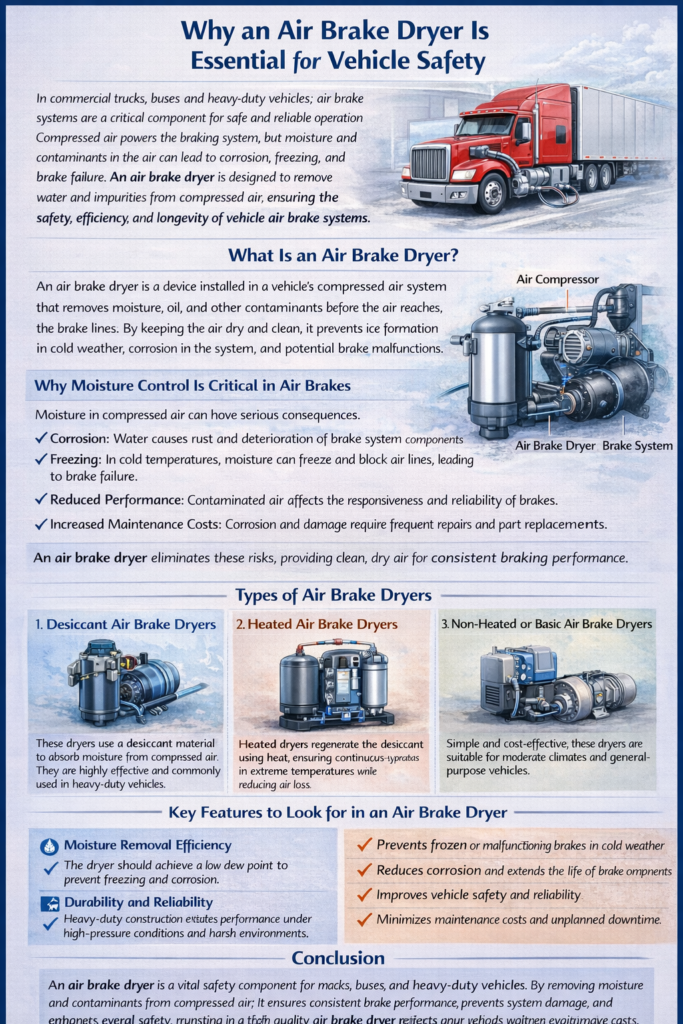
Why Moisture Control Matters in Air Brake Systems
Compressed air begins as atmospheric air, which naturally contains water vapor.
When air is compressed, the concentration of moisture per unit volume increases. As compressed air subsequently cools, some of that moisture can condense.
These physical moisture mechanisms help explain why water control is important in pneumatic vehicle systems.
Corrosion
Water that accumulates inside pneumatic components can contribute to rust and corrosion.
Over time, corrosion can affect valves, reservoirs, fittings, and air lines and can increase maintenance requirements.
Freezing in Cold Weather
Residual moisture becomes particularly important when a vehicle operates below freezing temperatures.
Water or condensate can freeze and potentially restrict small air passages or interfere with pneumatic component movement.
For a braking system that depends on controlled compressed-air flow, minimizing this risk is important.
Unstable Pneumatic Operation
Brake-system valves and control components are designed to operate within defined pressure and flow conditions.
Contamination, corrosion, or ice can interfere with normal operation, which is why moisture management forms an important part of maintaining a reliable compressed-air brake system.
Increased Maintenance
Allowing water and contamination to accumulate can increase servicing requirements and shorten the useful life of pneumatic components.
An effective dryer does not eliminate the need for inspection and maintenance, but it can reduce the amount of moisture entering downstream equipment.
How Does an Air Brake Dryer Work?
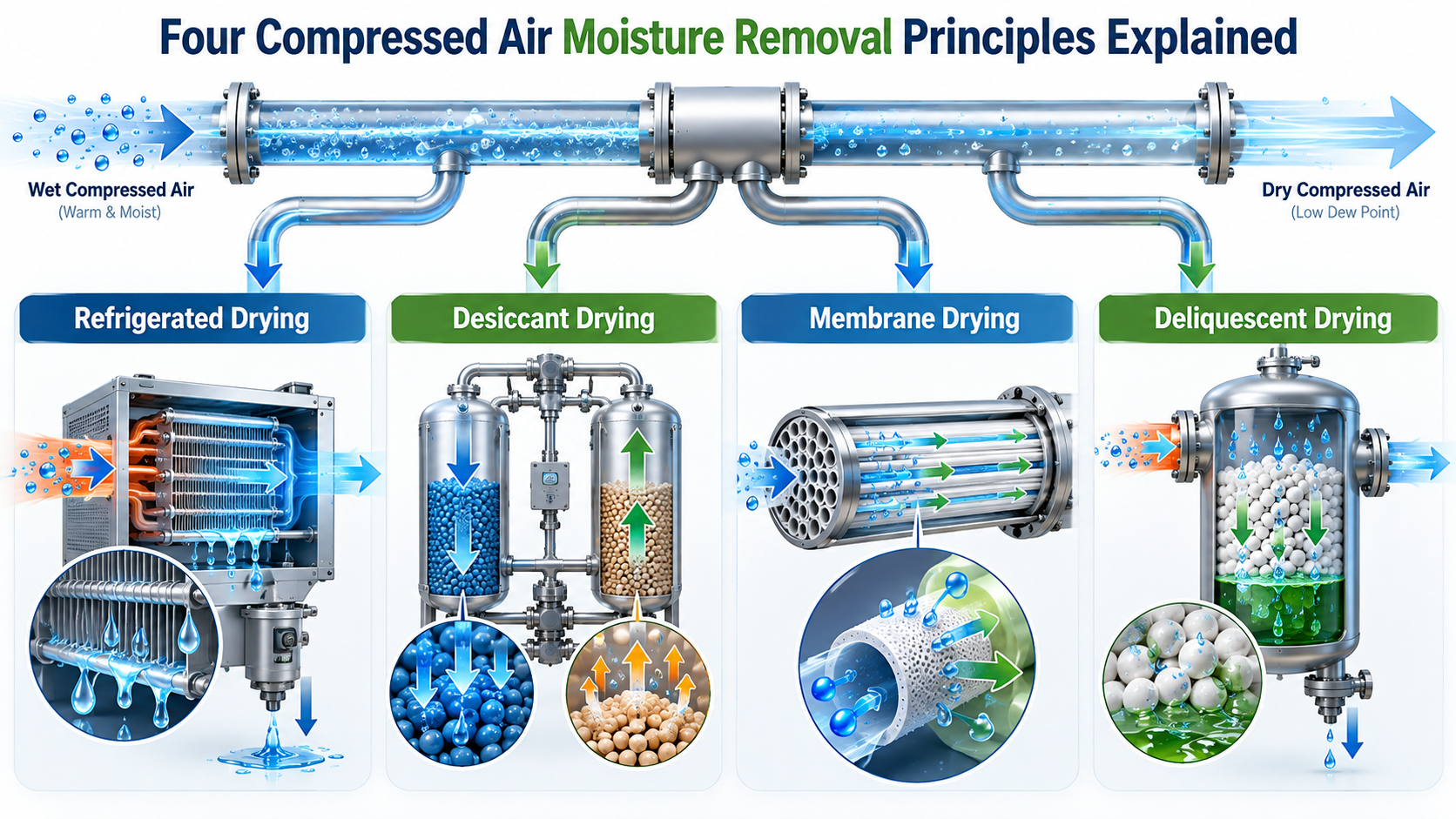
The exact design varies by manufacturer and vehicle platform, but many air brake dryers rely on the same general principle used in other desiccant-based compressed-air treatment systems: adsorption followed by regeneration.
During normal charging, compressed air passes through a drying medium that captures water vapor.
At an appropriate stage of the compressor or governor cycle, the dryer enters a regeneration or purge phase so that accumulated moisture can be discharged and the drying medium can recover its moisture-removal capacity.
The same fundamental adsorption/regeneration principle is used in industrial desiccant air dryer systems, although industrial dryers should not be treated as direct replacements for vehicle air brake dryers.
Industrial heatless adsorption dryers, for example, use desiccant adsorption followed by regeneration with dry compressed air. Their operating cycle includes adsorption, depressurization, regeneration, repressurization, and tower switching.
The underlying moisture-removal principle is similar, while the physical implementation is application-specific.
The Purge Cycle Is Normally Part of Operation
A short discharge of air from a desiccant-type brake dryer is not necessarily a fault.
Regenerative dryers need a method of removing accumulated moisture from the drying medium. A purge or regeneration event can therefore be a normal part of the operating cycle.
The same principle can be seen in industrial heatless adsorption dryers, where part of the dry compressed air is intentionally used during regeneration. Audible exhaust during the regeneration phase is therefore expected and does not automatically indicate a malfunction.
Continuous or abnormal air leakage, however, should be distinguished from a normal purge event.
For additional troubleshooting context, see the air dryer keeps purging guide.
For an actual truck or bus, vehicle-specific troubleshooting should always follow the approved brake-system and air-dryer manufacturer’s service procedures.
Desiccant Air Brake Dryers
Desiccant-based air brake dryers use an adsorbent medium to reduce water vapor in compressed air.
The desiccant captures moisture during the air-charging phase and is regenerated during an appropriate purge cycle.
Desiccant condition therefore matters. Contamination or deterioration of the drying medium can reduce moisture-removal performance over time.
Although the exact desiccant formulation and replacement procedure depend on the vehicle dryer manufacturer, the general principle is similar to industrial adsorption drying: desiccant capacity and regeneration effectiveness influence the dryer’s ability to maintain moisture-control performance.
Readers interested in the underlying industrial technology can review the desiccant air dryer working principle.
Heated vs. Non-Heated Air Brake Dryers
Heating should not automatically be treated as a completely separate drying principle from desiccant drying.
In vehicle systems, heater elements may be used to protect parts of the dryer or purge mechanism against freezing, depending on the specific equipment design.
This should not be confused with industrial heated-regeneration adsorption dryers, where heat is deliberately introduced as part of the desiccant regeneration process.
Lingyu manufactures stationary heated regeneration adsorption air dryers for industrial compressed-air systems. These are not vehicle-mounted truck or bus brake dryers.
This distinction prevents two technically different applications from being grouped together simply because both may involve desiccant and heating.
Important Features of an Air Brake Dryer
When evaluating or maintaining a vehicle air brake dryer, several characteristics are important.
Moisture-Removal Performance
Moisture-removal capability must be sufficient to limit water accumulation in the downstream pneumatic system.
Reliable Purge and Regeneration
The purge and regeneration process must operate correctly so that the drying medium can continue removing moisture effectively.
Low-Temperature Capability
Low-temperature performance is particularly important for trucks and buses operating in cold climates.
Pressure and Flow Compatibility
The dryer must match the compressor and brake-system pressure and flow requirements.
Durability
Vehicle-mounted equipment can experience vibration, temperature changes, contamination, and demanding duty cycles.
Serviceability
Desiccant cartridges, filters, valves, heaters, and other service components may require periodic inspection or replacement depending on the dryer design.
Because braking equipment is safety-critical, the vehicle manufacturer’s specifications should always take priority over generic dryer-selection advice.
Signs an Air Brake Dryer May Need Attention
A vehicle air dryer should be inspected when its operating behavior changes noticeably.
Potential warning signs include:
- Unusually frequent or abnormal air discharge
- Excessive water found downstream
- Slower-than-normal pressure build-up
- Visible contamination
- Repeated cold-weather problems
- Abnormal compressor cycling
- Dryer-related warnings specified by the vehicle manufacturer
These symptoms do not necessarily point to the same cause.
For example, excessive downstream moisture may indicate reduced drying performance, while continuous leakage may point more toward a purge valve, seal, or control problem.
For an actual truck or bus, diagnosis should follow the vehicle’s approved brake-system service information rather than applying stationary industrial dryer troubleshooting procedures directly.
Air Dryer Maintenance and Vehicle Safety
An air brake dryer should not be treated as a fit-and-forget component.
Maintenance intervals depend on vehicle duty cycle, compressor condition, operating environment, mileage or operating hours, dryer design, and manufacturer recommendations.
A vehicle operating in severe winter conditions, high humidity, frequent stop-and-go service, or demanding duty cycles may place a different load on the dryer than a vehicle operating under milder conditions.
Inspection should also consider the broader compressed-air system rather than looking at the dryer in isolation.
For example, if abnormal oil contamination appears in the dryer, simply replacing the desiccant may not address the underlying cause.
Because the air brake system is safety-critical, repair, modification, or replacement should use components specified for the vehicle and follow the applicable manufacturer’s maintenance procedure.
Industrial Vehicle Manufacturing Is a Different Application
Compressed air is also widely used in factories that manufacture vehicles and automotive components.
This is a completely different application from the vehicle-mounted air brake dryer.
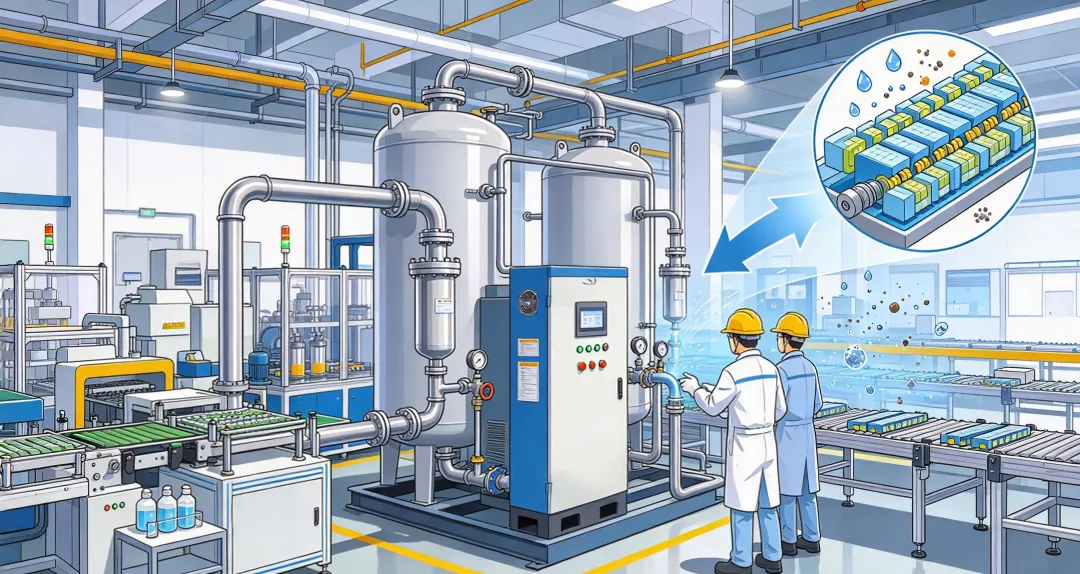
In automotive manufacturing plants, stationary compressed-air dryers can treat plant air used for pneumatic tools, automation, assembly equipment, controls, and production processes.
Lingyu’s automotive and general manufacturing solutions address these industrial compressed-air applications.
This should not be interpreted as indicating that Lingyu supplies the vehicle-mounted air brake dryer installed on trucks or buses.
Air Brake Dryer vs. Industrial Air Dryer
Both technologies address moisture in compressed air, but they serve very different systems.
| Factor | Air Brake Dryer | Industrial Air Dryer |
|---|---|---|
| Main application | Trucks, buses, heavy-duty vehicles | Factories and industrial plants |
| Installation | Vehicle-mounted pneumatic brake system | Stationary compressed-air system |
| Primary objective | Control moisture in vehicle air system | Achieve required industrial pressure dew point |
| Operating environment | Mobile, vibration, temperature changes | Industrial plant environment |
| System integration | Compressor, governor, reservoirs, brake components | Compressor, receiver, filters, production air network |
| Regeneration | Vehicle-specific purge/regeneration cycle | Heatless, heated, blower-heated, HOC, or other design |
| Selection basis | Vehicle/brake-system specification | Flow, pressure, temperature, dew point, air quality |
| Maintenance | Vehicle-specific service requirements | Industrial dryer maintenance requirements |
Lingyu specializes in stationary industrial compressed-air purification and separation equipment, including refrigerated dryers, adsorption dryers, combined dryers, filtration, and nitrogen-generation systems.
For stationary industrial applications, readers can review the industrial air dryer systems guide.
Conclusion
An air brake dryer plays an important role in managing moisture in the compressed-air systems used by many trucks, buses, and heavy-duty vehicles.
By reducing water vapor and helping control condensate before it reaches downstream pneumatic components, the dryer can help reduce corrosion, limit cold-weather freezing problems, and support reliable operation of the compressed-air brake system.
However, an air brake dryer should not be confused with a stationary industrial compressed-air dryer.
The two technologies share fundamental moisture-control principles, particularly desiccant adsorption and regeneration, but they are designed for different equipment and operating environments.
For vehicle applications, the correct dryer, replacement cartridge, maintenance interval, and repair procedure should always be determined from the vehicle and brake-system manufacturer’s specifications.
For factories that manufacture vehicles or use industrial pneumatic equipment, Lingyu’s refrigerated and adsorption dryers address a different requirement: treating the plant’s stationary compressed-air supply rather than serving as a vehicle-mounted braking component.