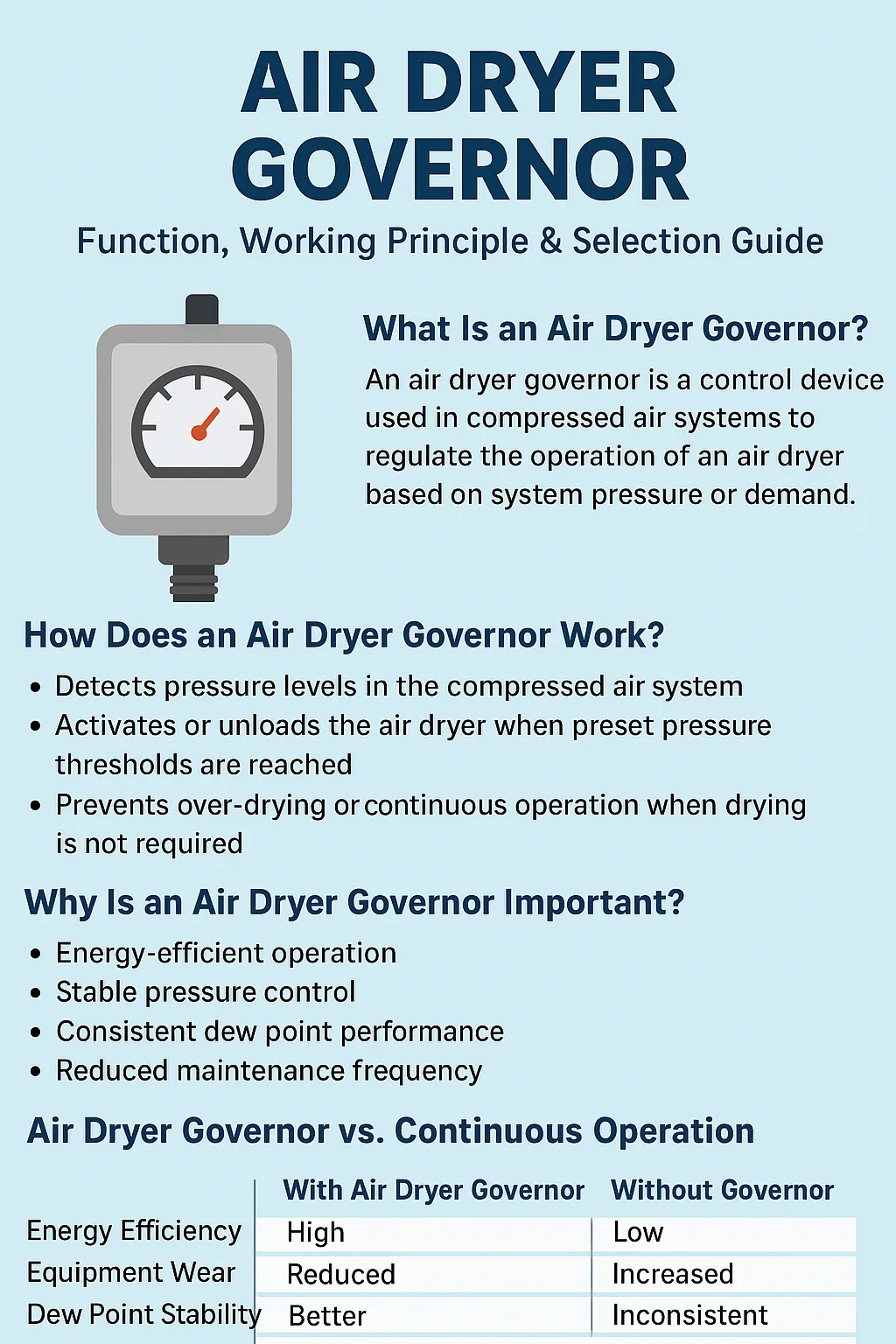
The term air dryer governor is sometimes used broadly to describe the control system that regulates the operation of a compressed-air dryer.
In modern industrial compressed-air systems, however, dryer control is usually performed by an electronic controller, PLC, variable-frequency control system, or dew-point-based control logic rather than by one universal component called a governor.
The purpose of these controls is to keep the dryer operating within the required pressure dew point and system conditions while avoiding unnecessary energy consumption or regeneration.
For industrial users, understanding how dryer control works is important when selecting either a refrigerated air dryer or an adsorption-based drying system.
What Is an Air Dryer Governor?
In an industrial compressed-air context, an air dryer governor is best understood as the dryer’s operating control or intelligent control system.
Depending on the dryer type, the controller may monitor or manage parameters such as:
- Air temperature
- System pressure
- Pressure dew point
- Compressor or refrigeration load
- Adsorption and regeneration timing
- Blower or heater operation
- Valve switching
- Alarm conditions
- Communication with the central control system
The exact control logic depends on the drying technology.
A refrigerated dryer does not normally use the same control strategy as a regenerative desiccant dryer.
For this reason, users should evaluate the actual control functions rather than simply asking whether the dryer has a “governor.”
How Does Air Dryer Control Work?
A dryer controller receives information from sensors and uses programmed logic to regulate dryer operation.
The objective is not simply to switch the entire dryer on and off according to compressed-air pressure.
Instead, different components are controlled according to operating conditions.
For example, variable-frequency refrigerated dryers can adjust refrigeration compressor speed according to changing air-treatment demand. Intelligent touchscreen control and RS-485 communication can also be integrated into the system.
For regenerative adsorption dryers, control is more complex because the operating sequence can include adsorption, depressurization, regeneration, heating, cooling, repressurization, and tower switching.
Air Dryer Governor and Refrigerated Air Dryers
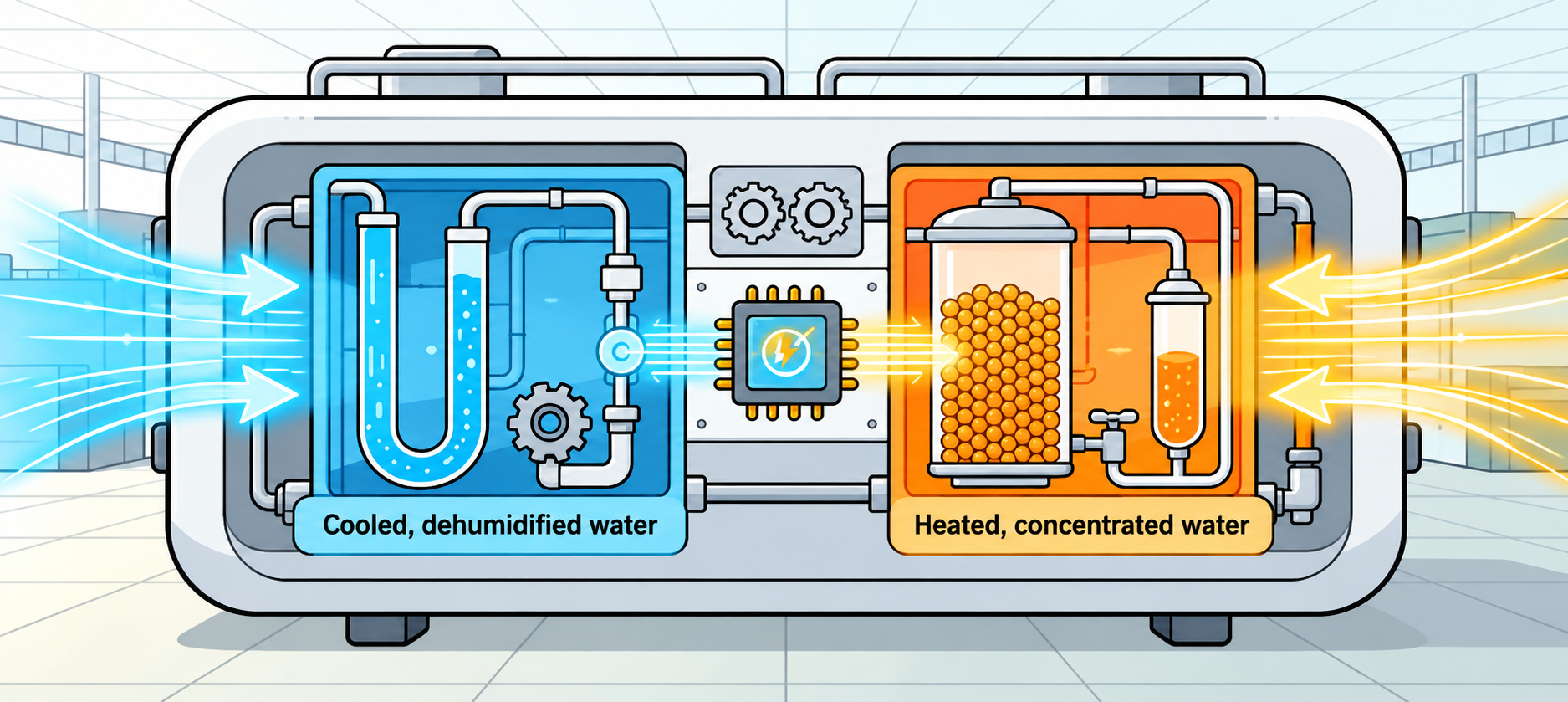
A refrigerated air dryer removes water by cooling compressed air until moisture condenses and can be separated from the air stream.
For this type of dryer, intelligent control can adjust refrigeration-system operation according to actual conditions.
Rather than continuously operating at maximum refrigeration capacity, some systems can reduce output when compressed-air demand or thermal load decreases.
Variable-frequency technology provides another level of load matching by automatically adjusting compressor speed according to the actual air-treatment demand.
Users interested in this approach can review the frequency conversion refrigerated air dryer.
In a variable-load refrigerated drying system, this type of control can maintain the required drying conditions while adapting refrigeration output to changing demand.
The controller therefore manages refrigeration-system operation rather than acting as a simple pressure switch for the entire dryer.
Air Dryer Governor and Desiccant Air Dryers
Desiccant air dryers require a different control strategy.
These dryers normally use two adsorption vessels or another alternating adsorption arrangement. While one side dries compressed air, the other side undergoes regeneration.
The controller must therefore coordinate valve switching, tower pressurization and depressurization, regeneration, cooling where applicable, and the return of each tower to adsorption service.
For users unfamiliar with the technology, the desiccant air dryer category provides a broader overview of adsorption drying solutions.
Depending on the dryer design, control can be based on fixed operating cycles or actual dew-point demand.
This distinction can have an important effect on energy efficiency.
Time-Based vs. Dew-Point-Based Control
A conventional regenerative dryer may switch adsorption cycles according to a fixed timer.
This approach is straightforward and predictable, but under partial load it may initiate regeneration before the available adsorption capacity has been fully utilized.
A dew-point-based control system uses actual drying conditions to determine whether the adsorption cycle can continue.
Selected Lingyu blower-heated and heat-of-compression systems support optional dew-point-based energy-saving control. Under fluctuating loads, the adsorption cycle can be extended according to actual operating demand instead of relying only on fixed-cycle timing.
This type of demand-responsive control is one of the functions users may be referring to when they use the general term “air dryer governor.”
Why Dryer Control Matters
The main purpose of intelligent dryer control is to maintain the required air quality without consuming more energy than necessary.
For refrigerated dryers, this can mean matching refrigeration capacity to actual airflow or thermal load.
For adsorption dryers, it can mean optimizing regeneration timing, reducing unnecessary purge-air consumption, or avoiding unnecessary heating and cooling cycles.
Good dryer control can also support system monitoring by providing information about temperatures, pressures, pressure dew point, operating status, and alarms.
However, control alone cannot compensate for an incorrectly sized dryer.
Airflow, operating pressure, inlet temperature, ambient temperature, and required pressure dew point must still be correctly defined.
Air Dryer Governor vs. Fixed-Cycle Operation
The comparison is better framed as fixed-cycle control versus intelligent or demand-based control, rather than “with governor versus without governor.”
| Control Method | Fixed-Cycle Control | Intelligent / Demand-Based Control |
|---|---|---|
| Operating logic | Predetermined intervals | Responds to measured conditions |
| Load adaptation | Limited | Better suited to changing demand |
| Energy optimization | Basic | Greater potential |
| Dew-point feedback | Usually limited | Can be included |
| Monitoring | Depends on controller | Often more comprehensive |
| Best use | Stable, predictable operation | Variable-load systems |
Actual savings depend on dryer design, load profile, inlet conditions, regeneration method, pressure dew point requirement, and operating hours.
Selected blower-heated adsorption systems use an intelligent energy-saving controller that can reduce overall energy consumption by more than 10% compared with conventional fixed-cycle operation. Under fluctuating loads, optional dew-point-based control can extend the adsorption cycle and is rated for more than 30% energy reduction under the specified control conditions. These values are specific to the applicable system and operating basis rather than universal savings for every dryer installation.
Controlling Regeneration in Desiccant Air Dryers
Regeneration represents a major part of adsorption dryer operating cost.
A heated-purge dryer uses an external heat source together with dry product air for regeneration.
Lingyu heated-purge configurations are available with average purge-air consumption of 4–8%, depending on the applicable series, with low pressure dew point capability such as ≤−40°C in the corresponding configuration.
A blower-heated design can reduce purge-air requirements further.
Lingyu’s HRB-E low-purge blower-heated regenerative desiccant dryer is specified with 2–3% regeneration air consumption and optional outlet pressure dew points of −20°C or −40°C.
For larger installations focused on minimizing compressed-air regeneration losses, the blower zero-purge adsorption dryer provides another regeneration approach.
In a zero-purge blower-heated configuration, ambient air is used during heating and the cooling circuit is designed to avoid dry product-air consumption during regeneration.
The controller therefore manages not only tower switching but also blower operation, heater operation, cooling, temperature conditions, and the complete regeneration sequence.
Pressure Control and Dryer Control Are Not the Same Thing
Compressed-air system pressure control and dryer control are related but not identical.
The air compressor and central compressed-air system are responsible for producing and maintaining the required system pressure.
The dryer is primarily responsible for achieving the required moisture level while minimizing unnecessary pressure loss and energy consumption.
A dryer controller may monitor pressure as one operating parameter, but it does not replace the compressor control system.
Understanding this distinction prevents the term “air dryer governor” from being interpreted as a device that regulates the entire plant’s compressed-air pressure.
For users evaluating the energy impact of dryer restriction, the compressed air pressure drop guide provides additional system-level context.
Required Dew Point and Control Strategy
The required pressure dew point determines the drying technology first; the control strategy comes second.
For general industrial applications, refrigerated drying may provide sufficient moisture control. Lingyu refrigerated dryers commonly provide pressure dew points of approximately 2–10°C, depending on the series and specified operating conditions.
Where substantially drier compressed air is required, adsorption drying becomes more appropriate.
For example, Lingyu’s modular adsorption dryer provides an outlet pressure dew point of ≤−20°C, with −40°C available as an option.
A modular adsorption air dryer may therefore be relevant where compact installation and low-dew-point compressed air are both required.
The key principle is that intelligent control improves the operation of an appropriately selected dryer; it does not change the fundamental drying capability of the technology itself.
Selecting the Right Air Dryer Control System
When evaluating a dryer and its controller, important factors include the required pressure dew point, actual airflow, operating pressure, inlet temperature, load variation, regeneration method, pressure drop, and monitoring requirements.
For relatively stable compressed-air demand, a standard controller may be sufficient.
For a variable-load system, variable-frequency refrigeration or dew-point-based adsorption control can provide greater operating flexibility.
Large or production-critical installations may also benefit from remote communication, central control integration, alarms, and monitoring of temperatures, pressures, and pressure dew point.
Selected Lingyu adsorption dryers support RS-485 communication, optional IoT connectivity, touchscreen monitoring, and optional dew-point monitoring or control, depending on the configuration.
Users comparing complete dryer technologies can review the refrigerated air dryer vs. desiccant air dryer guide before deciding which control strategy is appropriate.
Intelligent Control in Large Compressed Air Systems
The value of advanced control becomes greater as dryer capacity and system complexity increase.
Large adsorption dryers can include heaters, blowers, cooling systems, multiple switching valves, pressure sensors, temperature sensors, and pressure-dew-point monitoring.
Large zero-air-loss HOC and blower-heated installations can also use multi-point temperature monitoring, multi-point pressure monitoring, local/remote control, and time-based or dew-point-based operating modes.
This type of architecture shows why modern dryer control is better understood as an integrated control system rather than a single mechanical governor.
Applications
Intelligent dryer control can be useful in industries where compressed-air demand changes significantly or where stable pressure dew point is important.
In electronics and precision manufacturing, controlled dry-air conditions may be important for sensitive production equipment and processes.
In automotive and general manufacturing, compressed-air demand can fluctuate according to production shifts and equipment operation, making load-responsive control useful.
Other applications include pharmaceutical production, chemical processing, new-energy manufacturing, power generation, and other facilities operating large or variable-load compressed-air systems.
The appropriate control strategy should still be selected from the actual process conditions rather than the industry name alone.
Conclusion
An air dryer governor in an industrial compressed-air context is best understood as the dryer’s control and operating logic, not as one universal standalone component.
Modern refrigerated dryers may use automatic capacity adjustment or variable-frequency control to respond to changing air demand.
Regenerative desiccant dryers may use fixed-cycle, time-based, or dew-point-based control to manage adsorption and regeneration.
The correct control strategy depends on the dryer technology, airflow, required pressure dew point, operating pressure, inlet temperature, regeneration method, and variation in plant demand.
Pressure control and dryer control should also be distinguished: the compressor system manages plant compressed-air pressure, while the dryer controller manages drying performance and the components required to achieve it.
For users selecting a new system, the priority should therefore be to choose the correct drying technology first and then select the appropriate level of intelligent control, monitoring, communication, and energy optimization.