A high-efficiency air compressor does not automatically create a high-efficiency compressed air system.
The compressor generates compressed air, while downstream purification equipment—including filters and air dryers—removes contaminants and moisture so that the air meets the quality requirements of the production process.
Every pressure loss, kilowatt of electricity, and portion of compressed air consumed by the treatment system ultimately contributes to the total cost of producing usable compressed air.
Among these components, the compressed air dryer plays a particularly important role because it determines whether the system can achieve and maintain the required pressure dew point (PDP).
Pairing a highly efficient compressor with an incorrectly selected dryer can still result in unnecessary energy consumption, unstable dew point performance, or insufficient treatment capacity.
The objective is not simply to choose the most efficient compressor and then add any dryer. Instead, the compressor, dryer, filtration system, cooling conditions, and operating controls should be matched around the actual compressed air quality requirement.
1. Start With the Required Compressed Air Quality
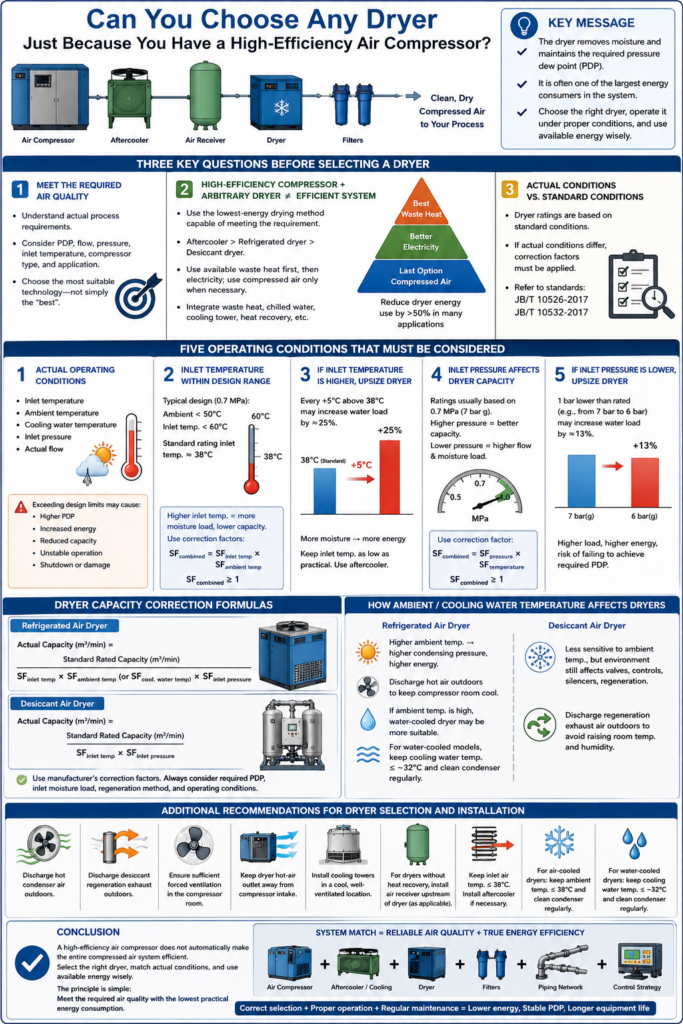
Before comparing dryer technologies, define what the production process actually requires.
Important parameters include:
- Required pressure dew point
- Maximum actual compressed air flow
- Operating pressure
- Dryer inlet temperature
- Compressor type
- Inlet air quality
- Load profile
- Downstream application
The objective is not to select the dryer capable of producing the lowest possible dew point. It is to select a dryer that reliably achieves the required pressure dew point under the site’s actual operating conditions.
For applications requiring moderate moisture control, a refrigerated air dryer may be appropriate.
When substantially lower pressure dew points are required, a desiccant air dryer may be necessary.
For a direct comparison, see how to choose between refrigerated and desiccant air dryers.
2. A High-Efficiency Compressor + the Wrong Dryer ≠ an Efficient System
Dryer energy consumption should always be evaluated in relation to the air quality actually required.
For example, if the application can be adequately served by refrigerated drying, specifying a regenerative adsorption dryer simply because it can produce a much lower pressure dew point may introduce unnecessary regeneration energy and maintenance requirements.
Likewise, an adsorption dryer should not be rejected purely because it consumes more regeneration energy if the production process genuinely requires a low pressure dew point that a conventional refrigerated dryer cannot provide.
The correct principle is to meet the required air quality with the lowest practical lifecycle energy consumption.
This requires evaluating the complete system rather than comparing dryer purchase prices alone.
3. Use Moisture Removal in Stages Where Appropriate
An aftercooler, refrigerated dryer, and adsorption dryer do not necessarily perform interchangeable functions.
An aftercooler can reduce compressed air temperature and remove a significant amount of condensable moisture when combined with effective separation and drainage.
A refrigerated dryer can then provide further moisture removal and maintain a controlled positive pressure dew point.
An adsorption dryer is used when the process requires substantially drier compressed air.
Instead of treating the selection as:
Aftercooler OR Refrigerated Dryer OR Desiccant Dryer
it is often more useful to think in terms of:
Cooling and Separation → Refrigerated Drying where appropriate → Adsorption Drying where required
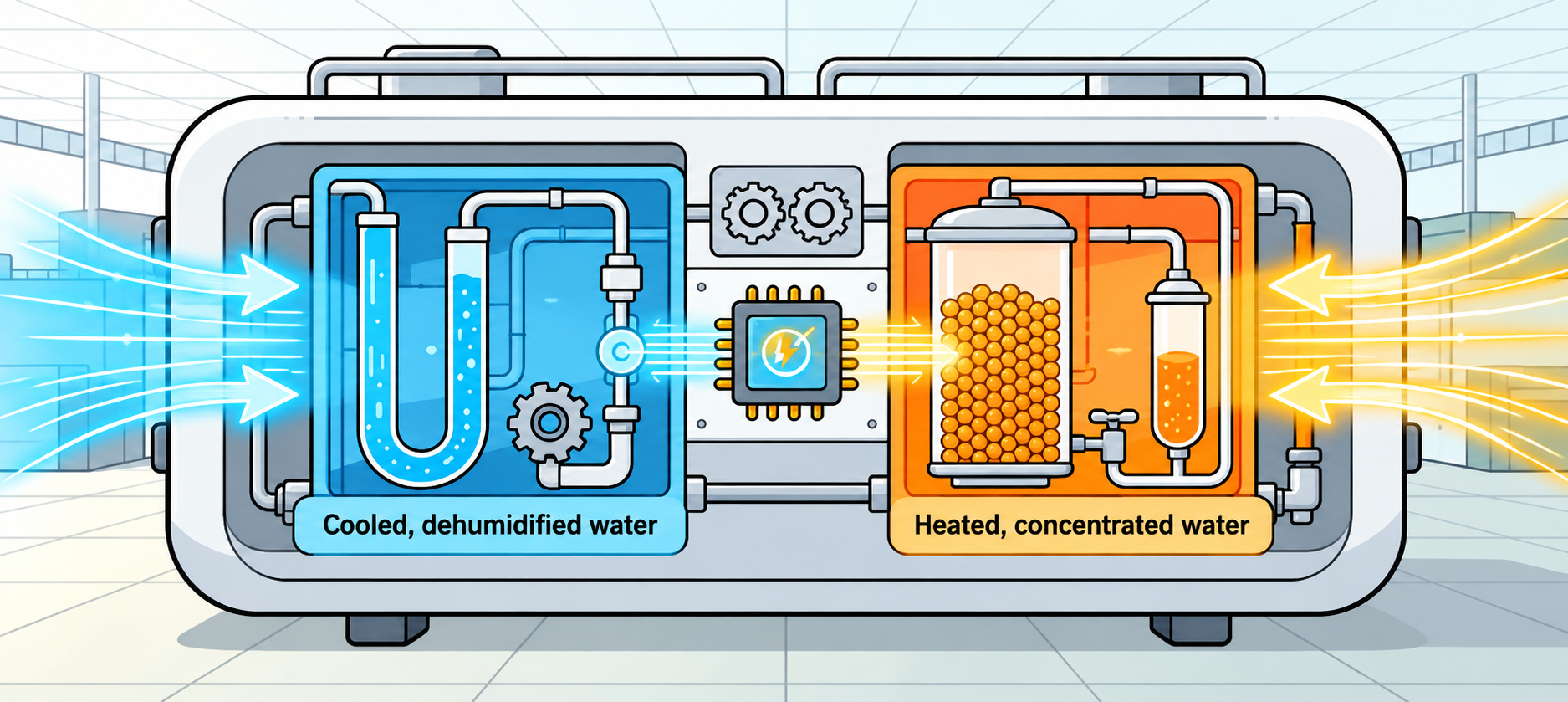
Lingyu’s combined drying systems use this staged principle. The refrigerated section first removes a large proportion of the moisture before the compressed air enters the adsorption stage. This reduces the moisture load on the adsorption bed, lowers regeneration-air demand, and helps extend desiccant service life.
For applications that benefit from staged moisture removal, Lingyu’s DC Series combined compressed air dryer integrates refrigerated and adsorption drying in one treatment system.
4. Regeneration Technology Can Have a Major Impact on Energy Consumption
If the required pressure dew point makes an adsorption dryer necessary, the next question is how the desiccant should be regenerated.
Different regeneration technologies use different energy sources.
Heatless Regeneration
A heatless regenerative dryer uses part of the already-dried compressed air for desiccant regeneration.
Lingyu HH Series heatless models, for example, specify average purge-air consumption of approximately 8–14% under rated conditions.
The design is relatively straightforward because no external regeneration heater is required, but the cost of purge air should be included in lifecycle energy calculations.
Heated Purge Regeneration
A heated regeneration system uses external heating to assist moisture desorption.
Lingyu heated-purge configurations specify average purge-air consumption of approximately 4–8%, depending on the series and operating conditions.
This reduces compressed-air regeneration demand compared with conventional heatless operation, but heater electricity must also be considered.
Blower-Heated Regeneration
A blower-heated adsorption dryer uses heated ambient air for regeneration.
Lingyu HRB-E low-purge models specify regeneration-air consumption of approximately 2–3%, while HRB-Z zero-purge configurations use closed-loop cooling and are specified at approximately 0% regeneration-air consumption under their defined operating conditions.
Heat-of-Compression Regeneration
Where the compressor system and operating conditions are suitable, compressor discharge heat can also be used as a regeneration energy source.
Lingyu HOC systems use thermal energy in high-temperature compressor discharge air to regenerate the desiccant.
HOC-E uses no compressed air during the heating/regeneration stage and only a small amount of dry product air during cooling, while HOC-Z configurations are specified with zero regeneration-air consumption under their defined conditions.
Plants considering this approach can review Lingyu’s heat-of-compression dryer range.
For adsorption drying, the energy question should therefore be broader than simply asking how much electricity the dryer uses.
A meaningful comparison should include:
Purge-air cost + heater energy + blower energy + available recovered heat + pressure drop + maintenance
5. Catalog Capacity Is Not the Same as Actual Site Capacity
A dryer is rated under defined operating conditions.
If actual inlet temperature, pressure, airflow, ambient conditions, or cooling-water conditions differ from the rating basis, the usable capacity of the dryer may also change.
This is one of the most important principles in compressed air dryer selection.
A dryer that appears large enough according to nominal flow alone may be undersized under actual operating conditions.
Before selecting equipment, evaluate:
- Maximum actual airflow
- Actual inlet temperature
- Minimum and normal operating pressure
- Ambient temperature
- Cooling-water temperature where applicable
- Required pressure dew point
- Load variation
Manufacturer correction factors and engineering selection data should then be applied where required.
For adsorption equipment specifically, see how to choose a desiccant air dryer and avoid common sizing mistakes.
6. Inlet Temperature Can Significantly Affect Dryer Performance
Inlet temperature is particularly important because warmer compressed air can carry more water vapor.
As inlet temperature rises, the moisture load entering the dryer can increase substantially.
However, there is no single universal inlet-temperature limit that applies to every dryer technology. Different Lingyu products are designed for different operating conditions.
For example, several Lingyu conventional heatless and heated-purge regenerative dryer series specify:
- Rated inlet temperature: 10–30°C
- Maximum inlet temperature: ≤40°C
under their defined operating conditions.
Heat-of-compression dryers are fundamentally different. Lingyu HOC configurations are designed around high-temperature compressor discharge air and specify:
- Rated inlet temperature: 120°C
- Allowable inlet temperature range: 110–180°C
This demonstrates why a universal rule such as “all dryer inlet temperatures should be ≤38°C” should not be applied to every compressed air dryer.
The correct rule is to keep the dryer inlet conditions within the specified range for the selected dryer technology and model.
7. Inlet Pressure Also Changes Effective Dryer Capacity
Pressure is another important selection parameter.
Several Lingyu regenerative dryer series use:
- Rated inlet pressure: 0.7 MPa
- Operating pressure range: 0.6–1.0 MPa
under their standard configurations.
If actual operating pressure differs from the rated condition, effective treatment capacity may change.
At lower pressure, the same mass flow occupies a greater volume, increasing volumetric airflow through the dryer.
This can affect:
- Air velocity
- Adsorption contact time
- Pressure drop
- Effective treatment capacity
- Moisture-removal performance
Therefore, dryer selection should be corrected for actual pressure rather than assuming that catalog capacity remains unchanged at every operating pressure.
8. Do Not Use Universal Temperature or Pressure Correction Percentages
Correction factors are important, but they should come from the manufacturer or the engineering data for the specific dryer.
A selection calculation may conceptually consider:
Required Dryer Capacity = Actual Air Demand × Applicable Correction Factors
Relevant correction factors may account for:
- Inlet temperature
- Operating pressure
- Ambient temperature
- Cooling-water temperature
- Required pressure dew point
However, the exact formula and direction in which individual correction factors are applied depend on how the manufacturer defines its selection tables.
Universal temperature or pressure correction percentages should therefore not be used as fixed selection rules unless they are explicitly supported by the engineering data for the specific product.
The more accurate approach is to use the correction factors supplied for the selected dryer series.
9. Ambient Conditions Matter More to Some Dryer Technologies Than Others
The compressor room environment can affect equipment performance, particularly for air-cooled refrigeration and blower-based systems.
Air-Cooled Refrigerated Dryers
Air-cooled refrigerated dryers depend on adequate heat rejection.
Poor ventilation and high ambient temperature can reduce condenser performance and increase refrigeration-system operating stress.
Installation should therefore provide:
- Adequate ventilation
- Sufficient clearance around heat-rejection surfaces
- Clean condenser surfaces
- Proper hot-air discharge
- Suitable service access
Recirculating hot condenser discharge air back into the dryer or compressor intake area should be avoided where practical.
Water-Cooled Refrigerated Dryers
Where a water-cooled design is used, cooling-water conditions become an important selection parameter.
Cooling-water temperature, flow, and condenser condition should remain within the requirements of the selected equipment.
High cooling-water temperature or condenser scaling can reduce heat-transfer performance.
Adsorption Dryers
Ambient conditions can also influence adsorption dryer components and regeneration systems.
For example, Lingyu HH heatless models specify an ambient operating range of 2–45°C under their defined conditions.
Blower-heated systems also use ambient air as part of the regeneration process, making environmental conditions relevant to overall operation.
Therefore, adsorption dryers should not simply be described as unaffected by ambient temperature.
10. Pressure Drop Must Be Included in the Energy Calculation
Dryer energy consumption is not limited to purge air or electrical power.
Pressure drop across compressed air treatment equipment also matters.
Every unnecessary restriction between the compressor and point of use can increase the pressure the compressor must generate to maintain the required downstream pressure.
This means two dryers capable of achieving the same pressure dew point may still have different effects on total system energy consumption.
When comparing dryers, consider:
- Dryer inlet-to-outlet pressure drop
- Filter differential pressure
- Pressure loss as airflow increases
- Pressure loss as components become contaminated
- Required compressor discharge pressure
For a system-level explanation, see how compressed air pressure drop affects system efficiency.
11. Variable Air Demand Should Influence Dryer Selection
Many compressed air systems do not operate continuously at full load.
Production shifts, machine cycles, seasonal conditions, and changes in process demand can cause airflow and moisture loading to vary significantly.
A dryer selected only around full-load conditions may therefore spend much of its operating life at partial load. This makes the control strategy an important part of equipment selection.
Some Lingyu energy-saving regenerative dryer configurations offer dew-point-based control that can extend adsorption cycles according to actual operating conditions instead of relying only on a fixed cycle.
For example, HRB-E configurations can use optional dew-point-based control for fluctuating loads. This can reduce unnecessary regeneration when moisture loading is lower.
The potential savings depend on the dryer configuration and actual load profile, so they should be evaluated for the specific installation rather than treated as a universal percentage.
12. Should You Always Use an Aftercooler Before the Dryer?
Aftercooling is highly important in many conventional compressed air systems because reducing compressed air temperature allows condensable moisture to be separated before the air reaches downstream treatment equipment.
However, the system arrangement depends on dryer technology.
For conventional refrigerated and many regenerative dryers, effective aftercooling and condensate separation can reduce the moisture load entering the dryer.
For heat-of-compression systems, however, high-temperature compressor discharge air is intentionally used as the regeneration energy source.
Therefore, a universal rule such as “always cool compressed air to 38°C or below before every dryer” would be incorrect.
System layout must match the drying technology.
13. When Does a Refrigerated + Desiccant Combination Make Sense?
In some applications, the most efficient solution is not choosing between refrigerated and adsorption drying. Instead, both technologies can be used in stages.
Lingyu DC and DH combined dryers use this principle.
Wet compressed air first enters the refrigerated section, where it is cooled and a large proportion of moisture is condensed and separated.
The air then passes through further treatment before entering the adsorption stage for deeper drying.
Reducing the moisture load before the adsorption stage can:
- Reduce regeneration-air consumption
- Reduce the moisture load on the desiccant
- Extend desiccant service life
- Improve overall operating economy
This type of configuration can be particularly useful where the inlet moisture load is relatively high but the downstream process still requires a low pressure dew point.
14. Evaluate Total Lifecycle Cost, Not Just Dryer Power
The most energy-efficient dryer cannot always be identified from one specification.
A meaningful lifecycle comparison should consider:
Initial investment + electricity + purge air + pressure drop + cooling + filtration + desiccant + maintenance
For example, a heatless dryer may have a relatively simple regeneration system but consume more compressed purge air.
A heated-purge dryer reduces purge-air demand but introduces heater energy.
A blower-heated dryer can substantially reduce compressed-air regeneration losses but adds blower and heater energy.
A heat-of-compression system can recover compressor discharge heat but requires the compressor and dryer to be properly integrated.
A refrigerated dryer may offer economical operation when a positive pressure dew point is sufficient, but it cannot simply replace adsorption drying when the process genuinely requires a substantially lower dew point.
The lowest lifecycle cost therefore depends on the actual operating profile.
15. A Practical Dryer Selection Sequence
Instead of selecting the compressor first and treating the dryer as an accessory, use the following sequence:
Required Air Quality → Actual Flow → Inlet Temperature → Operating Pressure → Dryer Technology → Regeneration Method → Available Energy Sources → Pressure Drop → Control Strategy → Lifecycle Cost
First, determine the required pressure dew point.
Then confirm actual airflow, pressure, and temperature rather than relying only on nominal compressor data.
Select the appropriate drying technology and, if adsorption drying is required, compare the available regeneration methods.
Finally, evaluate how the dryer interacts with filtration, cooling, pressure loss, compressor control, and variable plant demand.
This approach treats the dryer as part of the compressed air system rather than as an isolated piece of purification equipment.
Conclusion: System Efficiency Depends on Matching, Not Individual Equipment Efficiency
A high-efficiency air compressor is an important part of an energy-efficient compressed air system, but it is only one part.
If the dryer is incorrectly sized, operates outside its intended conditions, produces a pressure dew point far below what the process actually needs, wastes excessive regeneration air, or creates unnecessary pressure loss, part of the compressor’s efficiency advantage can be lost elsewhere in the system.
The correct approach is to evaluate:
Required PDP → Actual Operating Conditions → Dryer Technology → Regeneration Energy → Pressure Drop → Control Strategy → Lifecycle Cost
There is no single dryer technology that is automatically the most efficient for every application.
A refrigerated dryer may be the right choice for moderate moisture-control requirements.
A regenerative adsorption dryer may be necessary for low-dew-point applications.
A blower-heated or heat-of-compression configuration may reduce regeneration losses in suitable systems.
A combined refrigerated + adsorption system may provide a better solution when high inlet moisture loading and low final pressure dew point requirements exist together.
The principle is simple:
Meet the required compressed air quality with the lowest practical total energy consumption—not simply the lowest energy consumption of one individual component.
If you need help matching the compressor, dryer technology, operating conditions, and pressure dew point requirement, contact Lingyu for compressed air treatment system selection support.