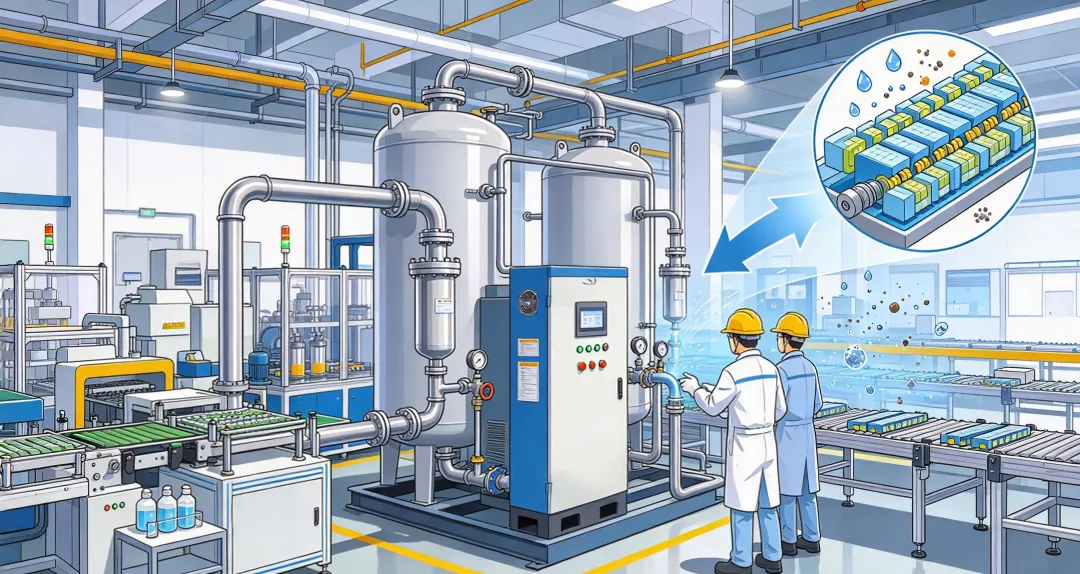
Compressed air is an essential utility in modern manufacturing, powering pneumatic tools, control systems, production machinery, packaging lines, and automated equipment.
However, compressed air naturally carries moisture and can also contain oil and solid contaminants. If these contaminants are not properly controlled, they may contribute to corrosion, freezing, equipment failure, unstable production, and product-quality problems.
A commercial air dryer helps control moisture in compressed-air systems and forms an important part of a broader compressed-air purification system.
For industrial facilities, the correct solution may be a refrigerated dryer, desiccant dryer, or combined drying system depending on the required pressure dew point, airflow, operating conditions, and air-quality target.
What Is a Commercial Air Dryer?
“Commercial air dryer” is a broad market term rather than one specific dryer technology.
In industrial compressed-air systems, it generally refers to equipment designed to remove moisture from compressed air continuously at the flow rates required by production facilities.
A commercial compressed-air drying system may use a refrigerated air dryer, a desiccant air dryer, or a combination of both technologies depending on the required air quality.
Lingyu’s air-treatment product range includes refrigerated dryers, multiple regenerative adsorption dryer configurations, combined dryers, precision filters, and related treatment equipment.
It is important to distinguish moisture removal from broader compressed-air purification.
Moisture removal is the dryer’s primary function. Oil aerosols, oil vapor, particles, and other contaminants may require appropriate filtration, separation, or additional treatment equipment.
Why Moisture Is a Problem in Compressed Air
Ambient air contains water vapor. When large volumes of air are compressed into a smaller space, the moisture concentration increases.
As compressed air subsequently cools, part of this water vapor can condense into liquid water.
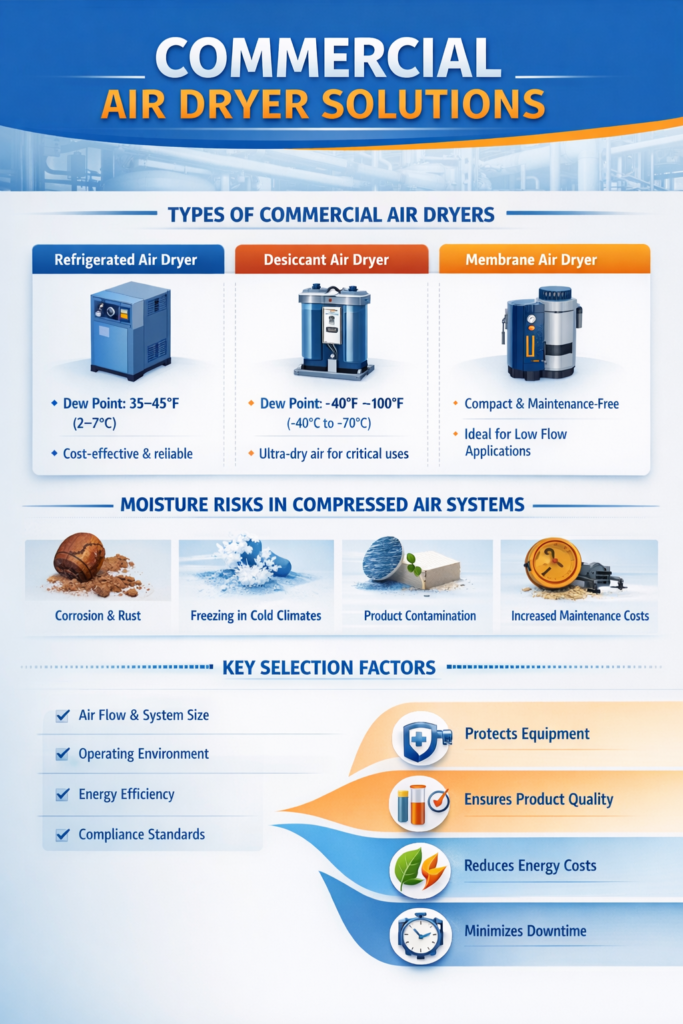
Uncontrolled moisture can contribute to pipeline corrosion, reduced product quality, control-system failures, freezing, and other compressed-air system problems.
Corrosion and Rust
Condensed water can contribute to corrosion inside piping, valves, receivers, and pneumatic components.
Over time, corrosion can increase maintenance requirements and may also introduce additional solid contamination into the compressed-air network.
Freezing
In low-temperature environments, residual moisture may freeze inside compressed-air lines or components.
This can restrict airflow and interfere with pneumatic equipment operation.
Product and Process Quality
Where compressed air comes into direct or indirect contact with production processes, excessive moisture can affect process consistency or product quality.
Industries such as pharmaceutical production, food processing, electronics, and precision manufacturing may therefore require tighter compressed-air quality control.
Increased Maintenance
Moisture-related corrosion, contamination, and equipment malfunction can increase maintenance frequency and contribute to unplanned production interruptions.
For a broader explanation, see why compressed air requires a dryer.
Main Types of Commercial Air Dryers
Refrigerated Air Dryers
Refrigerated dryers are widely used for general industrial compressed-air applications.
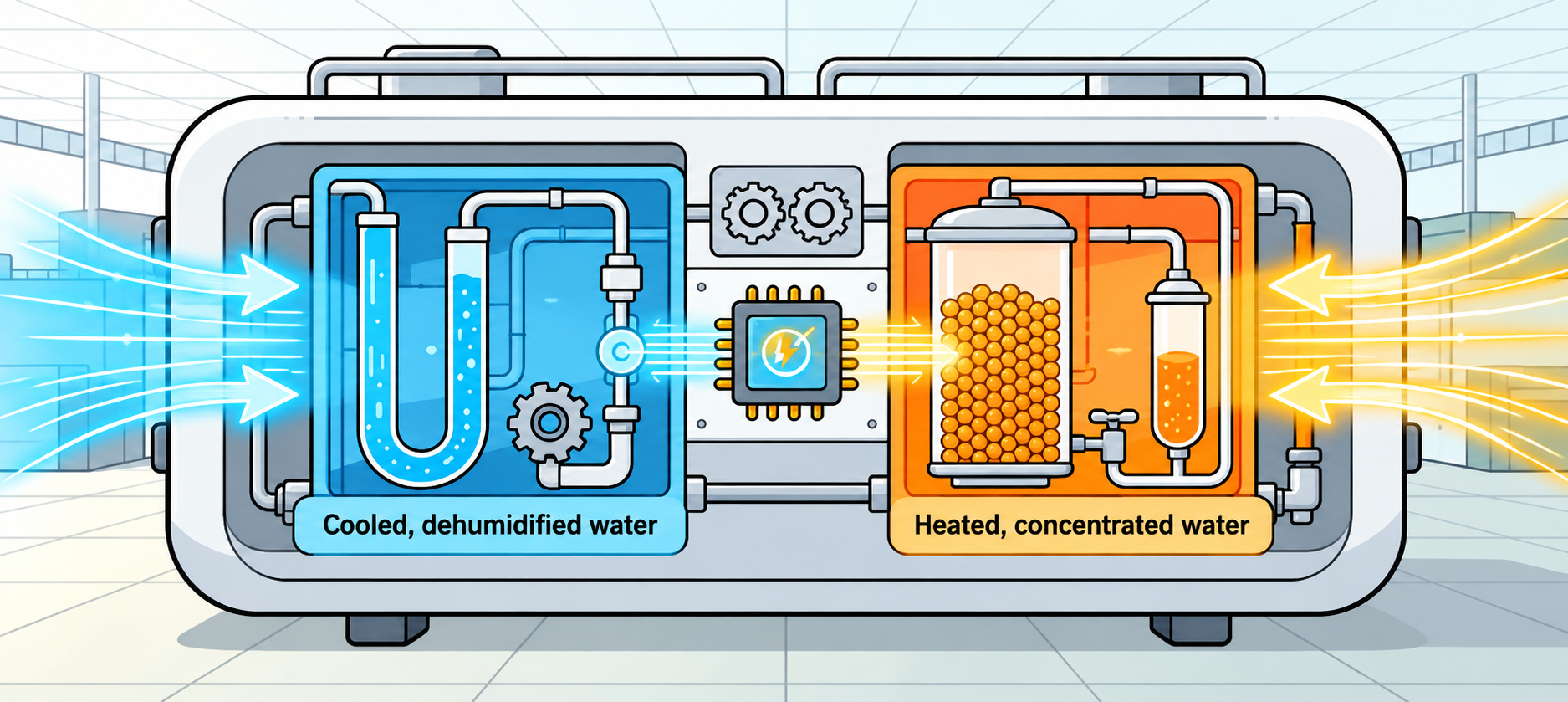
They cool compressed air so that water vapor condenses into liquid water. The condensed moisture is separated and discharged before the treated air is reheated toward ambient temperature.
Lingyu refrigerated dryer systems generally provide pressure dew points in the 2–10°C range, depending on the series and specified operating conditions.
Refrigerated dryers are generally suitable where the compressed-air system does not require an ultra-low pressure dew point.
Typical applications include manufacturing, automotive production, machinery, packaging, and general plant-air systems.
For more information about the operating process, see how a refrigerated air dryer works.
Desiccant Air Dryers
Where significantly lower moisture levels are required, a desiccant or adsorption dryer can be used.
These dryers pass compressed air through an adsorbent material that captures water vapor. Twin-tower regenerative systems allow one tower to dry compressed air while the second tower regenerates.
Lingyu provides heatless, heated-purge, modular, blower-heated, zero-purge blower-heated, and heat-of-compression regenerative adsorption dryer configurations.
Depending on the specific series, −20°C and −40°C pressure dew point configurations are available, with several product families designed around −40°C operation.
For facilities requiring a deeper explanation of adsorption drying, see Lingyu’s desiccant air dryer solutions.
Combined Refrigerated and Desiccant Dryers
Some facilities can benefit from combining refrigerated and adsorption drying.
A refrigerated dryer first removes a substantial portion of the moisture load. The partially dried compressed air then enters the adsorption stage, where residual water vapor is removed to achieve a much lower pressure dew point.
This arrangement reduces the moisture load entering the adsorption stage and can reduce regeneration demand.
Lingyu’s combined dryer configurations can provide an outlet pressure dew point of ≤−40°C under the specified operating conditions.
Users interested in this integrated approach can review Lingyu’s DC Series combined compressed air dryer.
What About Membrane Air Dryers?
Membrane drying is another compressed-air drying technology used in the wider industrial market.
However, Lingyu’s core commercial drying range is centered on refrigerated dryers, regenerative adsorption dryers, and combined drying systems.
For applications being evaluated specifically around Lingyu’s current dryer range, refrigerated, desiccant, and combined technologies are therefore the primary options to compare.
Air Dryers Do Not Replace Filtration
A dryer is primarily intended to control moisture. Other compressed-air contaminants require appropriate treatment methods.
Oil aerosols, oil vapor, and solid particles may require filters, separators, or other purification equipment depending on the required air quality.
A complete commercial compressed-air purification system can therefore include an air receiver, dryer, filters, automatic drains, separators, and other treatment components.
Where particulate and oil control are also required, Lingyu’s precision compressed air filter can form part of the treatment system.
Commercial Air Dryer Applications
General Manufacturing
Factories using pneumatic tools, automation equipment, cylinders, valves, and control systems often use refrigerated dryers when a moderate pressure dew point is sufficient.
The primary objective is to control condensate and protect the compressed-air network and downstream equipment.
Food and Beverage
Compressed-air quality can be important in packaging, processing equipment, instrumentation, and other production areas.
The required dryer and filtration system should be selected according to how compressed air interacts with the product or process.
Lingyu provides dedicated food and beverage compressed-air solutions.
Pharmaceutical Production
Pharmaceutical plants may require tighter moisture, oil, and particulate control for selected compressed-air applications.
The appropriate specification depends on whether compressed air is used for general utilities, instruments, production equipment, packaging, or direct process contact.
For this sector, see Lingyu’s pharmaceutical and biopharmaceutical solutions.
Electronics and Semiconductor Manufacturing
Moisture can be particularly undesirable in precision manufacturing environments.
Low-dew-point adsorption systems may therefore be considered where process requirements are more demanding than those for general plant air.
For this sector, see Lingyu’s semiconductor and PCB manufacturing solutions.
Chemical and Petrochemical Processing
Compressed air used for instrumentation and industrial processes may require controlled pressure dew point and reliable continuous operation.
Lingyu’s petrochemical and chemical processing solutions provide additional industry-specific context.
How to Choose the Right Commercial Air Dryer
Dryer selection should begin with the actual compressed-air system requirements rather than with the broad term “commercial.”
Important factors include:
- Required pressure dew point
- Actual and peak airflow
- Operating pressure
- Inlet temperature
- Ambient temperature
- Cooling method
- Daily operating hours
- Contamination level
- Acceptable pressure drop
- Regeneration air consumption
- Energy cost
- Future system expansion
A refrigerated dryer is generally appropriate when a 2–10°C pressure dew point is sufficient.
A desiccant dryer is better suited to applications requiring approximately −20°C or −40°C pressure dew points.
A combined dryer may be appropriate where the plant requires a low dew point while also reducing the moisture load and regeneration burden on the adsorption stage.
For a structured selection process, see Lingyu’s compressed air dryer buyer’s guide.
Do Not Size the Dryer Only by Compressor Nameplate Capacity
Dryer sizing should reflect actual operating conditions.
Temperature, pressure, and airflow all affect moisture load and the effective capacity of the dryer.
Peak flow is particularly important. If actual compressed-air demand exceeds the selected dryer’s capacity, dew-point performance may deteriorate even if average demand appears acceptable.
System pressure drop should also be evaluated because unnecessary pressure loss can increase compressor energy consumption.
For additional system-level context, see the guide to compressed air pressure drop and system efficiency.
Energy Efficiency Considerations
Energy efficiency depends on dryer technology and the plant’s operating profile.
For refrigerated systems, important factors include refrigeration compressor control, heat-exchanger efficiency, pressure drop, and load variation.
For example, Lingyu’s low-pressure-differential refrigerated dryer is designed to minimize pressure loss. Under its specified operating conditions, the DD Series has a full-load pressure drop of <0.01 MPa.
For adsorption dryers, regeneration strategy becomes especially important.
Lingyu’s HRB-E low-purge blower-heated regenerative dryer uses approximately 2–3% regeneration air under its specified operating conditions.
Heat-of-compression technology provides another approach. The HOC-E configuration has ≤3% regeneration air consumption, while the HOC-Z configuration is specified at 0% regeneration air consumption under the corresponding operating conditions.
Lifecycle energy cost should therefore be evaluated alongside initial equipment price.
Maintenance and Lifecycle Cost
A commercial air dryer should also be selected with long-term service requirements in mind.
For refrigerated dryers, maintenance can involve drains, condensers, heat exchangers, refrigeration components, and control systems.
For adsorption dryers, maintenance can involve switching valves, desiccant condition, silencers, heaters or blowers where applicable, filters, and dew-point monitoring equipment.
The most economical dryer is therefore not always the one with the lowest purchase price.
Pressure loss, regeneration air, electrical consumption, maintenance frequency, replacement components, operating hours, and downtime should all be considered when evaluating lifecycle cost.
Air Quality Requirements and System Compliance
Compressed-air quality should be defined according to the actual application, including relevant limits for moisture, oil, and solid particles.
A dryer by itself does not automatically make an entire compressed-air installation compliant with pharmaceutical, food, or other industry-specific requirements.
The dryer, filters, piping, condensate management, monitoring, maintenance procedures, operating environment, and process requirements should instead be evaluated as a complete system.
For applications where a particular compressed-air quality class or regulatory requirement applies, the complete treatment system should be selected and validated against that requirement rather than assuming that the dryer alone establishes compliance.
Benefits of a Properly Selected Commercial Air Dryer
When a dryer is correctly matched to the compressed-air system, it can help:
- Reduce moisture-related corrosion
- Limit freezing risk
- Support more stable pneumatic equipment operation
- Reduce moisture-related maintenance
- Maintain the required pressure dew point
- Protect downstream equipment and processes
- Support consistent compressed-air quality
The greatest benefit comes from treating the dryer as part of a complete compressed-air treatment system rather than as a standalone accessory.
A properly designed treatment sequence can coordinate the air compressor, receiver, dryer, filters, drains, separators, and other purification components according to the required final air quality.
Conclusion
A commercial air dryer is an important part of an industrial compressed-air system where moisture must be controlled for reliable equipment operation and stable production.
However, “commercial air dryer” is not one single technology.
Refrigerated dryers provide efficient moisture removal for general industrial applications, with Lingyu systems offering pressure dew points in the 2–10°C range depending on the series and operating conditions.
Desiccant dryers provide deeper drying for applications requiring pressure dew points around −20°C or −40°C, while combined systems integrate refrigerated and adsorption drying where lower dew point and system efficiency must be balanced.
The correct dryer should be selected according to dew point, airflow, pressure, inlet temperature, ambient conditions, contamination level, pressure drop, energy consumption, regeneration method, and lifecycle cost.
By selecting the appropriate drying technology and combining it with suitable filtration and condensate management, industrial users can build a compressed-air system that is cleaner, more reliable, and better matched to actual production requirements.